

If you keep asking Allah and nothing seems to change, you are not alone, and your dua is not being thrown away. This guide explains what “not accepted” really means, the nine reasons a dua may not be answered the way you expect, and the steps that help, all grounded in the Quran and authentic hadith.
- The 3 ways Allah answers
- 9 reasons and fixes
- Signs of acceptance
- Best times for dua
- Referenced Quran & Hadith
You have raised your hands, asked from the heart, and waited. Weeks pass, maybe months, and the thing you asked for has not come. The quiet question follows: why is my dua not accepted? It is one of the most painful questions a believer can carry, and it deserves an honest answer rather than a quick checklist.
Here is the honest answer up front: in the light of the Quran and Sunnah, a believer’s sincere dua is never wasted. What often changes is the form and timing of the answer, not whether Allah heard you. Let us start there, then look at the specific reasons a dua may not be answered the way you hoped, and what you can do about each one.
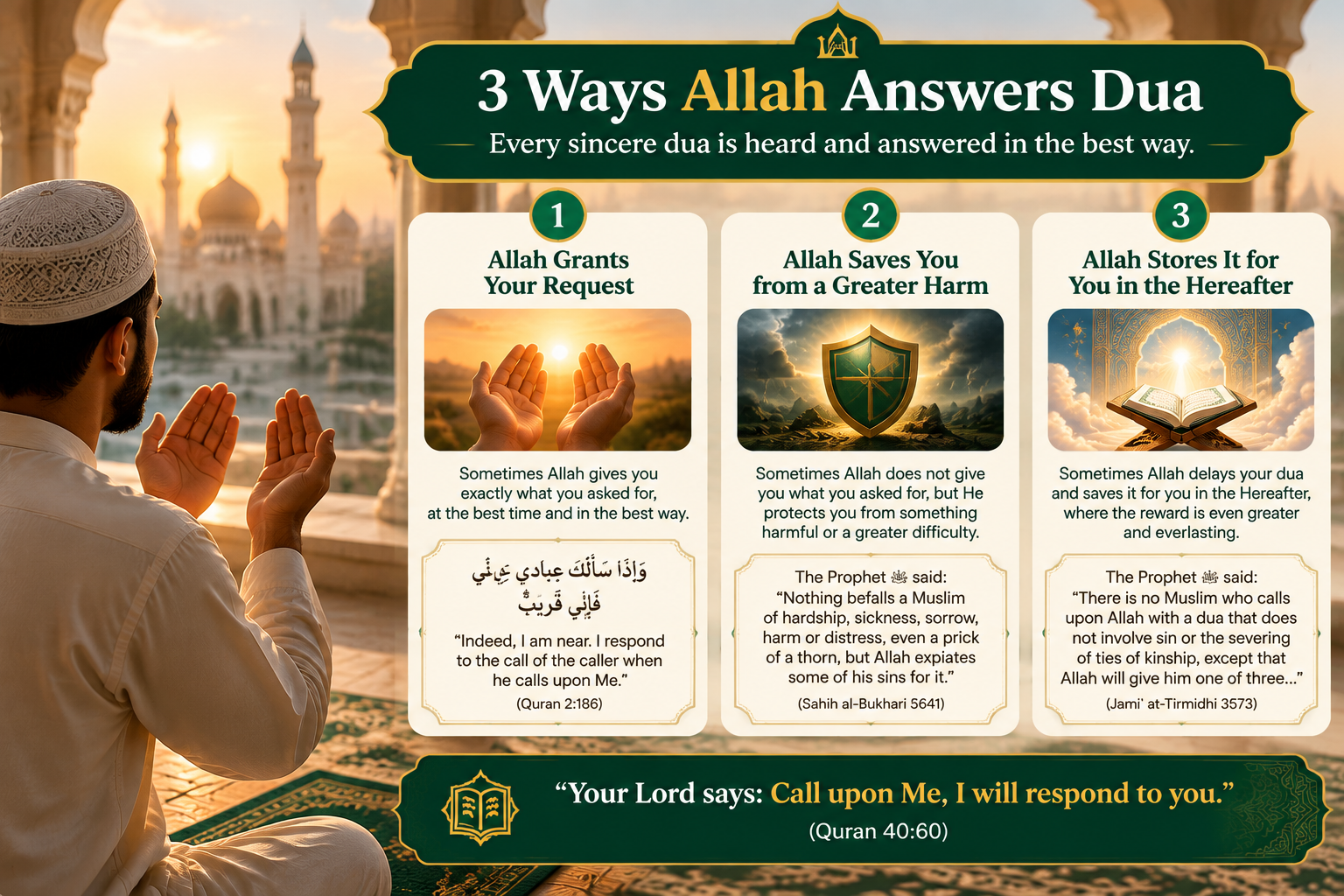
Allah hears every sincere dua, and the response comes according to His wisdom. The Prophet ﷺ taught that Allah answers a believer’s dua in one of three ways: He gives what was asked, He stores an even greater reward for the Hereafter, or He turns away a harm of equal weight (Jami’ at-Tirmidhi 3573). So a dua that feels “unanswered” is usually delayed, redirected, or being saved, not rejected. Certain barriers, such as unlawful income, ongoing sin, or impatience, can affect acceptance, and each has a clear fix.
The Truth First: Your Dua Is Never Ignored
Before listing reasons, the foundation has to be right, because a wrong belief about dua causes more pain than any delay. Allah promises directly that He hears and responds:
وَإِذَا سَأَلَكَ عِبَادِي عَنِّي فَإِنِّي قَرِيبٌ ۖ أُجِيبُ دَعْوَةَ الدَّاعِ إِذَا دَعَانِ
Meaning: “And when My servants ask you concerning Me, indeed I am near. I respond to the invocation of the supplicant when he calls upon Me.”
Surah Al-Baqarah 2:186 (Quran.com)
وَقَالَ رَبُّكُمُ ادْعُونِي أَسْتَجِبْ لَكُمْ
Meaning: “And your Lord says, ‘Call upon Me; I will respond to you.'”
Surah Ghafir 40:60 (Quran.com)
These are not vague promises. The question, then, is what “respond” looks like. The Prophet ﷺ explained that the response comes in one of three forms:
“There is no Muslim who calls upon Allah with a supplication containing no sin or severing of family ties but that Allah will give him one of three things: either He will hasten the answer for him, or He will store it up for him in the Hereafter, or He will divert an equivalent evil away from him.” They said, “Then we will ask for more.” He said, “Allah has even more.”
Jami’ at-Tirmidhi 3573 (also Musnad Ahmad); graded authentic
Read that again, because it reframes everything. This teaching shows that a sincere dua is not simply lost or unheard. Even when the worldly thing does not arrive, the dua worked, in a way you may only understand later or in the next life. This is why the Prophet ﷺ added, in another narration, that Allah “has even more” for the one who keeps asking.
“Not Accepted” vs “Not Answered Yet”
Much of the pain around dua acceptance in Islam comes from mixing up two different things. It helps to separate them clearly.
Not answered yet means the dua is valid and heard, but the answer is delayed by Allah’s wisdom, is being saved for the Hereafter, or is protecting you from harm. This is the situation for the overwhelming majority of sincere believers, and it is not a sign of rejection.
Barriers to acceptance are specific things that the Quran and Sunnah mention as weakening or blocking a dua, such as unlawful earnings or asking for something sinful. These are the real reasons a dua is not answered as expected. They are fixable, and they are the subject of the next section.
A delay is not the same as a refusal. Allah sometimes withholds the immediate answer precisely because He loves to hear His servant return and ask again, as the hadith of the three responses shows. Keep that distinction in mind as you read the reasons below, so you diagnose your situation honestly rather than assuming the worst.
9 Reasons Your Dua May Not Be Answered the Way You Expect
When people talk about a dua not accepted in Islam, some of these points are true barriers named in the texts, while others are simply reasons the answer looks different from what you pictured. Each one below includes a practical fix.
1. Impatience and Giving Up
One important barrier mentioned directly by the Prophet ﷺ is losing patience and abandoning the dua. He said the servant’s dua is answered “as long as he is not impatient, saying, ‘I supplicated but I was not answered,'” and then gives up (Sahih al-Bukhari 6340; Sahih Muslim 2735). Rushing Allah’s timing and quitting is itself a barrier.
2. Unlawful Income, Food, or Clothing
This is a barrier the scholars emphasize strongly, because the Prophet ﷺ himself emphasized it. He described a traveller, worn out and raising his hands to the sky crying “O Lord, O Lord,” yet “his food is unlawful, his drink is unlawful, his clothing is unlawful, and he was nourished by the unlawful, so how can his supplication be answered?” (Sahih Muslim 1015; also the tenth of Imam an-Nawawi’s Forty Hadith). Haram sustenance stands between many sincere people and their answer.
3. Praying Without Certainty
The Prophet ﷺ said to call upon Allah while being certain of a response, and warned that “Allah does not answer a dua from a heart that is heedless and inattentive” (Jami’ at-Tirmidhi 3479, graded hasan). Asking half-heartedly, while doubting whether it is worth it, weakens the dua from the inside.
4. Ongoing Sin Without Repentance
Persistent, unrepented sin dulls the heart and can hold back a dua. The early scholar Ibrahim ibn Adham, when asked why people’s duas were not answered, is reported to have pointed to knowing Allah yet disobeying Him. The point is not that a sinner may never ask, everyone should ask, but that turning back to Allah first clears the path.
5. A Distracted, Heedless Heart
Related to certainty is presence. A dua rushed between tasks, with the mind elsewhere, is not the same as a dua where the heart is truly turned to Allah. The texts tie acceptance to attentiveness, not to eloquent wording.
6. Asking for Something Sinful or Harmful
The three-ways hadith carries a condition: the dua must contain “no sin or severing of family ties.” Allah, out of mercy, does not grant a request that would harm you or others, even when you press for it. Sometimes what you are certain is good for you is not.
وَعَسَىٰ أَن تَكْرَهُوا شَيْئًا وَهُوَ خَيْرٌ لَّكُمْ ۖ وَعَسَىٰ أَن تُحِبُّوا شَيْئًا وَهُوَ شَرٌّ لَّكُمْ
Meaning: “Perhaps you hate a thing and it is good for you, and perhaps you love a thing and it is bad for you.”
Surah Al-Baqarah 2:216 (Quran.com)
7. Skipping the Manners of Dua
Dua has an etiquette that the Sunnah encourages: beginning with praise of Allah, sending blessings on the Prophet ﷺ, facing the request with humility, and choosing good moments. Neglecting all of this does not make a dua invalid, but observing it is part of asking well. The full manners are covered in how to make dua.
8. Expecting Your Timeline, Not Allah’s
Often the dua is not blocked at all; the expectation is simply wrong. We set a private deadline, and when it passes we conclude the dua failed. But Allah answers on a schedule shaped by wisdom you cannot see. A delay can be the answer being stored, or the harm being averted, exactly as the hadith describes.
9. Relying on Dua Alone Without Taking the Means
Dua is powerful, but Islam teaches that we tie our camel and then trust Allah. Asking for provision while refusing to work, or asking for healing while ignoring treatment, leaves out a step Allah Himself built into the world. Dua and effort are partners, not rivals.
Many duas that appear unanswered may actually be delayed, stored, or answered in another way. Where there is a real barrier, it is usually impatience, unlawful income, a distracted or doubting heart, or unrepented sin, and each of these has a clear, doable fix.
Can a Sinner’s Dua Be Accepted?
This is one of the heaviest versions of the question. Someone thinks, “I sinned, so of course my dua is not accepted,” and that thought quietly pushes them to stop asking altogether. It needs a clear and merciful answer.
Yes, a sinner’s dua can absolutely be accepted. In fact, some of the most powerful supplications in the Quran and Sunnah came from people at their lowest. Allah did not tell sinners to stay away until they were clean; He invited them to turn to Him as they are:
قُلْ يَا عِبَادِيَ الَّذِينَ أَسْرَفُوا عَلَىٰ أَنفُسِهِمْ لَا تَقْنَطُوا مِن رَّحْمَةِ اللَّهِ
Meaning: “Say, ‘O My servants who have transgressed against themselves, do not despair of the mercy of Allah.'”
Surah Az-Zumar 39:53 (Quran.com)
Notice the wisdom here. Sin is a reason to run toward Allah in dua, not away from Him. The two things work together: you ask Allah for what you need, and in the same breath you seek His forgiveness. That is exactly why istighfar was so central to the practice of the Prophet ﷺ, who sought Allah’s pardon many times a day despite being sinless.
The point of reason 4 above is not that a sinner is barred from asking. It is that clinging to a sin with no intention to leave it hardens the heart and stands in the way. The moment you turn back, that barrier begins to lift. So if guilt is the weight behind your question, let it move you to do two things at once: repent sincerely, and keep making your dua. A returning servant is among those who seek Allah’s mercy and forgiveness. Practical steps for this are in how to repent in Islam and what is Istighfar.
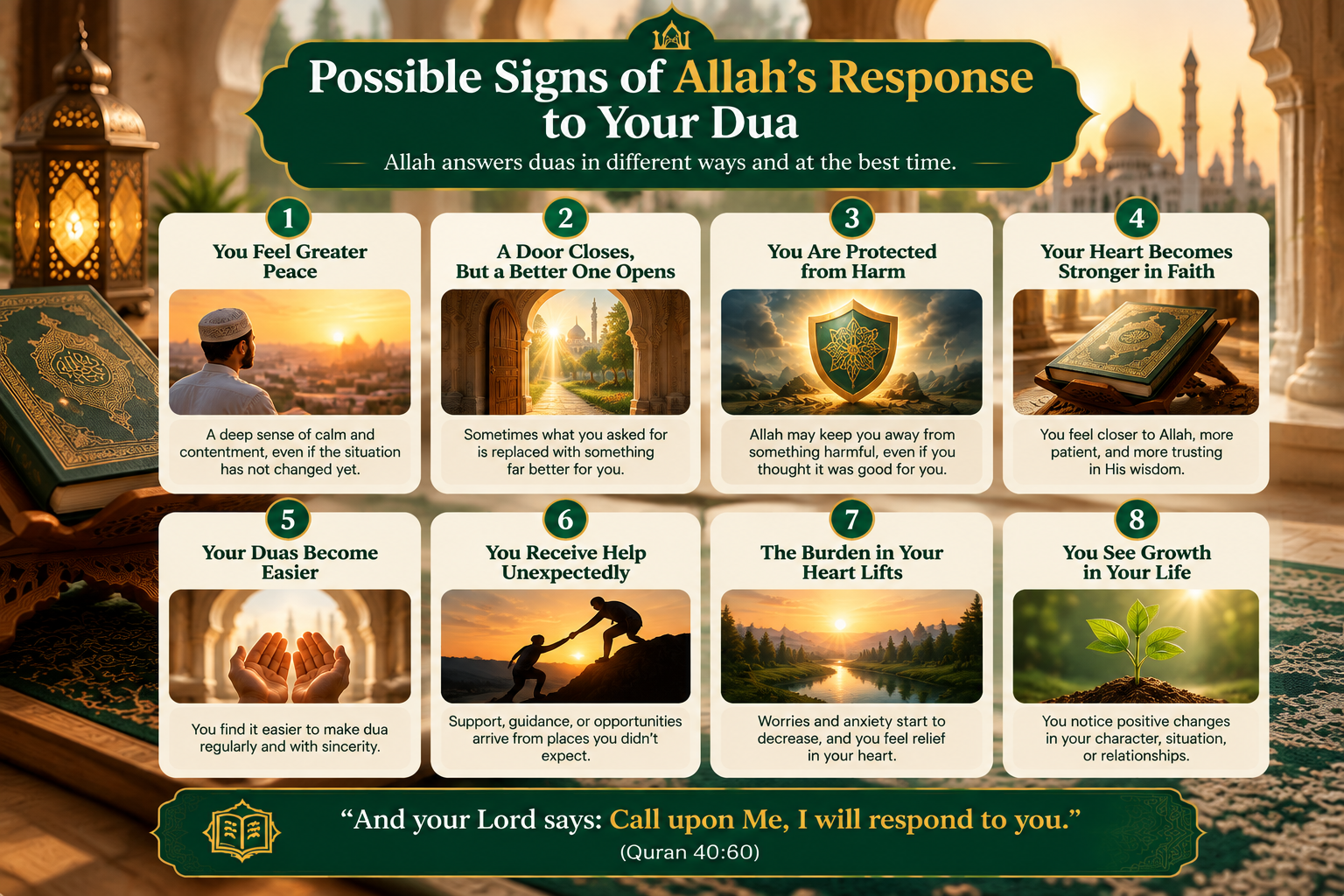
Possible Signs of Allah’s Response to Your Dua
People often search for signs Allah accepted their dua, hoping for certainty. The honest position is that final knowledge of acceptance rests with Allah alone, so treat the following as possible indicators, not a checklist. Acceptance does not always arrive as the exact thing you asked for, and scholars point to several quieter signs that a dua has been received:
- A sense of calm settles on the heart about the matter, even before anything visibly changes.
- You are moved to keep asking, and the desire to turn to Allah grows rather than fades. Being kept in a state of dua is itself a gift.
- A different door opens, and something better or safer comes in place of what you requested.
- A feared harm passes you by, which may be the “equivalent evil” the hadith says Allah diverts.
Because the reward may also be stored for the Hereafter, the absence of a visible sign is not proof of rejection. It may simply mean the best of your answer is waiting where it will last forever.
Etiquettes That Help a Dua Be Answered
If you are wondering how to make dua accepted, the Sunnah gives clear manners of asking. These do not force an answer, since Allah is never obligated, but they are the way the Prophet ﷺ taught us to ask and are linked in the texts to acceptance:
- Begin with praise of Allah and send blessings upon the Prophet ﷺ before and after the request.
- Face the Qiblah and raise your hands where appropriate.
- Call on Allah by His beautiful names that suit your need, such as Ar-Razzaq when asking for provision. Learn more in what Islam teaches about Allah.
- Ask with humility and a lowered voice, showing your need rather than demanding.
- Be sincere and present, certain that Allah hears.
- Choose authentic wordings from the Quran and Sunnah where you can. Our collection of duas and supplications in Islam gives verified examples.
Best Times When Dua Is More Readily Accepted
The Sunnah highlights certain moments as especially hopeful for dua. Turning to Allah at these times is a practical way to strengthen your asking:

- The last third of the night, a time of nearness described in the Sunnah. See how to pray Tahajjud.
- Between the adhan and iqamah, and in the depth of sujood during Salah.
- The last hour of Friday before Maghrib.
- While fasting, and at the moment of breaking the fast.
- In states of genuine need, such as travel, illness, or being wronged.
Building a habit of morning and evening remembrance also keeps your heart connected between these peak times; see morning and evening duas.
What to Do Right Now
If you are reading this while carrying a dua that has not been answered, here is a simple sequence to work through:
- Renew your belief that Allah has heard you and is answering in one of the three ways.
- Check the obvious barriers: is any of your income clearly unlawful, and is there a sin you have not turned away from?
- Repent sincerely, then make your dua again with a clean heart.
- Ask at a better time, such as the last third of the night or in sujood, with full presence.
- Take one lawful step toward what you are asking for, so dua and effort move together.
- Keep asking without a deadline, and add “if it is good for me” to worldly requests.
When You Feel Allah Has Left You
Sometimes the real weight behind “why is my dua not accepted,” or “why Allah does not answer my dua,” is not a fiqh question at all. It is the ache of feeling unheard, even abandoned. If that is where you are, take this gently.
The very fact that you still turn to Allah, still raise your hands, is itself a sign He has not left you. Shaytan wants you to believe you are unworthy and to stop asking; the Prophet ﷺ encouraged believers not to give up hope, teaching that Allah “has even more” for the one who keeps calling. Being kept in a state of dua, still reaching for your Lord in the dark, is one of the quiet mercies people often overlook.
Allah is described as nearer to you than your own jugular vein, and He calls Himself near in the very verse about dua (2:186). A delay is His choice, not His distance. If the weight ever grows into hopelessness that affects your daily life, reach out to people you trust and to those with knowledge, and do not carry it alone; seeking support is part of the means Allah has placed for us.
Frequently Asked Questions
Does Allah reject dua, or is it always answered?
A believer’s sincere dua, free of sin and cutting family ties, is always answered in one of three ways: given now, stored for the Hereafter, or used to avert a harm (Tirmidhi 3573). So it is not “rejected,” even when the worldly thing does not arrive.
Why does Allah delay answering my dua?
Delay can mean the answer is being saved for a better time, stored as greater reward, or that Allah loves to hear you keep asking. It is not a sign of refusal, and quitting out of impatience is itself discouraged (Bukhari 6340).
How long does Allah take to answer a dua?
There is no fixed timeframe. Some duas are answered quickly, others after months or years, and some are stored for the Hereafter or turned into protection from harm (Tirmidhi 3573). Because the “when” belongs to Allah’s wisdom, the best approach is to keep asking sincerely without setting a private deadline. A long wait is not evidence that your dua was rejected.
Can sins stop my dua from being accepted?
Ongoing, unrepented sin and unlawful income can be barriers, as the hadith of the dishevelled traveller shows (Muslim 1015). The fix is sincere repentance and moving away from haram, then asking again with a clean heart.
Does eating haram really block dua?
Yes, the Prophet ﷺ linked unlawful food, drink, and clothing directly to a dua not being answered (Muslim 1015). Prioritising lawful income and consumption is one of the clearest ways to remove a barrier.
How do I know if my dua was accepted?
There is no guaranteed checklist, but common signs Allah accepted my dua, as scholars describe them, include a settled calm about the matter, a stronger pull to keep asking, a better door opening, or a feared harm passing you by. Some answers are stored for the Hereafter, so no visible sign does not mean rejection.
Should I keep making the same dua repeatedly?
Yes. Repetition is encouraged, and the Prophet ﷺ said Allah “has even more” for those who keep asking. Persisting without a private deadline is closer to the Sunnah than giving up.
What should I do if my dua is delayed?
Treat a delay as part of the process, not a rejection. Keep asking with certainty, check for barriers such as unlawful income or an unrepented sin, seek forgiveness, choose blessed times like the last third of the night, and pair your dua with lawful effort. Above all, do not set a private deadline; the answer may be given later, stored for the Hereafter, or turned into protection from harm (Tirmidhi 3573).
Is there a special dua to have my duas accepted?
There is no single magic formula. Ask with sincerity and certainty, use authentic wordings from the Quran and Sunnah, observe the manners of dua, and choose blessed times. Substance and presence matter more than any one phrase.
Can I make dua in my own language?
Yes. In your personal, voluntary duas you may ask Allah in whatever language you speak, since He understands every tongue and looks at the heart. Many people mix memorised Arabic supplications from the Quran and Sunnah with heartfelt requests in their own language. The one exception is the required recitation inside the formal prayer, which is in Arabic; outside of that, speak to Allah in the words that come naturally to you.
What if I feel my dua will never be answered?
That feeling is a whisper to make you stop, not a verdict from Allah. He calls Himself near (2:186) and rewards persistence. Keep asking, repent, take lawful means, and if the despair is heavy, seek support from trusted people and those with knowledge.
Keep Asking, and Trust the One Who Hears
So, why is your dua not accepted? In most cases, it is not rejected at all. It is being answered in a way you have not yet seen: given, stored, or turned into protection. Where a real barrier exists, it is usually impatience, unlawful income, a doubting or distracted heart, or unrepented sin, and every one of these can be fixed today. Renew your certainty, clear the barriers, ask at the best times, take the means, and keep calling on the One who promised, “Call upon Me; I will respond to you.” Your dua is heard. Keep it going.
Want to strengthen your connection and ask with confidence?
Learn how to make dua Get closer to Allah Become a better MuslimRelated Guides
Sources and Methodology
Quran verses are referenced to Quran.com and every hadith was checked against its collection number on Sunnah.com: Sahih al-Bukhari 6340; Sahih Muslim 1015 and 2735; Jami’ at-Tirmidhi 3573 (the three ways Allah answers, graded authentic) and 3479 (calling with certainty, graded hasan); the hadith of the dishevelled traveller is also the tenth of Imam an-Nawawi’s Forty Hadith. Quran references: Al-Baqarah 2:186 and 2:216, and Ghafir 40:60. The saying attributed to Ibrahim ibn Adham is a narration from the early scholars, cited here as guidance, not as a Prophetic hadith.
What is settled: Allah hears and responds to the sincere believer’s dua, and unlawful sustenance and asking for sin are named barriers in authentic texts. What involves scholarly explanation: how the three forms of response apply in a given case, and the fine points of what counts as doubtful income. The signs of acceptance and the emotional guidance here are drawn from scholarly counsel, not treated as fixed rulings.
IslamicEduHub Editorial Team writes practical guides on dua, Salah, Quran and Islamic basics for beginners. Every Quran reference is checked against Quran.com, every hadith is checked on Sunnah.com, and disputed or weak narrations are labeled as such.
Reviewed for Quran references, Hadith references, and Islamic terminology against Quran.com and Sunnah.com. Last reviewed: September 2026.
Found an error? Contact IslamicEduHub. Follow us on Facebook.