
A clear, beginner-friendly walk through the core Islamic beliefs about Allah — who He is, what makes Him different from creation, and why these beliefs shape how Muslims live — each grounded directly in the Qur’an.
Home › Beliefs & Aqeedah › What Does Islam Teach About Allah?
The core beliefs about Allah in Islam are that He is the one, unique Creator of everything, with no partners and nothing comparable to Him. He is all-knowing, all-powerful, ever-living, merciful, and just — and He alone deserves worship. These beliefs come directly from the Qur’an and form the foundation (Tawhid) that everything else in Islam is built on.
In This Guide
- 1. Allah Is One (Tawhid)
- 2. Allah Alone Deserves Worship
- 3. Allah Has No Partner or Equal
- 4. Allah Is the Creator of Everything
- 5. Allah Does Not Resemble His Creation
- 6. Allah Is Eternal — Without Beginning or End
- 7. Allah Has the Most Beautiful Names and Attributes
- 8. Allah Is All-Knowing
- 9. Allah Is All-Powerful
- 10. Allah Is Ever-Living and Self-Sustaining
- 11. Allah Is Near and Responds to Dua
- 12. Allah Is Most Merciful
- 13. Allah Is Perfectly Just
- 14. Allah Sent Prophets to Guide Humanity
- 15. Allah Will Resurrect and Judge Everyone
- Why These Beliefs About Allah in Islam Matter
- Frequently Asked Questions
Ask a Muslim what they believe, and almost everything traces back to one starting point: who Allah is. The core beliefs about Allah in Islam aren’t an abstract force or a distant idea — they’re a specific set of teachings, drawn directly from the Qur’an, about a Creator who is one, who has no equal, and who is closer to His creation than many people expect.
This guide walks through 15 of the most essential of these beliefs — each with its own Qur’anic grounding, kept at the level most Muslims across different schools of thought agree on, rather than wading into the finer theological debates scholars have long had about how exactly to understand some of Allah’s attributes.
If you’ve ever wondered why Islamic art avoids depicting Allah, or why Muslims begin almost everything — a meal, a journey, a piece of writing — by saying “In the name of Allah,” these beliefs are the reason. They aren’t background theology; they show up constantly, in small everyday habits as much as in formal worship.
1. Allah Is One (Tawhid)
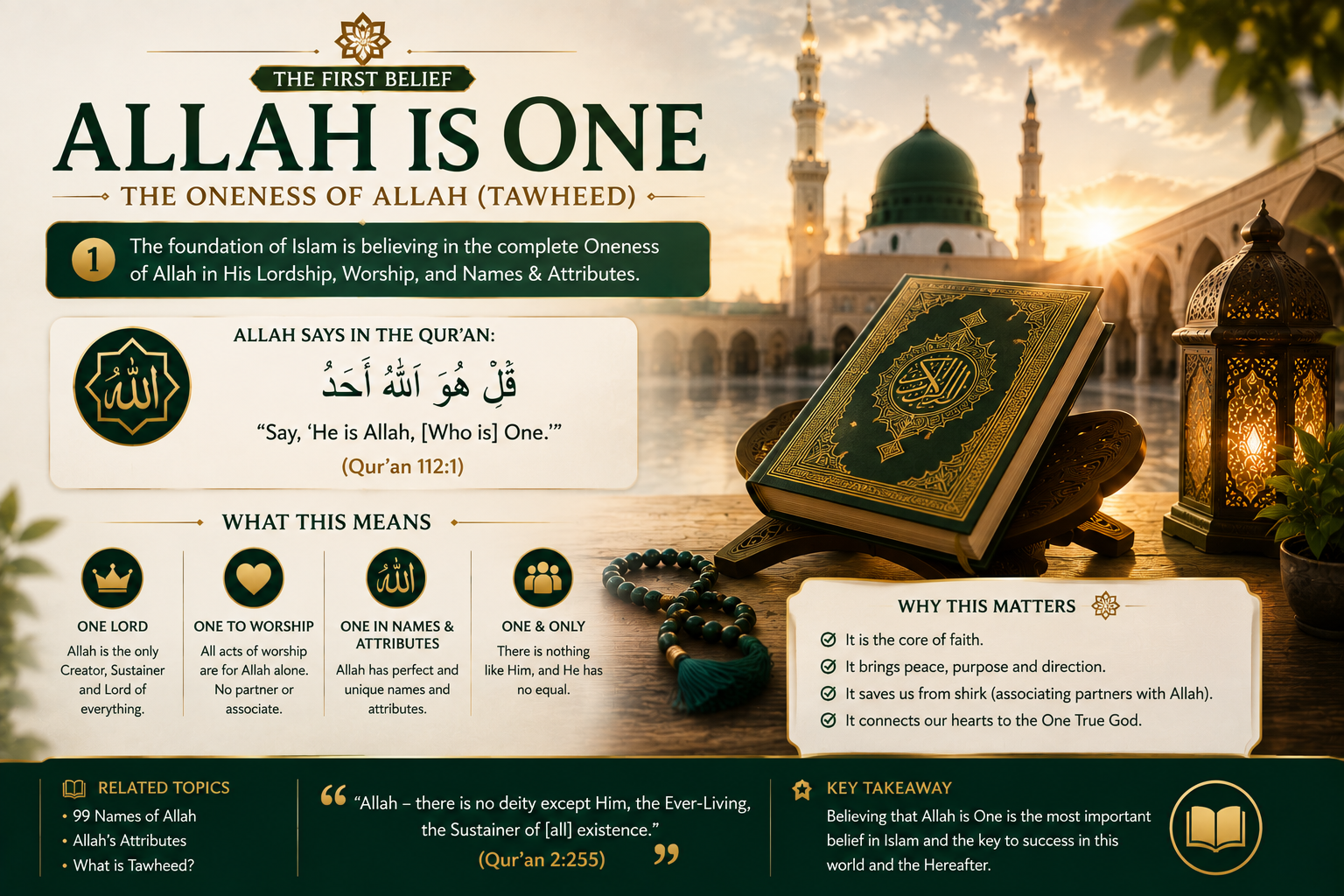
The single most foundational belief in Islam is that Allah is one — not one among several, not part of a trinity or hierarchy, but absolutely, indivisibly one. This is stated with total clarity in Surah Al-Ikhlas: “Say, He is Allah, [who is] One.”
قُلْ هُوَ اللَّهُ أَحَدٌ
فرما دیجیے: وہ اللہ ایک ہے
Qur’an 112:1
2. Allah Alone Deserves Worship
Because Allah alone is the one true God, worship — prayer, sacrifice, reliance, supplication — belongs to Him alone. This is the meaning Muslims repeat at least seventeen times a day in prayer: “It is You we worship and You we ask for help.”
إِيَّاكَ نَعْبُدُ وَإِيَّاكَ نَسْتَعِينُ
ہم تیری ہی عبادت کرتے ہیں اور تجھ ہی سے مدد مانگتے ہیں
3. Allah Has No Partner or Equal
Islam rejects any notion of Allah having a son, a partner, or an equal. Surah Al-Ikhlas closes with this point directly: “He neither begets nor is born, nor is there to Him any equivalent.” This belief — that nothing shares in Allah’s divinity — is called Tawhid, and it’s considered the single most important teaching in Islam.
لَمْ يَلِدْ وَلَمْ يُولَدْ وَلَمْ يَكُن لَّهُ كُفُوًا أَحَدٌ
نہ اس نے کسی کو جنا اور نہ وہ جنا گیا، اور نہ کوئی اس کا ہمسر ہے
Qur’an 112:3–4
4. Allah Is the Creator of Everything
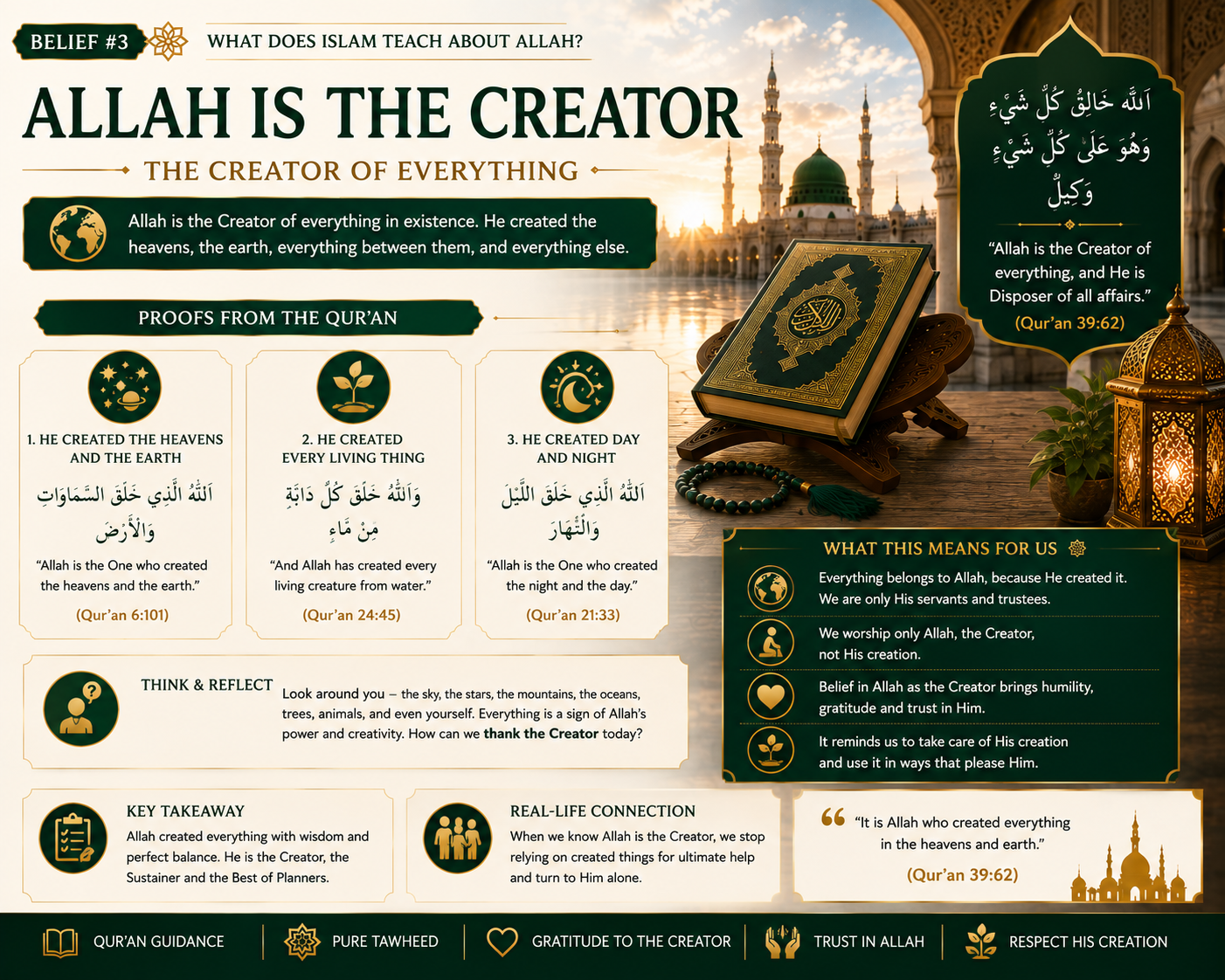
Everything that exists — the heavens, the earth, everything within them — was created by Allah, and nothing exists independently of His creation and sustaining. “Allah is the Creator of all things, and He is, over all things, Disposer of affairs.”
اللَّهُ خَالِقُ كُلِّ شَيْءٍ
اللہ ہر چیز کا خالق ہے
Qur’an 39:62
5. Allah Does Not Resemble His Creation
The Qur’an teaches that nothing is like Allah. “There is nothing like unto Him” is one of the clearest statements in the Qur’an on this point. Muslims therefore affirm what Allah has revealed about Himself while rejecting any comparison between Allah and His creation. Detailed theological discussions about how to understand particular attributes are beyond the scope of this beginner’s guide.
لَيْسَ كَمِثْلِهِ شَيْءٌ
اس جیسی کوئی چیز نہیں
Qur’an 42:11
6. Allah Is Eternal — Without Beginning or End
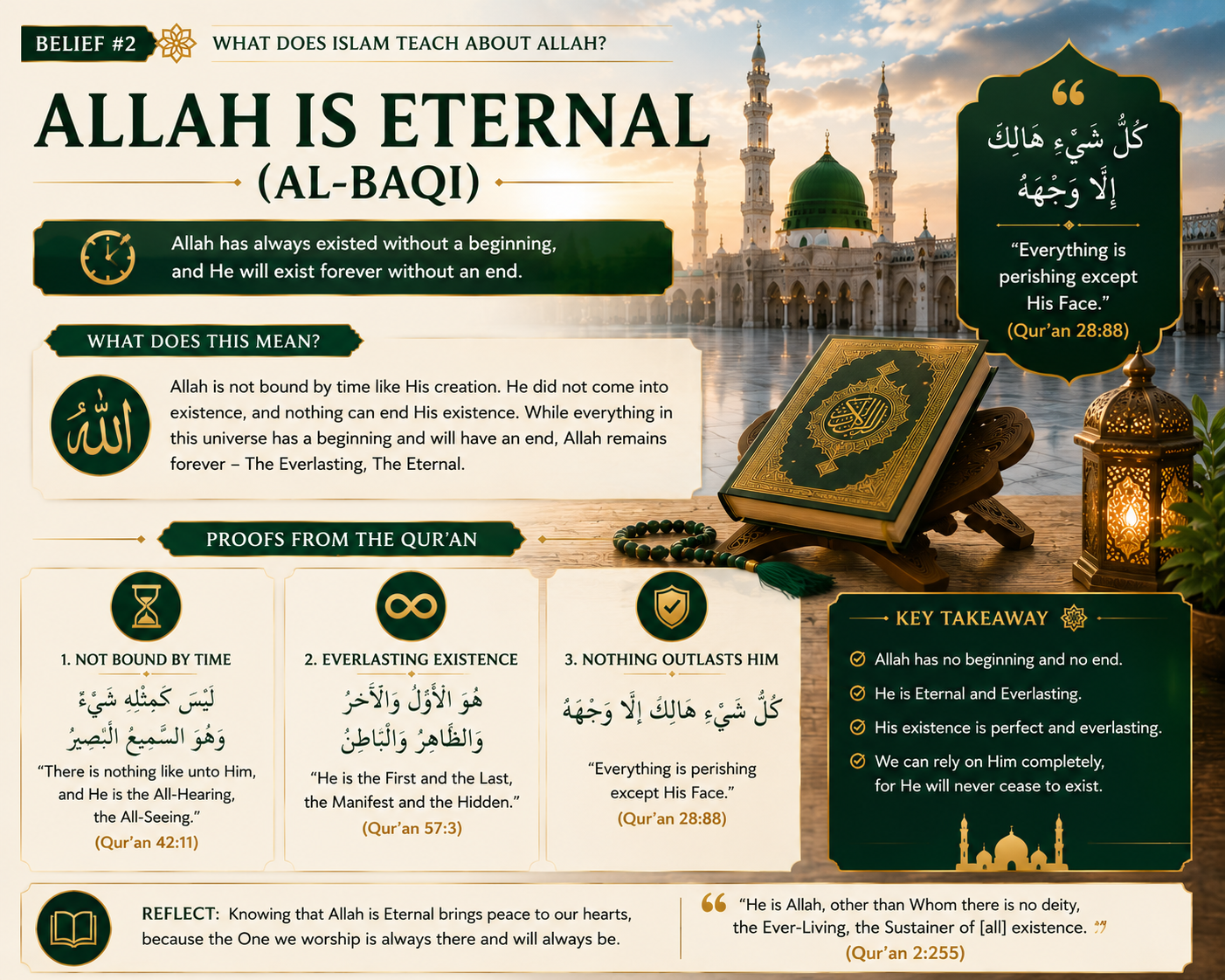
Allah has always existed and will always exist; He was not created and does not come into being. “He is the First and the Last, the Manifest and the Hidden, and He is Knowing of all things” — a verse that rules out the idea that Allah’s existence depends on anything else.
هُوَ الْأَوَّلُ وَالْآخِرُ وَالظَّاهِرُ وَالْبَاطِنُ وَهُوَ بِكُلِّ شَيْءٍ عَلِيمٌ
وہی اول ہے اور آخر ہے، اور ظاہر ہے اور باطن ہے، اور وہ ہر چیز کو خوب جاننے والا ہے
Qur’an 57:3
7. Allah Has the Most Beautiful Names and Attributes
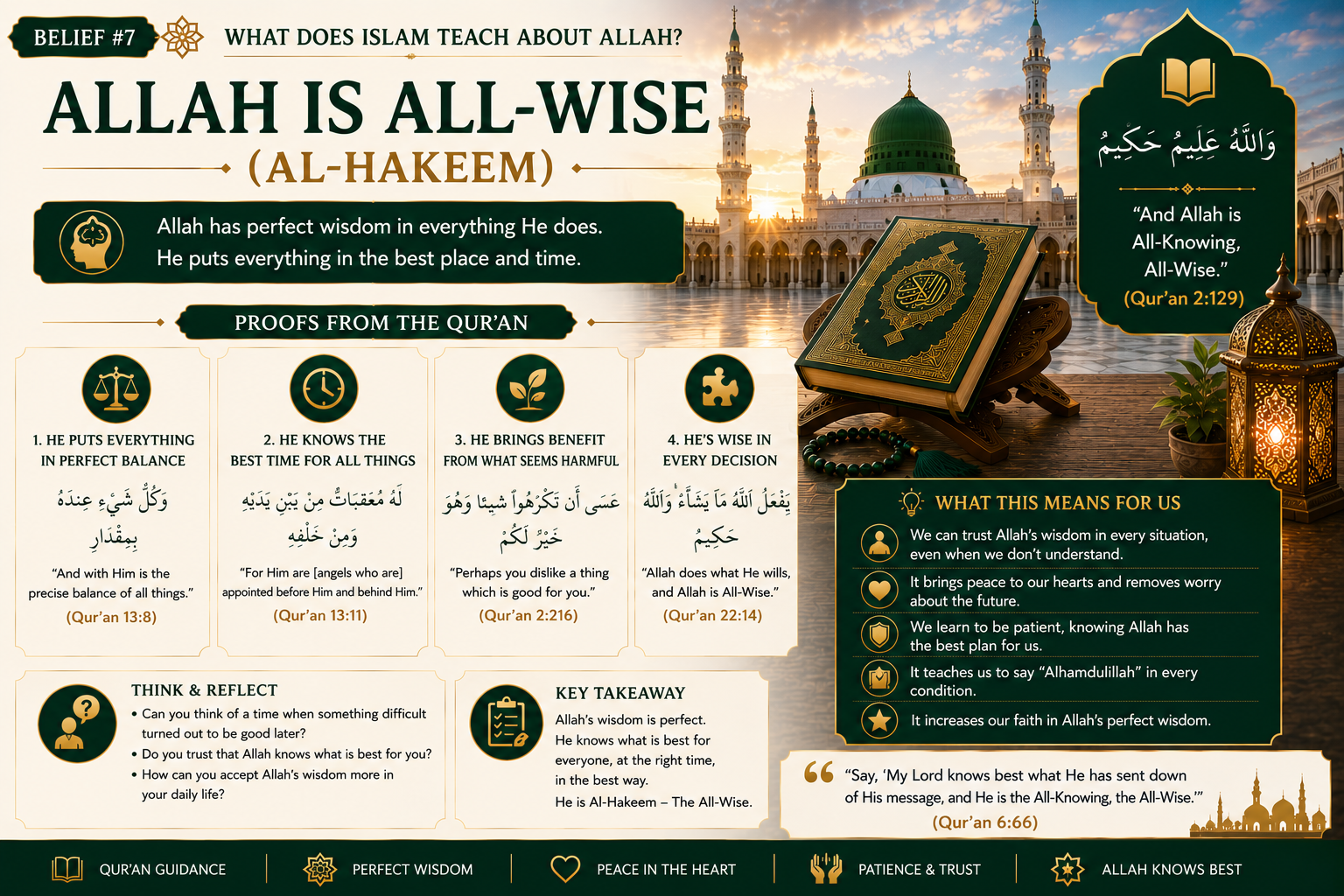
Allah has the Most Beautiful Names — Al-Rahman (the Most Merciful), Al-Alim (the All-Knowing), Al-Qadir (the All-Powerful), Al-Hakeem (the All-Wise), and others — each describing a real attribute of Allah, not just a poetic title. “And to Allah belong the best names, so invoke Him by them.” A well-known authentic Hadith mentions ninety-nine names and the virtue of learning and preserving them, though scholars have explained this doesn’t necessarily mean Allah has only ninety-nine names. Many Muslims memorize these names as a way of getting to know Allah more personally.
وَلِلَّهِ الْأَسْمَاءُ الْحُسْنَىٰ فَادْعُوهُ بِهَا
اور اللہ ہی کے لیے اچھے نام ہیں، سو اسے انہی سے پکارو
Qur’an 7:180; Hadith Sahih al-Bukhari 2736
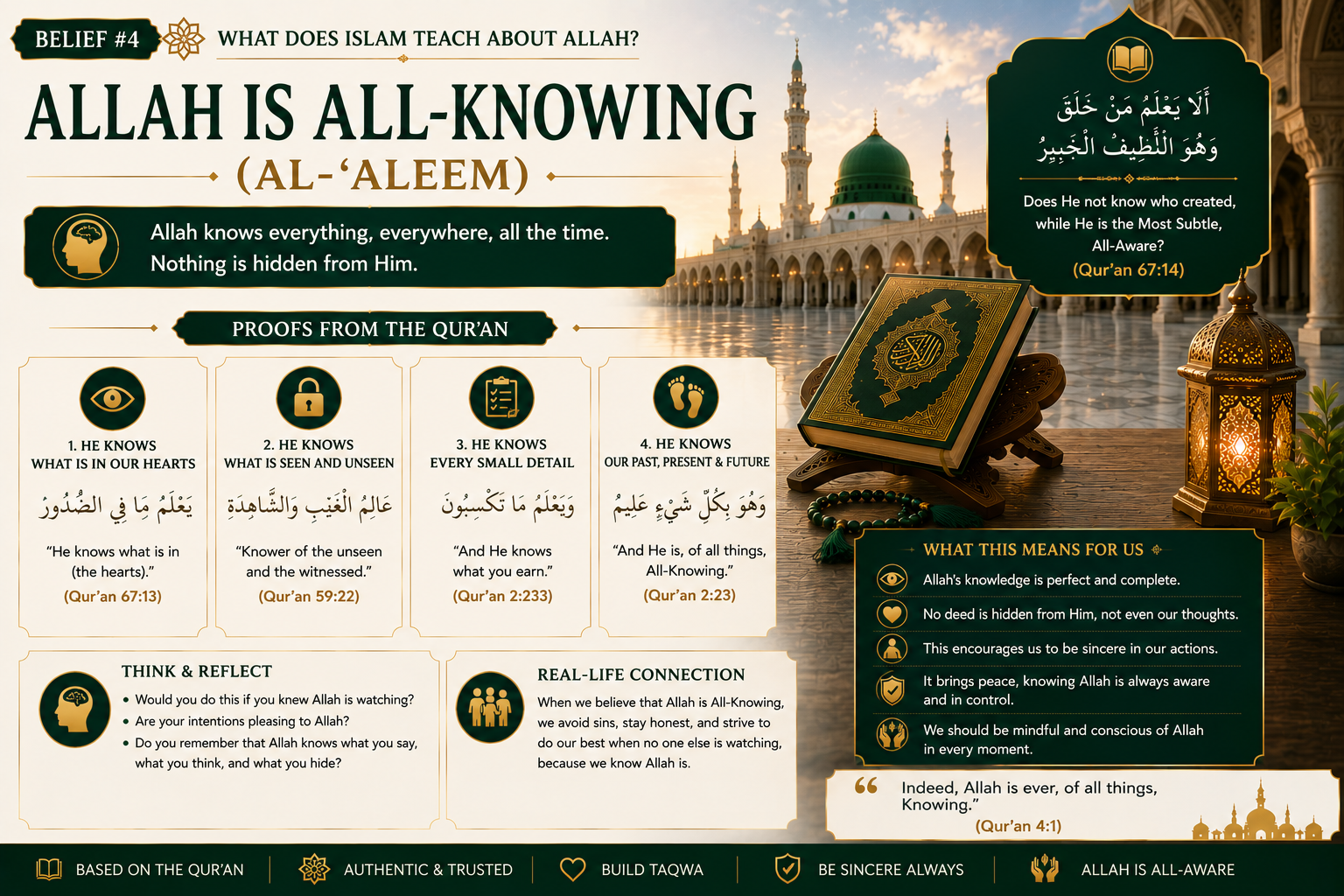
8. Allah Is All-Knowing
Nothing escapes Allah’s knowledge — not what’s spoken aloud, not what’s hidden in a person’s heart, not a single leaf that falls. “And He knows what is in the land and sea. Not a leaf falls but that He knows it.” For many Muslims, this belief is one of the most practically important on this list — it shapes conduct even when no one else is watching.
وَمَا تَسْقُطُ مِن وَرَقَةٍ إِلَّا يَعْلَمُهَا
اور کوئی پتہ نہیں گرتا مگر وہ اسے جانتا ہے
Qur’an 6:59
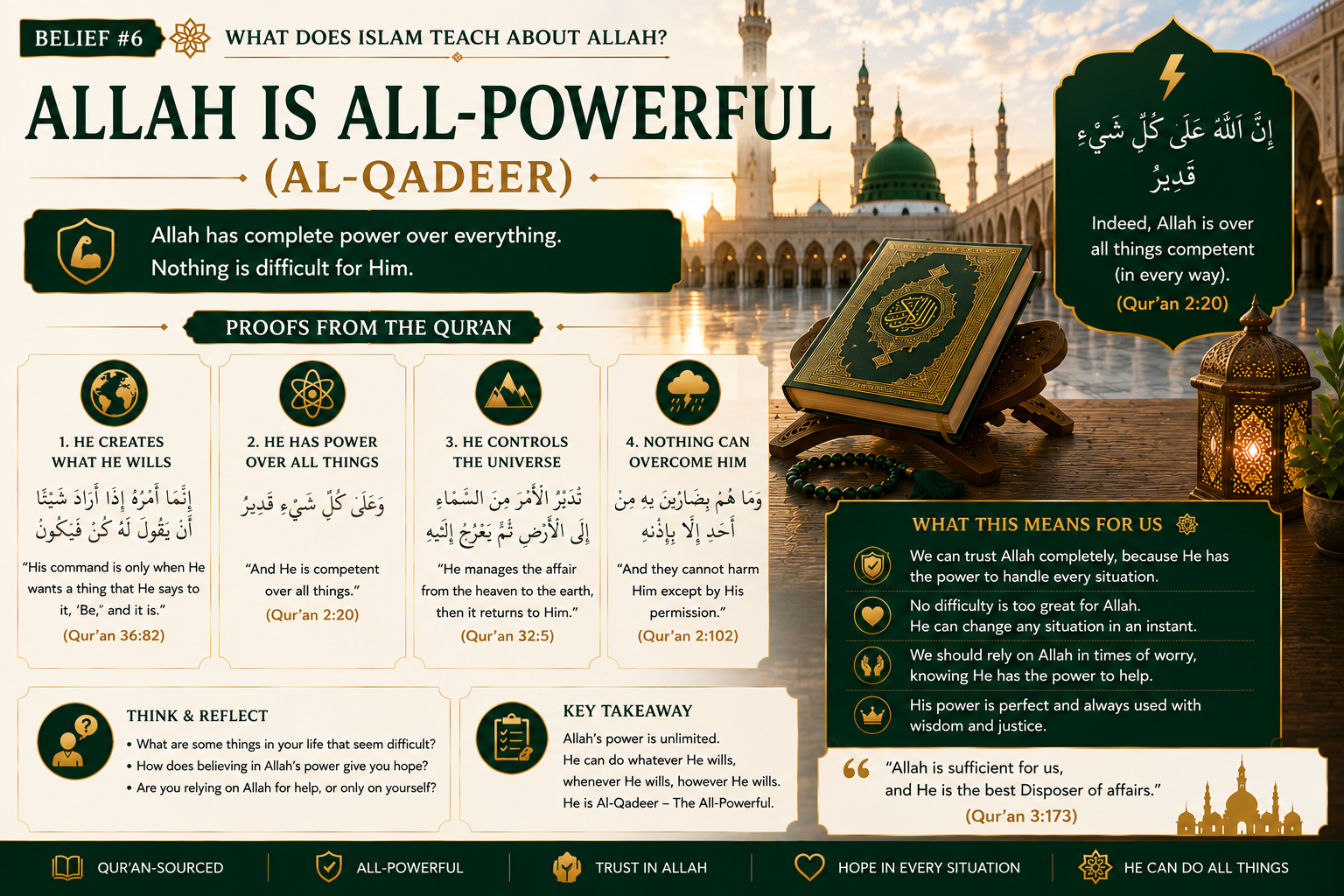
9. Allah Is All-Powerful
Allah’s power has no limit — He is able to do anything He wills, and nothing can resist or oppose Him. “Indeed, Allah is competent over all things” is one of the most frequently repeated statements about Allah in the Qur’an.
إِنَّ اللَّهَ عَلَىٰ كُلِّ شَيْءٍ قَدِيرٌ
بے شک اللہ ہر چیز پر قادر ہے
Qur’an 2:20
10. Allah Is Ever-Living and Self-Sustaining
Allah does not sleep, tire, or depend on anything — while everything else depends entirely on Him. This is central to Ayat al-Kursi, widely considered the greatest verse in the Qur’an: “Allah — there is no deity except Him, the Ever-Living, the Sustainer of existence. Neither drowsiness overtakes Him nor sleep.”
اللَّهُ لَا إِلَٰهَ إِلَّا هُوَ الْحَيُّ الْقَيُّومُ ۚ لَا تَأْخُذُهُ سِنَةٌ وَلَا نَوْمٌ
اللہ، اس کے سوا کوئی معبود نہیں، وہ زندہ ہے، ہر چیز کو قائم رکھنے والا ہے، نہ اسے اونگھ آتی ہے نہ نیند
Qur’an 2:255 (Ayat al-Kursi)
11. Allah Is Near and Responds to Dua
Despite His transcendence, Allah is close to His servants and responds to sincere supplication (dua). “And when My servants ask you concerning Me — indeed I am near. I respond to the invocation of the supplicant when he calls upon Me.” This nearness should not be understood as Allah being physically contained within creation. A response to dua also doesn’t necessarily mean receiving exactly what was asked for at the exact time expected — Allah is understood to answer in the way, and at the time, that is ultimately best.
وَإِذَا سَأَلَكَ عِبَادِي عَنِّي فَإِنِّي قَرِيبٌ ۖ أُجِيبُ دَعْوَةَ الدَّاعِ إِذَا دَعَانِ
اور جب میرے بندے تجھ سے میرے بارے میں سوال کریں تو بے شک میں قریب ہوں، پکارنے والے کی پکار کا جواب دیتا ہوں جب وہ مجھے پکارے
Qur’an 2:186
12. Allah Is Most Merciful
Mercy is arguably the attribute most emphasized in the Qur’an — nearly every chapter opens with “In the name of Allah, the Most Merciful, the Especially Merciful.” Allah describes His own mercy as limitless: “My mercy encompasses all things.” A well-known Hadith adds that Allah’s mercy exceeds even a mother’s love for her child.
وَرَحْمَتِي وَسِعَتْ كُلَّ شَيْءٍ
اور میری رحمت ہر چیز پر چھائی ہوئی ہے
Qur’an 7:156; Hadith Sahih al-Bukhari 5999, Sahih Muslim 2754
13. Allah Is Perfectly Just
Allah never wrongs anyone, even by the smallest measure, and ultimate justice — even for wrongs never resolved in this life — rests with Him. “Indeed, Allah does not do injustice, [even] as much as an atom’s weight.” This belief is often described as a source of comfort for people who have experienced injustice they cannot correct themselves.
إِنَّ اللَّهَ لَا يَظْلِمُ مِثْقَالَ ذَرَّةٍ
بے شک اللہ ذرہ برابر بھی ظلم نہیں کرتا
Qur’an 4:40
14. Allah Sent Prophets to Guide Humanity
Allah sent messengers to guide humanity and call people to worship Him alone. “And We certainly sent into every nation a messenger, [saying], Worship Allah and avoid false gods.” Muslims believe Muhammad ﷺ was the final prophet in this line, and the Qur’an the final revelation.
وَلَقَدْ بَعَثْنَا فِي كُلِّ أُمَّةٍ رَّسُولًا أَنِ اعْبُدُوا اللَّهَ وَاجْتَنِبُوا الطَّاغُوتَ
اور بے شک ہم نے ہر امت میں ایک رسول بھیجا کہ اللہ کی عبادت کرو اور طاغوت سے بچو
Qur’an 16:36
15. Allah Will Resurrect and Judge Everyone
Death is not the end — Allah will resurrect every person and hold them accountable for their beliefs and actions. “The disbelievers have claimed that they will never be resurrected. Say, Yes, by my Lord, you will surely be resurrected; then you will surely be informed of what you did.” Belief in this Day is one of the core articles of Islamic faith.
زَعَمَ الَّذِينَ كَفَرُوا أَن لَّن يُبْعَثُوا ۚ قُلْ بَلَىٰ وَرَبِّي لَتُبْعَثُنَّ
کافروں نے دعویٰ کیا کہ وہ ہرگز نہیں اٹھائے جائیں گے، فرما دیجیے: کیوں نہیں، میرے رب کی قسم تم ضرور اٹھائے جاؤ گے
Qur’an 64:7
Why These Beliefs About Allah in Islam Matter
Maybe you’ve caught yourself saying “insha’Allah” (if Allah wills) without really thinking about it — a habit of speech, nothing more. For a practicing Muslim, that small phrase is these beliefs in miniature: Allah is in control and knows what will happen, and it’s worth acknowledging before making any plan.
These aren’t abstract theological trivia — in Islam, belief about Allah shapes daily life directly. Believing Allah is all-knowing shapes how a Muslim behaves in private. Believing Allah is merciful shapes how a Muslim responds to their own mistakes. Believing Allah is just shapes how a Muslim handles wrongs they can’t fix themselves. The technical term for this entire framework is Tawhid — the oneness of Allah — the first and central of the six articles of Islamic faith the Prophet ﷺ described when the angel Jibril asked him directly what belief (iman) means.
That’s also why getting this foundation right matters so much to Muslims. The five daily prayers, the fast of Ramadan, even everyday phrases like “insha’Allah” all rest on these same beliefs — that Allah exists, is one, knows everything, and is worth turning to. Change the foundation, and the rest of Islamic practice loses its basis.
Frequently Asked Questions
Quick, direct answers to common questions about what Islam teaches regarding Allah.
What does Islam teach about who Allah is?
Islam teaches that Allah is the one, unique Creator of everything — with no partners, no equal, and nothing comparable to Him — who alone deserves worship.
What is Tawhid?
Tawhid is the belief in Allah’s absolute oneness — that He has no partner, no son, and no equal, and that worship belongs to Him alone. It’s considered the foundation of Islamic belief.
Does Islam believe Allah has a physical form?
No — the Qur’an teaches that nothing resembles Allah (42:11). How to understand verses describing His attributes is a genuine area of classical scholarly discussion, and Muslims are generally taught to avoid imagining Him as physically like His creation.
What are the 99 names of Allah?
They are titles describing Allah’s attributes — such as Ar-Rahman (the Most Merciful) and Al-Alim (the All-Knowing) — that Muslims are encouraged to reflect on and call upon Him by.
Is Allah the same God worshipped in Christianity and Judaism?
Muslims believe Allah is the same God who sent earlier prophets, including Abraham, Moses, and Jesus — though Islamic belief about His nature differs from later Christian theology, particularly regarding the Trinity.
Why is belief in Allah’s mercy important in Islam?
It shapes how Muslims relate to their own mistakes — encouraging repentance and hope rather than despair, since the Qur’an describes Allah’s mercy as encompassing all things.
What happens after death according to Islamic belief about Allah?
Islam teaches that Allah will resurrect every person and hold them accountable for their beliefs and actions on the Day of Judgment.
Where does Islam get its teachings about Allah?
Primarily from the Qur’an itself, along with authentic Hadith that record how the Prophet ﷺ explained and lived out these beliefs.
May Allah increase our understanding of Him, and make that understanding a source of peace and guidance in daily life.
Editorial & Source Note
This guide is drawn directly from the Qur’an, kept at the level of belief shared broadly across Sunni schools of thought. It intentionally avoids taking a position on contested theological details, such as the precise nature of Allah’s attributes — a genuine, longstanding scholarly debate.
- This is educational content, not a fatwa or substitute for study with a qualified teacher.
- Last reviewed: August 17, 2026.
References & Further Reading
Qur’an References
- Qur’an 112 (Al-Ikhlas) — Allah’s oneness, and that nothing is comparable to Him.
- Qur’an 1:5, 51:56 — worship belongs to Allah alone.
- Qur’an 39:62 — Allah as Creator of all things.
- Qur’an 42:11 — nothing is like Allah.
- Qur’an 57:3 — Allah as the First and the Last.
- Qur’an 7:180 — Allah’s beautiful names.
- Qur’an 6:59 — Allah’s all-encompassing knowledge.
- Qur’an 2:20 — Allah’s power over all things.
- Qur’an 2:255 — Ayat al-Kursi.
- Qur’an 2:186 — Allah’s nearness and response to prayer.
- Qur’an 7:156 — Allah’s encompassing mercy.
- Qur’an 4:40 — Allah’s justice.
- Qur’an 16:36 — prophets sent to every nation.
- Qur’an 64:7 — the promise of resurrection.
Hadith References
- Sahih al-Bukhari 2736 — Allah’s ninety-nine names and the virtue of preserving them.
- Sahih al-Bukhari 5999, Sahih Muslim 2754 — Allah’s mercy exceeding a mother’s love for her child.
- Sahih Muslim 8 (“Hadith of Jibril”) — the Prophet ﷺ defining Iman (belief) as belief in Allah, His angels, His books, His messengers, the Last Day, and divine decree; the classical basis for the six articles of Islamic faith referenced in “Why These Beliefs Matter.”
On the classical scholarly discussion of how to understand verses describing Allah’s attributes: see the discussion at Tafsir Ma’ariful Qur’an on 57:3, which notes that early scholars, including Ibn Abbas, held that more than one interpretation of these attributes is valid and non-contradictory. This guide does not take a position in that debate.
Related IslamicEduHub Guides
Unpublished guides above stay as plain text to avoid 404s — linked once live.