
How to Pray Salah Correctly: The Ultimate Step-by-Step Guide for Beginners (2026)
 IslamicEduHub
A beginner learning the correct posture and direction for Salah
Do you remember the first time you tried to pray and weren’t sure if you were doing it right? Maybe you rushed through the movements, mixed up the order of Ruku and Sujud, or whispered the words without really knowing what they meant. If that sounds familiar, you are not alone. Almost every Muslim, whether born into the faith or new to it, has stood on a prayer mat at some point feeling unsure of the next step.
Salah is not just a ritual to memorize. It is described in the Quran as a direct conversation with Allah, repeated five times a day, meant to anchor the heart no matter how busy or difficult life becomes. Learning how to pray Salah correctly is therefore one of the most important skills a Muslim can build, and it is entirely learnable, one step at a time, with patience and the right guidance.
This guide walks you through everything: the meaning behind Salah, what you need before you begin, and a complete step-by-step walkthrough of the prayer itself, backed by authentic references from the Quran and Sahih Hadith. If you are also working on your recitation, our guide on How to Read the Quran Correctly pairs well with this article, since Salah requires reciting portions of the Quran by heart.
If you are searching for how to pray salah correctly, this complete guide will teach you every step using authentic Quran and Sahih Hadith.
Quick Answer
To pray Salah correctly:
- Perform Wudu
- Face the Qiblah
- Make Niyyah (intention) in the heart
- Say Takbir (“Allahu Akbar”)
- Recite Surah Al-Fatihah
- Perform Ruku (bowing)
- Perform Sujud (prostration) twice per Rak’ah
- Sit for Tashahhud and Durood Ibrahim
- End with Salam (Taslim)
Table of Contents
- Why Salah Matters in Islam
- Before You Begin: What You Need
- The Five Daily Prayers and Their Times
- How to Pray Salah Correctly: Step-by-Step
- Common Mistakes When You Pray Salah
- How to Pray Salah Correctly for Beginners: Building Khushu
- Classical References Behind This Guide
- Frequently Asked Questions
- Conclusion
Why Salah Matters in Islam
Salah is the second of the five pillars of Islam, and among acts of worship, it holds a place unlike any other. It was not revealed through Angel Jibreel on earth like most other commandments; instead, Allah commanded it directly during the night of Al-Isra wal-Mi’raj, the Prophet’s night journey. This alone tells us how central prayer is to a believer’s relationship with Allah.
If you’ve ever felt nervous before your first Salah, remember that every practicing Muslim was once a beginner too. Even the most knowledgeable scholars started by learning one movement at a time.
This verse makes it clear that Salah is not optional or flexible in timing; it is a fixed obligation tied to specific windows throughout the day. Another verse describes the deeper purpose behind this obligation:
Salah is designed to reshape character, not just fill a daily quota. The Prophet Muhammad (peace be upon him) placed it above almost every other deed:
The Prophet (peace be upon him) said: “The first matter that the slave will be brought to account for on the Day of Judgment is the prayer. If it is sound, then the rest of his deeds will be sound. And if it is bad, then the rest of his deeds will be bad.”
Reference: Jami’ at-Tirmidhi 413 — Hasan (graded Hasan by Al-Albani)
According to The 5 Pillars of Islam, Salah is what separates belief from disbelief in practice, which is why scholars have always emphasized learning it correctly rather than approximately.

Quran and Hadith references establishing the importance of Salah
Before You Begin: What You Need for Salah
Before starting the actual movements of Salah, a few conditions must be fulfilled. Skipping these is a common reason a beginner’s prayer feels incomplete. Don’t worry if this feels like a lot to remember at first — most of it becomes second nature within a few weeks of practice.
1. Wudu (Ablution)
Wudu is the ritual washing that purifies a Muslim before standing in prayer. It includes washing the hands, mouth, nose, face, arms up to the elbows, wiping the head, and washing the feet up to the ankles, all performed in a specific order.
2. Covering the Body (Satr al-Awrah)
Men must be covered at minimum from the navel to the knees, though loose, modest clothing is recommended. Women are required to cover their entire body except the face and hands during Salah.
3. Facing the Qiblah
Every Salah must be performed facing the Kaaba in Makkah. Most mosques mark this with a mihrab, and beginners at home can use a compass app or Qiblah locator to confirm direction.
4. A Clean Place of Prayer
The spot where you pray, whether a mat, carpet, or floor, must be free from impurities.
5. Niyyah (Intention)
Niyyah is made in the heart, not out loud. You simply intend which prayer you are about to perform, for example Fajr or Dhuhr, before saying the opening Takbir.
The Prophet (peace be upon him) said: “Actions are judged by intentions, and every person will get the reward according to what he has intended.”
Reference: Sahih al-Bukhari 1 & Sahih Muslim 1907 — Sahih
The Five Daily Prayers and Their Times
Salah is performed five times a day, each within its own window:
- Fajr — from dawn until just before sunrise
- Dhuhr — from just after midday until Asr begins
- Asr — mid-afternoon until just before sunset
- Maghrib — just after sunset until twilight fades
- Isha — from nightfall until midnight (with some flexibility)
Many beginners use a mosque prayer timetable or a reliable prayer times app, and cross-check against verified sources such as Sunnah.com for the Hadith basis of these timings.
How to Pray Salah Correctly: Step-by-Step
Now to the heart of this guide. Every unit of prayer is called a Rak’ah, and most prayers consist of two, three, or four Rak’ahs. Below is the complete cycle, explained slowly so nothing feels rushed.
Imagine waking up for your first Fajr. The room is quiet, you’re still learning the words, and you’re worried about making a mistake. That’s completely normal — Allah values sincerity more than perfection while you’re genuinely trying to learn.
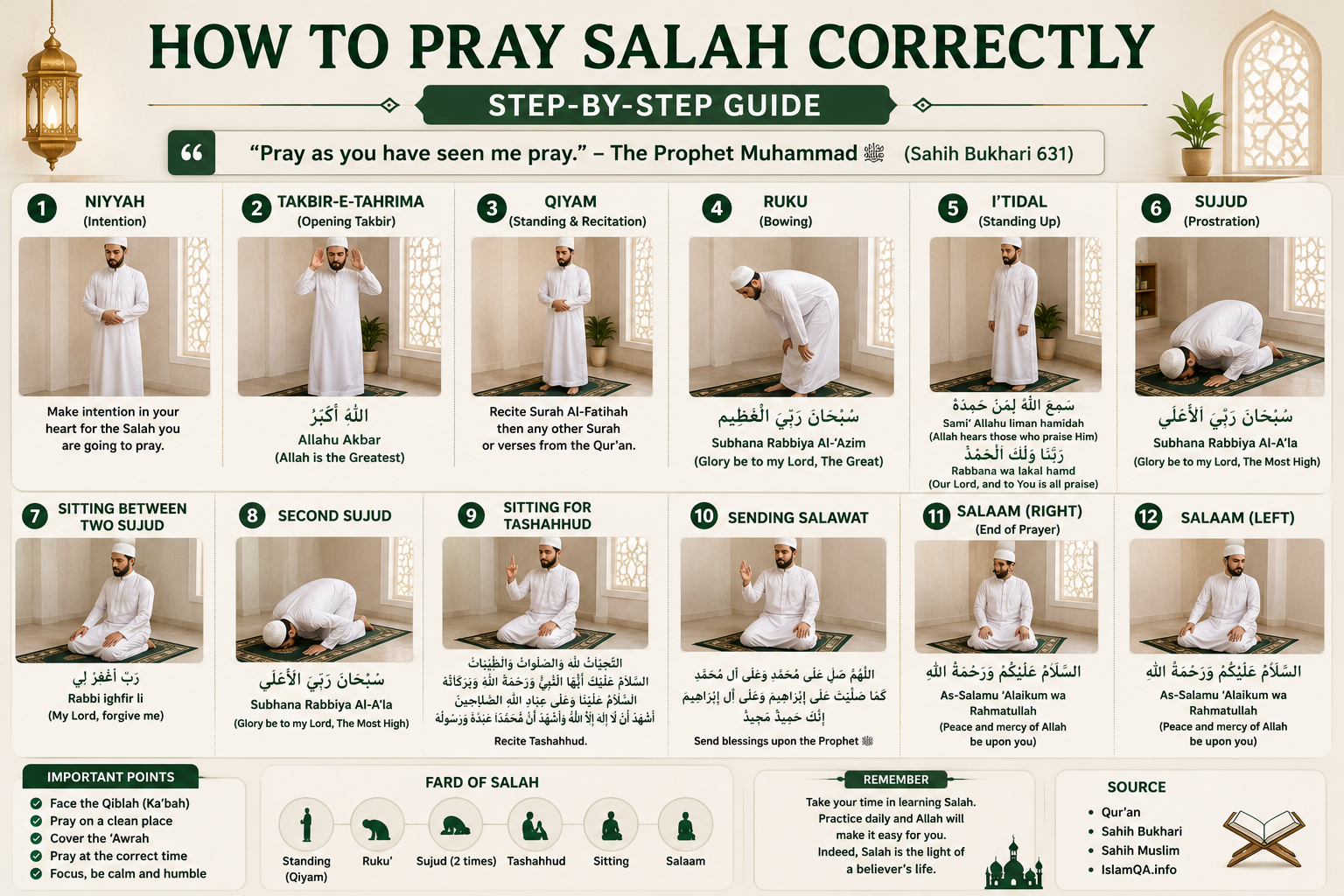
The core physical positions of Salah in sequence
1Takbiratul Ihram (Opening Takbir)
Stand facing the Qiblah, raise both hands to shoulder or ear level, and say “Allahu Akbar” (Allah is the Greatest). This phrase formally begins the prayer; talking, eating, or unrelated movement is no longer permitted from this point.
Takbiratul Ihram
اللَّهُ أَكْبَرُ
Allahu Akbar
“Allah is the Greatest.”
2Qiyam (Standing) and Recitation
Place your right hand over your left on your chest. Many Muslims begin with Sana, a short opening supplication, before reciting Surah Al-Fatihah, the opening chapter of the Quran, which is obligatory in every Rak’ah.
Sana (Opening Dua)
سُبْحَانَكَ اللَّهُمَّ وَبِحَمْدِكَ، وَتَبَارَكَ اسْمُكَ، وَتَعَالَى جَدُّكَ، وَلَا إِلَٰهَ غَيْرُكَ
Subhanaka Allahumma wa bihamdika, wa tabarakasmuka, wa ta’ala jadduka, wa la ilaha ghairuk
“Glory be to You, O Allah, and praise be to You. Blessed is Your name, exalted is Your majesty, and there is no god but You.”
The Prophet (peace be upon him) said: “There is no prayer for the one who does not recite Al-Fatihah.”
Reference: Sahih al-Bukhari 756 — Sahih
Surah Al-Fatihah (1:1-7)
بِسْمِ اللَّهِ الرَّحْمَٰنِ الرَّحِيمِ ﴿١﴾ الْحَمْدُ لِلَّهِ رَبِّ الْعَالَمِينَ ﴿٢﴾ الرَّحْمَٰنِ الرَّحِيمِ ﴿٣﴾ مَالِكِ يَوْمِ الدِّينِ ﴿٤﴾ إِيَّاكَ نَعْبُدُ وَإِيَّاكَ نَسْتَعِينُ ﴿٥﴾ اهْدِنَا الصِّرَاطَ الْمُسْتَقِيمَ ﴿٦﴾ صِرَاطَ الَّذِينَ أَنْعَمْتَ عَلَيْهِمْ غَيْرِ الْمَغْضُوبِ عَلَيْهِمْ وَلَا الضَّالِّينَ ﴿٧﴾
Bismillahir Rahmanir Raheem. Alhamdu lillahi Rabbil ‘alameen. Ar-Rahmanir Raheem. Maliki yawmid-deen. Iyyaka na’budu wa iyyaka nasta’een. Ihdinas-siratal mustaqeem. Siratal-ladheena an’amta ‘alaihim ghairil-maghdubi ‘alaihim wa lad-dalleen.
“In the name of Allah, the Most Gracious, the Most Merciful. All praise is for Allah, Lord of all the worlds. The Most Gracious, the Most Merciful. Master of the Day of Judgment. You alone we worship, and You alone we ask for help. Guide us to the straight path, the path of those You have blessed, not of those who earned Your anger or went astray.”
Surah Al-Fatihah 1:1-7
After Al-Fatihah, in the first two Rak’ahs, it is recommended to recite another short Surah or a few verses from the Quran.
3Ruku (Bowing)
Say “Allahu Akbar” and bend forward from the waist, placing your hands on your knees with your back straight and level. While in Ruku, repeat the Tasbih below at least three times.
Ruku Tasbih
سُبْحَانَ رَبِّيَ الْعَظِيمِ
Subhana Rabbiyal Adheem (x3)
“Glory be to my Lord, the Magnificent.”
4Rising from Ruku (Qawmah)
Stand fully upright again, saying “Sami’ Allahu liman hamidah” (Allah hears whoever praises Him), then “Rabbana wa lakal hamd” (Our Lord, praise be to You).
5Sujud (Prostration)
Say “Allahu Akbar” and go down into prostration, placing your forehead, nose, both palms, both knees, and toes of both feet on the ground. While prostrating, repeat the Tasbih below at least three times.
Sujud Tasbih
سُبْحَانَ رَبِّيَ الْأَعْلَى
Subhana Rabbiyal A’la (x3)
“Glory be to my Lord, the Most High.”
The Prophet (peace be upon him) said: “The closest that a servant comes to his Lord is when he is prostrating, so increase in supplication then.”
Reference: Sahih Muslim 482 — Sahih
6Sitting Between the Two Prostrations
Rise saying “Allahu Akbar,” sit briefly on your left foot with your right foot upright, say “Rabbighfirli” (My Lord, forgive me), then perform a second Sujud identical to the first.
7Completing the Rak’ah and Repeating
After the second Sujud, rise for the next Rak’ah and repeat the cycle. The number of Rak’ahs depends on the prayer (Fajr has 2, Maghrib has 3, and Dhuhr, Asr, and Isha have 4 each).
8Tashahhud (Sitting Recitation)
After the second Rak’ah (and again at the final Rak’ah), sit and recite At-Tahiyyat, raising the index finger of the right hand while reciting the testimony of faith.
At-Tahiyyat (Tashahhud)
التَّحِيَّاتُ لِلَّهِ وَالصَّلَوَاتُ وَالطَّيِّبَاتُ، السَّلَامُ عَلَيْكَ أَيُّهَا النَّبِيُّ وَرَحْمَةُ اللَّهِ وَبَرَكَاتُهُ، السَّلَامُ عَلَيْنَا وَعَلَى عِبَادِ اللَّهِ الصَّالِحِينَ، أَشْهَدُ أَنْ لَا إِلَٰهَ إِلَّا اللَّهُ وَأَشْهَدُ أَنَّ مُحَمَّدًا عَبْدُهُ وَرَسُولُهُ
At-tahiyyatu lillahi was-salawatu wat-tayyibat. As-salamu ‘alaika ayyuhan-Nabiyyu wa rahmatullahi wa barakatuh. As-salamu ‘alaina wa ‘ala ‘ibadillahis-saliheen. Ash-hadu an la ilaha illallah, wa ash-hadu anna Muhammadan ‘abduhu wa rasuluh.
“All greetings, prayers, and good deeds are for Allah. Peace be upon you, O Prophet, and the mercy of Allah and His blessings. Peace be upon us and upon the righteous servants of Allah. I bear witness that there is no god but Allah, and I bear witness that Muhammad is His servant and Messenger.”
Reference: Sahih al-Bukhari 831 & Sahih Muslim 402 — Sahih
9Salawat and Final Dua
In the final sitting, after Tashahhud, recite Durood Ibrahim (sending blessings upon the Prophet), and it is recommended to add a short personal supplication before ending the prayer.
Durood Ibrahim
اللَّهُمَّ صَلِّ عَلَى مُحَمَّدٍ وَعَلَى آلِ مُحَمَّدٍ، كَمَا صَلَّيْتَ عَلَى إِبْرَاهِيمَ وَعَلَى آلِ إِبْرَاهِيمَ، إِنَّكَ حَمِيدٌ مَجِيدٌ. اللَّهُمَّ بَارِكْ عَلَى مُحَمَّدٍ وَعَلَى آلِ مُحَمَّدٍ، كَمَا بَارَكْتَ عَلَى إِبْرَاهِيمَ وَعَلَى آلِ إِبْرَاهِيمَ، إِنَّكَ حَمِيدٌ مَجِيدٌ
Allahumma salli ‘ala Muhammad, wa ‘ala aali Muhammad, kama sallaita ‘ala Ibrahima wa ‘ala aali Ibrahim, innaka Hameedum Majeed. Allahumma barik ‘ala Muhammad, wa ‘ala aali Muhammad, kama barakta ‘ala Ibrahima wa ‘ala aali Ibrahim, innaka Hameedum Majeed.
“O Allah, send blessings upon Muhammad and the family of Muhammad, as You sent blessings upon Ibrahim and the family of Ibrahim; indeed You are Praiseworthy, Glorious. O Allah, bless Muhammad and the family of Muhammad, as You blessed Ibrahim and the family of Ibrahim; indeed You are Praiseworthy, Glorious.”
Reference: Sahih al-Bukhari 3370 — Sahih
10Taslim (Ending the Prayer)
Turn your face to the right saying “Assalamu alaikum wa rahmatullah,” then to the left repeating the same phrase, formally ending the Salah.
The Prophet (peace be upon him) said to a man whose prayer was incomplete: “Go back and pray, for you have not prayed,” repeating this until he taught the man the full, correct method.
Reference: Sahih al-Bukhari 757 & Sahih Muslim 397 — Sahih
Common Mistakes When You Pray Salah
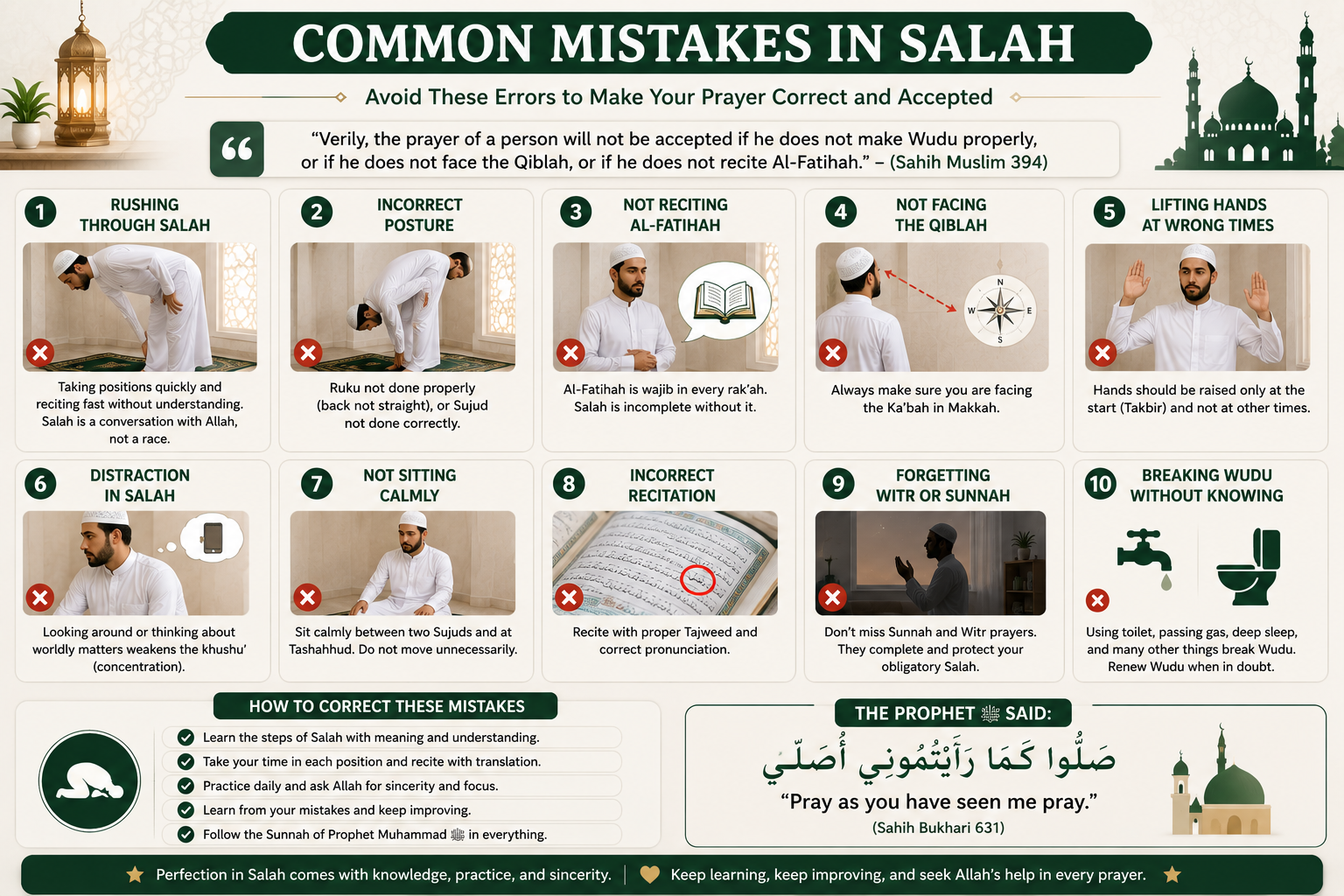
Frequent errors beginners should watch out for during Salah
Even sincere beginners repeat the same handful of mistakes. You may recognize a few of these from your own prayer — that’s completely normal, and noticing them is the first step to fixing them.
Many beginners struggle with how to pray salah correctly because they rush through the prayer or skip important Sunnah actions.
- Rushing through Ruku and Sujud without pausing to say the required Tasbih
- Not keeping the back straight and level during Ruku
- Reciting Surah Al-Fatihah too fast to be understood, even by the person praying
- Forgetting Niyyah before Takbir, or trying to say it out loud instead of in the heart
- Losing focus (Khushu) by letting the mind wander to unrelated thoughts
- Praying in clothing that does not properly cover the Awrah
- Skipping Wudu renewal after something that invalidates it
According to IslamQA.info, most fiqh rulings agree that fixing the physical form of Salah comes before worrying about advanced spiritual states.
How to Pray Salah Correctly for Beginners: Building Khushu (Focus)
Once the mechanics of Salah feel natural, the next stage is depth. Khushu, or heartfelt focus, is what separates a mechanical prayer from one that genuinely transforms a person. If this feels difficult at first, take your time — it builds gradually, not overnight.
- Learn the meaning of what you are reciting, not just the pronunciation
- Remove distractions from your prayer space (phone notifications, noise, clutter)
- Pause briefly between phrases instead of rushing to the next one
- Remind yourself before Takbir that you are standing before Allah
A new Muslim once asked a scholar, “What if I forget a verse while praying?” The scholar smiled and replied, “Allah knows you’re learning. Keep praying and keep improving.” That reminder applies to every beginner working through this guide. If you want structured help learning to read and recite, our Online Quran Classes for Kids and Adults can guide you further.
Imam Nawawi’s Al-Adhkar is widely referenced by scholars for the supplications recommended after Salah, and is a valuable resource once you are comfortable with the basic prayer itself.
Classical References Behind This Guide
This guide draws on classical scholarship in addition to the Quran and Hadith directly:
Tafsir Ibn Kathir Riyad us-Salihin Al-Adhkar — Imam Nawawi Ar-Raheeq Al-Makhtum Bulugh al-Maram Forty Hadith NawawiThese works are commonly used by scholars to explain both the correct form and inner meaning of Salah, worth exploring further as your practice matures.

A quick-reference checklist summarizing the full Salah routine — save or print it for daily practice.
Frequently Asked Questions
This guide explains how to pray salah correctly for beginners in the simplest possible way.
What is the correct way to pray Salah?
The correct way to pray Salah involves Wudu, facing the Qiblah, Niyyah, Takbir, standing recitation, Ruku, rising, two Sujud with a sitting pause between them, and finishing with Tashahhud and Salam, repeated per the number of Rak’ahs for that prayer.
How many times a day does a Muslim pray Salah?
Five times a day: Fajr, Dhuhr, Asr, Maghrib, and Isha, each within its own fixed time window.
Can a beginner pray Salah without memorizing Arabic?
A beginner should learn the essential short Surahs and phrases in Arabic, since Salah must be recited in Arabic. Understanding the meaning alongside memorization helps focus and correctness.
What breaks Wudu before Salah?
Using the toilet, passing gas, deep sleep, and loss of consciousness break Wudu. When in doubt, renew Wudu before praying.
What should a beginner do if they forget a step in Salah?
Most schools of thought allow performing Sujud as-Sahw, the prostration of forgetfulness, at the end of the prayer rather than restarting the entire Salah.
Conclusion
Learning how to pray Salah correctly is not a one-day achievement; it is a lifelong relationship that deepens with practice. Start with getting the physical form right, then slowly build focus and understanding into every movement and word. Every beginner who now prays with confidence once stood exactly where you are, unsure but willing to learn.
Remember, Allah does not expect perfection on your first day. Every correct Salah begins with a sincere intention to improve. Keep learning, keep praying, and never let fear of mistakes stop you from standing before your Creator.
Now you know how to pray salah correctly. Practice every day and ask Allah to make your Salah beautiful and accepted.
- Tafsir Ibn Kathir — commentary on the Quranic verses cited
- Sahih al-Bukhari — Hadith 1, 756, 757, 831, 3370
- Sahih Muslim — Hadith 397, 402, 482, 1907
- Jami’ at-Tirmidhi — Hadith 413
- Riyad us-Salihin — chapters on Salah and sincerity of intention
- Bulugh al-Maram — Hadith on the conditions and pillars of Salah
- Al-Adhkar by Imam Nawawi — supplications recommended after Salah
Disclaimer: This guide follows authentic Quran and Sahih Hadith. For detailed rulings on differences between Islamic schools of thought (Madhahib), consult a qualified local scholar.