
Learn what dua means in Islam, how to make sincere supplication, when to make it, beautiful duas from the Qur’an, and how to build a simple daily habit from the Qur’an and authentic Sunnah.
Home › Duas and Supplications › Duas and Supplications in Islam
What is dua? Dua is a believer’s supplication to Allah: calling upon Him, asking Him for help, forgiveness, guidance, protection, mercy, and other good things. A Muslim can make personal dua at any time. The Qur’an and Sunnah also teach particular moments and manners of supplication. The goal is not to memorize hundreds of words at once, but to turn to Allah sincerely and consistently.
In This Guide
- 1. What Does Dua Mean?
- 2. Why Is Dua Important?
- 3. How to Make Dua
- 4. Can You Make Dua in Your Own Language?
- 5. Best Times to Make Dua
- 6. Beautiful Quranic Duas
- 7. Duas for Everyday Life
- 8. What Can You Ask Allah For?
- 9. When a Dua Seems Unanswered
- 10. Dua and Taking Practical Action
- 11. Common Mistakes to Avoid
- 12. A Simple Daily Dua Routine
- 13. How to Learn Duas Responsibly Online
- 14. Frequently Asked Questions
- 15. Final Thoughts
- 16. References & Further Reading
There are moments when you have a lot on your mind but do not know what to do next. You may be worried about your family, waiting for an answer, struggling with a decision, asking Allah for forgiveness, or simply feeling grateful for something good that happened. Islam gives a believer a simple way to turn back to Allah in all of these moments: dua.
What makes dua special is that it belongs in ordinary life as well as difficult moments. You do not have to wait until everything goes wrong before speaking to Allah. You can ask for guidance before making a decision, thank Him after receiving a blessing, seek forgiveness after a mistake, and ask for strength when something feels too heavy.
So where do we start? This guide to duas and supplications in Islam covers the basics — what dua actually means, how to make it, some of the best moments to say it, a handful of beautiful duas from the Qur’an, the mistakes people commonly fall into, and a small routine you can realistically stick to.
1. What Does Dua Mean in Islam?
The Arabic word dua (دعاء) carries meanings connected with calling, asking, and supplicating. In Islamic worship, dua means turning to Allah with a request, need, hope, gratitude, or appeal.
It is therefore more than repeating a sentence. Dua is an expression of dependence upon Allah. When you make dua, you acknowledge that Allah hears you, knows your situation, and has power over every matter.
One of the clearest Quranic passages about dua is found in Surah Al-Baqarah. Allah says that He is near and responds to the supplication of the one who calls upon Him.
“I respond to the invocation of the supplicant when he calls upon Me.”
This verse gives a beginner an important starting point: you do not need to feel that Allah is distant. Turn to Him honestly, believe in Him, and continue building that relationship through worship and obedience.
2. Why Is Dua Important for Muslims?
Life does not stay the same. Some days are easy and others are difficult. A person may experience success, disappointment, uncertainty, loss, gratitude, or fear within the same week. Dua gives the believer a way to remain connected to Allah through all of those changes.
When Life Is Difficult
Ask Allah for patience, guidance, protection, relief, and the strength to respond to a problem in the right way.
When Life Is Good
Thank Allah for His blessings and ask Him to keep your heart grateful rather than allowing comfort to make you forget Him.
For the Hereafter
Ask for forgiveness, steadfastness, mercy, Paradise, and protection from the Fire.
For Everyday Needs
Ask for beneficial knowledge, halal provision, family wellbeing, good character, and help with your responsibilities.
Dua also teaches humility. Even when a person is capable of taking action, they still recognize that their success, strength, opportunities, and final outcomes are ultimately in Allah’s hands.
3. How to Make Dua in Islam
You don’t need a script to talk to Allah — a believer can simply speak to Him, sincerely, in whatever words come naturally. That said, the Qur’an and Sunnah do teach some manners around it, and knowing them helps you approach supplication with more humility and respect.
- Turn to Allah sincerely. Make your request honestly and remember that you are asking Allah.
- Praise Allah. Begin by recognizing His greatness and thanking Him for His blessings.
- Send blessings upon the Prophet ﷺ. Include salah and salam upon Prophet Muhammad ﷺ as part of your supplication.
- Ask for what is good. Ask for guidance, forgiveness, mercy, protection, beneficial knowledge, halal provision, and other lawful good.
- Ask with hope. Do not approach dua with the assumption that Allah will not hear you.
- Remain patient. If the result does not appear immediately, continue turning to Allah rather than giving up.
- Take practical action. If your request involves something you can work toward, take the lawful means available to you.
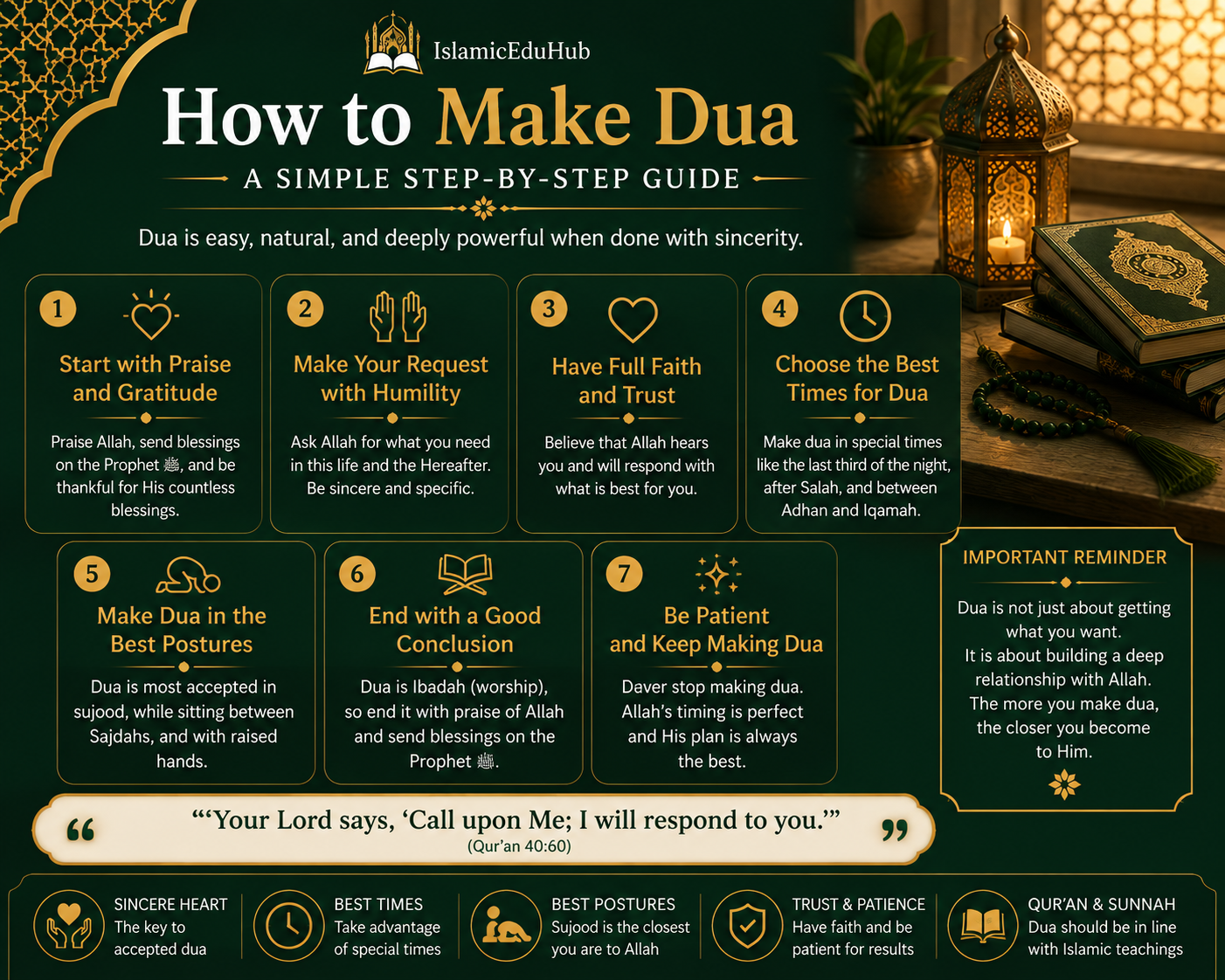
Image description: An illustration summarizing the step-by-step approach to making dua covered in this section.
4. Can You Make Dua in Your Own Language?
For personal supplication outside the formal prayer, a person can ask Allah in a language they understand. This is especially helpful for beginners who are still learning Arabic.
At the same time, learning authentic duas from the Qur’an and Sunnah is extremely valuable. When you memorize an Arabic supplication, learn its translation too. Understanding the words helps you connect the dua with your actual needs and feelings.
You can therefore build two habits together: learn authentic supplications from revelation and Sunnah, and make personal requests in words you genuinely understand.
5. What Are the Best Times to Make Dua?
A Muslim can make dua at any time. However, authentic hadith mention particular opportunities for supplication. Knowing these times can help a beginner turn dua into a regular part of worship rather than something reserved for emergencies.
The Last Third of the Night
Sahih Muslim reports a hadith describing the last third of the night as a special time in which Allah calls people to ask Him and seek forgiveness.
Sahih Muslim 758a →During Sujood
The Prophet ﷺ taught that the servant is closest to his Lord while prostrating and encouraged increasing supplication in that state.
Sahih Muslim 482 →After a Blessing
Do not wait for a problem. Use moments of happiness and gratitude to remember Allah and ask Him to bless what you have.
During Difficulty
When something becomes difficult, turn to Allah while also taking the sensible practical steps needed for your situation.
None of this means your dua “doesn’t count” outside these moments — Allah hears you at any time. Think of them more like appointments you already know are on your calendar: good moments to lean on, especially when you’re trying to build the habit in the first place.
6. Beautiful Quranic Duas to Learn
The Qur’an itself contains supplications made by prophets and righteous believers. These are excellent starting points because they cover some of the deepest needs of human life: guidance, forgiveness, family, mercy, goodness in this world, and goodness in the Hereafter.
“Our Lord, give us good in this world and good in the Hereafter, and protect us from the punishment of the Fire.”
“اے ہمارے رب! ہمیں دنیا میں بھی بھلائی دے اور آخرت میں بھی بھلائی دے اور ہمیں آگ کے عذاب سے بچا۔”
“Our Lord, do not let our hearts deviate after You have guided us, and grant us mercy from Yourself. Indeed, You are the Bestower.”
“اے ہمارے رب! ہمیں ہدایت دینے کے بعد ہمارے دلوں کو ٹیڑھا نہ کر اور ہمیں اپنے پاس سے رحمت عطا فرما، بےشک تو ہی بہت عطا کرنے والا ہے۔”
“Our Lord, we have wronged ourselves. If You do not forgive us and have mercy upon us, we will surely be among the losers.”
“اے ہمارے رب! ہم نے اپنی جانوں پر ظلم کیا، اگر تو ہمیں معاف نہ کرے اور ہم پر رحم نہ فرمائے تو ہم ضرور نقصان اٹھانے والوں میں سے ہو جائیں گے۔”
“My Lord, expand for me my chest and ease for me my task.”
“اے میرے رب! میرا سینہ کھول دے اور میرا کام میرے لیے آسان کر دے۔”
“My Lord, have mercy upon them as they raised me when I was small.”
“اے میرے رب! ان دونوں پر رحم فرما جیسا کہ انہوں نے بچپن میں مجھے پالا۔”
“There is no deity except You; exalted are You. Indeed, I have been among the wrongdoers.”
“تیرے سوا کوئی معبود نہیں، تو پاک ہے، بےشک میں ظالموں میں سے تھا۔”
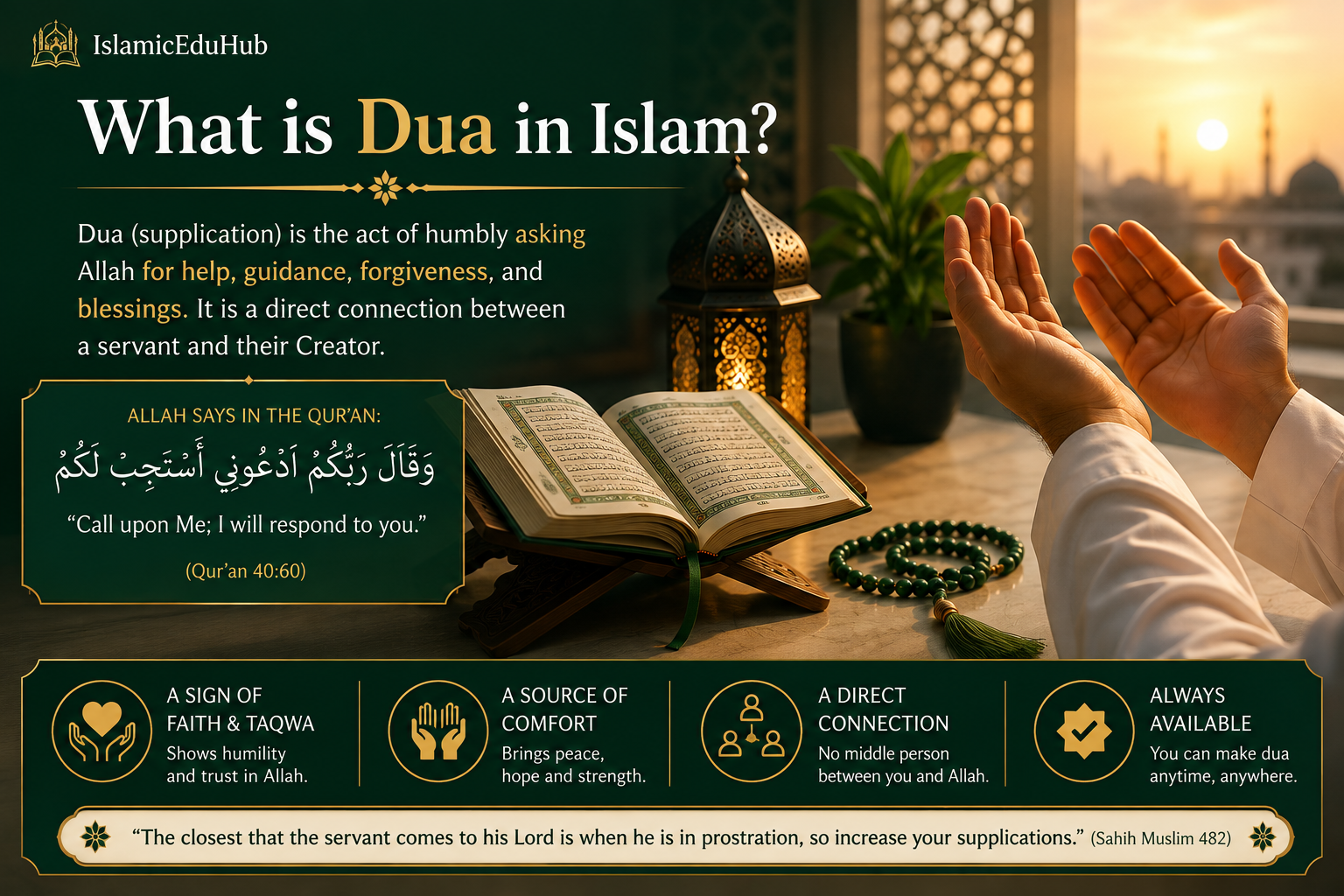
Image description: An illustration representing the practice of learning Quranic supplications by heart.
7. Duas for Everyday Life
Islamic supplication is not limited to major life events. The Sunnah contains remembrance and duas connected with many ordinary parts of the day. That makes dua practical: an ordinary routine can become an opportunity to remember Allah.
8. What Can You Ask Allah For?
A Muslim can ask Allah for beneficial matters related to both this life and the Hereafter. Your dua does not need to sound formal or impressive. It can be a sincere request about something that is genuinely important to you.
- Guidance and stronger faith
- Forgiveness and mercy
- Protection from harm and temptation
- Beneficial knowledge
- Patience and good character
- Halal and beneficial provision
- Righteous family and children
- Ease during difficult circumstances
- Success in beneficial work and study
- Goodness in this world and the Hereafter
- Paradise and protection from the Fire
A balanced dua does not focus only on material success. Ask Allah for a good outcome in this life, but remember the greater importance of faith, forgiveness, character, and the Hereafter.
9. What If My Dua Seems Unanswered?
Honestly, this is probably the hardest part for most people. You ask Allah for something, again and again, and the thing you wanted still hasn’t happened. It’s easy to start wondering if He’s even listening.
The Qur’an’s message in 2:186 gives believers a reason to keep turning to Allah: He describes Himself as near and says He responds to the supplication of the caller.
Allah knows what we do not know. The thing we want may not be good for us in the way we imagine, or the timing may not be what we expected. A believer therefore asks Allah while leaving the final outcome to Him — without dropping the effort on their end, which is exactly what the next section is about.
10. Dua and Taking Practical Action
Asking Allah for something and working toward it aren’t two separate tracks — they go together. If you ask for success in an exam, study. If you ask for halal provision, go seek lawful opportunities. If you ask Allah to improve a relationship, examine your own behavior and communicate honestly too.
Dua
Turn to Allah and ask Him for help, guidance, forgiveness, and what is good.
Effort
Take sensible and lawful steps toward the goal rather than waiting without action.
Patience
Continue doing what is right even when the result takes longer than expected.
Trust
Leave the final outcome to Allah and remember that His knowledge is greater than ours.
This combination protects dua from becoming either passive waiting or anxious self-reliance. The believer asks Allah, does what they reasonably can, and trusts Him with what is beyond their control.
Dua vs Dhikr: What Is the Difference?
Dua is asking and calling upon Allah, while dhikr broadly means remembering Allah through words and acts of remembrance. They overlap: many authentic remembrances contain praise, and many supplications include remembrance of Allah.
In practice, don’t treat them as competing practices — they’re not in competition. Learn the established adhkar for parts of the day, and also make sincere personal dua for whatever’s actually on your mind.
Dua and Salah: How Are They Connected?
Salah contains praise, recitation, remembrance, and supplication. One especially important place for supplication is sujood. In Sahih Muslim 482, the Prophet ﷺ encouraged believers to increase supplication while prostrating. If your own prayer routine is still new, our guide on how to pray Fajr prayer correctly covers where these moments of sujood fit into the prayer itself.
Important Etiquettes of Dua
Good manners of supplication help a believer approach Allah with humility rather than treating dua like a mechanical formula.
- Call upon Allah sincerely and with humility.
- Praise Allah and send blessings upon the Prophet ﷺ.
- Ask for lawful and beneficial things.
- Do not become impatient because an answer is not immediate.
- Avoid claiming that an invented number, phrase, or ritual guarantees a result.
- Combine dua with repentance, obedience, and the lawful practical means available to you.
Prophetic Duas vs Personal Duas
Quranic & Prophetic Duas
These give believers words taught in revelation or authentically reported from the Prophet ﷺ. Learn the meaning as well as the wording, and preserve the source accurately.
Personal Dua
You can also ask Allah sincerely about your own needs in words you understand, especially outside the formal prayer. Personal dua does not need to sound poetic or impressive.
The strongest beginner habit is to learn authentic transmitted supplications while also speaking to Allah sincerely about your real needs.
How to Check Whether a Dua Is Authentic
Since a dua attributed to the Prophet ﷺ is technically a Hadith, the same verification principles apply — if you’re not yet familiar with terms like isnad, matn, or how narrations get graded, our guide on what Hadith is and how it’s authenticated covers that groundwork in more depth.
- Identify the claim. Is it being called a Quranic verse, a Prophetic dua, a companion’s dua, or simply a permissible personal supplication?
- Look for the exact reference. A Hadith collection name and number are more useful than “Hadith says.”
- Check the source. Compare the wording and context with a reliable Qur’an or Hadith reference.
- Separate wording from promised benefits. A dua may be permissible while a viral claim about repeating it a certain number of times has no established evidence.
- Ask a qualified scholar when needed. Detailed questions of authenticity or fiqh should not be settled from a social-media graphic alone.
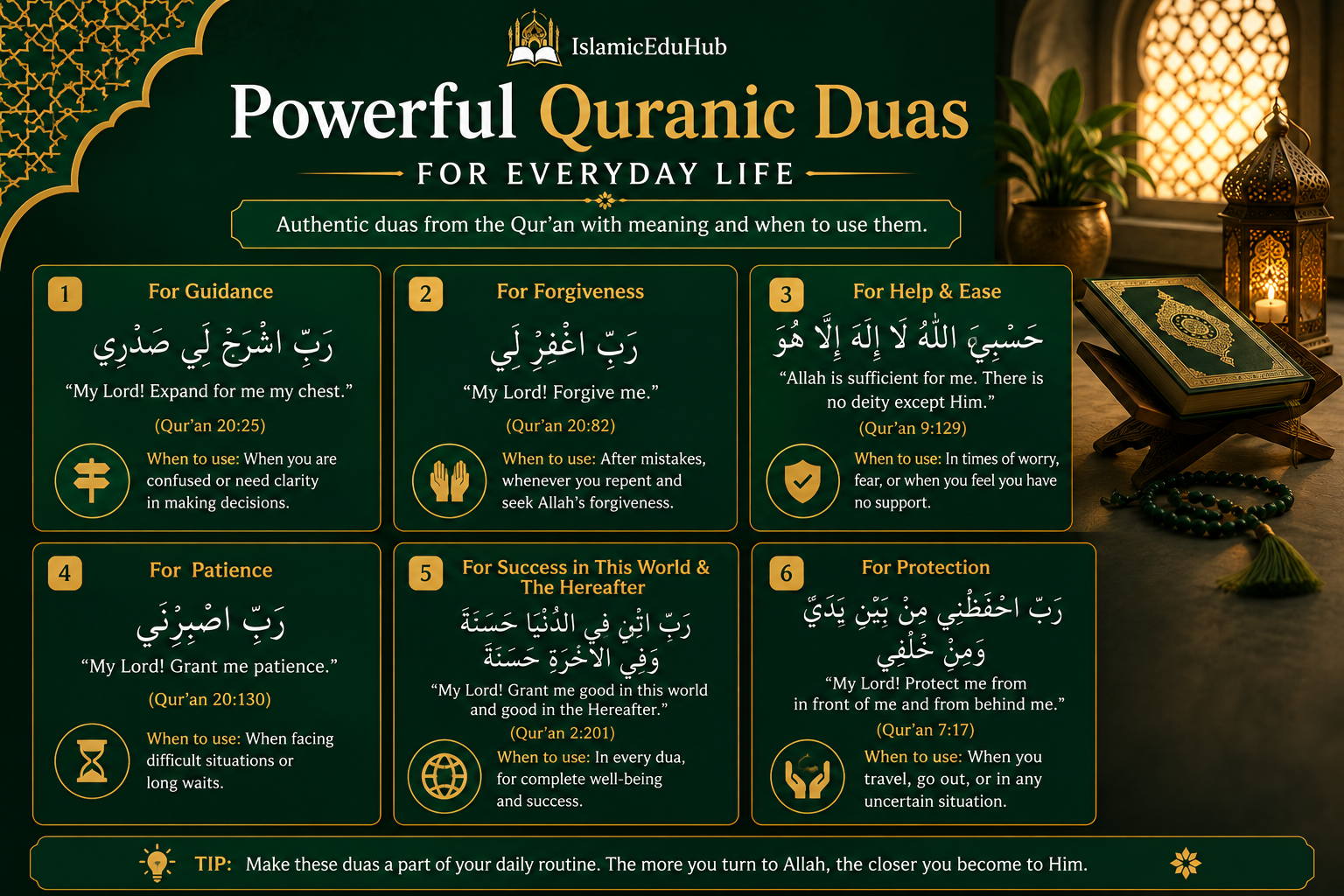
Image description: An illustration representing the practice of checking a claimed dua’s source before sharing it as authentic.
11. Common Mistakes to Avoid When Making Dua
Mistake 1: Treating dua like a guaranteed formula
Be cautious when someone claims that repeating a particular sentence a fixed number of times will definitely produce a particular worldly result. Such claims need evidence.
Mistake 2: Only making dua in emergencies
Do not make dua part of your life only when you are frightened. Remember Allah during peaceful days too.
Mistake 3: Memorizing without understanding
Learning Arabic is valuable, but understanding the translation helps you know what you are actually asking Allah for.
Mistake 4: Sharing unverified duas
A beautiful quote is not automatically a Prophetic dua. If a statement is attributed to the Prophet ﷺ, check its source before sharing it as Sunnah.
Mistake 5: Giving up quickly
A delayed result does not give you a reason to abandon dua. Keep asking Allah and remain patient.
Mistake 6: Forgetting practical action
If your request involves something you can work toward, take the appropriate lawful steps. Dua and responsible effort belong together.
12. A Simple Daily Dua Routine for Beginners
If you are starting from zero, keep your routine small. The goal is consistency, not collecting a huge number of duas that you forget after a few days.
- Morning: learn one authentic morning remembrance and understand its meaning.
- During the day: make personal dua whenever you need help, guidance, or forgiveness.
- After Salah: practice the established post-prayer adhkar you have learned.
- Quranic Dua: spend a few minutes learning one supplication from the Qur’an.
- Before sleep: learn and practice an authentic bedtime remembrance.
- Weekly: add another dua only after the earlier ones are becoming familiar.
13. How to Learn Duas Responsibly Online
The internet makes Islamic knowledge easier to access, but it also makes unverified religious claims easier to spread. A beginner can build good research habits with a few simple checks.
- Look for a Qur’an verse or Hadith reference.
- Check the original Hadith collection when a narration is quoted.
- Do not confuse a popular saying with a Prophetic statement.
- Check whether a claimed special number or benefit actually has evidence.
- Use reliable reference sites for verification.
- Ask a qualified scholar when a question involves detailed Islamic rulings.
None of this is about making every answer sound complicated — it’s really just about being honest. Say clearly what’s established, what’s still debated, and what genuinely needs a scholar’s input.
14. Frequently Asked Questions About Dua
A few questions come up again and again on this topic — here are quick, direct answers.
Can I make dua in English?
Yes. For personal supplication outside the formal prayer, you can ask Allah in a language you understand. Learning authentic Arabic duas is also highly beneficial.
Can I ask Allah for worldly things?
Yes. You can ask Allah for beneficial worldly matters such as lawful provision, family wellbeing, beneficial knowledge, safety, and success in good work, while also asking for the Hereafter.
What is the best time to make dua?
Dua can be made at any time. Authentic hadith highlight opportunities such as the last third of the night and while a person is in sujood.
Why does my dua take so long to be answered?
A delayed outcome should not automatically be understood as rejection. Continue asking Allah, remain patient, and take the practical steps appropriate to your situation.
Do I need to know Arabic before making dua?
No. Personal supplication can be made in a language you understand. At the same time, learning authentic Arabic supplications from the Qur’an and Sunnah is an excellent part of Islamic study.
How many times should I repeat a dua?
There is no single number that applies to every personal dua. When a particular number is established by an authentic source for a specific remembrance, follow that evidence. Avoid inventing fixed numbers and presenting them as Sunnah.
Can I make dua for another person?
Yes. Asking Allah to guide, forgive, protect, bless, or help another person is a good way to remember others in your worship.
Is every dua I see online authentic?
No. Some are authentic, some are general permissible supplications, and some claims are unsupported. If something is presented as a statement of the Prophet ﷺ, verify its source before sharing it as Sunnah.
15. Final Thoughts
That’s really the heart of it: dua is one of the most personal ways a Muslim turns toward Allah. It belongs in the quiet moments before sleep, the difficult moments when you need help, the happy moments when you are grateful, and the ordinary moments when you simply remember your Creator.
You do not need to begin with a huge collection. Start with one or two authentic supplications. Learn what they mean. Make personal dua for the things that matter to you. Keep asking Allah during both easy and difficult times, and combine your supplication with patience and practical effort.
The Qur’an’s reminder in 2:186 is a beautiful foundation: Allah describes Himself as near and tells believers that He responds to the supplication of the one who calls upon Him.
May Allah guide us, forgive us, accept our supplications, increase us in beneficial knowledge, strengthen our faith, and make our hearts constantly connected to Him. Ameen.
Editorial & Source Note
This beginner guide distinguishes between general personal supplication and claims attributed specifically to the Qur’an or Prophet Muhammad ﷺ. Qur’anic and Hadith references are included so readers can verify the cited source themselves.
- Primary references checked: Qur’an 2:186, 2:201, 3:8, 7:23, 20:25–26, 17:24, 21:87; Sahih Muslim 758a; Sahih Muslim 482.
- Religious accuracy policy: unsupported “guaranteed result” formulas are not presented as Sunnah.
- Scope: this is educational content, not a substitute for a qualified scholar on detailed fiqh rulings.
- Last reviewed: August 2026.
16. References & Further Reading
Qur’an References
- Qur’an 2:186 — Allah’s nearness and response to supplication.
- Qur’an 2:201 — asking for good in this world and the Hereafter.
- Qur’an 3:8 — asking Allah to keep hearts firm upon guidance.
- Qur’an 7:23 — seeking forgiveness and mercy.
- Qur’an 20:25–26 — dua of Prophet Musa (Moses) for ease before a difficult task.
- Qur’an 17:24 — dua for one’s parents.
- Qur’an 21:87 — dua of Prophet Yunus (Jonah) in distress.
Hadith References
- Sahih Muslim 758a — supplication and seeking forgiveness in the last part of the night.
- Sahih Muslim 482 — increasing supplication while prostrating.
Related IslamicEduHub Guides
IslamicEduHub provides beginner-friendly Islamic learning resources covering Qur’an, Hadith, Sunnah, Duas, prayer, history, and practical Islamic guidance.
This guide is written for educational purposes. For detailed Islamic rulings or questions requiring scholarly judgment, consult a qualified scholar.