

How to memorize Quran effectively: the 10 methods, realistic timeline, 90-day plan, and how to retain what you learn. Whether you’re looking for Quran memorization techniques, a Hifz plan for your schedule, or how to become a Hafiz, this guide covers the foundations and the practice.
- 10 methods
- Realistic timeline table
- 90-day starter plan
- Adult-friendly
- Referenced Quran & Hadith sources
To memorize Quran effectively, you need three things working together: small daily portions learned with correct pronunciation, a fixed revision routine for everything you have already memorized, and someone who listens to your recitation and corrects it. Retention matters far more than speed. This guide turns the methods used in Hifz circles for generations into a plan you can start this week.
The most effective way to memorize the Quran is to learn a small new portion daily (often 3 to 10 lines), repeat it with a teacher-checked pronunciation until you can recite it without looking, and spend most of your session revising older portions. Consistency over months beats long, irregular sessions.
What Is Hifz and Why Memorize the Quran?
Hifz (حفظ) comes from an Arabic root meaning to guard or preserve. In practice, it means memorizing the Quran’s words exactly, with correct pronunciation, so you can recite them from the heart. Someone who has memorized the whole Quran is called a Hafiz (or Hafizah for a woman).
Memorization has been one of the central ways Muslims have transmitted and preserved Quranic recitation since the earliest generations. This verse highlights that Allah’s revelation is carried and recognized by people of knowledge:
بَلْ هُوَ آيَاتٌ بَيِّنَاتٌ فِي صُدُورِ الَّذِينَ أُوتُوا الْعِلْمَ
Meaning: “Rather, it is clear verses in the breasts of those who have been given knowledge.”
Surah Al-Ankabut 29:49 (Quran.com)
Allah also repeats a promise four times in Surah Al-Qamar that should reassure every beginner:
وَلَقَدْ يَسَّرْنَا الْقُرْآنَ لِلذِّكْرِ فَهَلْ مِن مُّدَّكِرٍ
Meaning: “And We have certainly made the Quran easy for remembrance, so is there anyone who will remember?”
Surah Al-Qamar 54:17 (also 54:22, 54:32, 54:40), Quran.com
The Prophet ﷺ described the reward for people devoted to the Quran in the Hereafter:
“It will be said to the companion of the Quran: Recite and rise, and recite slowly as you used to recite in the world, for your rank will be at the last verse you recite.”
Sunan Abi Dawud 1464; Jami’ at-Tirmidhi 2914 (graded hasan sahih)
Two clarifications help. First, every Muslim needs at least Surah Al-Fatihah and some additional verses to pray, so a small amount of memorization is part of daily worship (see how to pray Salah correctly). Second, memorizing the entire Quran is not required of every individual; many scholars describe it as a communal obligation (fard kifayah), and a great act of worship for anyone who takes it on.
How Long Does It Take to Memorize the Quran?
Students completing Quran memorization typically take one to five years, depending on daily schedule, revision routine, and guidance, but the real driver is simple arithmetic. The widely used Madinah Mushaf has 604 pages. Your daily amount decides the minimum time, before any rest days or revision-only days are added:
| New memorization per day | Pages per month (30 days) | Minimum time for 604 pages | Who this suits |
|---|---|---|---|
| 5 lines (1/3 page) | about 10 | about 5 years | Working adults, busy students |
| Half a page | 15 | about 3.3 years | Steady part-time learners |
| 1 page | 30 | about 20 months | Dedicated learners with 2+ hours daily |
| 2 pages | 60 | about 10 months | Full-time Hifz students with a teacher |
In reality, add 15 to 30 percent for revision days and interruptions. A plan that looks slower on paper but keeps your old pages strong will finish sooner than a fast plan that forces you to re-memorize whole sections.
Your pace also depends on how fluently you read Arabic script, whether you have a teacher, and how much you already know from Salah.
10 Time-Tested Methods to Memorize Quran Effectively
The Sabaq (new lesson), Sabqi (yesterday’s review), and Manzil (older material) system forms the foundation of most traditional Hifz programs. The other methods strengthen and support this core structure.
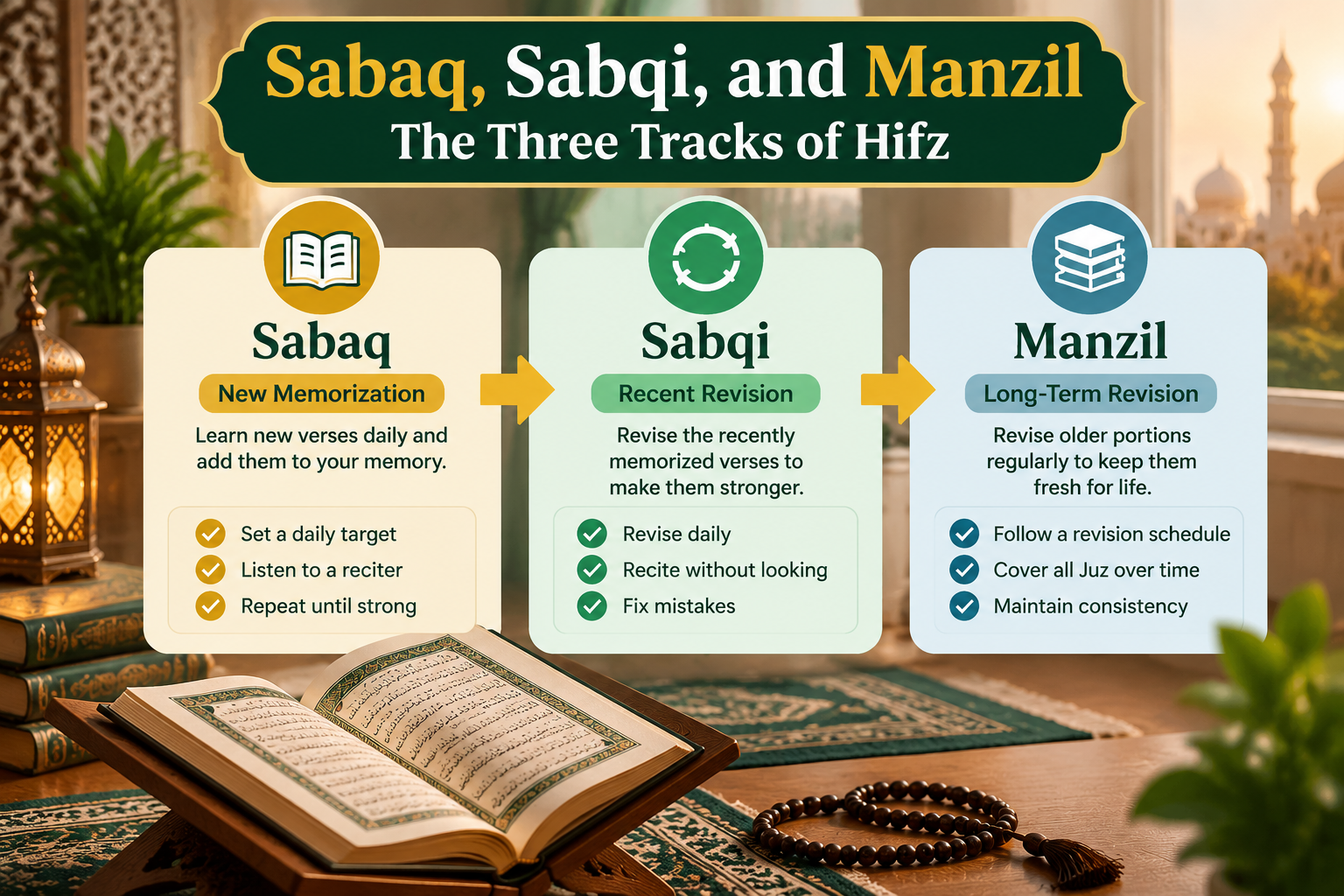
1. Use the Three-Track System: Sabaq, Sabqi, Manzil
Traditional Hifz programs divide each day into three tracks. Sabaq is today’s new lesson. Sabqi is revision of recent lessons, usually the last few days to the last Juz. Manzil is revision of older portions, rotated so that everything you know is recited regularly. Arab circles use the word muraja’ah (revision) for the second and third tracks.
A simple starting ratio is one part new to two parts revision. If you have 45 minutes, spend 15 on sabaq and 30 on sabqi and manzil. As your memorized amount grows, revision time grows too. That is normal.
2. Memorize in Small Portions With Focused Repetition
Read one verse while looking at the Mushaf about 10 times, slowly and correctly. Then close the Mushaf and recite it 3 times from memory without a mistake. Many teachers use: read verse 10 times while looking, recite 3 times from memory without error; adjust for difficult verses. Then move to the next verse. When you finish the second verse, recite the first and second together, and keep chaining until the whole portion flows.
The chaining step matters: many learners know each verse alone but freeze at the joins between them.
3. Stick to One Mushaf
Your mind remembers where a verse sits on the page: top left, near the page end, just before a surah heading. Switching between printed copies with different layouts scrambles that picture. Choose one Mushaf and use it for the whole journey. The 15-line Madinah layout and the 13-line or 16-line Indo-Pak copies all work; consistency is what counts.
4. Listen Before You Memorize
Play your new portion several times from a clear, slow reciter before you start repeating it yourself. This fixes correct sounds in your ear before you repeat them. Choose a reciter with clear Tajweed and a pace suitable for learners, and stay with them. Students often use the slow murattal recitation of Sheikh Mahmoud Khalil al-Husary because every letter is easy to hear.
5. Recite to a Teacher Regularly
The Quran has traditionally been passed on by recitation from teacher to student (talaqqi). A teacher hears errors you cannot hear in yourself: a missing elongation, a letter from the wrong point of the mouth, a skipped word in a similar verse. If there is no qualified teacher near you, an online teacher is a real option; see our guide to Quran online classes for kids and adults.
6. Understand the Meaning of the Portion First
Before memorizing, read a reliable translation of the verses you are about to learn. When you know that one verse describes a story scene and the next gives a command, the order makes sense and is easier to recall. For a deeper approach, see how to understand the Quran.
7. Recite Your New Portion in Salah
Use what you memorize in your Sunnah and voluntary prayers the same day. Night prayer is especially suited to this; our Tahajjud guide explains how to pray it. Allah instructs the Prophet ﷺ to recite the Quran with tartil, measured recitation (Al-Muzzammil 73:4), which is also the pace that builds lasting memory.
8. Fix One Daily Time Slot
Many students find after Fajr a suitable time because the mind is fresh and the house is quiet. The Prophet ﷺ taught that the deeds most beloved to Allah are those done consistently, even if they are small (Sahih al-Bukhari 6464; Sahih Muslim 783).
9. Write Out Difficult Verses
When a verse will not settle, write it from memory in Arabic, then compare it letter by letter with the Mushaf. Writing exposes small details, such as a wa versus a fa, that fast recitation hides.
10. Keep a Similar-Verses Notebook and Progress Log
The Quran contains many verses that are almost identical but differ by a word or two (mutashabihat). These cause most mid-recitation mix-ups. Each time you confuse two verses, write both references side by side and underline the difference. Keep a simple log too: date, pages memorized, pages revised, and mistakes made.
If you only apply three methods, choose the three-track system (1), small portions with chaining (2), and regular recitation to a teacher (5). Everything else strengthens those three.
Your First 90 Days: A Starter Plan
This plan assumes 30 to 60 minutes a day and basic ability to read Arabic script. If you cannot yet read fluently, start with how to read the Quran correctly and return to this plan after a few weeks of reading practice.
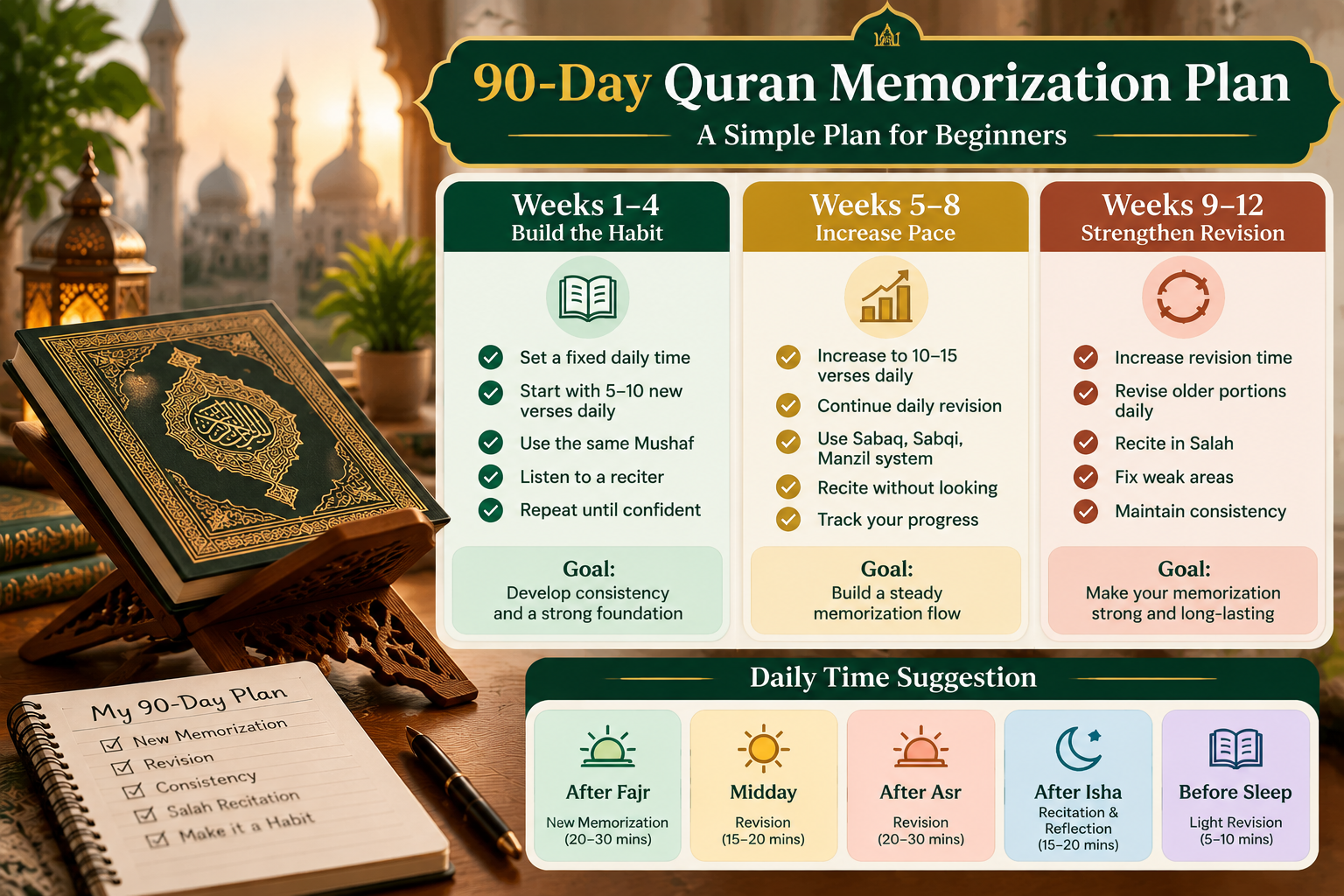
- Days 1 to 14: Set the foundation. Choose your Mushaf and one reciter. Find a teacher, online or local, and recite Surah Al-Fatihah and any short surahs you already know so they can check your pronunciation. Set your daily time slot.
- Days 15 to 45: Juz Amma, short surahs. Begin from Surah An-Nas and move backwards through the short surahs of Juz 30. Aim for 3 to 5 lines a day. Revise all previous surahs daily.
- Days 46 to 75: Longer surahs of Juz Amma. Continue backwards toward Surah An-Naba. If your revision is holding, increase to half a page a day; if not, stay at your current amount. Keep one day a week for revision only: recite that week’s lessons without the Mushaf and fix the weak spots.
- Days 76 to 90: Review and assess. Reduce new memorization and recite everything you have learned to your teacher. Mark weak surahs in your log and strengthen them. Then decide your pace for the next three months using the timeline table above.
A realistic scenario: if you work during the day, 25 minutes after Fajr for sabaq and 20 minutes after Isha for revision fits most schedules. Plan it with our Prayer Time Calculator.
7 Common Quran Memorization Mistakes (and How to Fix Them)
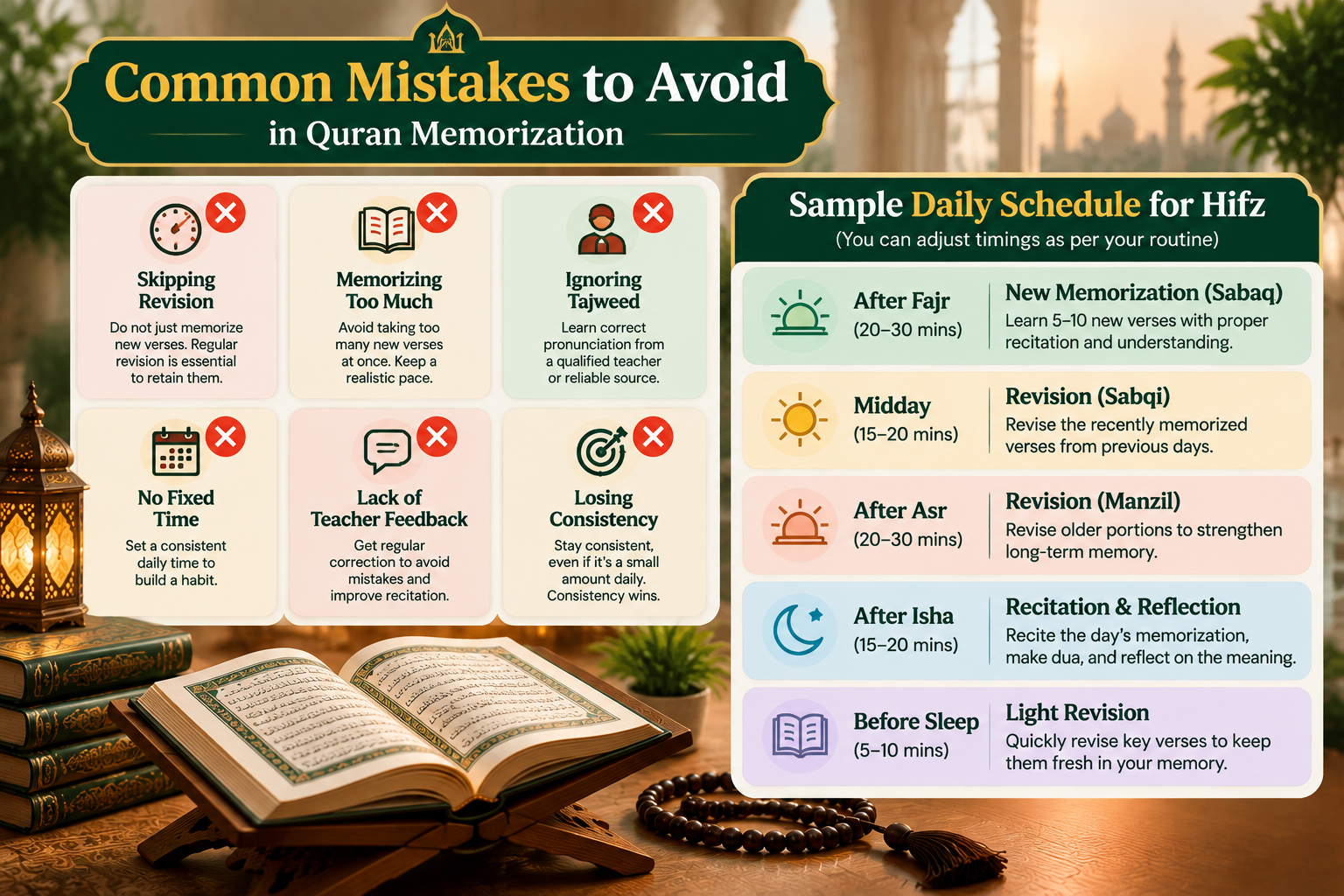
- “I memorize fine but forget within a week.” Your sabqi period is too short. Revise each new lesson daily for at least the next 7 to 10 days.
- “I mix up similar verses.” Start the notebook from Method 10 and recite the confused pair back to back.
- “My family doesn’t know I’m doing this.” A quiet, fixed slot and headphones are enough. Nobody needs to know your schedule for it to work.
Best Times to Memorize the Quran
Time of day: most learners find early morning, especially after Fajr prayer, the easiest time for new material because the mind is rested. Evening works well for revision, since recalling known material requires less fresh energy. Test both and keep what works for you.
Ramadan: the Quran was revealed in Ramadan (Al-Baqarah 2:185), and Jibril used to meet the Prophet ﷺ every night of Ramadan to study the Quran with him (Sahih al-Bukhari 6). It is a good season to strengthen revision, but do not wait for it to start.
Life stage: any age can begin. The best time to start is the next day you can keep going.
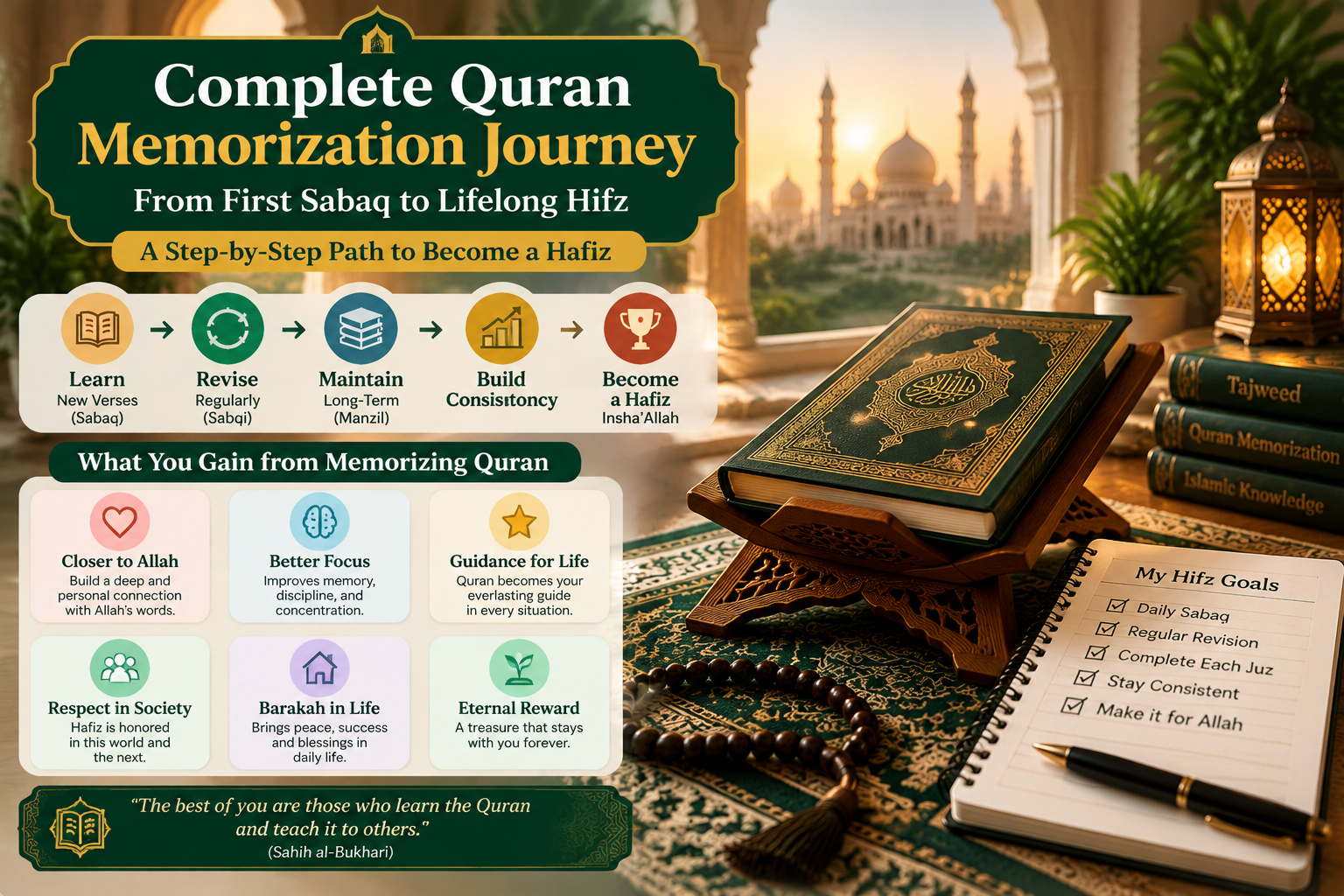
Tools and Resources That Help
- Quran.com and verse-repeat audio: listen to your portion, loop a single verse, and check its meaning.
- A printed Mushaf: keep one physical copy as your main memorization copy so your visual memory stays fixed.
- A progress tracker: paper works, or use our Quran Reading Tracker.
- A teacher: apps support memorization; they cannot replace a person who listens and corrects.
The Spiritual Side of Hifz: Motivation, Dua and Patience
Start with a sincere intention. The Prophet ﷺ said that actions are judged by their intentions (Sahih al-Bukhari 1). Memorize to please Allah, not for a title or praise. Many scholars have encouraged spiritual discipline, repentance, and good habits alongside Quran learning, so pair your Hifz with regular repentance; our guide on how to repent in Islam explains how.
Forgetting is expected. The Prophet ﷺ compared the person who has memorized the Quran to the owner of tied camels: if he keeps watch over them, he keeps them, and if he lets them loose, they wander off (Sahih al-Bukhari 5031). He also said:
“Keep refreshing your knowledge of the Quran, for by Him in whose hand is my soul, it escapes more quickly than camels from their tethers.”
Sahih al-Bukhari 5033; Sahih Muslim 791
Even the Prophet ﷺ, on hearing a man reciting at night, prayed for him because the man had reminded him of verses he had been caused to forget (Sunan Abi Dawud 1331). Forgetting is human. The response is revision, not guilt.
Struggling is rewarded. The Prophet ﷺ said that the one skilled in the Quran will be with the noble, righteous scribes, and the one who recites it with difficulty, stumbling over it, receives a double reward (Sahih al-Bukhari 4937; Sahih Muslim 798). If memorization feels hard for you, that effort itself is counted.
Make dua, using authentic words. A lengthy “dua for memorizing Quran” attributed to Ali ibn Abi Talib circulates widely. It is recorded by at-Tirmidhi, but hadith scholars differed sharply over it; some, including adh-Dhahabi and Ibn al-Jawzi, considered it very weak or fabricated. Rather than depend on a disputed text, you can ask Allah in your own words and use duas from the Quran itself:
رَبِّ اشْرَحْ لِي صَدْرِي وَيَسِّرْ لِي أَمْرِي وَاحْلُلْ عُقْدَةً مِّن لِّسَانِي يَفْقَهُوا قَوْلِي
Meaning: “My Lord, expand for me my chest, ease for me my task, and untie the knot from my tongue, so they may understand my speech.” (Musa’s dua)
Surah Ta-Ha 20:25-28 (Quran.com)
رَّبِّ زِدْنِي عِلْمًا
Meaning: “My Lord, increase me in knowledge.”
Surah Ta-Ha 20:114 (Quran.com)
Handle burnout early. If dreading sessions, reduce new lessons and focus on revision. Celebrate each finished surah.
Frequently Asked Questions
Can adults memorize the Quran?
Yes. Adults memorize every year while working and raising families. 5 lines to half a page daily is realistic. See our Quran learning plan for adults for structure.
Do I need to learn Tajweed before memorizing?
You should be able to read Arabic script correctly and know the basic rules before you memorize a portion, because errors memorized early are hard to remove. You can keep refining advanced Tajweed alongside your Hifz with a teacher.
How can I do Hifz at home easily?
Set one quiet spot and one fixed daily slot, use one Mushaf, and follow the sabaq, sabqi and manzil routine from Method 1. The part you should not skip is correction: recite to a qualified teacher at least weekly, in person or online, because self-study alone can lock in pronunciation mistakes.
Why do I forget verses after memorizing them?
Usually the new portion lacks revision days, or older portions aren't on manzil rotation. Without regular review, the Quran slips away (Bukhari 5033).
Can I become a Hafiz in 1 year?
Possible but demanding — 1.7 pages/day with growing revision. Full-time students only, often 5+ hours/day. Most learners do 2–5 years.
How do I memorize 2 pages of the Quran a day?
Only attempt this once 1 page a day is stable. Split the work: one page in the morning session and one in the afternoon or evening, each learned verse by verse with a focused repetition approach, then link the two pages before sleeping. Revision must still come first, so budget several hours a day.
Is there a special dua for memorizing the Quran?
No single agreed dua exists. The Ali narration is disputed. Use Quranic duas like “Rabbi zidni ilma” (20:114) or ask Allah in your own words.
Is it too late to memorize the Quran if I’m older?
No. Adults of different ages continue Quran memorization, adapting their schedules to their circumstances. Older learners often memorize deeply, though sometimes more slowly. Age is not a barrier — inconsistency is. Start at whatever pace suits your life.
Start Your Quran Memorization This Week
Memorizing the Quran effectively comes down to a small daily lesson, strong revision, and regular correction. You need one Mushaf, one reciter, one daily slot, and the first surah of Juz Amma. Recite it to a teacher this week, revise it tomorrow, and add the next one. Months of small, steady days are how every Hafiz reached the end.
Need guidance with your Quran memorization journey?
Explore Quran online classes Track your daily pagesRelated Guides
Sources and Methodology
Quran verses in this guide are referenced to Quran.com, and every hadith was checked against its collection number on Sunnah.com: Sahih al-Bukhari 1, 6, 4937, 5031, 5033 and 6464; Sahih Muslim 783, 791 and 798; Sunan Abi Dawud 1331 and 1464; Jami’ at-Tirmidhi 2914. Quran references: 2:185, 20:25-28, 20:114, 29:49, 54:17, 73:4. The narration attributed to Ali ibn Abi Talib about a memorization dua (Tirmidhi) is mentioned only to explain its disputed status, not as a recommended practice.
What is settled: regular revision of memorized Quran is emphasized in authentic hadith, and reciting Al-Fatihah is part of Salah. What involves scholarly nuance: the exact ruling on memorizing the whole Quran (commonly described as a communal obligation), and how much Tajweed must be mastered before memorizing. Timelines and methods here are practical teaching patterns, not religious rulings.
IslamicEduHub Editorial Team writes practical guides on Quran, Salah and Islamic basics for beginners. Every Quran reference is checked against Quran.com, every hadith is checked on Sunnah.com, and disputed narrations are labeled as such. Last reviewed: September 2026.
Found an error? Contact IslamicEduHub. Follow us on Facebook.