
Hadith Source Checker
Paste a hadith you already have — with or without its citation — and the Hadith Source Checker gives you a field‑by‑field check: narrator, collection, book, number, and grade, cross‑checked against a curated reference library.
🔒 Runs entirely in your browser — no sign‑up, no external calls, nothing sent off this page.
Check a Hadith Source ↓
Check a hadith’s source, field by field
Enter whatever you already have — the wording, the narrator, the collection, the number, or a claimed grade — and the checker will confirm what it can, flag what’s missing, and cross‑reference our library of 9 well‑established hadith.
Local, deterministic check against a fixed library of 9 hadith — not a live database and not AI‑generated text. See the FAQ for how this differs from a full scholarly authentication.
Verification Ledger
Wording shown for library matches is a plain‑English rendering for study purposes, not a certified translation. For religious rulings (fiqh) or public citation, verify each hadith and its Arabic text against a primary collection such as sunnah.com or consult a qualified scholar.
What is a hadith source check?
A hadith is a recorded report of what the Prophet Muhammad ﷺ said, did, or approved of. A complete source for that report has five parts: the wording itself, the narrating Companion, the collection and book it was preserved in, its hadith number, and the grade a hadith scholar gave its chain of narration (Sahih, Hasan, or weaker).
A source check is simply confirming those five parts belong together — that the number really points to that collection, that the narrator is the one recorded, and that the grade matches what scholars actually assigned. It is a citation audit, not a re‑verification of the underlying scholarship: only a qualified hadith specialist can authenticate a chain from scratch.
The Hadith Source Checker exists to make that citation audit fast for the hadith you already have in hand, alongside the rest of Islamic Education Hub’s Quran and hadith study tools.

How this hadith source checker works
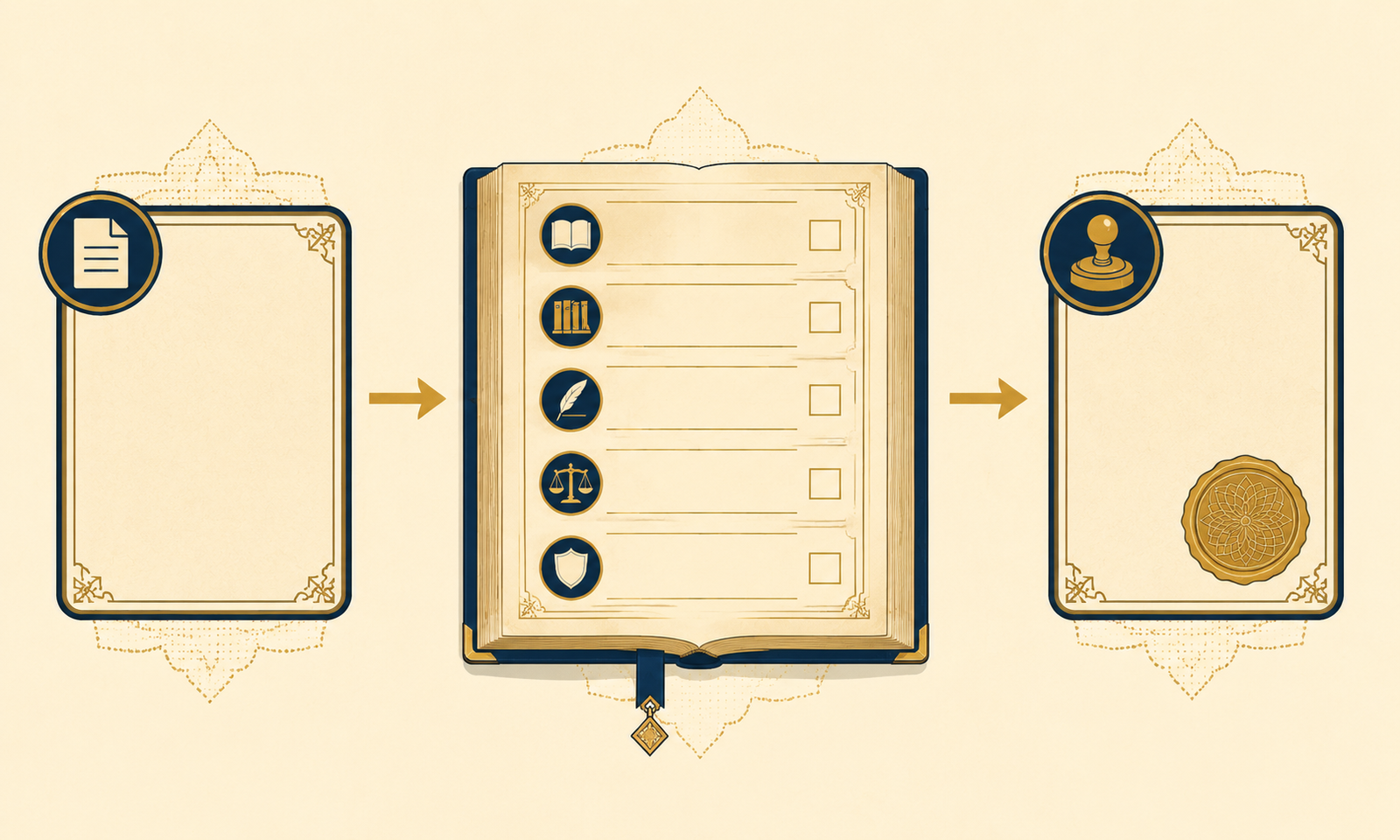
Enter what you have
Type the wording or topic, and any of the narrator, collection, number, or grade you already believe to be correct.
Local cross-check
The engine compares your input against a fixed library of 9 hadith — no external call is made.
Ledger stamped
Each of the five citation fields is stamped confirmed, mismatched, or missing in the verification ledger.
Take the result forward
Copy, print, or download the finished citation — or the “verify before citing” flags if no library match was found.
What should a hadith citation include?
- The wording or translation, clearly marked as a rendering if it is not the certified Arabic text.
- The narrator — the Companion who reported it from the Prophet ﷺ.
- The collection and book, e.g. Sahih al‑Bukhari, Book of Faith.
- The hadith number, so the reference can be looked up in the original.
- The authenticity grade — Sahih, Hasan, or weaker — and ideally who assigned it.
A worked example
Here is what the hadith source checker confirms for three common entries:
| Entered | Ledger Result | Confirmed Reference |
|---|---|---|
| Text: “actions are judged by intentions” | All 5 fields confirmed | Sahih al‑Bukhari 1 · Umar ibn al‑Khattab · Sahih |
| Narrator: Abu Hurairah + claimed grade “Sahih” for the fasting hadith | Text, narrator, grade confirmed | Sahih al‑Bukhari 1894 · Sahih |
| Text: “smiling is charity”, claimed collection “Sahih al‑Bukhari” | Text confirmed; collection flagged mismatch | Jami at‑Tirmidhi 1956 · Hasan |
Built for different uses
Students
Double-check a citation before it goes into an assignment.
Khatibs & Teachers
Confirm a reference is correctly stated before a khutbah or class.
Writers & Editors
Catch a mismatched number or collection before publishing.
New Muslims
Learn what a complete, trustworthy hadith citation actually looks like.
Using a hadith source checker responsibly
Treat a match from this tool as a confirmed citation for the 9 hadith in its library — not as a general authentication service. For any hadith outside that library, the checker can only tell you which citation fields are present, not whether the underlying chain is sound.
For the methodology real hadith specialists use to grade a chain of narration, see Sunnah.com’s explanation of how hadith are verified and referenced, which also documents which of its collections have been fully checked against the printed Arabic text.
Rule of thumb: use this checker to catch an obviously incomplete or mismatched citation quickly, then verify anything you plan to publish or teach against a primary collection.
Common mistakes
The Hadith Source Checker flags each of these before a citation goes into a lesson, khutbah, or article.
Citing a number without the collection
The same number means nothing without naming which book it belongs to — always pair them.
Assuming a well-known saying is Sahih
Some widely repeated lines are weak or fabricated. Popularity is not a grade.
Treating a paraphrase as the Arabic text
An English rendering is a study aid; the ruling authority is the original wording.
Skipping the primary-source check
A confirmed ledger from this tool is a starting point for the 9 hadith it knows, not a substitute for a primary collection.
Frequently asked questions
What is the Hadith Source Checker and how does it work?
It’s a free tool that checks whatever citation details you enter — wording, narrator, collection, number, or grade — against a fixed library of 9 well-established hadith, then stamps each field as confirmed, mismatched, or missing in a verification ledger.
Is this tool connected to a live hadith database or an AI model?
No. It runs a local, rule-based matching engine built into this page — there is no external API call and no AI-generated grading. Every hadith and reference shown was written into the tool in advance.
Does a “confirmed” result mean the hadith is authentic?
It means the citation fields you entered match our library’s record for that hadith, which was selected because it is a well-established Sahih or Hasan hadith. It is not a substitute for a qualified scholar re-verifying the chain of narration.
What happens if my hadith isn’t in the library?
The checker will say so plainly rather than guessing, and will still show you which of the five citation fields you provided are complete — so you know exactly what to look up before citing it.
What do “Sahih” and “Hasan” mean?
Sahih means the hadith’s chain of narration meets the strictest criteria for authenticity. Hasan means the chain is reliable but slightly less strong than Sahih. Both are usable in Islamic scholarship, unlike a Da’if (weak) or Mawdu’ (fabricated) grading.
Can I use this before publishing an article or giving a khutbah?
Yes — that’s exactly what it’s built for. Run your citation through the checker, then cross-verify anything you plan to publish or present against a primary collection.
Check your next hadith citation
Enter what you have, get a stamped verification ledger, and cite with confidence.
Open the Hadith Source Checker ↑