
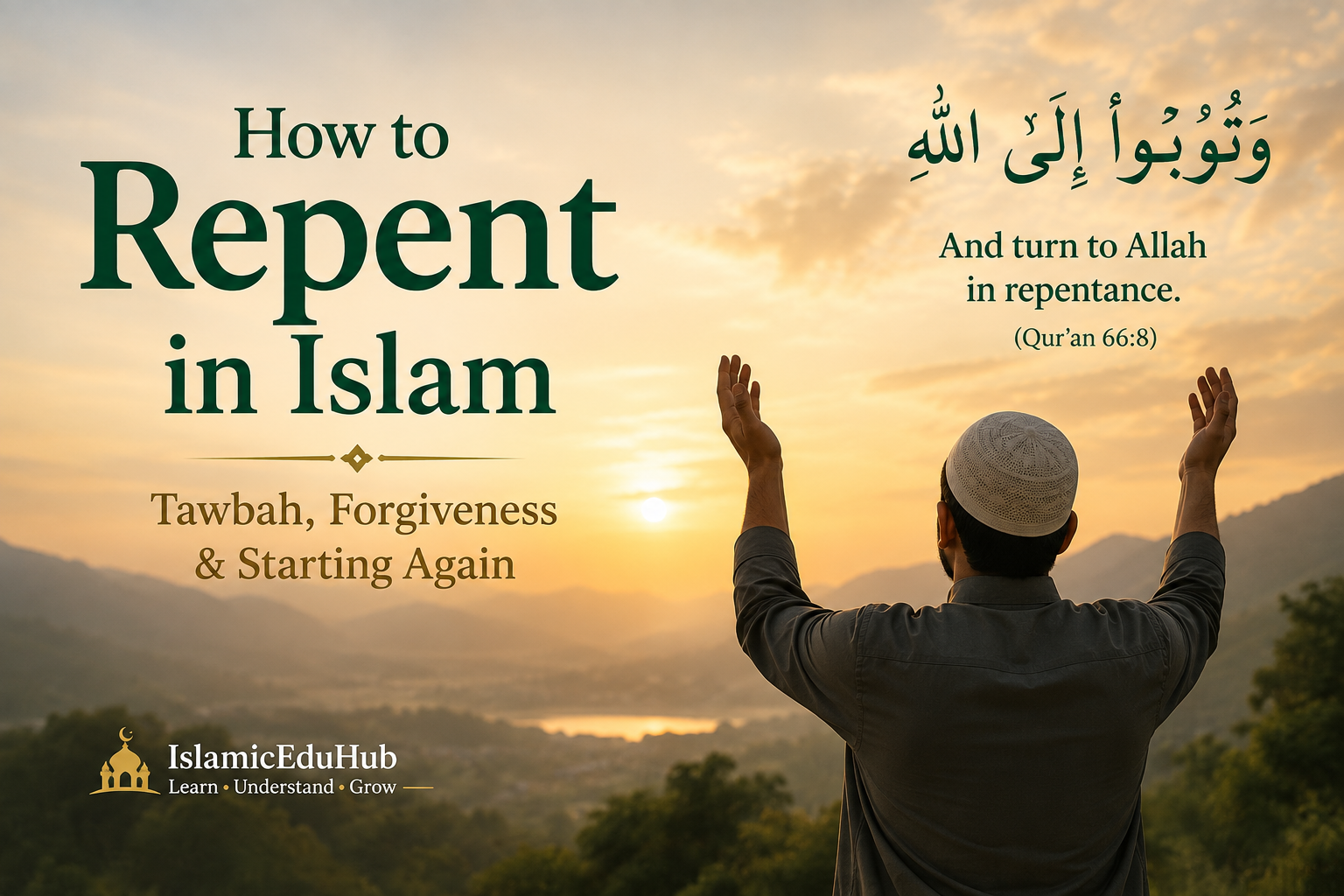
A practical, step-by-step guide to Tawbah (repentance) in Islam — the conditions of sincere repentance, how to pray Salat al-Tawbah, powerful duas for forgiveness, and how to start again after sin without losing hope in Allah’s mercy.
To repent (make Tawbah) in Islam, you sincerely regret the sin, stop doing it immediately, resolve never to return to it, and — if it involved another person’s rights — put that right. You then turn to Allah directly in sincere dua, without any intermediary, asking for forgiveness (istighfar). Many Muslims also pray two voluntary rak’ahs known as Salat al-Tawbah. Allah’s mercy is described in the Qur’an as encompassing all sins for those who turn back to Him sincerely, no matter how great the sin.
In This Guide
- 1. What Is Tawbah (Repentance) in Islam?
- 2. Why Repentance Matters — Allah’s Mercy
- 3. The Conditions of Sincere Tawbah
- 4. How to Repent in Islam: A Step-by-Step Method
- 5. How to Pray Salat al-Tawbah
- 6. Duas & Adhkar for Seeking Forgiveness
- 7. Repenting From Major vs. Minor Sins
- 8. What If I Repeat the Same Sin?
- 9. Possible Signs of Sincere Change After Tawbah
- 10. Common Mistakes People Make When Repenting
- 11. Repentance and the Rights of Other People
- 12. Frequently Asked Questions
Every human being sins — this isn’t a controversial statement in Islam, it’s built into how the Qur’an describes us. What separates a believer from someone lost in wrongdoing isn’t the absence of sin, but the response to it. That response has a name: Tawbah, usually translated “repentance,” though the Arabic word means “to return.” To repent, in the Islamic sense, is to return to Allah.
If you’re reading this because you truly regret something you’ve done, you don’t need to wait until you feel perfect before turning back to Allah.
Whatever brought you here — big or small — this guide walks through how to repent in Islam: what Tawbah requires, how to pray Salat al-Tawbah, and the specific duas the Prophet ﷺ used to seek forgiveness. This follows our earlier guide on How to Make Dua, since Tawbah is, at its core, a form of dua.
1. What Is Tawbah (Repentance) in Islam?
Tawbah (توبة) is usually translated as “repentance,” but the word literally means “to return” or “to turn back.” In the Islamic understanding, sin is seen as a kind of distance a person creates between themselves and Allah. Tawbah is the act of closing that distance — turning away from the sin and turning back toward Allah with sincerity.
This concept appears throughout the Qur’an. Allah says:
“O you who have believed, repent to Allah with sincere repentance. Perhaps your Lord will remove from you your misdeeds and admit you into gardens beneath which rivers flow…” (Qur’an, Surah At-Tahrim, 66:8)
Unlike some religious traditions, Islam does not require a priest, confession booth, or any intermediary for repentance to be valid. A person turns directly to Allah — in private, in their own words, at any time of day or night — and Allah hears them. This directness is one of the most emphasized aspects of Tawbah in Islamic teaching: no one stands between the sinner and their Lord.
Tawbah isn’t reserved for major, dramatic sins — it’s meant to be a daily practice. Hadith narrations report that the Prophet ﷺ himself sought Allah’s forgiveness dozens of times a day, showing that Tawbah is a practice for every believer, not only for those who feel they’ve sinned greatly.
2. Why Repentance Matters — Allah’s Mercy
One of the most common barriers to repentance is not disbelief in Islam, but despair — the feeling that “I’ve done too much wrong” or “Allah won’t forgive something like this.” The Qur’an addresses this feeling directly and firmly discourages it. In one of the most quoted verses on this topic, Allah says:
“Say, ‘O My servants who have transgressed against themselves [by sinning], do not despair of the mercy of Allah. Indeed, Allah forgives all sins. Indeed, it is He who is the Forgiving, the Merciful.'” (Qur’an, Surah Az-Zumar, 39:53)
The verse gives hope to people who have committed serious sins and warns them not to despair of Allah’s mercy. Despairing of Allah’s mercy is itself considered a serious matter, since it underestimates His capacity to forgive.
A well-known hadith Qudsi adds that even sins “as great as the earth” would be met with forgiveness “as great as the earth,” so long as the person seeks forgiveness without associating partners with Allah (Jami’ at-Tirmidhi 3540). Scholars discuss this narration’s exact grading, but its meaning is reinforced by the Qur’anic verses above.
This mercy is also the reason Tawbah isn’t only about wiping out a mistake, it’s one of the clearest ways to get closer to Allah, since turning back to Him sincerely after a sin often leaves a person more attentive to Him than they were before it happened.
3. The Conditions of Sincere Tawbah
Not every expression of regret is complete Tawbah. Classical scholars outline three core conditions for sins between a person and Allah, plus a fourth when another person’s rights are involved.
1. Sincere Regret (Nadam)
The person must sincerely feel regret over having committed the sin — not simply regret being caught, or regret over consequences, but a heartfelt recognition that the act displeased Allah. Many scholars consider this regret to be, in a sense, the core of Tawbah itself — a hadith states that “regret is repentance” (recorded in Sunan Ibn Majah 4252).
2. Immediately Stopping the Sin
A person cannot claim to be repenting from something they are still actively doing. If the sin is ongoing — for example, an unlawful relationship, consuming something forbidden, or a habitual act — it must stop as a practical first step, to whatever extent is within the person’s control.
3. A Firm Resolve Not to Return
The person must sincerely intend not to repeat the sin — not certainty they’ll never slip again, since human weakness is accounted for (see Section 8), but sincerity of intention in the moment.
4. Returning Rights, If the Sin Involved Another Person
If the sin involved wronging another person — taking their money, backbiting them, damaging their reputation, or harming them physically or emotionally — Tawbah requires making things right with that person as well, not only with Allah. This point is significant enough that we cover it in its own section later in this guide.
4. How to Repent in Islam: A Step-by-Step Method
With the conditions understood, here is a practical sequence covering how to repent in Islam, step by step, that many scholars and teachers recommend for someone who wants to repent properly, especially after a specific sin.
- Pause and acknowledge the sin honestly, without minimizing it or making excuses to yourself.
- Make wudu (ablution) if you’re able to. While not strictly required for Tawbah itself, purifying oneself physically before turning to Allah is recommended and mirrors the state one enters before prayer.
- Pray two rak’ahs of Salat al-Tawbah if possible (detailed in the next section). This isn’t obligatory, but it is a Sunnah practice with strong precedent.
- Turn to Allah in your own words, in whatever language you’re most sincere in. Admit the sin specifically (even if only in your heart), express regret, and ask for forgiveness.
- Recite istighfar — “Astaghfirullah” (I seek forgiveness from Allah) — along with any of the specific duas listed in Section 6.
- Take a concrete step away from the sin’s environment where relevant — delete something, end an influence, or change the routine that leads to it.
- If someone else was wronged, take steps to make it right — return what was taken, apologize, or seek reconciliation, as covered in Section 11.
- Follow the sin with a good deed. The Prophet ﷺ advised, “Follow up a bad deed with a good deed which will wipe it out” (recorded in Jami’ at-Tirmidhi 1987). This could be charity, extra prayer, helping someone, or any act of worship or kindness.
5. How to Pray Salat al-Tawbah (The Prayer of Repentance)
Salat al-Tawbah is a voluntary (Sunnah) two-rak’ah prayer performed specifically when a person wants to repent from a sin. It is based on a hadith in which the Prophet ﷺ said that if a person sins, then purifies themselves well, prays two rak’ahs, and then asks Allah for forgiveness, Allah forgives them (recorded in Sunan Abi Dawud 1521 and similarly in Jami’ at-Tirmidhi 406).
How to Pray It
- Make wudu carefully, paying attention to performing it properly and completely.
- Make the intention (niyyah) in your heart to pray two rak’ahs of Salat al-Tawbah — no verbal declaration is required, intention is a matter of the heart.
- Pray two rak’ahs as you would any voluntary prayer — reciting Surah Al-Fatiha and any additional surah or verses you know in each rak’ah.
- After completing the prayer, remain seated or in a position of humility and sincerely ask Allah for forgiveness — using your own words, istighfar, or any of the duas below.
Because Salat al-Tawbah is a voluntary prayer, it should be offered outside the prohibited times for voluntary salah. The exact details of these times can vary by school of Islamic jurisprudence, so if you’re unsure, our guide on how to pray Fajr correctly covers the basics of prayer structure and timing in more depth.
6. Duas & Adhkar for Seeking Forgiveness
Alongside your own personal words, the following duas are drawn directly from the Qur’an and the Sunnah of the Prophet ﷺ, and are commonly recommended for anyone seeking forgiveness.
Sayyid al-Istighfar (The Master of Seeking Forgiveness)
اللَّهُمَّ أَنْتَ رَبِّي لَا إِلَٰهَ إِلَّا أَنْتَ، خَلَقْتَنِي وَأَنَا عَبْدُكَ، وَأَنَا عَلَىٰ عَهْدِكَ وَوَعْدِكَ مَا اسْتَطَعْتُ، أَعُوذُ بِكَ مِنْ شَرِّ مَا صَنَعْتُ، أَبُوءُ لَكَ بِنِعْمَتِكَ عَلَيَّ، وَأَبُوءُ بِذَنْبِي فَاغْفِرْ لِي، فَإِنَّهُ لَا يَغْفِرُ الذُّنُوبَ إِلَّا أَنْتَ
Allahumma anta Rabbi, la ilaha illa anta, khalaqtani wa ana ‘abduka, wa ana ‘ala ‘ahdika wa wa’dika mastata’tu, a’udhu bika min sharri ma sana’tu, abu’u laka bini’matika ‘alayya, wa abu’u bidhanbi faghfir li, fa innahu la yaghfirudh-dhunuba illa ant.
اے اللہ! تو میرا رب ہے، تیرے سوا کوئی معبود نہیں، تو نے مجھے پیدا کیا اور میں تیرا بندہ ہوں، اور میں جہاں تک ہو سکے تیرے عہد اور وعدے پر قائم ہوں، میں اپنے کیے کی برائی سے تیری پناہ مانگتا ہوں، میں تیری نعمتوں کا اعتراف کرتا ہوں اور اپنے گناہ کا اعتراف کرتا ہوں، سو مجھے بخش دے، بے شک تیرے سوا کوئی گناہ نہیں بخشتا
“O Allah, You are my Lord, there is no god but You. You created me and I am Your servant, and I abide by Your covenant and promise as best as I can. I seek refuge in You from the evil of what I have done. I acknowledge Your favor upon me, and I acknowledge my sin, so forgive me, for none forgives sins except You.” — recorded in Sahih al-Bukhari 6306
The Prophet ﷺ called this dua the best form of seeking forgiveness, adding that whoever recites it with certainty and dies before the day or night ends is among the people of Paradise (same narration).
A Qur’anic Dua of Repentance
رَبَّنَا ظَلَمْنَا أَنفُسَنَا وَإِن لَّمْ تَغْفِرْ لَنَا وَتَرْحَمْنَا لَنَكُونَنَّ مِنَ الْخَاسِرِينَ
Rabbana zalamna anfusana wa in lam taghfir lana wa tarhamna lanakunanna minal khasirin.
اے ہمارے رب! ہم نے اپنی جانوں پر ظلم کیا، اور اگر تو نے ہمیں نہ بخشا اور ہم پر رحم نہ کیا تو ہم یقیناً نقصان اٹھانے والوں میں سے ہو جائیں گے
“Our Lord, we have wronged ourselves, and if You do not forgive us and have mercy upon us, we will surely be among the losers.” — Qur’an, Surah Al-A’raf, 7:23
Simple Istighfar
أَسْتَغْفِرُ اللَّهَ
Astaghfirullah
میں اللہ سے بخشش مانگتا ہوں
“I seek forgiveness from Allah.”
This short phrase can be repeated throughout the day, in any spare moment — one of the most accessible forms of ongoing Tawbah. Our complete guide on what Istighfar means covers its benefits and how to build it into a daily habit in more depth. For more on structuring personal dua, see our companion article, How to Make Dua.
7. Repenting From Major vs. Minor Sins
Islamic scholarship generally distinguishes between major sins (kaba’ir) — such as those explicitly warned against with severe consequences in the Qur’an or Sunnah, like major forms of injustice, disbelief, or serious harm to others — and minor sins (sagha’ir), the smaller everyday lapses most people fall into regularly.
| Aspect | Major Sins | Minor Sins |
|---|---|---|
| Basic requirement | Explicit, dedicated Tawbah with full conditions | Some minor sins may be expiated through righteous deeds and acts of worship, while sincere repentance remains important |
| Qur’anic basis | Surah An-Nisa, 4:31 mentions avoiding major sins | Same verse notes minor lapses may be removed by avoiding the major ones |
| Practical approach | Specific, deliberate repentance; may require repairing harm | Regular istighfar, five daily prayers, general good conduct |
Scholars still caution against complacency toward “minor” sins, since repeated small sins can accumulate and affect the heart. The safest approach, modeled by the Prophet ﷺ, is to treat every sin as worth turning back to Allah over.
8. What If I Repeat the Same Sin?
This is one of the most common and most human concerns people have about repentance: “What if I repent, and then fall into the same sin again?” Islam addresses this directly, and with notable compassion.
A hadith describes a man who sinned, asked forgiveness, and was forgiven — then sinned again, asked again, and was forgiven again, repeated several times (Sahih Muslim 2758a). The narration is not permission to deliberately continue sinning. Rather, it describes Allah’s forgiveness for a servant who repeatedly sins and sincerely returns to Him — proof that sincere, repeated returning to Allah keeps His forgiveness available.
Repeating a sin doesn’t mean the earlier Tawbah was invalid — human weakness is acknowledged throughout Islamic teaching. What matters is not giving up: each fall meets the same door — stop, regret, resolve, return. Despair can become a serious barrier to sincere repentance, because it may lead a person to stop turning back to Allah altogether. If this cycle feels tangled up with a broader loss of motivation or connection to your faith rather than just one recurring sin, our guide on how to strengthen weak iman after repentance goes deeper into that underlying struggle.
9. Possible Signs of Sincere Change After Tawbah
No one can be absolutely certain their repentance has been accepted — that knowledge belongs to Allah alone. However, many scholars point to certain signs a person can reflect on, drawn from broader Islamic teaching about spiritual change:
- A noticeable change in behavior — moving away from the sin in practice, not just words.
- A softened heart — increased sensitivity to right and wrong, and discomfort with sin in general.
- Increased devotion — more consistency in prayer, Qur’an, and good deeds following the Tawbah.
- A sense of relief or lightness, rather than lingering guilt used as self-punishment.
- Improved relationships, especially where rights of others were involved and repaired.
Their absence doesn’t mean Tawbah was rejected either — spiritual growth is gradual. The healthiest approach is to keep striving and leave the outcome to Allah, rather than trying to “measure” acceptance. That steady, ongoing effort is really what it means to get closer to Allah: not a single moment of Tawbah, but the consistency that follows it. Our guide on how to become a better Muslim covers practical ways to build that consistency once the immediate sin has been addressed.
10. Common Mistakes People Make When Repenting
Maybe you’ve told yourself you’ll “really” repent once things calm down — after this exam, this deadline, this rough patch. That instinct is common, and it’s usually one of a few patterns rather than a sign anything is fundamentally wrong.
- Waiting for the “right moment.” Some delay Tawbah, planning to repent “properly” later. Islam encourages turning to Allah immediately, since death and future circumstances are unknown.
- Repenting only in words, without changing behavior. Saying “Astaghfirullah” while continuing the sin unchanged does not fulfill the condition of sincerely stopping.
- Excessive self-punishment or despair. Believing one is “too far gone” contradicts the Qur’anic message discussed in Section 2 and can push a person further from faith rather than closer.
- Ignoring the rights of other people. Focusing only on the relationship with Allah while neglecting to repair harm done to another person leaves Tawbah incomplete.
- Isolating from community and worship out of shame — withdrawing from the mosque or fellow Muslims, when returning to worship is actually part of the path back.
11. Repentance and the Rights of Other People
For sins involving a person’s duties toward Allah, sincere Tawbah is essential. When another person’s rights are involved, repentance also requires addressing that person’s right where reasonably possible.
This might mean:
- Returning money, property, or anything taken unlawfully.
- Apologizing sincerely for harm caused — emotional, verbal, or physical.
- Seeking the other person’s forgiveness for backbiting or slander, where telling them directly would not cause further harm (scholars differ on whether disclosure is always necessary, especially if it would create new conflict — in cases of doubt, seeking knowledgeable guidance is recommended).
- If direct restitution is not possible, seek qualified scholarly guidance about the appropriate way to discharge the person’s right.
The Prophet ﷺ warned that on the Day of Judgment, a person’s good deeds may be taken to compensate those they wronged if the matter was never resolved (Sahih Muslim 2581) — one reason resolving human relationships is treated as seriously as the spiritual side of Tawbah.
12. Frequently Asked Questions
1. What does Tawbah mean in Arabic?
Tawbah literally means “to return.” It’s the Arabic term for how to repent in Islam — turning back to Allah after sin through sincere regret, stopping the sin, and resolving not to repeat it.
2. Do I need to confess my sin to an imam or scholar?
No. Islam does not require confession to a religious authority for Tawbah to be valid. A person repents directly to Allah, privately, without any intermediary.
3. Is Salat al-Tawbah obligatory?
No, it is a recommended (Sunnah) voluntary prayer, not an obligation. Tawbah itself — the sincere turning back to Allah — is what’s required; the two-rak’ah prayer is an encouraged practice that can accompany it.
4. Can I repent for a sin I’m not sure was actually a sin?
General istighfar (“Astaghfirullah”) covers uncertainty well — you’re not claiming certainty about the act, only humbly seeking forgiveness. If you’re unsure whether something is sinful, it can help to ask a knowledgeable scholar for clarity.
5. What if I keep committing the same sin over and over?
Keep repenting each time, sincerely. Islamic teaching (see Section 8) shows that repeated sin followed by repeated sincere Tawbah does not exhaust Allah’s mercy, as long as a person keeps returning rather than giving up or growing arrogant.
6. Is there a specific time of day best for Tawbah?
Tawbah can be made at any time. However, the last third of the night is often mentioned as an especially valued time for dua and seeking forgiveness, based on hadith describing Allah’s mercy being particularly near during that time.
7. Can major sins really be forgiven?
Yes. The Qur’an (39:53) states Allah forgives all sins for those who turn to Him sincerely. The one exception classical scholarship notes is dying in a state of shirk without repentance.
8. What if the person I wronged has passed away or I can’t reach them?
If the person has died or cannot be reached, the appropriate way to address the person’s right can depend on what happened. Where restitution is unclear or impossible, consult a qualified scholar for guidance rather than assuming one solution applies to every case.
9. Does Tawbah erase the sin completely?
The Qur’an states that for those who repent, believe, and do righteous deeds, Allah can change their evil deeds into good deeds (Surah Al-Furqan, 25:70).
10. Is it too late to repent if I’ve stopped practicing Islam for years?
No. The invitation to repent (Qur’an 39:53) is open to anyone, at any time, as long as it comes before death and before the specific end-times signs Islamic teaching describes as closing the door of repentance.
11. What’s the difference between Tawbah and Istighfar?
Istighfar (seeking forgiveness) is one part of Tawbah — the verbal/heartfelt request for forgiveness. Tawbah is the fuller process that includes istighfar along with regret, stopping the sin, and resolving not to return to it. Our guide to Istighfar covers this distinction in more depth.
12. How many times should I say “Astaghfirullah”?
There is no fixed obligatory number. A person may seek Allah’s forgiveness frequently throughout the day, following the Prophet’s ﷺ own reported practice of regular istighfar.
Ready to Build on This?
Repentance is not the end of a story — it’s often the beginning of a stronger one. Whatever led you to search for this guide, know that the door back to Allah remains open, and sincere effort is what’s asked of you, not perfection. The real work now is learning how to become a better Muslim through consistent change, one small habit at a time, rather than a single dramatic turnaround.
Last updated: September 2026
Update note: removed inline share-link script (converted to static links), added Get Closer to Allah, Istighfar, Weak Iman, Become a Better Muslim and Learn Islam Properly links, expanded Continue Learning, added a two-option closing CTA
Sources: Qur’an and authentic hadith collections (see in-text references above)
Found an error? Contact IslamicEduHub · Follow us on Facebook