
Knowing how to read the Quran correctly is one of the most important goals for every Muslim. This complete beginner’s guide explains how to read the Quran correctly using authentic Islamic guidance, Tajweed basics, and practical step-by-step learning.
Maybe you just took your Shahada last month. Maybe you grew up hearing the Quran playing softly in the background of your childhood home but never actually opened the Mushaf yourself. Or maybe you’ve been reciting for years, quietly worried you’ve been mispronouncing the same letters since you were seven. Wherever you’re starting from — you are not behind. You are exactly where every Hafiz, every Qari, and every scholar once stood: at the very beginning, unsure of the first letter.
When we first started helping beginners learn how to read the Quran correctly, one pattern showed up again and again: almost everyone wanted to jump straight into a long Surah before they had fully mastered the individual Arabic letters. It felt natural — reading a whole page feels like “real progress,” while sitting with the alphabet for a week feels slow. But over dozens of students, the ones who slowed down at the very beginning were consistently the ones who read more fluently, and with fewer bad habits, six months later. That single observation shapes almost everything in the guide below.
This guide is written for that exact starting point. No assumed knowledge, no rushed shortcuts — just a clear, honest, step-by-step path to reading the Quran correctly, built around authentic Quranic guidance, verified Hadith, and the writings of classical scholars who dedicated their lives to exactly this subject.
How to Read the Quran Correctly: Quick Answer
To read the Quran correctly: (1) purify your intention, (2) learn the Arabic alphabet and Makhraj, (3) study basic Tajweed rules, (4) work through a Noorani Qaida before the full Mushaf, (5) practice daily with short Surahs, and (6) get real-time correction from a qualified teacher. Most beginners can read connected Quranic text within 2–3 months of consistent daily practice, with stronger fluency developing over 6–12 months.
Why Reading the Quran “Correctly” Actually Matters
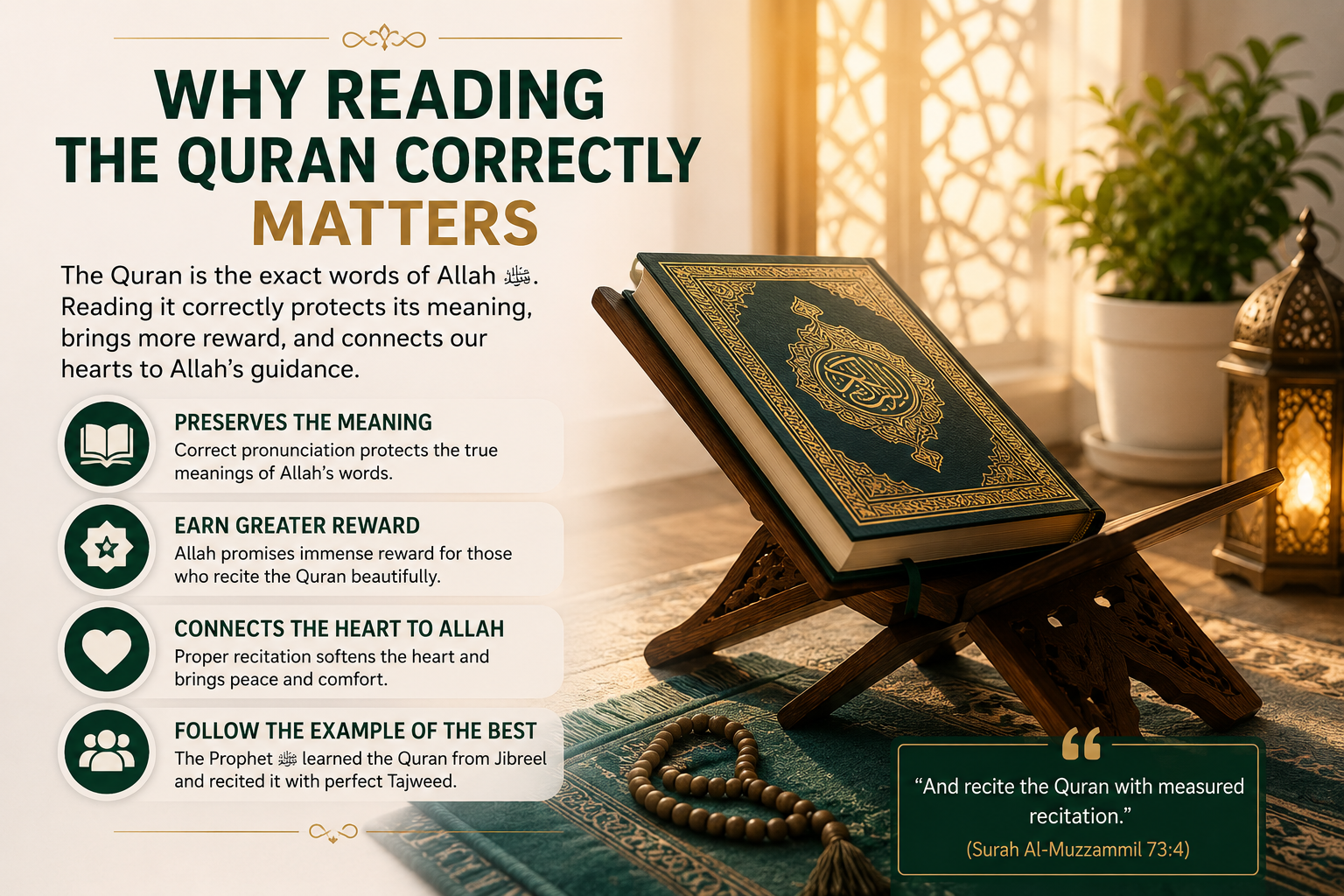
Some people ask, honestly, “Isn’t sincerity enough? Why does pronunciation matter so much when learning how to read the Quran correctly?” It’s a fair question — and Allah answers it directly, in His own words, rather than leaving it to scholars to debate.
Classical commentators such as Ibn Kathir explain this instruction plainly in his Tafsir Ibn Kathir: Allah is not asking for speed. He is asking for tarteel — reading slowly and clearly, giving every letter its rightful place, so the heart has time to absorb what is actually being said. This measured style is what allows a reciter to reflect on the meaning rather than racing past it without absorbing a single word. Imam As-Sa’di makes a similar point in Tafsir As-Sa’di, noting that tarteel is what turns recitation into genuine reflection (tadabbur) rather than mere sound.
Imam An-Nawawi goes even further in his dedicated work on Quran etiquette, At-Tibyan fi Adab Hamalat al-Quran (“The Clarification on the Etiquette of the Carriers of the Quran”). He emphasized that learning how to read the Quran correctly, with proper etiquette, is among the greatest acts of worship a Muslim can undertake, and devoted an entire book to the manners, preparation, and precision expected of anyone approaching the Quran.
“It is recommended for the reciter of the Quran to recite it with tarteel (careful, measured recitation), whether he is praying or not… for this is more befitting of reverence and more effective in reflection.”
And in case anyone feels intimidated by the size of that goal, Allah gives an immediate reassurance elsewhere in the Quran:
Read that twice if you need to. Allah Himself describes the Quran as made easy. Not effortless — but not out of reach either. Learning how to read the Quran correctly, then, isn’t a technicality reserved for the gifted. It’s a door Allah has deliberately left open for you.
Quran Learning in 2026 — What the Data Shows
The global Muslim population has grown substantially over the past decade. Pew Research Center reported in 2025 that the global Muslim population grew from roughly 1.6 billion in 2010 to 1.9 billion in 2020 — a 21% increase — and by 2025 estimates put the global Muslim population at approximately 2 billion people, around a quarter of the world’s population.
Interest in learning how to read the Quran correctly specifically is also visible online. A late-2025 study on religion and digital search behaviour found that Islamic teaching-related searches were among the highest-volume religious search categories worldwide, with millions of people searching specifically for Quran-related content every month.
Online Quran education accelerated sharply after mosque and Islamic-school closures during the pandemic pushed many students toward live online classes for the first time — a shift that, for many beginners, has stayed permanent because of the flexibility it offers.
Figures above are drawn from Pew Research Center demographic reporting and independent 2025–2026 digital search studies. See the Sources Used section for full attribution.
What this tells a beginner is simple: you are joining a genuinely large, active, global community of people learning how to read the Quran correctly right now — not a small or shrinking group. Whatever pace you’re starting at, you have far more company than it might feel like from your own room.
9 Steps to Learn Quran Reading From Zero
Step 1: Purify Your Intention (Niyyah) Before You Begin
The first step in how to read the Quran correctly has nothing to do with letters at all. Before you open the Mushaf for the first time, pause. Ask Allah sincerely to make this easy for you, and remind yourself why you’re doing this — not to impress anyone, not to race through a checklist, but to actually meet His words. This one mental shift changes everything about how patient you’ll be with yourself when a single letter refuses to come out right on the tenth attempt.
Imam An-Nawawi opens At-Tibyan by stressing that the reciter should approach the Quran the way one approaches speaking directly with Allah — with humility, presence of heart, and freedom from distraction — because the outward correctness of the letters is meant to reflect an inward sincerity, not replace it.
Step 2: Learn the Arabic Alphabet (Huroof) First
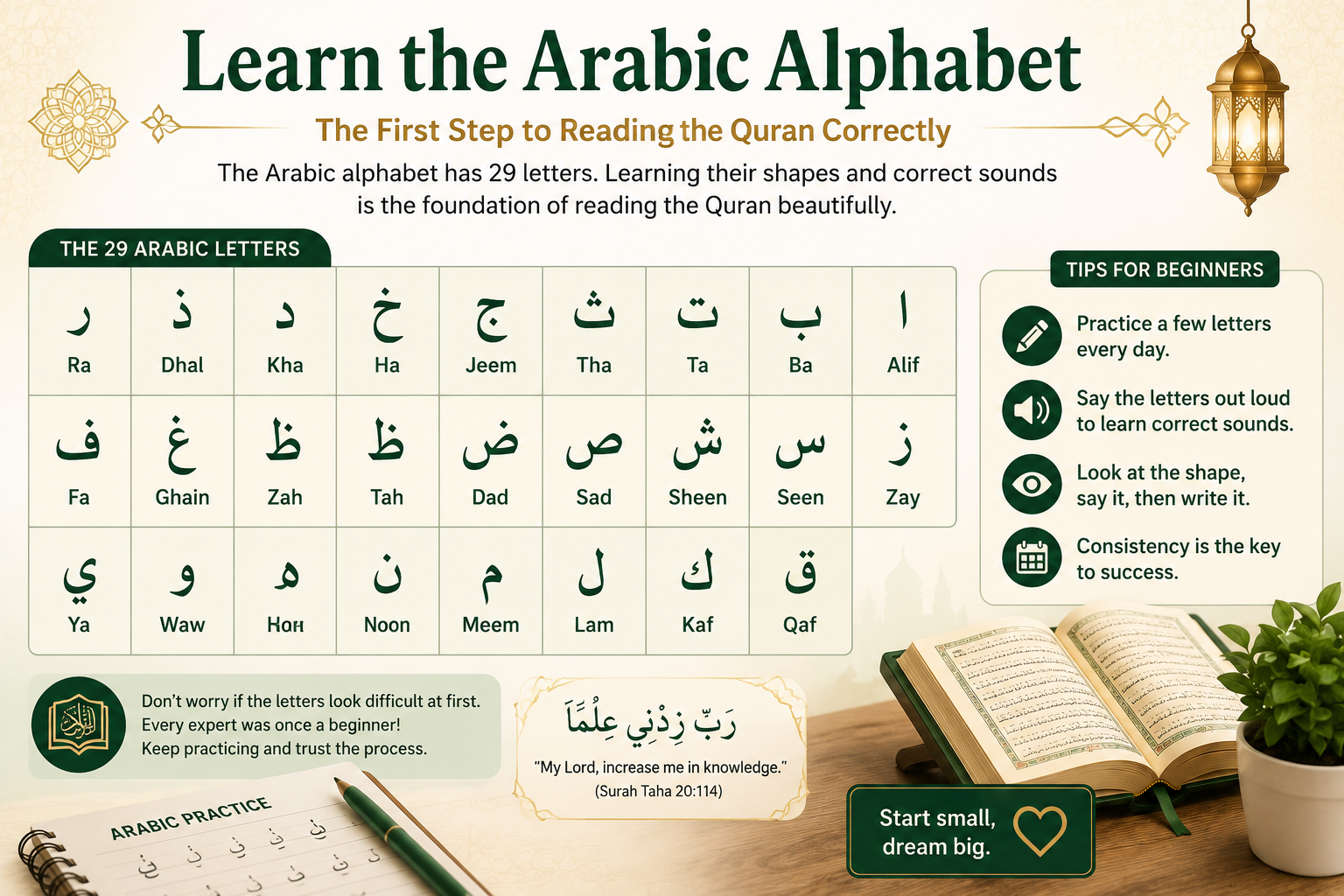
You cannot skip this step, no matter how tempting it is to jump straight to a Surah. Arabic has 28 letters, and each one has its own shape, sound, and behaviour depending on where it sits in a word — beginning, middle, or end.
- Learn to recognise each letter in isolation before anything else.
- Then learn how the same letter changes shape once it’s connected to others.
- Practise writing them by hand — this cements recognition far faster than reading alone.
- Don’t move on until you can identify every letter instantly, without stopping to think.
Most beginners need one to three weeks of short, daily practice for this stage. There is no prize for rushing it, and every hour spent here saves you months of frustration later. In our own experience working with new students, the single biggest predictor of a smooth Qaida stage was simply whether someone had truly finished this step first, rather than moved on at the “good enough” point.
Step 3: Understand Makhraj — Where Each Letter Comes From
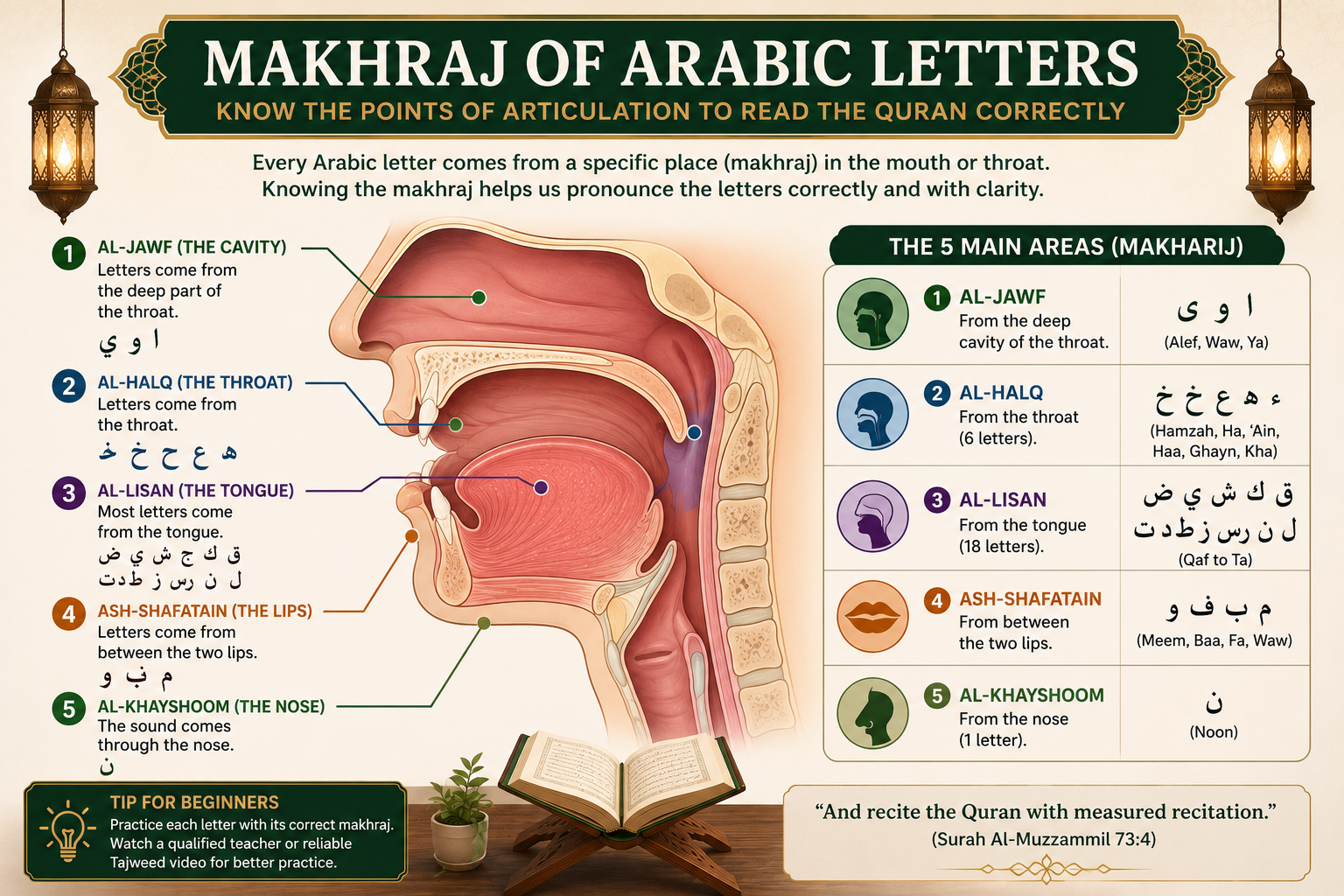
This is the step most self-taught readers skip entirely, and it’s exactly why so many adults recite for decades with the same mispronunciations nobody ever corrected. Makhraj is the precise point in the mouth or throat where a letter’s sound is produced — deep in the throat, against the teeth, from the lips, and so on.
Take ح (Haa) and ه (Ha) as an example. To an untrained ear they sound almost identical, yet they come from two completely different points in the throat — and mixing them up can quietly change the meaning of a word. This is exactly why listening and repeating after a qualified teacher matters more than any transliteration ever could.
Imam An-Nawawi devotes an entire chapter of At-Tibyan to the importance of correcting pronunciation with a teacher rather than relying on self-study alone, precisely because errors in Makhraj are very difficult to hear in one’s own voice.
Step 4: Learn the Basic Rules of Tajweed
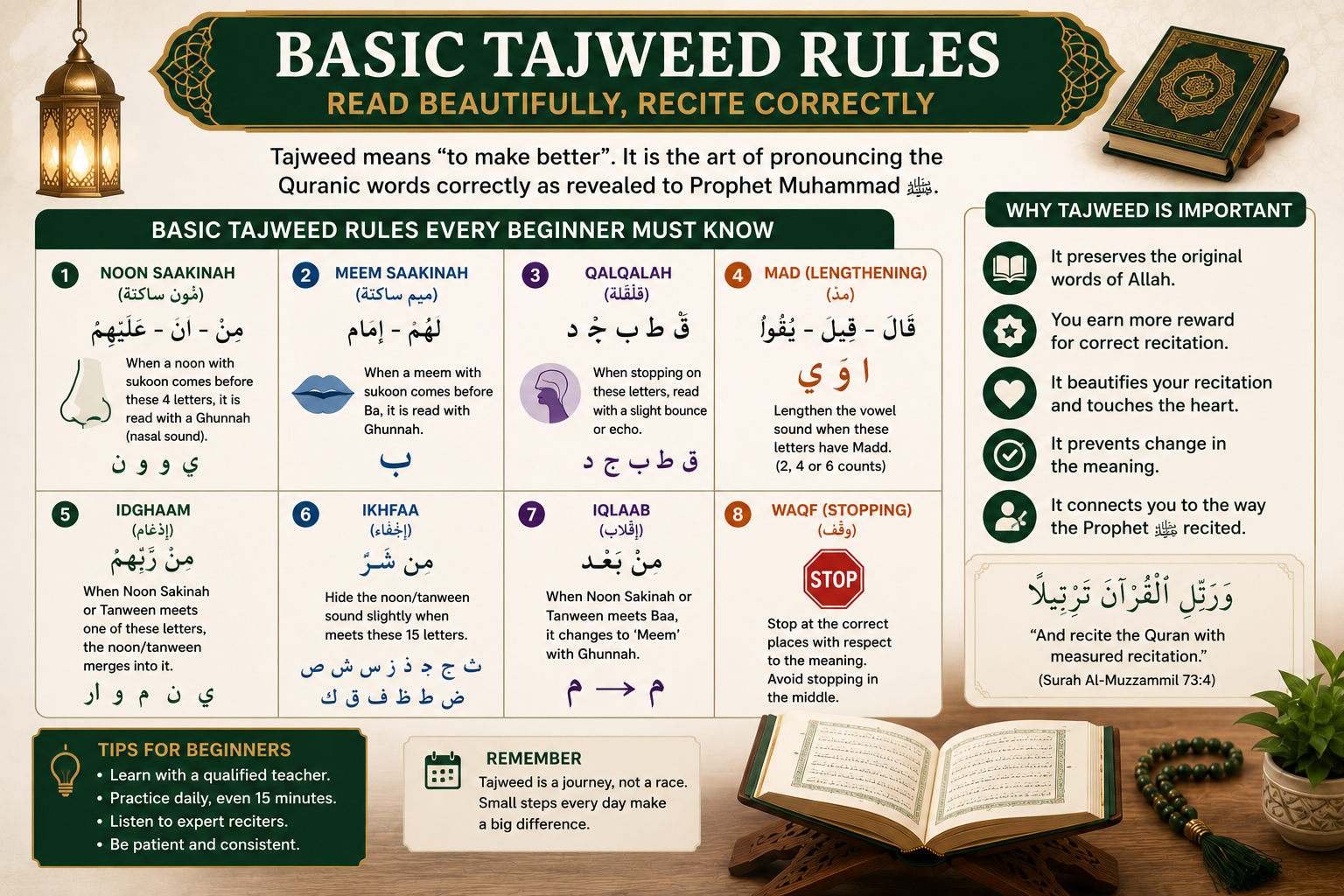
Tajweed is simply the rulebook for correct Quranic pronunciation: when to lengthen a sound (Madd), when to merge two letters together (Idgham), when to give a nasal sound (Ghunnah), and when to stop with a slight bounce (Qalqalah). You don’t need to master every rule on day one — start with these four:
- Noon Sakinah and Tanween rules — how the “n” sound behaves before different letters.
- Meem Sakinah rules — the equivalent behaviour for the “m” sound.
- Madd (elongation) — knowing when to stretch a vowel for 2, 4, or 6 counts. Our full Tajweed rules guide breaks each of these down individually with audio examples.
- Qalqalah letters — the five letters (ق ط ب ج د) that carry a slight “bounce” when they hold a sukoon.
Think of Tajweed as grammar for recitation. It doesn’t need to be flawless on your first attempt — it needs to be learned, one rule at a time, with honest repetition.
Step 5: Start With Noorani Qaida, Not the Full Mushaf
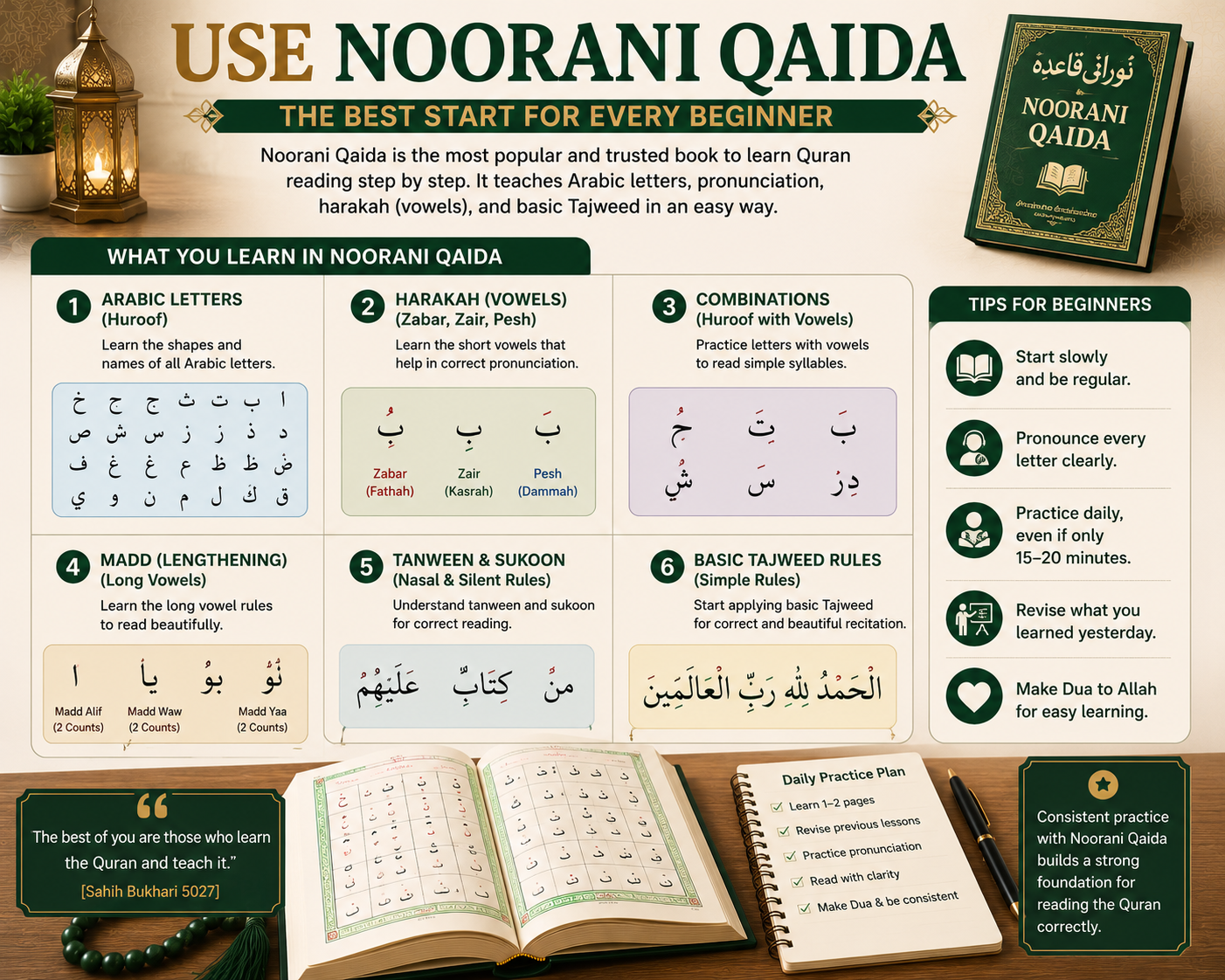
One of the most common mistakes beginners make is opening a full copy of the Quran on day one. Instead, start with a Noorani Qaida (or a similar beginner primer) — our Noorani Qaida beginner guide walks through each lesson in order. It exists specifically to bridge the gap between “I know the alphabet” and “I can read connected Quranic text,” using short, deliberate drills that build up gradually. Skipping this step is a bit like trying to read a novel before you’ve ever practised a full sentence.
Step 6: Practice With Short Surahs Daily
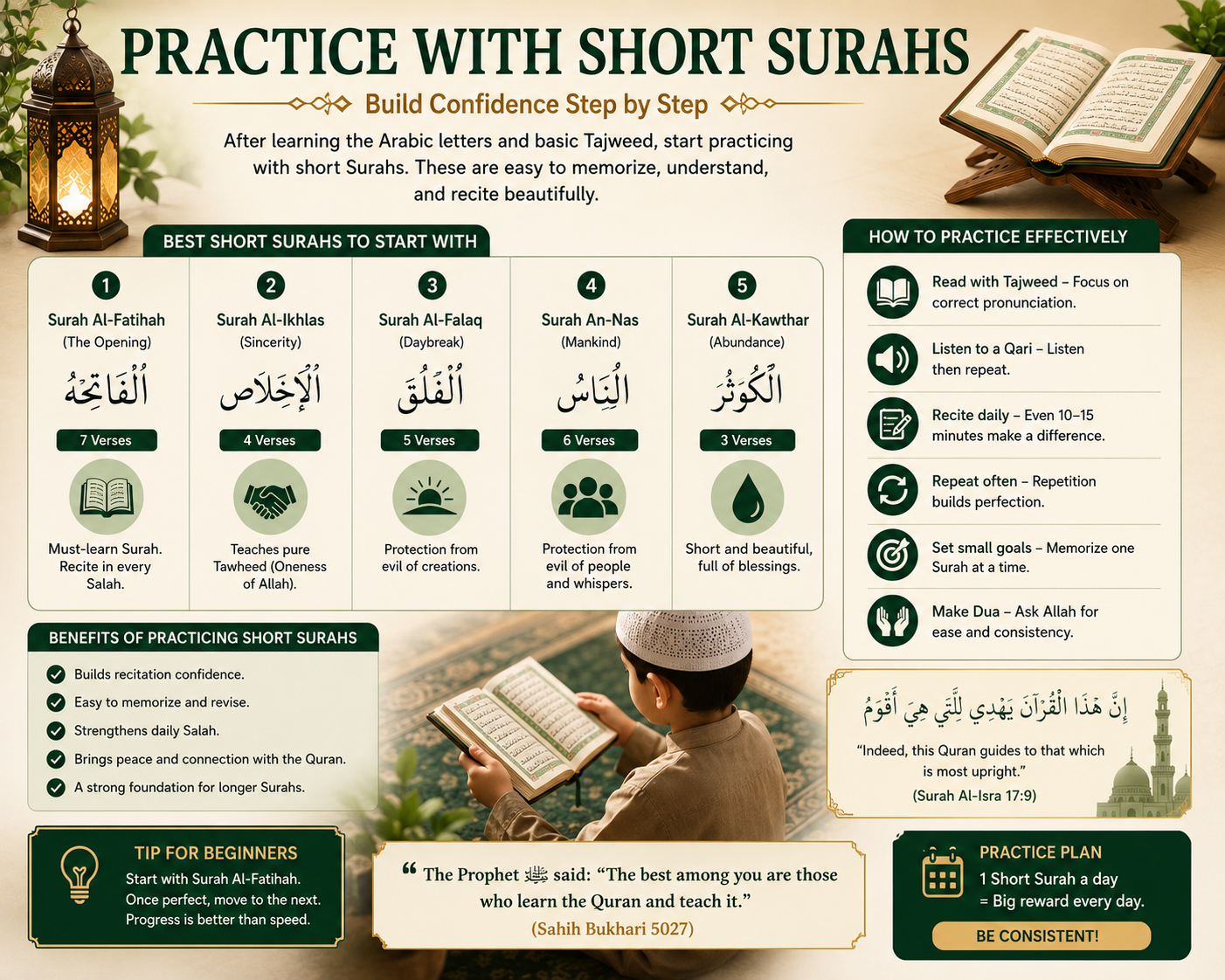
Once you’ve completed a Qaida, move to the short, familiar Surahs near the end of the Quran — Al-Ikhlas, Al-Falaq, An-Nas, and Al-Fatihah. These are recited in every single prayer, which means you get built-in, daily repetition without extra effort. Read the same few lines slowly for several days before moving forward. Repetition — not speed — is what quietly builds real fluency. Our detailed breakdown of Surah Al-Fatihah, verse by verse is a useful companion for this stage, as is our guide to the last three Surahs of the Quran.
Step 7: Learn With a Qualified Teacher
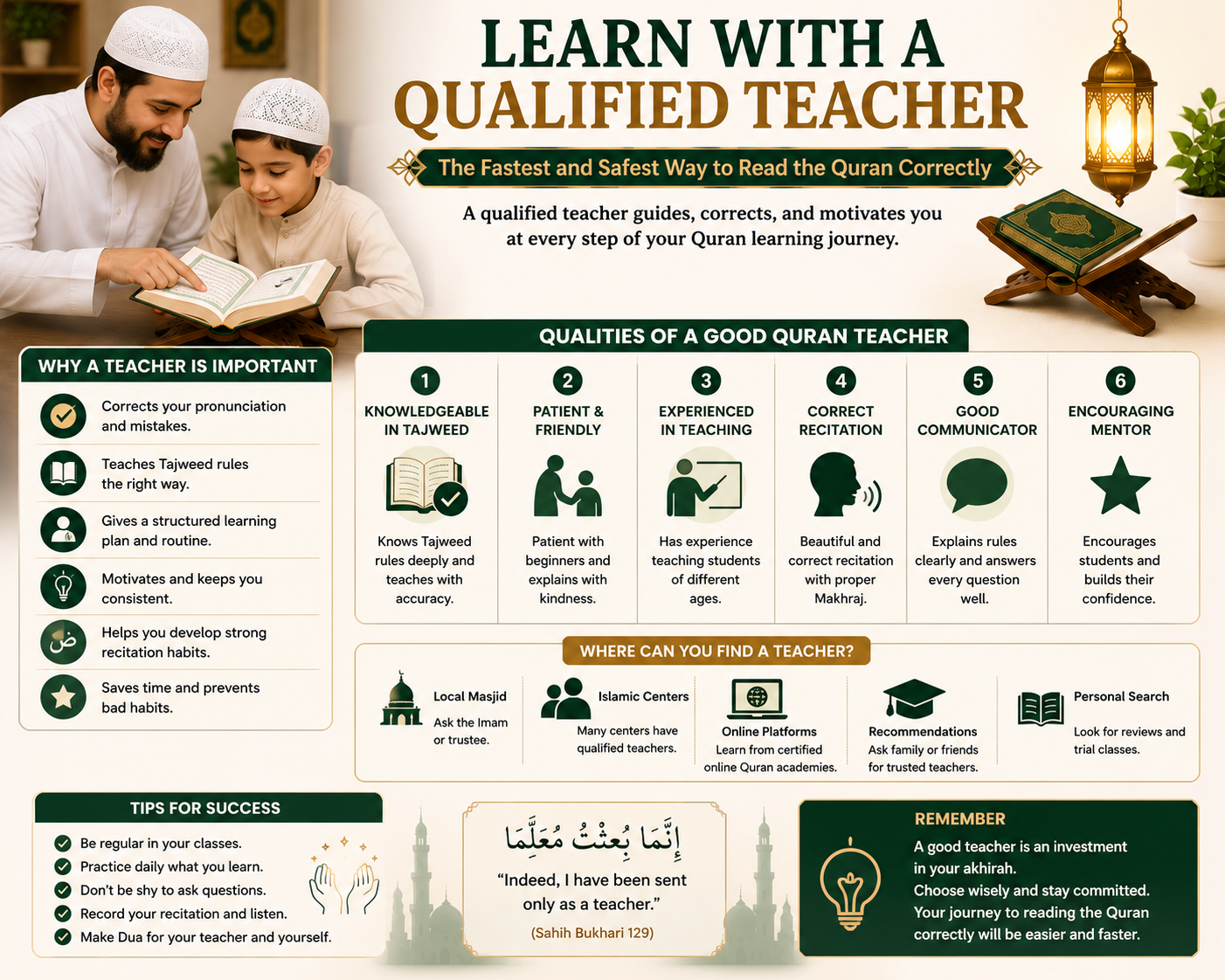
Apps and videos are genuinely useful supplements, but they cannot hear you and correct you in real time. A teacher — in person or through a live online Quran class — can catch the exact moment your tongue placement is off and fix it before it turns into a lifelong habit. This one factor is the biggest predictor of whether someone is reading the Quran accurately five years from now, or still quietly repeating the same mistake they started with.
Imam An-Nawawi was explicit on this point too: he considered learning directly from a qualified teacher, whose own chain of recitation traces back correctly, to be essential rather than optional — because the Quran was transmitted orally, letter by letter, and self-correction alone cannot fully replace that chain.
Step 8: Listen to Qualified Qaris and Shadow Their Recitation
Pick one or two reciters known for clear, measured Tajweed rather than fast recitation styles. Listen to a short passage, pause, and repeat it aloud yourself — a technique often called “shadowing.” Your ear will start recognising correct pronunciation long before your tongue can consistently reproduce it, and that gap is completely normal. Don’t let it discourage you.
Step 9: Learn the Meaning As You Read (Tafsir)
Correct pronunciation opens the door — understanding is what actually transforms you once you’re through it. As your recitation strengthens, begin pairing each Surah with a simple, plain-language tafsir guide so you know exactly what you’re reciting. Two classical works worth knowing about, even as a beginner, are Tafsir Ibn Kathir and Tafsir As-Sa’di — both are available in accessible English translations and are widely recommended as reliable starting points for lay readers moving beyond pronunciation into meaning.
And in case you ever feel like a single letter you struggled with “doesn’t count,” listen to what the Prophet ﷺ said about it:
“Whoever recites a letter from the Book of Allah will be credited with a good deed, and a good deed gets a ten-fold reward. I do not say that Alif-Lam-Mim is one letter, but Alif is a letter, Lam is a letter, and Mim is a letter.”
Now picture that reward multiplied even further once you understand the meaning behind what you’re saying. Imam An-Nawawi also collects a related narration in his companion work Riyad us Saliheen, in the chapter on the virtues of the Quran, reinforcing the same idea from a different angle: reward is tied to sincere effort at every stage, not only to fluent completion.
Common Mistakes Beginners Make
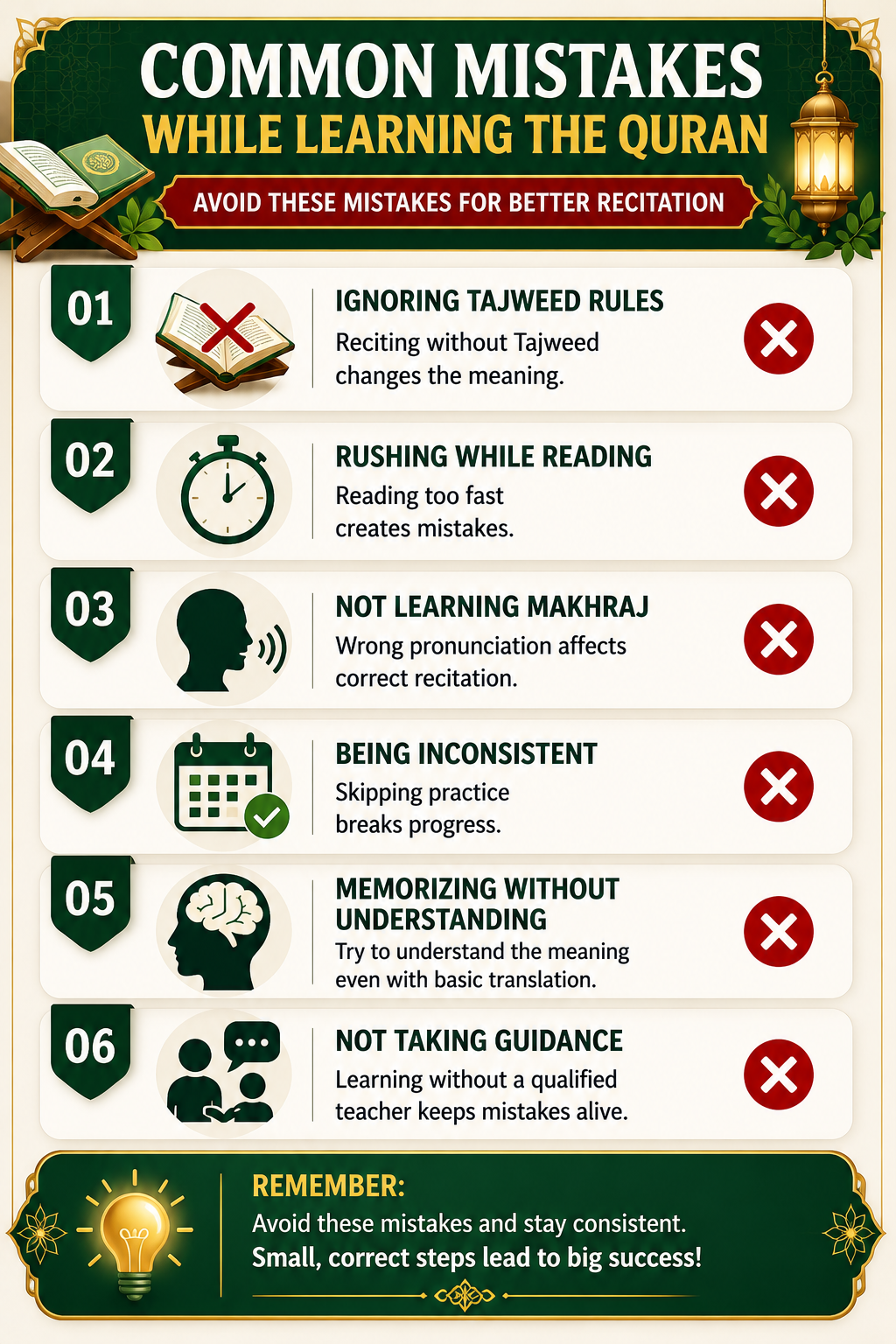
Even sincere beginners trying to learn how to read the Quran correctly tend to repeat the same handful of avoidable mistakes:
- Skipping the alphabet stage to “save time,” then quietly struggling with basic letters for years.
- Reading only transliteration (Arabic sounds written in English letters) instead of the actual Arabic script — this locks in bad pronunciation habits early.
- Rushing through Tajweed rules instead of practising each one until it becomes natural.
- Comparing themselves to fluent reciters and giving up out of discouragement.
- Learning entirely alone, with no teacher to catch pronunciation errors before they set in.
- Inconsistent practice — ten focused minutes daily will always outperform two rushed hours once a week.
The Reward of Learning to Read the Quran — Even Imperfectly
If part of you is worried that struggling through your letters somehow makes your effort worth less, this authentic Hadith should put your heart completely at ease:
Aisha (may Allah be pleased with her) reported that the Prophet ﷺ said: “The one who is proficient in reciting the Qur’an will be with the noble, righteous scribes (the angels), and the one who reads it and stumbles over it, finding it difficult, will have a double reward.”
Read that again, slowly. Struggling through your recitation as a beginner doesn’t lower your reward — Allah has made it double. Every letter you correct after getting it wrong, every session you show up for despite feeling clumsy and slow, is being counted, not overlooked.
The Prophet ﷺ also described the effect that regular recitation has on your own home:
“Do not turn your homes into graveyards. Indeed, Shaytan flees from the house in which Surat Al-Baqarah is recited.”
And for those who commit to this path and later go on to help someone else walk it too, the Prophet ﷺ gave this simple, profound praise:
“The best among you are those who learn the Qur’an and teach it.”
This same narration appears in Imam An-Nawawi’s Riyad us Saliheen in the opening chapter on the virtues of Quran recitation and teaching, where he groups it alongside several related Hadith encouraging both learning and passing the Quran on to others — worth reading in full if you want a broader picture of how central this act of worship is considered.
Tools and Resources to Support Your Learning in 2026
These are the tools that make the biggest practical difference once you’re actively practising how to read the Quran correctly:
- A Mushaf with colour-coded Tajweed rules — helps you visually recognise elongation, merging, and nasalisation marks at a glance.
- A live online Quran teacher or local mosque class — for real-time correction that recordings alone can’t give you. See our guide to choosing an online Quran tutor.
- Recordings from reciters known for clear, measured Tajweed — for daily listening and shadowing practice.
- A simple tafsir in your own language, such as an accessible edition of Tafsir Ibn Kathir or Tafsir As-Sa’di — to pair meaning with pronunciation as you progress.
- A dedicated notebook — to track which Surahs and rules you’ve practised each week, so progress feels visible. Our printable Quran learning tracker is built exactly for this.
A Simple 30-Day Starter Plan
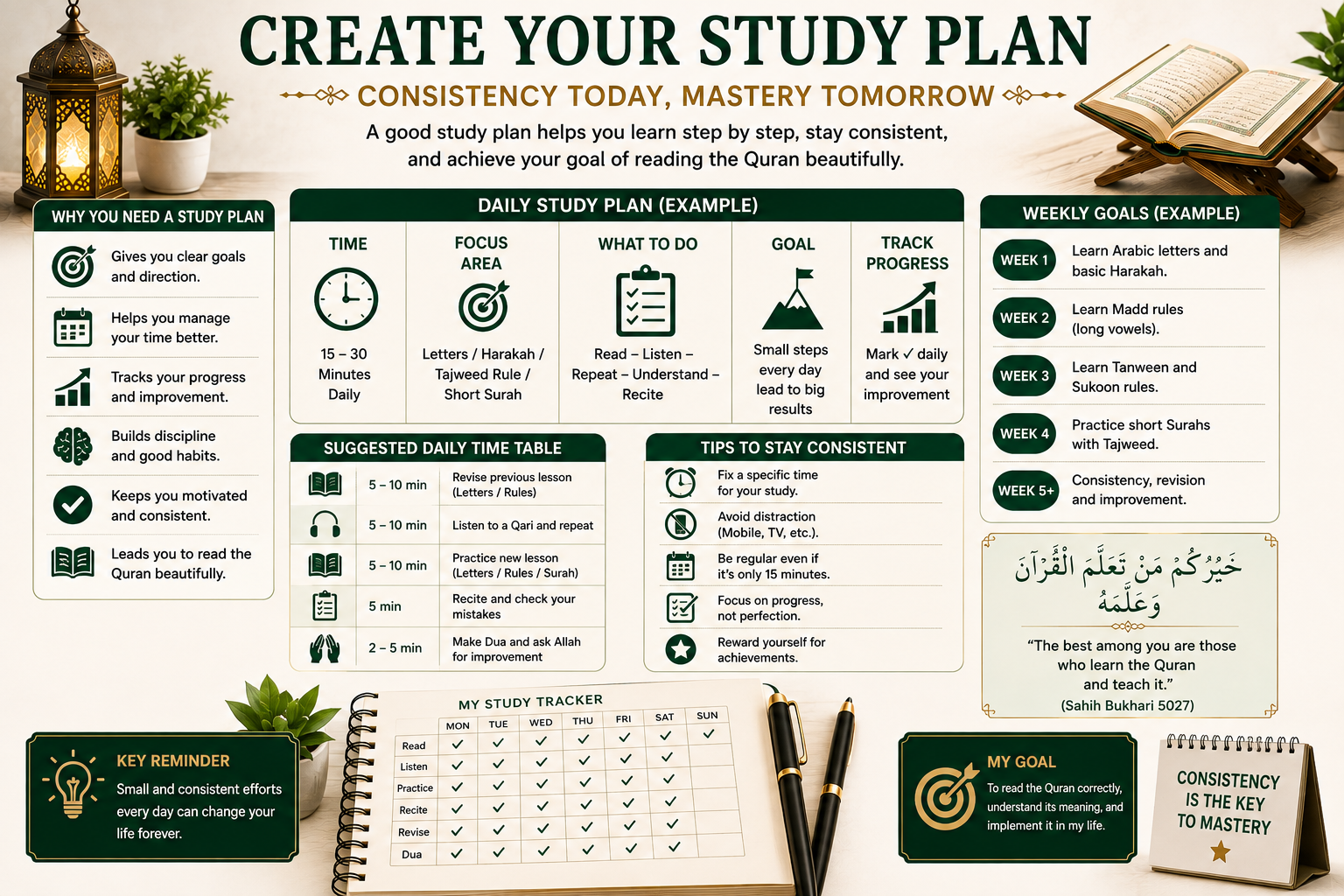
Here is exactly how those steps for how to read the Quran correctly fit into a simple 30-day starter schedule:
| Days | Focus |
|---|---|
| 1–7 | Master the Arabic alphabet — shapes, sounds, and handwriting practice |
| 8–14 | Learn connected letter forms and begin Noorani Qaida |
| 15–21 | Introduce basic Tajweed rules (Noon Sakinah, Madd, Qalqalah) |
| 22–26 | Apply everything to Surah Al-Fatihah and the last three Surahs |
| 27–30 | Review with a teacher, correct mistakes, and lock in a daily recitation habit |
For a longer-range version of this same approach, see our 90-day Quran memorisation and recitation plan, which picks up right where this 30-day plan ends.
Frequently Asked Questions
A few more questions beginners commonly ask about how to read the Quran correctly:
Can I learn to read the Quran correctly without a teacher?
You can begin on your own using a Qaida and quality recordings, but a qualified teacher is strongly recommended for correcting Makhraj and Tajweed mistakes you genuinely cannot hear in your own recitation. Imam An-Nawawi’s At-Tibyan treats this as close to essential rather than optional, given how the Quran was transmitted.
How long does it take to learn to read the Quran fluently?
This varies by person, but with consistent daily practice, most beginners can read basic connected text within 2–3 months and build stronger fluency and Tajweed accuracy over 6–12 months.
Do I need to know Arabic to read the Quran?
You don’t need conversational Arabic to recite correctly — you need to recognise the letters and Tajweed rules. Understanding the meaning, through tafsir such as Tafsir Ibn Kathir or Tafsir As-Sa’di, is a separate and equally valuable step you can build alongside it.
Is it a sin to mispronounce words while learning?
No. As shown in the authentic Hadith above, a struggling beginner is promised a double reward for the effort itself. What matters is sincere effort and steady improvement, not instant perfection.
What is the difference between Tarteel and Tajweed?
Tajweed is the set of technical rules for correct pronunciation. Tarteel is the broader command to recite slowly, clearly, and reflectively — Tajweed is one of the main tools that helps you actually achieve Tarteel.
Which Surah should a beginner start with?
Surah Al-Fatihah, followed by the last three short Surahs of the Quran (Al-Ikhlas, Al-Falaq, An-Nas), since these are recited in daily prayer and reinforce learning through natural, built-in repetition.
What books besides the Quran and Hadith are useful for a beginner?
Imam An-Nawawi’s At-Tibyan fi Adab Hamalat al-Quran is specifically about the etiquette of learning how to read the Quran correctly and is a natural next read. His Riyad us Saliheen is useful for the surrounding virtues and motivation. For meaning, an accessible edition of Tafsir Ibn Kathir or Tafsir As-Sa’di is a reliable, widely recommended starting point.
Final Thoughts
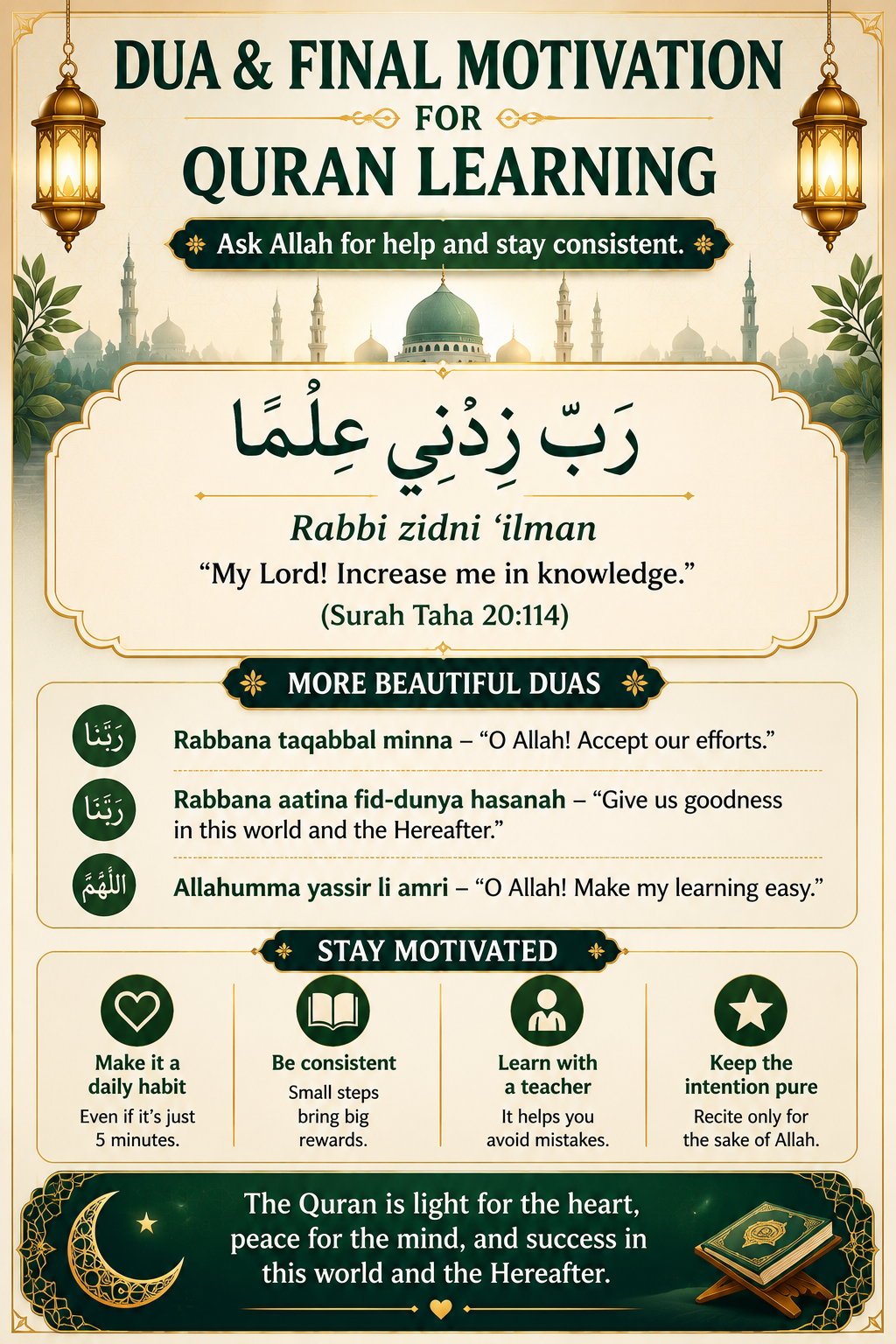
Every Hafiz, every Qari, every scholar you admire once sat exactly where you are now — unsure of a letter, mixing up a Tajweed rule, reading slower than they wished they could. What separated them from everyone who gave up wasn’t talent. It was that they kept showing up, one letter, one verse, one Surah at a time.
Start today, even if it’s only five minutes with the alphabet. Ask Allah to make it easy for you — He has already promised that the struggling reciter is doubly rewarded. That promise is yours the moment you begin, and it’s the whole reason this guide exists: to make how to read the Quran correctly feel achievable, one small step at a time.
Ready for the next step?
If this guide helped you understand how to read the Quran correctly, continue with our Tajweed rules guide, or book a free trial with one of our online Quran teachers to get real-time correction on your recitation.
Read Next: Tajweed Rules for Beginners → (coming soon)Sources Used in This Article
- The Noble Quran — Surah Al-Muzzammil (73:4), Surah Al-Qamar (54:17) — Quran.com
- Sahih al-Bukhari 4937 — Sunnah.com
- Sahih Muslim 798 — Sunnah.com
- Sahih al-Bukhari 5027 — Sunnah.com
- Sahih Muslim 780 — Sunnah.com
- Sunan al-Tirmidhi 2910 — Sunnah.com
- Imam An-Nawawi, At-Tibyan fi Adab Hamalat al-Quran (etiquette of learning and reciting the Quran)
- Imam An-Nawawi, Riyad us Saliheen (chapters on the virtues of the Quran)
- Ibn Kathir, Tafsir Ibn Kathir, commentary on Surah Al-Muzzammil
- Abd al-Rahman As-Sa’di, Tafsir As-Sa’di, commentary on tarteel and reflection in recitation
- Pew Research Center, 2025 report on global Muslim population growth (2010–2020) — pewresearch.org
- IslamQA.info — for further reading on rulings related to Quran recitation
- Yaqeen Institute — for further reading on Quranic studies and contemporary research