
Everything you need before enrolling in online Quran classes — what 1-to-1 lessons actually include, how to choose a qualified Quran teacher, what classical scholars say about learning the Quran, and how to keep going once the first month’s motivation fades. Whether you’re a parent looking for a qualified Quran teacher or an adult beginning your Quran journey, this guide will help you make the right choice with confidence.
The best online Quran classes for kids and adults are 1-to-1, taught by an Ijazah-holding teacher, and include live Tajweed correction, structured Hifz revision, and flexible scheduling. A short paid trial class — not a sales call — is the single best way to judge fit before enrolling a child or starting as an adult beginner.
In This Guide
- Benefits of Online Quran Classes
- What Makes 1-to-1 Online Quran Classes Different
- What You Actually Learn in Online Quran Classes
- Online Quran Classes for Kids vs. Online Quran Classes for Adults
- How to Choose the Right Online Quran Classes
- What a Typical Online Quran Class Looks Like
- Comparing Common Course Tracks
- Mistakes Parents Make When Enrolling Kids
- Online Quran Classes vs. the Traditional Madrassa
- What Classical Scholars Say About Learning the Quran
- Getting Real Progress: Practical Tips
- How to Tell If Real Progress Is Actually Happening
- People Also Ask
- Online Quran Classes FAQ
A few years ago, “online Quran classes for kids and adults” usually meant a shaky video call, a teacher reciting into a phone propped against a stack of books, and a connection that dropped every ten minutes. Sometimes it worked out fine. Often it didn’t, and families quietly went back to searching for a local teacher instead.
That picture has changed a lot. Proper online Quran classes for kids and adults now come with real Tajweed correction, teachers who track a student’s actual progress instead of just reaching the end of the page, and scheduling that fits around school runs, night shifts, and everything in between. If you’re looking into online Quran classes for kids, or you’re an adult finally starting the memorization you’ve been putting off for years, this guide is meant to save you the trial and error — what a good program actually includes, what to check before paying for anything, and how to keep going once the initial motivation wears off.
Imagine sitting together after Maghrib, the room quiet except for the sound of the Quran being read slowly, one verse at a time. There’s no rush, no comparison to other students, just your child’s voice growing steadier week by week — and you watching, quietly proud, as something that once felt intimidating starts to feel familiar.
Many parents worry whether they’re choosing the right Quran teacher. Adults often wonder if they’re too late to begin. The good news is that it’s never too late to build a relationship with the Quran — and the right class, at the right pace, is usually closer than it feels.

Benefits of Online Quran Classes
Ask five families why they switched to online Quran classes for kids and adults and you’ll get five slightly different answers, but they usually circle back to the same three things: time, access, and comfort.
Time is the obvious one. A parent driving two kids to a physical class twice a week, waiting in the car, then driving home, is losing an hour just in transit — before any actual learning happens. Cut the commute, and online Quran classes give that hour back to a longer lesson instead of a rushed one.
Access matters more than people expect. Not every city has a strong local Hifz teacher, and not every household is close to a masjid offering structured lessons for adults. Online Quran classes mean a family in a small town can sit with the same calibre of teacher as a family in a major city — the postcode stops being the limiting factor.
Comfort is the one people mention last but feel most strongly. A shy adult beginner who’s embarrassed about mispronouncing basic letters is far more likely to actually ask questions in a private online Quran class at their own kitchen table than in a room full of other students. Mothers often prefer a female teacher for their daughters; that’s simple to arrange in online Quran classes and much harder to guarantee locally.
This shift isn’t just anecdotal, either. Islam is already the world’s second-largest religion, with close to 2 billion adherents globally according to Pew Research Center — and a rising share of that community lives outside traditional Muslim-majority regions, in cities and towns with few or no local Quran teachers. That gap, more than any single trend, is what’s been pulling so many families toward structured online Quran classes instead of leaving Quran education to chance.
None of this means online Quran classes for kids and adults are automatically better than a good local teacher — they aren’t, if that teacher is available and accessible. It just means they’ve removed most of the practical excuses that used to stop people from starting at all.
What Makes 1-to-1 Online Quran Classes Different
Group classes are cheaper, and there’s a place for them — but Tajweed is a skill you correct by ear, not by watching someone else get corrected. If a teacher has six students on a call and one child is dropping the qalqalah on ق, there’s a real chance that mistake gets missed simply because there wasn’t time to hear every student read the same line.
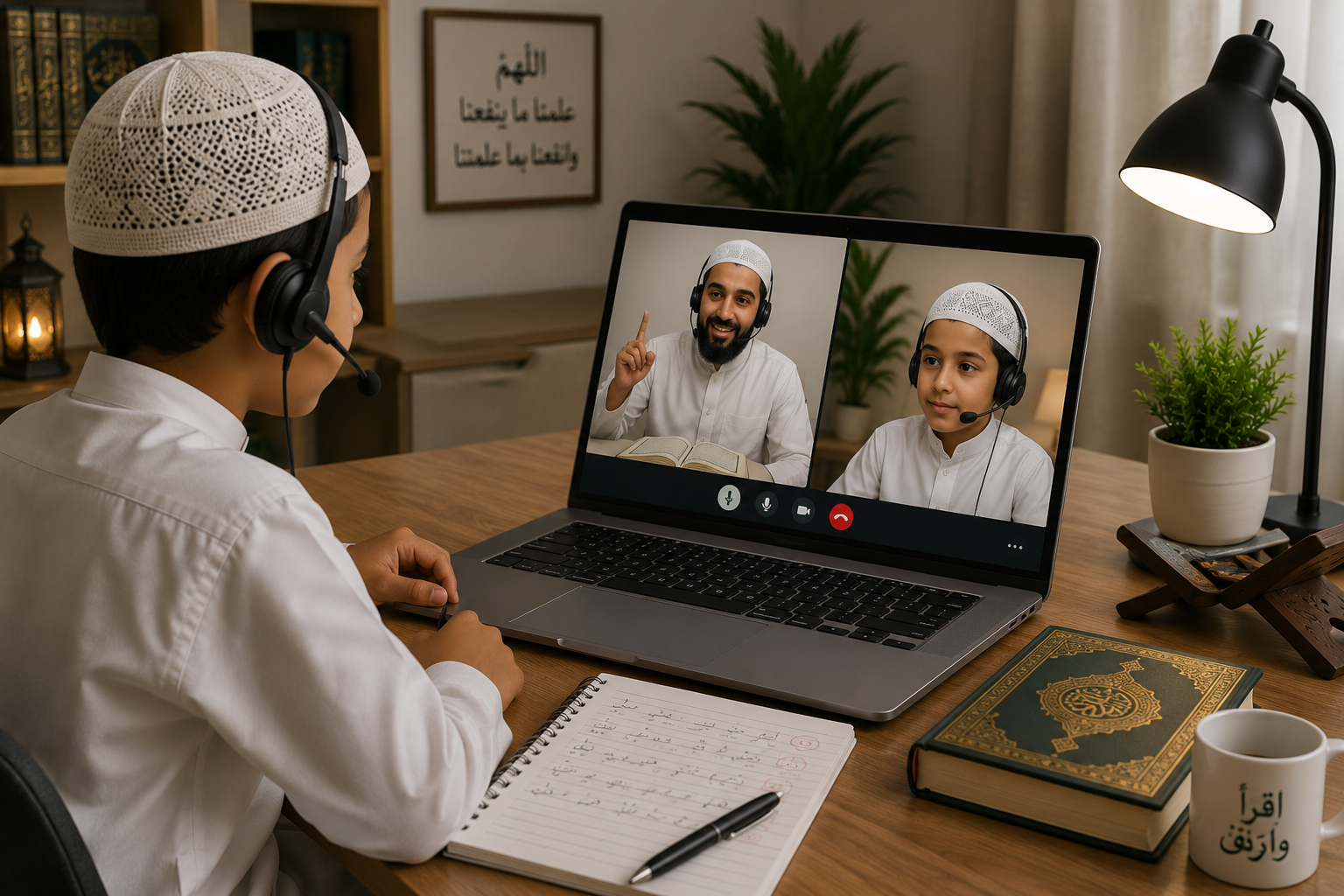
1-to-1 online Quran classes for kids and adults remove that guesswork entirely. The teacher hears every single word the student reads, stops immediately when a makhraj (pronunciation point) is off, and repeats it until it’s actually correct — not just “close enough for today.” Over months, that difference compounds. A student in well-run online Quran classes tends to read with noticeably cleaner Tajweed than one who’s been in a large group for the same length of time.
The other advantage is pacing. Some children pick up Arabic letters in a week; others need a month, and there’s nothing wrong with either. In private online Quran classes, the teacher can slow down without holding a whole class back, or speed up without leaving a quick learner bored and disengaged. The same applies to adults — someone with a full Hifz goal will move very differently through the syllabus than someone who simply wants to correct their Surah Al-Fatihah before praying.
What You Actually Learn in Online Quran Classes
“Online Quran classes” is a broad label, and it’s worth knowing what should actually be inside online Quran classes for kids and adults before you sign up for anything.
Quran Recitation and Tajweed
This is the foundation almost everyone starts with — correct pronunciation of Arabic letters, the rules of noon sakinah and tanween, madd (elongation), and the smaller rules most self-taught readers never quite pick up on their own. A good teacher doesn’t just tell you the rule; they make you apply it, verse after verse, until it stops needing conscious thought.
Hifz — Quran Memorization Classes
Memorization works surprisingly well online once there’s a structured revision system in place. The teacher assigns new lines, checks the previous day’s portion, and — this part matters — checks older, already-memorized sections regularly so nothing quietly slips away. Memorization without a strong revision cycle is the single biggest reason students “forget everything” after finishing a juz.
Tafseer — Understanding the Meaning
Reading the Arabic correctly is only half the picture. Tafseer classes walk through what a verse actually means, the context it was revealed in, and how classical scholars have explained it — turning recitation into something a student can actually reflect on rather than just recite by sound.
Arabic Grammar (Nahw & Sarf)
For older students and adults who want to go further, basic Arabic grammar unlocks the ability to read the Quran directly instead of relying entirely on translation. It’s a slower, more academic track, but it changes the relationship a student has with the text permanently.
وَرَتِّلِ الْقُرْآنَ تَرْتِيلًا “And recite the Quran with measured recitation.” — Surah Al-Muzzammil, 73:4
This single instruction — to recite slowly and clearly, not to rush through the words — is essentially the founding principle behind Tajweed itself, and it’s why a rushed reading, however confident, isn’t the goal that structured online Quran classes are actually built around.
Online Quran Classes for Kids vs. Online Quran Classes for Adults
These two groups need genuinely different approaches, and a program that treats them the same usually fails one of them.
Short, encouraging, consistent
Sessions of 20–30 minutes hold a child’s attention far better than an hour ever will. Good teachers build in small wins — a sticker chart, verbal encouragement, short breaks — and involve parents in short daily check-ins rather than leaving all correction to twice a week.
Efficient, private, judgment-free
Adults tend to want early morning or late evening slots around work, and they need a teacher who won’t make basic mistakes feel embarrassing. Many adult beginners — including converts and those returning to practice after years away — do best with a teacher who explains the “why” behind a rule, not just the rule itself.
Many adults quietly believe they are “too late” to start. That isn’t true, and it’s worth saying plainly: thousands of people begin their first proper online Quran classes in their thirties, forties, and well beyond. Sincerity and consistency matter far more than the age you started at.
There’s also a character-building side that matters most for children. A young student in online Quran classes for kids isn’t only decoding Arabic letters — a good teacher weaves in manners, patience, and respect for the Quran itself, so the habit being built is bigger than the skill alone.
Not Sure Where to Start?
Book a short trial class and let a qualified teacher tell you exactly where your child — or you — should begin.
Join Quran ClassesHow to Choose the Right Online Quran Classes
Enthusiasm fades fast if the teacher isn’t the right fit — this is usually the actual reason families quit after a month, not a lack of commitment. A short checklist before enrolling in online Quran classes for kids and adults saves a lot of wasted time later.
| What to Check | Why It Matters |
|---|---|
| Ijazah or recognised Tajweed qualification | Confirms the teacher’s own recitation has been formally verified, not self-taught |
| A real trial class, not just a sales call | Shows you exactly how the teacher corrects mistakes in practice |
| Progress notes after each lesson | Keeps you aware of what’s actually being learned, especially for kids |
| Teacher gender preference honoured | Matters to many families, particularly for daughters and adult women |
| Clear, flexible rescheduling policy | Life happens — a rigid policy quietly kills consistency |
| Transparent pricing, no vague packages | Avoids surprise charges after the first month |
It’s worth sitting in on at least the first couple of online Quran classes, especially with younger children. You’ll learn more about whether a teacher is the right fit in ten minutes of watching than from any amount of reading a bio online.
What a Typical Online Quran Class Looks Like
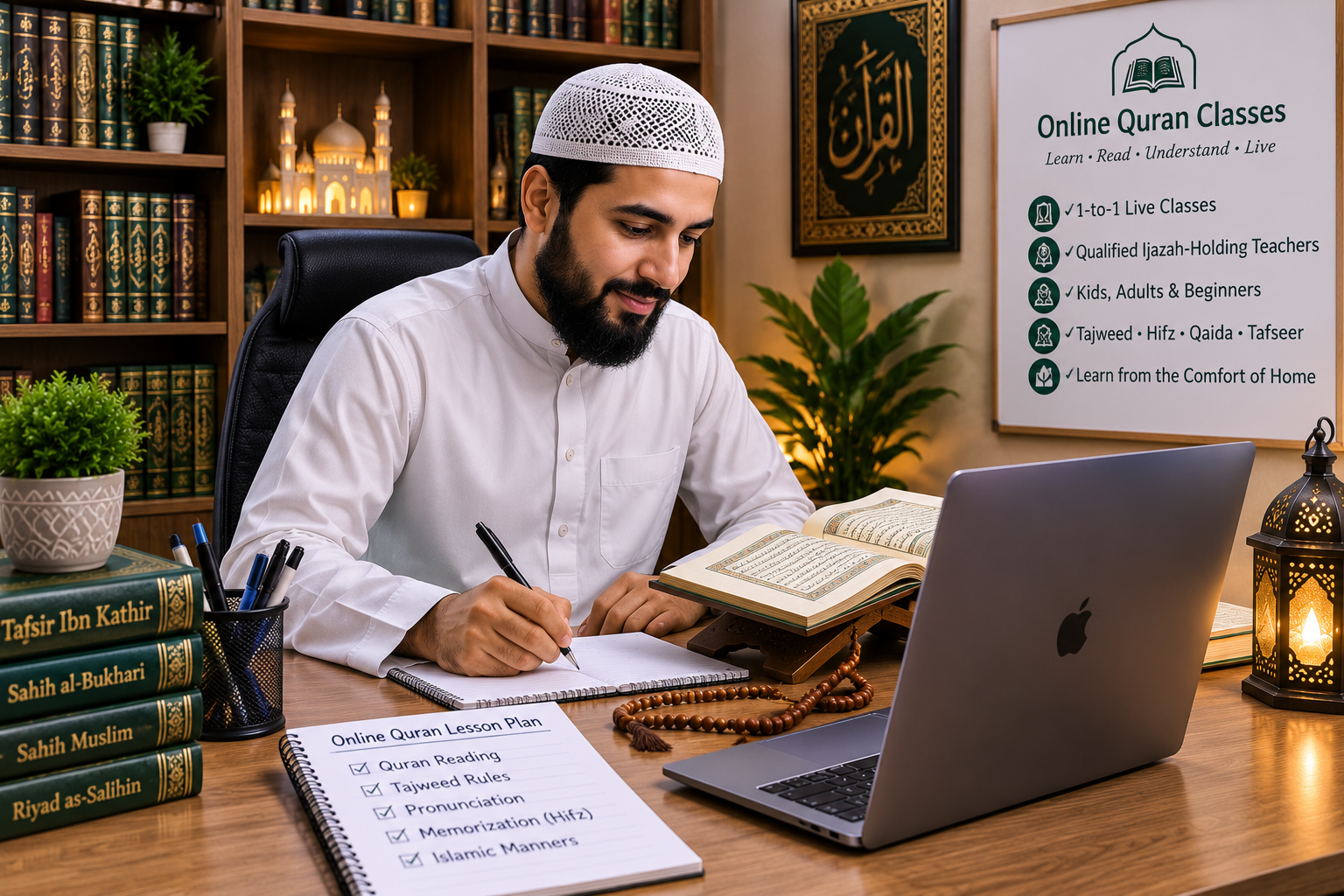
It helps to know what you’re actually paying for, so here’s roughly how a well-run 30-minute session tends to unfold.
The first few minutes are recap — the teacher asks the student to read yesterday’s portion from memory or from the page, mostly to warm up and check nothing’s been lost. Then comes the new material: a few lines or a short passage, read slowly, with the teacher stopping at every Tajweed slip to correct it on the spot rather than letting it pass. For a child, there’s usually a short breather in the middle — a quick question about their day, a joke, something to reset attention before continuing.
The last five minutes are usually reserved for setting homework — which lines to revise, how many times to repeat them — and a short summary sent to the parent or student afterward. It’s not glamorous, and it isn’t meant to be. Consistency, not excitement, is what actually produces a hafiz or a confident reciter over time.
Comparing Common Course Tracks
Most online Quran classes for kids and adults are built around a handful of standard tracks. Here’s roughly how they compare, so you know what to expect when a teacher recommends one.
| Course | Typical Duration | Best For |
|---|---|---|
| Noorani Qaida | ~2 months | Complete beginners learning Arabic letters and basic pronunciation |
| Tajweed | ~4 months | Students who can already read but need correction and fluency |
| Hifz (Memorization) | 2–5 years | Students working toward memorizing part or all of the Quran |
Timelines vary by student, age, and how much daily revision time is realistically available — treat the durations above as a general guide, not a guarantee.
Mistakes Parents Make When Enrolling Kids
A few patterns show up again and again in online Quran classes for kids and adults, and most are easy to avoid once you know to look for them.
- Booking too many sessions too soon. Three or four classes a week sounds ambitious, but it often burns a child out within a month. Two focused sessions usually beat five rushed ones.
- Switching teachers too quickly. A child needs a few weeks to get comfortable with a new teacher’s style before real progress shows. Jumping between teachers resets that comfort every time.
- Skipping the trial class. It’s tempting to enrol straight into a package for a discount, but a trial class is the only real way to see how a teacher handles a child who’s tired, distracted, or shy.
- Leaving all responsibility to the teacher. Thirty minutes twice a week isn’t enough on its own — five minutes of daily revision with a parent listening in makes a bigger difference than people expect.
- Ignoring the child’s own feedback. If a child consistently dreads a particular class, that’s information worth acting on, not a phase to push through regardless of the reason behind it.
Most parents carry a quiet guilt about this — wondering if they started too late, chose the wrong teacher, or should have pushed harder on the days their child resisted. That guilt rarely helps. A child who feels rushed or judged remembers the tension long after they’ve forgotten the actual lesson, so it’s worth being as patient with yourself as you’re asking your child to be with the Quran.
Online Quran Classes vs. the Traditional Madrassa
Neither format is universally “better” — they solve different problems.
| Factor | Online 1-to-1 Classes | Traditional Madrassa |
|---|---|---|
| Individual correction | Every mistake heard directly | Shared across a group |
| Scheduling flexibility | Fits around work/school | Fixed class timings |
| Teacher choice | Wide pool, any location | Limited to local availability |
| In-person community feel | Limited | Strong, built-in |
| Cost per student | Usually higher per hour | Often lower, group-shared |
Plenty of families end up combining both — a local madrassa for the community aspect and Friday gatherings, and private online Quran classes for focused, corrected recitation during the week.
What Classical Scholars Say About Learning the Quran
The virtue of learning and teaching the Quran is not a modern marketing idea — it runs through centuries of classical Islamic scholarship, and it’s part of why so many families feel a pull toward starting, even when the process feels intimidating at first.
Ibn Kathir
In his Tafsir, Ibn Kathir repeatedly highlights that engaging with the Quran — reading it, reflecting on it, and teaching it to others — is among the most beloved acts a believer can undertake, describing the Quran itself as a mercy and a healing for those who approach it sincerely.
Imam Nawawi
Imam Nawawi, in his commentary on the hadith literature, stresses that teaching the Quran to children carries a lasting reward precisely because the benefit continues long after the individual lesson ends — a point often used to encourage parents not to delay their children’s Quran education.
Ibn Taymiyyah
Ibn Taymiyyah wrote extensively on the Quran as a source of spiritual purification (tazkiyah), arguing that regular, unhurried engagement with its verses gradually reshapes a person’s character far more than occasional, rushed reading ever could.
Imam Al-Ghazali
In Ihya Ulum al-Din, Imam Al-Ghazali places heavy emphasis on sincerity (ikhlas) in seeking any knowledge, including Quranic knowledge — reminding students that the intention behind starting online Quran classes matters as much as the schedule or method chosen.
“The best among you are those who learn the Quran and teach it.” — Sahih al-Bukhari, Hadith 5027
Getting Real Progress: Practical Tips
A handful of small habits separate students who genuinely progress through online Quran classes for kids and adults from students who quietly stop attending after a few months.
- Keep a fixed time slot. The same time each day, even if short, beats an irregular hour that keeps moving.
- Revise before adding new material. A rushed student who keeps moving forward without solid revision ends up with a shaky foundation that shows up later.
- Use a physical mushaf, not just a screen. Many teachers and students find that handling an actual copy — turning real pages — helps memorization stick better than scrolling a PDF.
- Treat the first two weeks as a trial for you, too. If a teacher’s style isn’t clicking after several honest attempts, it’s fine to switch — that’s not giving up, it’s finding the right fit.
There’s a particular kind of quiet joy in this journey that’s easy to miss when you’re focused on schedules and correction sheets — the moment a child reads a full verse without a single prompt for the first time, or an adult beginner finishes Surah Al-Fatihah cleanly after weeks of stumbling over the same word. Those small moments are the actual reward. Everything else — the teacher search, the rescheduling, the slow weeks — is just the road that gets you there.
وَلَقَدْ يَسَّرْنَا الْقُرْآنَ لِلذِّكْرِ فَهَلْ مِن مُّدَّكِرٍ “And We have certainly made the Quran easy for remembrance, so is there any who will remember?” — Surah Al-Qamar, 54:17
That verse is worth returning to on the days progress feels slow. The Quran itself makes a point of being accessible — the difficulty families feel is usually about consistency, not the material being beyond reach.
These habits echo a lot of what we cover in our complete beginner’s guide to learning Islam, particularly the idea that small, consistent daily effort outperforms occasional long sessions almost every time.
How to Tell If Real Progress Is Actually Happening
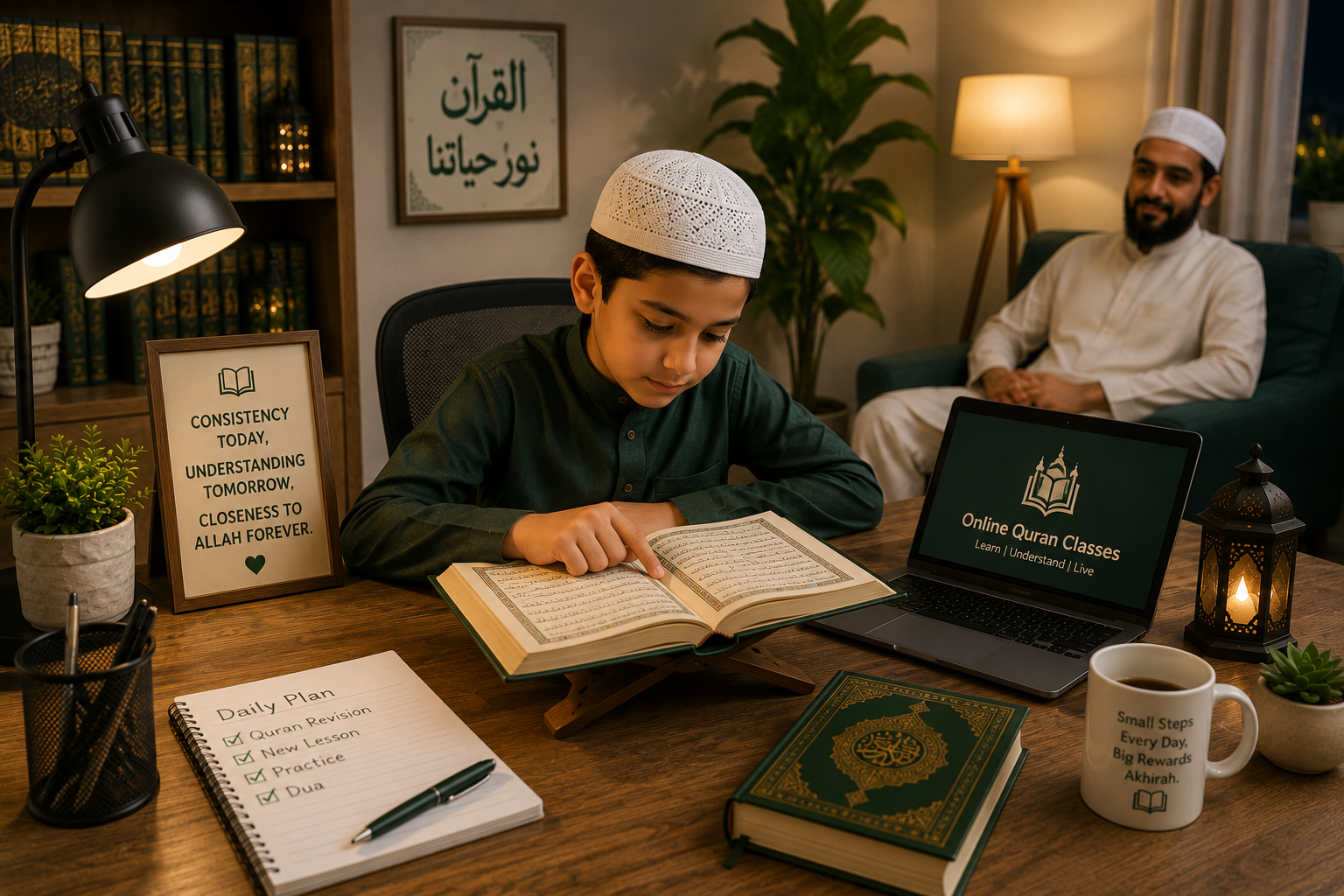
Because online lessons happen behind a screen, it’s easy for a parent to lose track of whether a child is genuinely improving or simply attending. A few honest signals are worth checking every few weeks rather than waiting for a term to end.
- Fewer repeated corrections. If the teacher is still correcting the exact same makhraj mistake after two months, that’s worth a direct conversation — not necessarily a red flag, but something to ask about.
- The student can read without constant prompting. Early on, a teacher prompts almost every word. A student making progress needs fewer nudges over time, even if the pace stays slow.
- Old material still comes back cleanly. Ask your child to read a page they learned a month ago. If it’s completely gone, the revision cycle needs adjusting, regardless of how much new material has been covered since.
- The student can explain, not just recite. Even a simple “what does this verse mean?” answered in a child’s own words is a strong sign that learning is going deeper than memorized sound.
None of this requires a background in Tajweed yourself — it just requires sitting in occasionally and asking a few honest questions instead of assuming attendance equals progress.
“Whoever follows a path in pursuit of knowledge, Allah will make easy for him a path to Paradise.” — Sahih Muslim, Hadith 2699
Ready to Start Online Quran Classes?
If you’ve read this far, you already know more about choosing good online Quran classes for kids and adults than most people do before enrolling. The next step is simple — book a trial class and see how it actually feels.
Book a Trial Class
People Also Ask
For 1-to-1 correction specifically, yes — the teacher hears every word regardless of format. What online classes can’t fully replace is the in-person community feel of a physical madrassa, which is why many families use both.
Some academies do, particularly for completed Hifz or Tajweed courses, but requirements vary — always ask a prospective academy directly what their certification actually covers before enrolling.
Two to three sessions a week is a realistic starting point for both children and adult beginners — enough for steady progress without the burnout that comes from over-scheduling.
Online Quran Classes FAQ
What age should a child start online Quran classes?
Most teachers suggest starting around age 4 to 5, once a child can sit and focus for short stretches. Sessions at this age are usually 15–20 minutes and focus on Arabic letter recognition before moving into full recitation.
Can adults really learn Quran from scratch through online classes?
Yes, and it’s more common than people assume. Many adult students — including converts and those returning to practice after years away — start from zero, learning the Arabic alphabet before moving into Tajweed and recitation, at whatever pace fits their schedule.
How long does it take to memorize the Quran through online Hifz classes?
It varies enormously by age, prior recitation ability, and how much daily revision time a student can commit. Children in structured programs often complete memorization over several years; the honest answer is that consistency matters far more than speed.
Is it better to choose a male or female teacher for online Quran classes?
This comes down to family preference and comfort, especially for daughters and adult women. A good academy should let you request a teacher’s gender without hesitation rather than treating it as an inconvenience.
How much should online Quran classes cost?
Pricing varies by region, session length, and whether lessons are individual or group. Rather than chasing the cheapest option, it’s worth weighing cost against teacher qualification, trial-class quality, and how clearly progress is tracked.
What do I need at home to start online Quran classes?
A stable internet connection, a device with video and audio, a mushaf or Quran app for the student to follow along, and a quiet spot with minimal distractions — that’s genuinely all it takes to begin.
Can I learn Quran online without knowing Arabic?
Yes — this is exactly what a Noorani Qaida course is for. It starts with Arabic letter shapes and sounds before any recitation begins, so knowing Arabic beforehand isn’t a requirement, just a starting point everyone works through.
How long does it take to complete a Tajweed course?
A typical Tajweed course runs around four months for a student who can already read Arabic, though this depends heavily on how much time is given to daily practice between lessons.
Final Thought
Years from now, what most families remember isn’t which academy they chose or how many certificates were earned — it’s the sound of their own child reciting confidently at a family gathering, or the quiet pride of finally praying with real understanding instead of just memorized motion. That’s the actual destination. The classes are just how you get there.
Choosing online Quran classes for kids and adults in your own household isn’t really about finding the “best” platform on the internet — it’s about finding one teacher, one time slot, and one small daily habit that you can actually keep up with. Everything else in this guide exists to help you get to that point a little faster, without the months of trial and error a lot of families go through first.
For everyday reading and listening practice between lessons, Quran.com is a solid free companion, and Sunnah.com is a reliable place to verify any hadith you come across. If you’re still working out where to begin more broadly, our beginner’s guide to learning Islam properly is a good next stop.
Read More Before You Enrol
Want the fundamentals down first? Start with our step-by-step recitation guide.
Read Quran GuideYou May Also Like
Trust & Verification
- Reviewed By
- IslamicEduHub in-house Tajweed panel
- Last Updated
- July 2026
- Reviewed Date / Version
- v2.0 — July 2026
- Sources
- Quran.com, Sunnah.com, IslamQA.info
- Books Used
- Tafsir Ibn Kathir, Sharh Sahih Muslim (Imam Nawawi), Ihya Ulum al-Din (Imam Al-Ghazali), Majmu’ al-Fatawa (Ibn Taymiyyah)
- Scholar Review
- Reviewed by IslamicEduHub’s Tajweed panel
- Quran References
- Surah Al-Muzzammil 73:4; Surah Al-Qamar 54:17
- Hadith References
- Sahih al-Bukhari 5027; Sahih Muslim 2699