
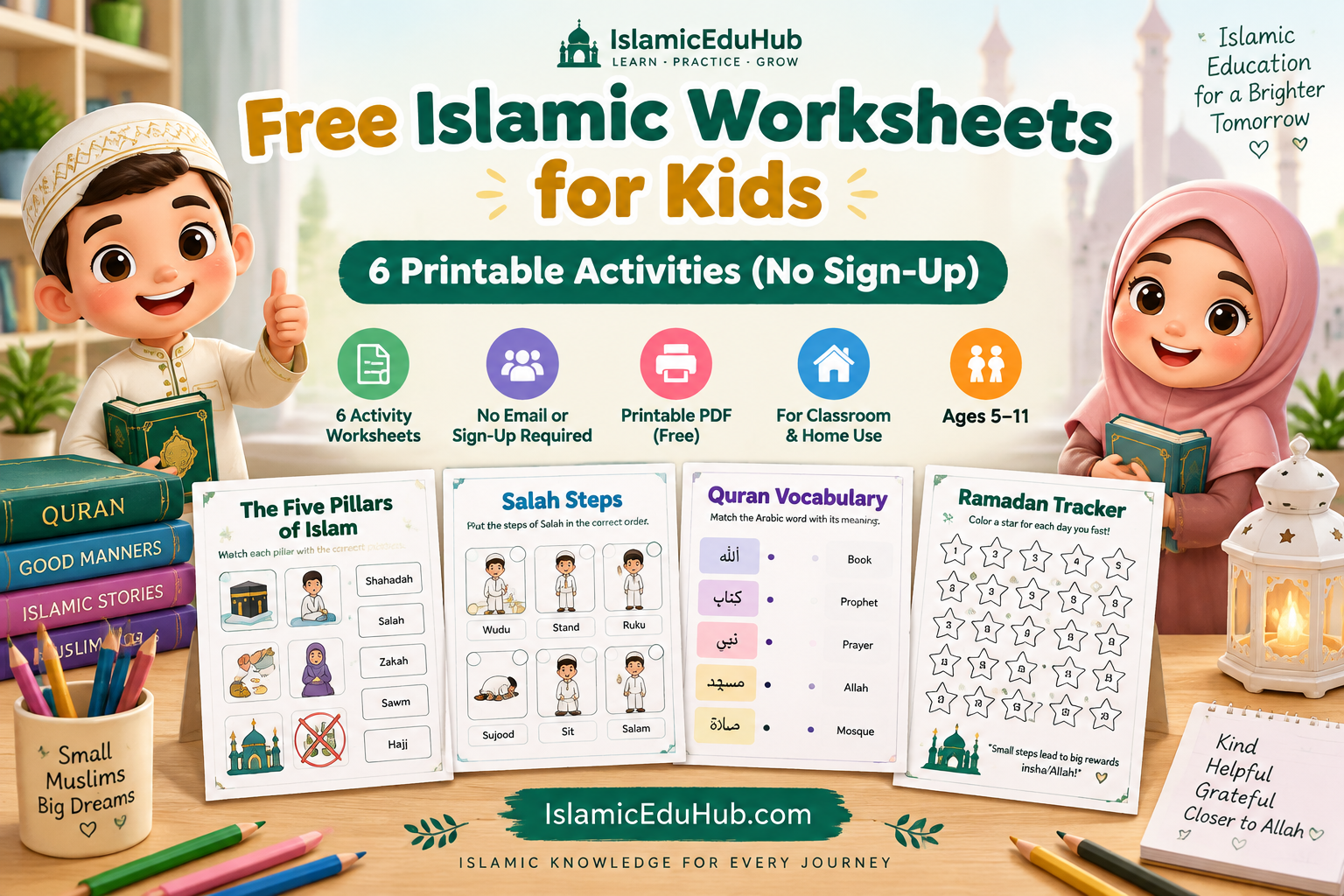
A free, instantly downloadable PDF activity pack covering the Five Pillars, Salah, a Prophet story, good manners, Quran vocabulary, and a Ramadan tracker — with an answer key included.
This free printable pack has 6 Islamic worksheets for kids — covering the Five Pillars, Salah steps, a Prophet story, good manners, Quran vocabulary, and a Ramadan tracker — plus a full answer key. Download the PDF instantly below, no email or sign-up needed.
📥 Download the Free Worksheet Pack
6 Activity Worksheets + 1 Answer Key Page — ready to print at home or in the classroom.
Download Free Islamic Worksheets PDFPreview Inside the Worksheet Pack
If any of this sounds familiar, you’re not alone — these come up constantly for parents and teachers:
- Wanting Islamic learning material but not having time to design it yourself
- Finding worksheets that require signing up with an email before you can even see them
- Needing something age-appropriate that doesn’t feel like a lecture
- Wanting to check a child’s understanding without turning it into a test
On this page
What’s Included in These Free Islamic Worksheets for Kids
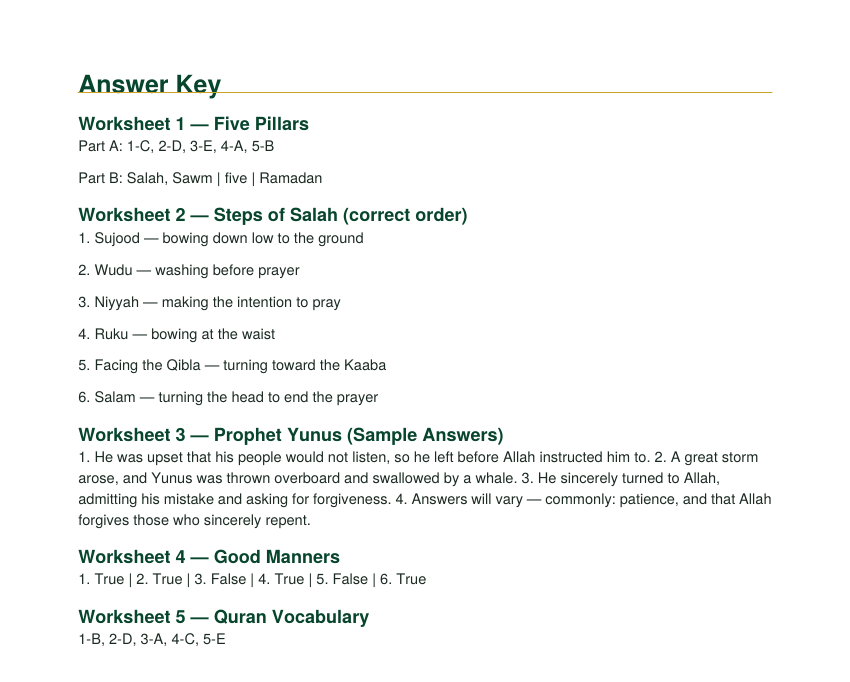
This is one downloadable PDF with six distinct worksheets, each covering a different foundational topic, plus a full answer key at the end so you don’t have to work out the answers yourself before handing it to a child.
The Five Pillars of Islam
A matching activity (pillar to meaning) plus fill-in-the-blank sentences.
Steps of Salah
A sequencing activity — put the six main parts of Salah in the correct order.
Prophet Yunus (AS) and the Whale
A short, simplified retelling followed by four comprehension questions.
Good Islamic Manners
A true-or-false activity covering everyday manners like greetings, honesty, and kindness.
Quran Vocabulary
Matching common Arabic phrases (like Alhamdulillah, SubhanAllah) to their English meaning.
Ramadan Activity Page
A word search plus a printable daily habit tracker for fasting, prayer, and good deeds.
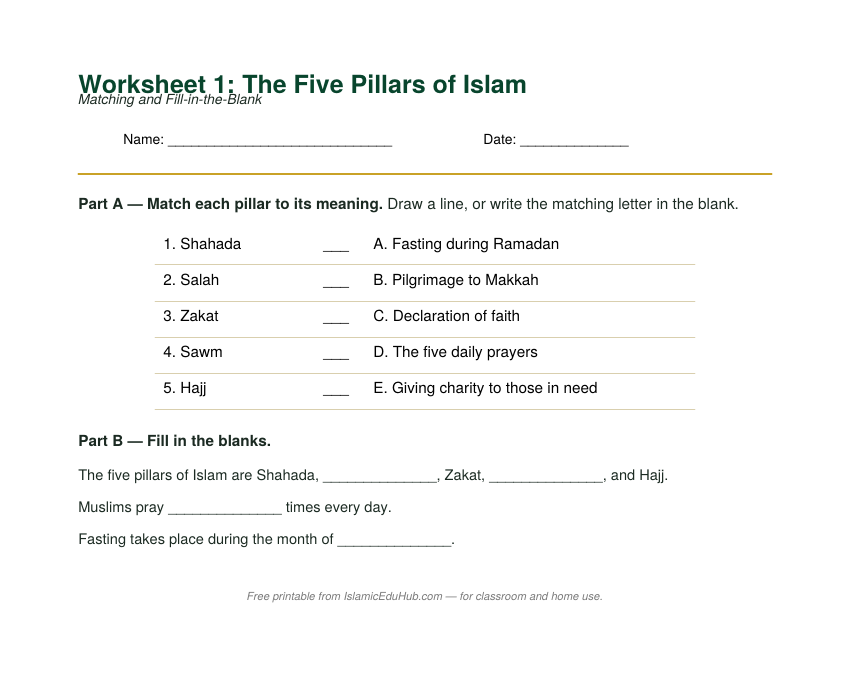
Worksheet 1: The Five Pillars of Islam
This page opens the pack because the Five Pillars are the foundation everything else builds on. Part A asks children to match each pillar — Shahada, Salah, Zakat, Sawm, and Hajj — to its correct meaning, which reinforces vocabulary before Part B asks them to recall the pillars themselves in a fill-in-the-blank format. It’s intentionally short, since this is meant as a starting point rather than a full lesson on any single pillar.
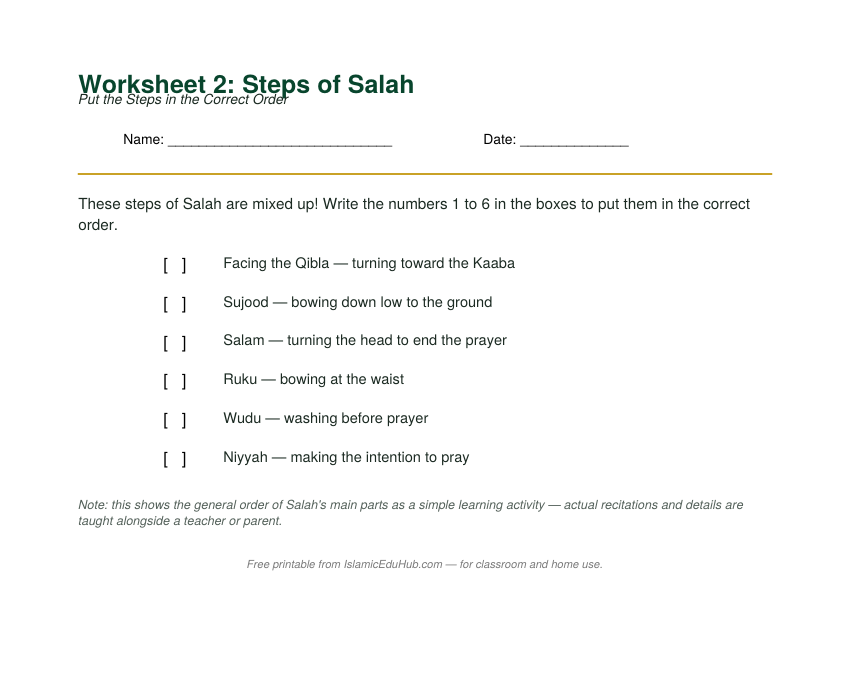
Worksheet 2: Steps of Salah
Rather than asking children to memorize Salah from a list, this worksheet scrambles the basic Salah steps commonly introduced to beginners — Wudu, facing the Qibla, Niyyah, standing and reciting, Ruku, Sujood, and Salam — and asks them to number them in a sensible order. Reconstructing the order tends to stick better than simply reading it, and the worksheet includes a note clarifying that this covers the general structure, not the full recitations, which are best learned alongside a parent or teacher.
Worksheet 3: Prophet Yunus (AS) and the Whale
This is the only worksheet built around a story rather than a list or chart. It’s a short, simplified retelling of Prophet Yunus (AS), referenced in the Quran including Surah As-Saffat, followed by four open-ended comprehension questions. The goal isn’t to test memorization of the story’s wording — the lesson focuses on turning back to Allah, making sincere dua, and learning from mistakes.
Worksheet 4: Good Islamic Manners
Six true-or-false statements cover everyday manners: saying Bismillah before eating, greeting others with Salam, listening when parents speak, honesty, kindness to neighbors, and smiling as a small act of charity. A couple of the statements are deliberately framed as the opposite of good manners, so children have to actually think about each one rather than marking every answer “True” by habit.
Worksheet 5: Quran Vocabulary
Five commonly used Arabic phrases — Bismillah, Alhamdulillah, SubhanAllah, InshaAllah, and Astaghfirullah — are matched to their English meanings. These are words most Muslim children hear constantly in daily conversation, so this worksheet is less about introducing new vocabulary and more about making sure the meaning behind familiar words is understood, not just repeated.
Worksheet 6: Ramadan Activity Page
The final page combines a word search (RAMADAN, FASTING, IFTAR, SUHOOR, QURAN, DUA, ZAKAT, EID, hidden across, down, and diagonally) with a printable daily habit tracker for fasting, on-time prayer, Quran reading, and good deeds. The tracker shown covers the first 10 days as a template — photocopy it separately to cover a full month.
How to Use These Worksheets
- Download and print. The PDF is designed to print cleanly on standard letter-size paper, in black and white or color.
- Pick one worksheet at a time. Working through all six in one sitting is a lot for most children — one topic per session tends to land better.
- Read the story aloud for Worksheet 3. Younger children often follow along better when the Prophet Yunus story is read to them first, before they answer independently.
- Check answers together. Use the answer key on the last page to review as a conversation, not just a mark right/wrong exercise.
- Reuse the Ramadan tracker each month. Photocopy the tracker page separately if you want to reuse the chart format for a full 30 days.
What Age Group Are These For
The pack is designed for roughly ages 5 to 11, though the range within that is wide. Younger children (5–7) will likely need the Prophet story read aloud and may need help with the true-or-false wording. Older children (8–11) can typically work through the matching and comprehension activities independently, and may finish the whole pack in one or two sittings.
Why Printable Worksheets Help Kids Learn
Screen-based Islamic learning apps have their place, but there’s a reason paper worksheets haven’t disappeared from classrooms. Writing an answer by hand, rather than tapping a multiple-choice option, tends to slow a child down just enough to actually think about the question. A word search or matching activity also gives a child something concrete to hold and finish, which matters more for younger learners than it might seem.
There’s also a practical side: a printed worksheet doesn’t need charging, doesn’t come with notifications, and can be done at a kitchen table without anyone needing to hand over a device. For families managing screen time carefully, that’s often a real factor in choosing a printable over an app.
Why This Worksheet Pack Is Easy to Use
The goal with this pack was to make it as frictionless as possible to actually get and use — no account, no email, and everything in one file.
| Feature | Included |
|---|---|
| Instant PDF download | Yes |
| Answer key included | Yes |
| Free for classroom use | Yes |
| No sign-up or email required | Yes |
| Printable in black & white or color | Yes |
Tips for Parents and Teachers
- Laminate the tracker page if you want to reuse it with a dry-erase marker instead of printing a fresh copy each month
- For a classroom setting, the matching worksheets (1 and 5) work well as partner activities rather than solo work
- If a child gets stuck on the word search, let them find words in any direction — they’re placed across, down, and diagonally
- The comprehension questions in Worksheet 3 don’t have single “correct” wording — focus on whether the core idea came through, not exact phrasing
- If you’re using this at home with more than one child, print a fresh copy for each rather than sharing one sheet — it keeps the activity from turning into a competition
- Keep a completed pack in a folder; children often enjoy looking back at earlier worksheets months later
Common Mistakes to Avoid
The most common mistake is treating this as a test rather than a conversation starter. A wrong answer on the manners or comprehension worksheets is a good opening to talk through the “why,” not just correct it and move on.
A second common mistake is trying to complete all six worksheets back-to-back. Spacing them out — one per week, or one per weekend — tends to hold a child’s attention far better than a single long session.
The Prophet Yunus (AS) story in Worksheet 3 is a simplified retelling for children, based on the account referenced in the Quran, including Surah As-Saffat. The Five Pillars, Salah sequence, and Arabic vocabulary terms reflect widely agreed, foundational Islamic teaching rather than any single school’s specific ruling.
- Quran reference: Surah As-Saffat, referenced in Worksheet 3; read the full surah in context at Quran.com.
Last reviewed for references: September 2026.
Frequently Asked Questions
Is this worksheet pack really free?
Yes. The PDF downloads directly with no email, account, or payment required.
Can I use these in my classroom or Islamic school?
Yes, the pack is free for classroom, homeschool, and personal home use.
What age group is this best suited for?
Roughly ages 5 to 11. Younger children may need some activities read aloud, while older children can typically work through the pack independently.
Is there an answer key?
Yes, a full answer key for all six worksheets is included on the final page of the PDF.
Can I print this in black and white?
Yes, the pack is designed to print cleanly in both black-and-white and color.
Will there be more worksheet packs like this?
This is intended as the first in an ongoing series — check back on IslamicEduHub for future printable packs.
Do I need any special software to open the file?
No. It’s a standard PDF, viewable in any browser or free PDF reader, and prints normally from any device.
Is this suitable for a child who is new to learning about Islam?
Yes. The worksheets start with foundational topics (the Five Pillars, basic vocabulary) rather than assuming prior knowledge, which makes them a reasonable starting point for beginners.
Keep building your child’s foundation
Pair this worksheet pack with our full beginner’s guide, or test older kids’ knowledge with our interactive quiz.