
A clear, step-by-step guide to the funeral prayer — the four takbirs, what to recite at each one, and what to do differently if the deceased is a man, woman, or child.
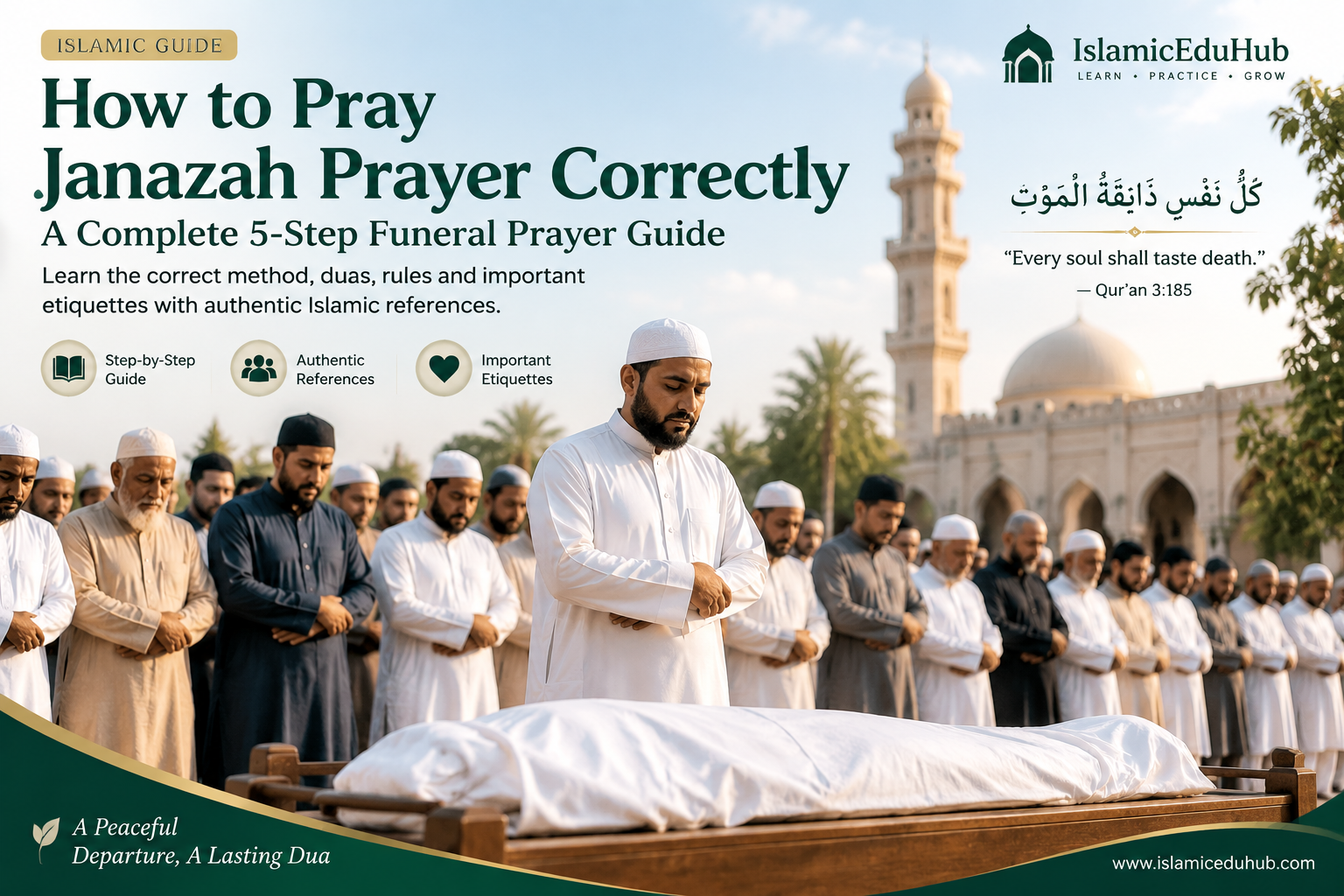
To pray Janazah prayer correctly, stand facing the Qibla, make your intention, and say four takbirs (Allahu Akbar) without ruku or sujood — reciting Al-Fatihah after the first, sending blessings on the Prophet ﷺ after the second, making dua for the deceased after the third, and ending with salam after the fourth.
If any of this sounds familiar, you’re not alone — these come up constantly:
- Losing count of the takbirs partway through the prayer
- Not knowing what to recite after each specific takbir
- Being unsure where to stand — behind the imam, near the head, or near the middle
- Never having learned this prayer because it isn’t performed daily like Salah
On this page
- What Is Janazah Prayer?
- Who Needs to Know This
- How to Pray Janazah Prayer: Step-by-Step
- Janazah Prayer Dua
- Janazah vs. Regular Salah
- Where to Stand
- Praying Janazah for a Child
- Praying Janazah in Absentia
- The Reward of Attending a Funeral Prayer
- Best Practices for Attending a Funeral
- What Happens After Janazah
- How to Pray Janazah Prayer Correctly: Mistakes to Avoid
- FAQ
What Is Janazah Prayer?
Janazah (also spelled Janaza) is the funeral prayer offered for a deceased Muslim before burial. Unlike the five daily prayers, it has no ruku (bowing) or sujood (prostration) — the entire prayer is performed standing, consisting of four takbirs with specific recitations between each one.
It is classified as Fard Kifayah, a communal obligation: if enough members of the community perform it, the rest are absolved of the duty, but scholars explain that the community shares responsibility if it is neglected altogether. This is different from Salah, which is Fard Ayn — an individual obligation on every Muslim regardless of whether anyone else prays it.
Janazah is usually the final public step before burial, coming after two preparations that are handled separately: Ghusl (ritually washing the body) and kafan (wrapping it in a simple shroud). By the time the community gathers for the prayer itself, both of those steps are already complete — the prayer’s role is specifically the collective supplication, not the physical preparation.
Who Needs to Know This
Most Muslims encounter Janazah far less often than the five daily prayers, which is exactly why it catches people off guard — you don’t get years of daily repetition to make it automatic. A few situations where knowing this prayer matters most:
- Anyone attending a funeral for the first time — knowing the structure in advance means you can focus on the moment rather than watching everyone else for cues.
- New Muslims — this prayer is rarely covered in early lessons since it isn’t performed daily, but a death in the community can happen at any point.
- Community members who might be asked to lead — if you’re one of few people present with prior knowledge, you may be asked to lead even if you weren’t expecting to.
- Parents preparing older children — walking a child through what to expect before their first funeral prayer can make a difficult day less confusing.
How to Pray Janazah Prayer: Step-by-Step
The four-takbir structure is widely practiced among Muslims, although details such as some recitations may differ between schools of thought.
- Make your intention (niyyah) and stand. Face the Qibla, with the body of the deceased placed in front of the row of worshippers. There is no adhan or iqamah before Janazah.
- First takbir — recite Al-Fatihah. Say “Allahu Akbar,” raise your hands as you would at the start of Salah, then place them on your chest and recite Surah Al-Fatihah silently.
- Second takbir — send blessings on the Prophet ﷺ. Say “Allahu Akbar” again (without raising your hands this time) and recite Durood Ibrahim, the same blessings recited in the final sitting of Salah.
- Third takbir — make dua for the deceased. Say “Allahu Akbar” and offer a sincere supplication asking Allah for the deceased’s forgiveness and mercy.
- Fourth takbir — end with salam. Say “Allahu Akbar” one final time, then turn your head to the right and say “Assalamu Alaikum wa Rahmatullah.” Some also turn to the left and repeat it, similar to the end of Salah.
Janazah Prayer Dua (Arabic, Transliteration & Meaning)
This is recited silently after the third takbir. It’s a general dua covering the whole community, living and deceased, not just the person being prayed for — which is why it doesn’t need to be adjusted by name.
اللَّهُمَّ اغْفِرْ لِحَيِّنَا وَمَيِّتِنَا، وَشَاهِدِنَا وَغَائِبِنَا، وَصَغِيرِنَا وَكَبِيرِنَا، وَذَكَرِنَا وَأُنْثَانَا
Transliteration: Allahumma ighfir li-hayyina wa mayyitina, wa shahidina wa gha’ibina, wa sagheerina wa kabeerina, wa dhakarina wa unthana.
Translation: “O Allah, forgive our living and our dead, those present among us and those absent, our young and our old, our males and our females.”
Sunan Abi Dawud 3201; Jami’ at-Tirmidhi 1024Some also add a fuller version asking Allah to keep the deceased firm in faith and grant them a better home and family in the Hereafter. This shorter version above is the one most commonly taught first, since it’s easier to memorize and covers the essential meaning.
Janazah vs. Regular Salah: Key Differences
| Janazah Prayer | Regular Salah |
|---|---|
| No ruku (bowing) | Includes ruku |
| No sujood (prostration) | Includes sujood |
| Four takbirs total | Varies by rakah count (2–4 rakahs) |
| Entirely performed standing | Standing, bowing, and prostrating |
| No adhan or iqamah | Preceded by adhan and iqamah |
| Fard Kifayah (communal obligation) | Fard Ayn (individual obligation) |
Where to Stand
The imam stands facing the body: near the chest if the deceased is male, and near the middle of the body if the deceased is female. Worshippers form rows behind the imam, facing the Qibla, the same as in congregational Salah. If you’re attending as part of a larger congregation, simply follow the row structure already in place — you don’t need to identify the exact position yourself unless you’re leading the prayer.
Praying Janazah for a Child
The structure stays the same — four takbirs, no ruku or sujood — but the dua after the third takbir changes. Since a child who has not reached puberty has no recorded sins to seek forgiveness for, the dua instead asks Allah to make the child a source of reward, intercession, and comfort for the parents, rather than asking for the child’s own forgiveness.
Praying Janazah in Absentia
It’s permissible to pray Janazah for someone whose body is not physically present — known as Salat al-Ghaib (the prayer in absentia). This is typically done when a Muslim has passed away in a location where a proper funeral prayer wasn’t performed, or as an additional act of remembrance. The steps are identical to a standard Janazah prayer.
The Reward of Attending a Funeral Prayer
Attending and praying Janazah carries a specific, named reward described in hadith — distinct from simply hearing about someone’s passing.
“Whoever attends the funeral until the prayer is offered will have a reward of one Qirat, and whoever attends until burial is completed will have a reward of two Qirats, each Qirat being equivalent to Mount Uhud.”
Sahih al-Bukhari 1325; also Sahih Muslim 945The distinction in the hadith is specific: attending only until the prayer earns one reward, while staying through the burial earns a second. If your schedule allows, staying for the burial isn’t a minor add-on — it’s described as carrying its own separate reward.
Best Practices for Attending a Funeral
A few practical points beyond the prayer itself make attending a funeral easier, especially the first time:
- Arrive a few minutes early if possible — Janazah is often scheduled tightly around burial logistics, and the prayer itself only lasts a few minutes once it begins.
- Dress modestly and simply; elaborate or bright clothing is generally avoided at funerals across most Muslim communities.
- Keep phones silent and avoid conversation once the prayer begins — even brief, quiet talking during Janazah is discouraged, the same as during Salah.
- If you don’t know the family well, a short, sincere expression of condolence after the prayer is appropriate; you don’t need an elaborate speech.
- If you’re unsure whether you’ll remember the recitations, that’s fine — following the imam’s lead and standing respectfully allows you to participate in the prayer while learning its details.
What Happens After Janazah
Once the four takbirs and final salam are complete, the body is carried to the burial site, usually accompanied by as many of the attendees as can join. The hadith cited above specifically distinguishes between attending the prayer and staying through burial — both carry reward, but they’re treated as two separate acts, not one combined step.
At the graveside, the body is placed on its right side facing the Qibla, and it’s common for those present to each place a small amount of soil into the grave as it’s lowered, though local customs vary. Loud wailing or expressions of despair are discouraged in Islamic teaching, while quiet grief, dua for the deceased, and offering condolences to the family afterward are all encouraged.
How to Pray Janazah Prayer Correctly: Common Mistakes to Avoid
The four-takbir structure described above is widely practiced among Muslims, cross-checked against multiple primary and scholarly sources. Details such as some recitations may differ between schools of thought; this guide presents the widely-taught general structure rather than a single school’s exact wording.
- Quran citations: Surah and verse number given directly above each quotation; read the full verse in context at Quran.com.
- Hadith citations: collection and hadith number given directly above each quotation; verify exact wording against Sunnah.com before teaching or publishing from it.
Last reviewed for references: September 2026.
Frequently Asked Questions
Is Janazah prayer obligatory on every Muslim?
No — it’s Fard Kifayah, a communal obligation. If enough people in the community perform it, the rest are absolved. If no one performs it, the whole community shares the responsibility.
Do I need wudu to pray Janazah?
Yes. The same conditions of purification required for Salah apply to Janazah, since it is still a form of prayer.
Can women pray Janazah?
Yes, women are permitted to attend and perform the Janazah prayer. Views vary by school regarding whether women should follow the procession to the burial site itself.
What if I arrive after the prayer has already started?
Join the row and follow along with whichever takbir the imam is currently on — if you miss a takbir, some scholars say to make it up in sequence after the imam finishes, rather than skipping it.
Is there a khutbah (sermon) before or after Janazah?
No, Janazah does not include a khutbah. It is a short, direct prayer without a sermon attached.
What do I say if I don’t know the exact dua for the third takbir?
If someone does not know the specific wording, they should ask a qualified teacher or follow the guidance of their school of thought.
Can Janazah be prayed at any time of day?
Janazah can generally be prayed at most times, though it is discouraged during the same specific windows Salah is discouraged — around sunrise, when the sun is at its peak, and around sunset.
Do I need to know Arabic to pray Janazah?
The takbirs and core recitations (Al-Fatihah, Durood Ibrahim) are in Arabic, as with Salah. If you’re still learning them, you should learn the required recitations gradually and follow the imam according to your ability.
How long does Janazah prayer take?
Very short — typically two to five minutes. With no ruku, no sujood, and only brief recitations after each of the four takbirs, it moves much faster than a regular Salah.
Keep learning the essentials
Understand what comes before this — how the body is purified and prepared before Janazah — or build your foundation with our full beginner’s guide.