
A complete, step-by-step guide to sincerely accepting Islam — the Shahada, what happens after, and your first steps as a new Muslim.
If you have been searching for how to become Muslim, there is a good chance you already know more than you think. Maybe you have been reading about Islam for months, maybe a conversation with a Muslim friend opened a door in your heart, or maybe you simply feel drawn to the idea of one God without partners. Whatever brought you here, the process itself is far simpler than most people expect. There is no interview, no waiting period, and no one who can tell you that you are not “Muslim enough” to take this step.
This guide walks through what becoming Muslim actually involves, in plain language — the declaration of faith itself, the beliefs underneath it, what typically happens afterward, and the practical questions almost every new Muslim asks. If you only remember one thing about how to become Muslim, let it be this: sincerity matters far more than ceremony.
Becoming Muslim requires one thing above all — sincerely believing and declaring the Shahada, the testimony of faith. No ceremony, no fee, no committee that approves you. Below, you’ll find what that declaration means, how to say it, what happens afterward, and how to take your first steps with confidence.
What Does It Mean to Become Muslim?
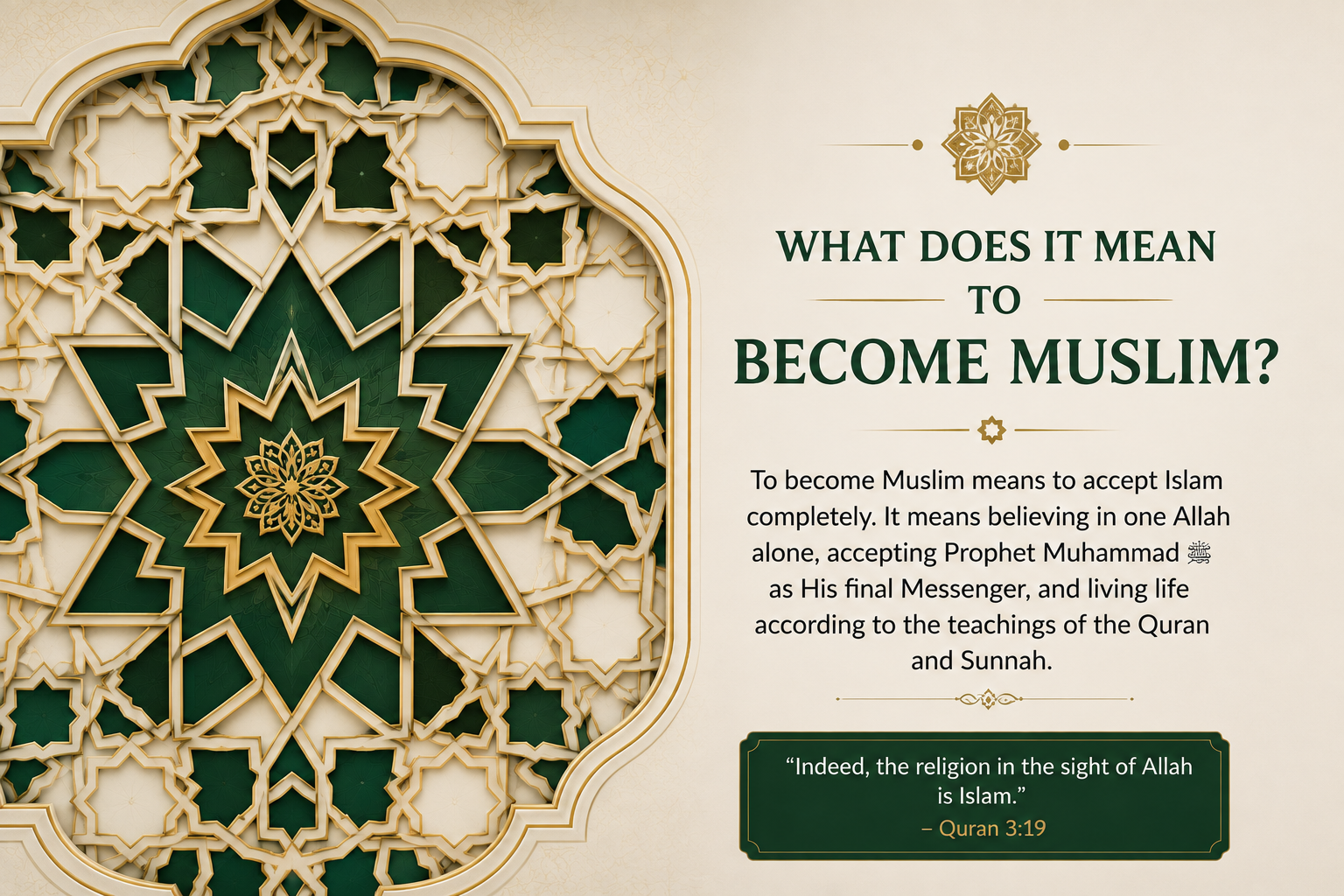
The word “Muslim” means someone who submits to Allah. At its center, Islam asks a person to accept one core idea: there is one God, without equal or partner, and Muhammad ﷺ is His final messenger — a title the Quran itself uses, calling him the “Seal of the Prophets” (Quran 33:40). Everything else in Islamic practice — prayer, fasting, charity, pilgrimage — grows out of that single belief.
Islamic teaching describes conversion not as joining an organization, but as returning to a natural, original state — which is why many Muslims use the word “revert.” This reflects a hadith in which the Prophet ﷺ said every child is born upon the fitrah, a natural inclination toward belief in one God (Sahih Muslim 2658). You don’t need to have grown up in a Muslim family, speak Arabic, or come from any particular background for this to apply to you.
“There is no compulsion in religion. The right path has become distinct from error.”
How Do You Know You’re Ready?
There’s no test, checklist, or minimum study period Islam requires before someone can say the Shahada. Some people arrive here after months or years of independent reading and quiet conviction; others reach a turning point — a difficult period, a verse that resonated, or the character of Muslims they know. Both are valid starting points; Islam doesn’t rank sincerity by how it was reached, only by whether it’s genuine.
A helpful question: if nothing else in your life changed — no new community, no family reaction — would you still believe this is true? If yes, that’s generally a sign of readiness, even with basic knowledge and many questions. You don’t need every question resolved, but you should sincerely believe the core message; discuss major doubts with a knowledgeable teacher rather than setting them aside. If a relationship is part of what brought you here, make sure your belief stands on its own.
What If You’re Afraid?
Fear near the Shahada is rarely fear of the declaration itself — it’s usually fear of what comes after: family reaction, getting the prayers wrong, “doing it right.” That doesn’t mean you’re unready. It helps to separate the two questions you’re actually facing: do you believe this is true, and what happens once people know? The Shahada only asks the first; the second is something you can plan for and get support with, including keeping your decision private for a while if needed.
Before You Take the Step: What You’re Actually Affirming
You Don’t Need to Be a Scholar First
A common misconception is that a person needs deep religious knowledge before they’re “ready.” That’s not how Islam works. You’re not expected to memorize the Quran, know Arabic, or master Islamic law before entering the faith — knowledge comes after belief, the same way a person learns to swim after getting into the water, not before.
The Core Beliefs You’re Affirming
While detailed study can wait, it helps to understand the six areas of belief (iman) underneath the Shahada, drawn from the well-known Hadith of Jibril, where the angel Jibril asked the Prophet ﷺ to define faith:
- Allah — One God, without partners, equals, or physical form
- The angels — Unseen beings carrying out Allah’s commands
- The revealed books — The Quran as the final, unaltered revelation
- The prophets — From Adam through Abraham, Moses, Jesus, and Muhammad ﷺ
- The Day of Judgment — Accountability for one’s life in the Hereafter
- Divine decree (qadar) — Allah’s knowledge and will encompass all things
Source: Sahih al-Bukhari 50 and Sahih Muslim 8, Book of Faith (Hadith of Jibril) — sunnah.com/bukhari:50
You don’t need a lecture-level understanding right now. If you can honestly say “I believe this,” that’s enough to move forward. Qadar often takes longer to sit comfortably with than the others — that’s normal, and deepens with years of practice.
Your Step-by-Step Path to Saying the Shahada
Reflect and Make Sure Your Intention Is Sincere
Before saying anything out loud, take a quiet ten minutes to ask yourself honestly why you want to do this — genuine conviction, or a relationship, family pressure, or a temporary feeling? Sincerity (ikhlas) matters more than the wording itself.
It’s normal to still have questions. Some feel sure within days; others sit with it for a year — neither is wrong. If a relationship is part of what brought you here, that isn’t disqualifying, but make sure your belief stands on its own.
Understand the Shahada — The Declaration of Faith
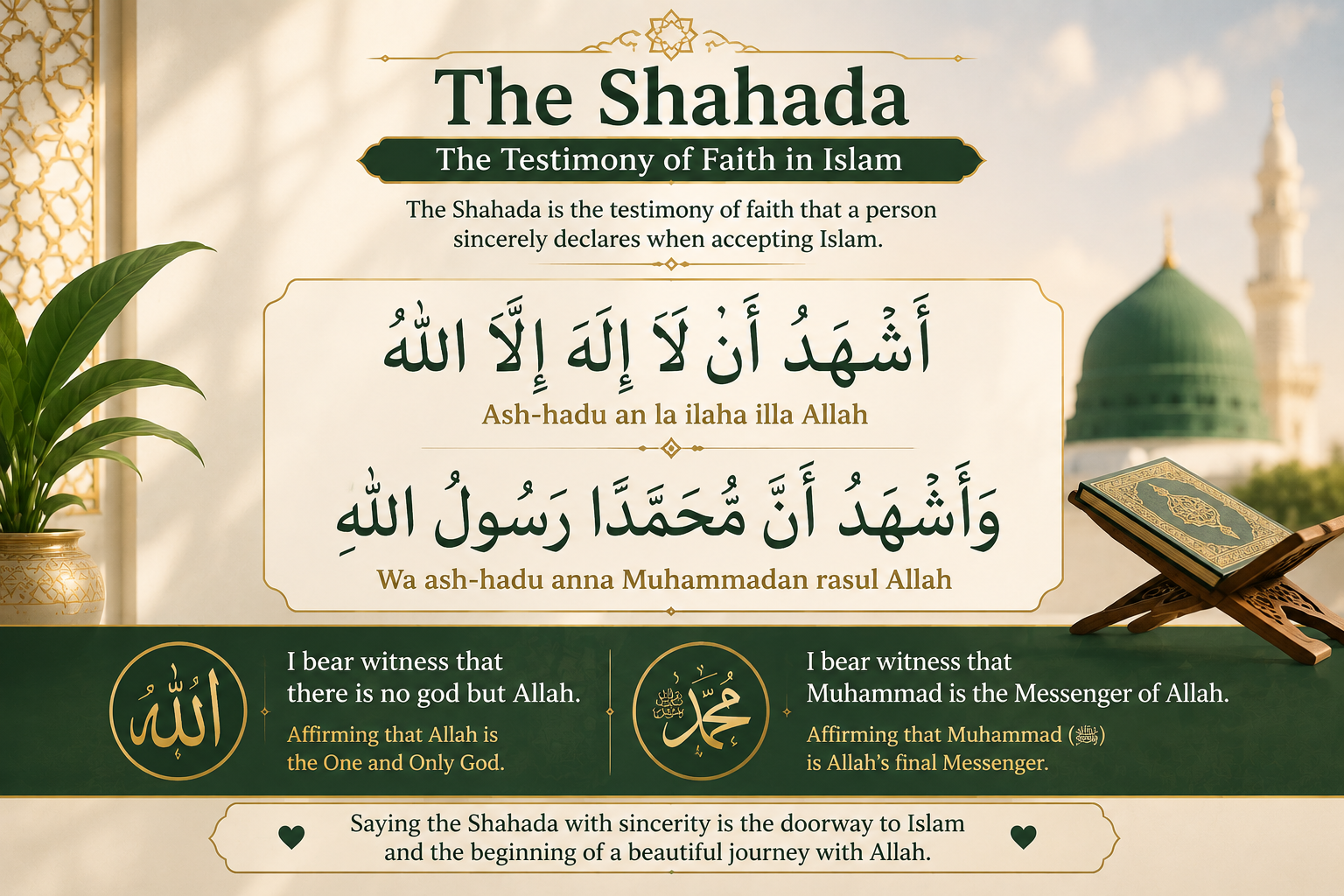
The Shahada is the sentence that, said with belief, makes a person Muslim:
Entering Islam means affirming both parts of the testimony — Allah alone is worthy of worship, and Muhammad ﷺ is His Messenger, which means accepting his teachings (the Sunnah) as a guide for living out the first. Scholars widely hold that saying it sincerely in a language you understand is valid, since belief and sincerity are what count, though learning the Arabic wording is worthwhile since it’s used throughout prayer.
Recite the Shahada
Say the Shahada out loud, understanding and believing each phrase. It’s the essential declaration by which a person enters Islam; other obligations are learned and practiced afterward as part of Muslim life.
Witnesses aren’t needed for the Shahada to count between you and Allah, but saying it in front of an imam or congregation is commonly recommended — it helps you get welcomed into a community and, if you want one, a conversion certificate. You can also say it alone at home; it’s fully valid, though visiting a mosque afterward is worthwhile for connecting with other Muslims.
What Happens the Moment You Say the Shahada
Ibn Shamasa al-Mahri narrated that as the companion Amr ibn al-As lay near death, he recalled asking the Prophet ﷺ to stretch out his hand so he could pledge allegiance on condition of forgiveness. The Prophet ﷺ asked whether Amr did not know that Islam, emigration (hijrah), and pilgrimage (Hajj) each wipe away what came before them.
Scholars explain this hadith as referring to sins against Allah alone. Debts or wrongs against other people are separate — it’s good practice to make things right with people once you’re able.
From the moment the Shahada is said with sincere belief, a person is fully Muslim — no probation period, no waiting period, no additional requirement between the declaration and full standing in the community.
Your First 24 Hours
If you have recently accepted Islam, our guide on your first 30 days as a Muslim can help you take the next steps with confidence.
If you’ve just said the Shahada, here’s a simple starting point — no need to rush all of it today:
- Make dua and thank Allah for guiding you here
- Learn the basics of purification (wudu)
- Learn today’s five prayer times using a prayer time calculator
- Begin learning the five daily prayers, one at a time
- Look for a trustworthy local teacher or community
- Give yourself permission not to learn everything in one day
How to Become Muslim: Common Practical Questions After Shahada
Do You Need to Perform Ghusl?
Ghusl is a full-body ritual bath. Many new Muslims perform it after Shahada as a symbolic fresh start, and some scholars view it as recommended (mustahabb), though this is a matter of scholarly discussion, not settled agreement. It is not a condition for the Shahada’s validity. If you’ll pray soon afterward, you’ll need wudu anyway, and ghusl can cover that too. For fuller discussion, IslamQA.info is a useful resource.
Do You Need to Change Your Name?
Generally, no. Islamic tradition documents the Prophet ﷺ changing a companion’s name only when it carried an objectionable meaning — not names that were simply non-Arabic. If your name is fine as is, keep it. If you choose a new first name — common but optional — guidance is to keep your father’s name and family name (nasab) intact.
Scholars differ on circumcision for male converts. It should never be presented as required before saying the Shahada — it isn’t a barrier to becoming Muslim, and is best discussed privately with a qualified scholar in your own time.
Do You Need Legal or Official Documentation?
Not for your faith to be valid. That said, many mosques offer a formal conversion certificate on request — no religious weight of its own, but useful later for things like a nikah or, in some countries, immigration paperwork.
What About Retaining Your Family Name and Lineage?
Islamic teaching places real importance on preserving lineage — the Quran instructs believers to call adopted or step-children by their fathers’ names rather than reassigning lineage, reflecting a broader principle that identity and ancestry aren’t discarded upon accepting Islam. Your family name, relationships, and history all remain exactly as they were.
Your First Steps as a New Muslim
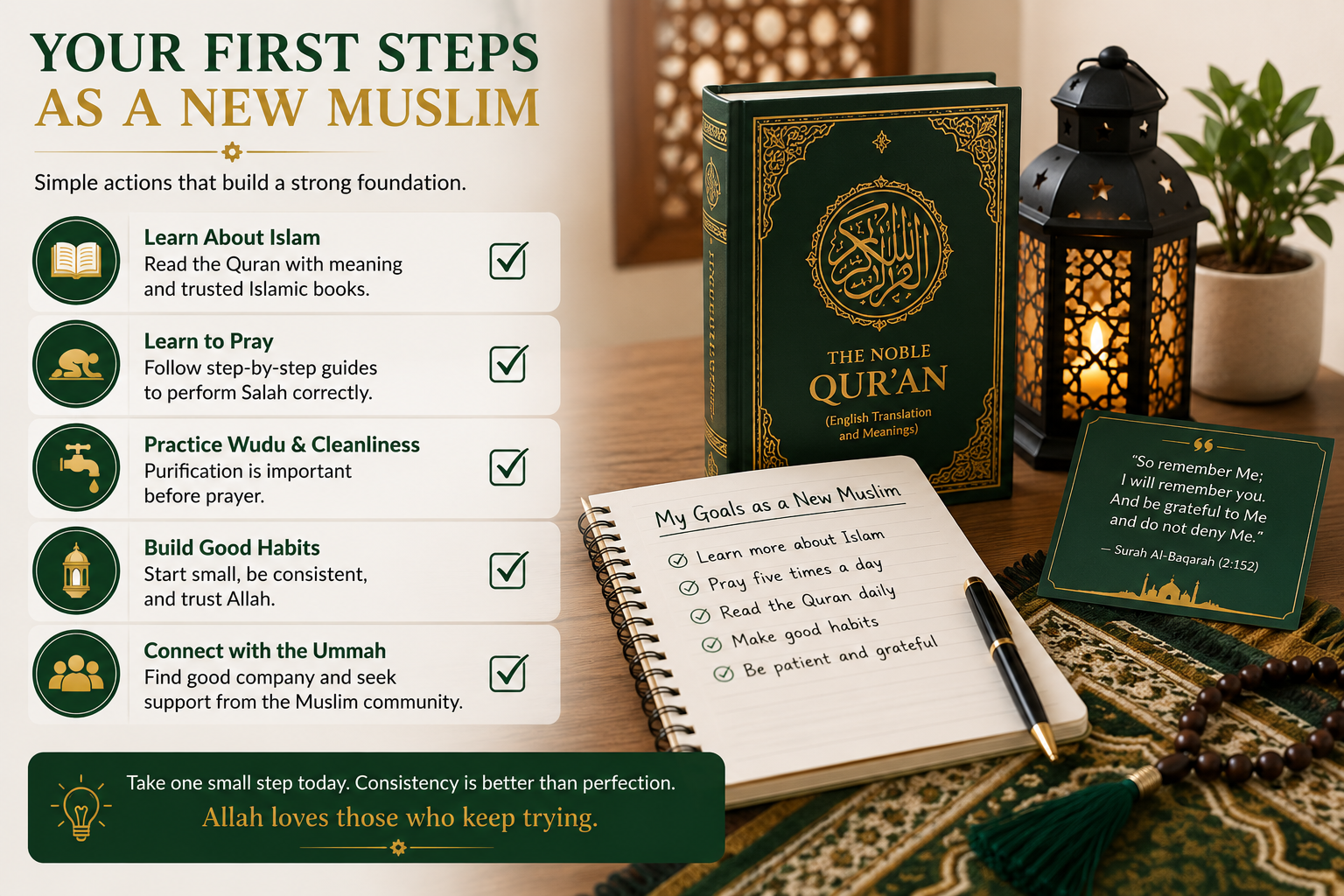
Once the Shahada is said, the day-to-day work of living it out begins. The Quran describes Allah’s intention as ease rather than hardship in matters of faith (Quran 2:185), so the goal is steady, sustainable progress rather than overnight perfection.
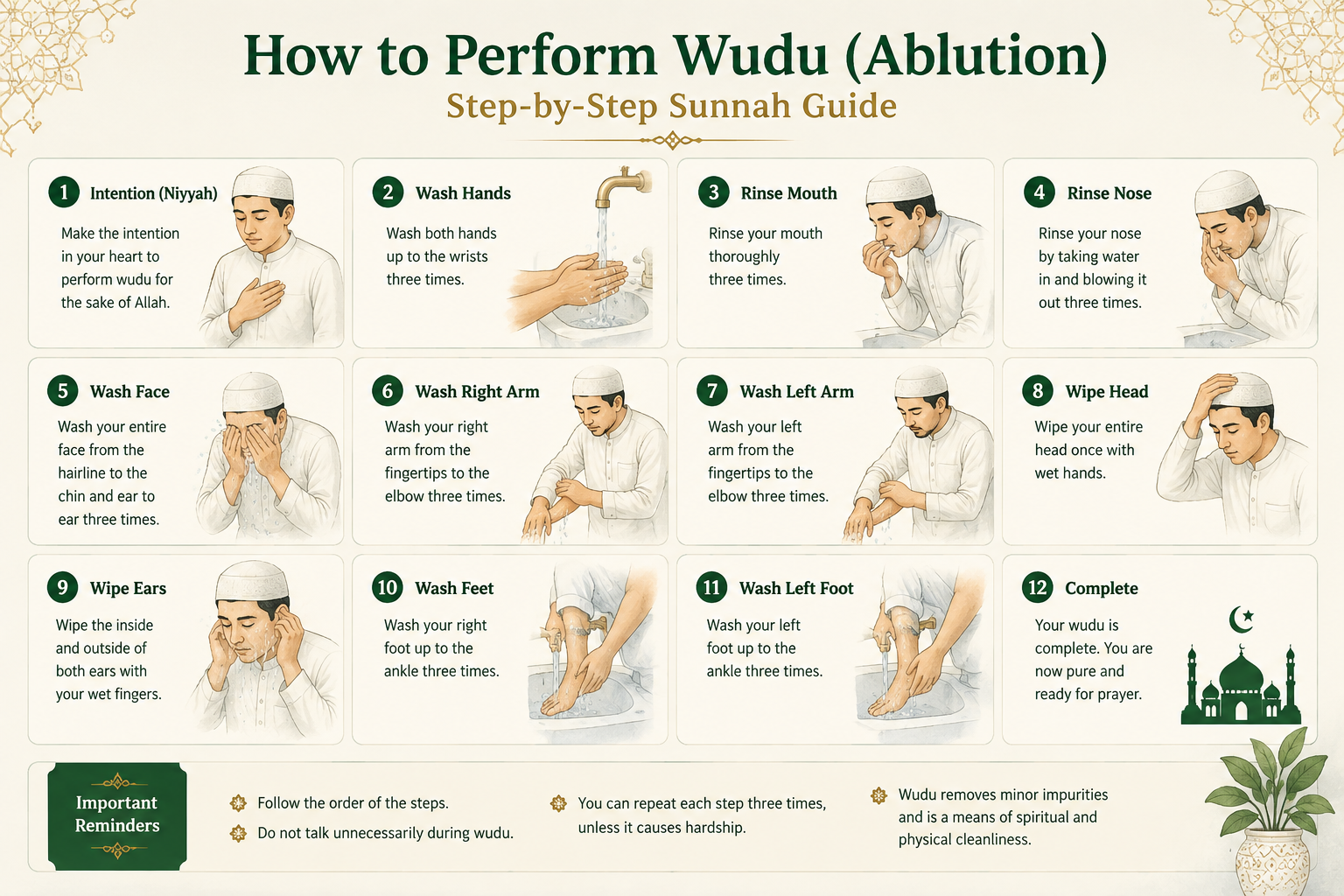
1. Learn Wudu (Ritual Purification)
Wudu covers the hands, mouth, nose, face, arms, head, and feet in a specific order. See our full guide on how to perform wudu correctly — a mosque or trusted friend can also show it to you in person.
2. Learn to Pray (Salah)
The five daily prayers are obligatory, so start learning all of them as soon as you’re able. Many people begin with Maghrib or Isha, since the movements are shorter, while continuing to learn the rest rather than treating them as optional. Our guide to praying Salah correctly walks through all five.
3. Start Reading the Quran in Translation
You don’t need Arabic to begin — a reliable translation lets you start understanding the message right away. See our guides on how to read the Quran correctly and how to understand the Quran. Many new Muslims start with shorter chapters near the end, which are also common in daily prayer.
4. Find a Local Community
A mosque is often the fastest way to get real answers and avoid the isolation that can come with a major life change. Many run dedicated new-Muslim classes.
5. Pace Yourself
It’s tempting to try to change everything in the first week. Good intentions can make that pressure feel even stronger, but sustainable change usually comes one step at a time — belief and daily prayer first, with diet, dress, and social habits following gradually.
One Possible First Week
There’s no required timeline, and pacing yourself matters more than following a schedule exactly — but if you’d like a rough shape for your first week, this is one reasonable way it could look:
- Reflect on the Shahada and what it means
- Learn wudu
- Begin learning the five daily prayers, one prayer at a time (e.g., start with Maghrib)
- Memorize Al-Fatihah
- Learn the five daily prayer times
- Begin reading a Quran translation
- Reach out to a local mosque or teacher
Common Mistakes New Muslims Make
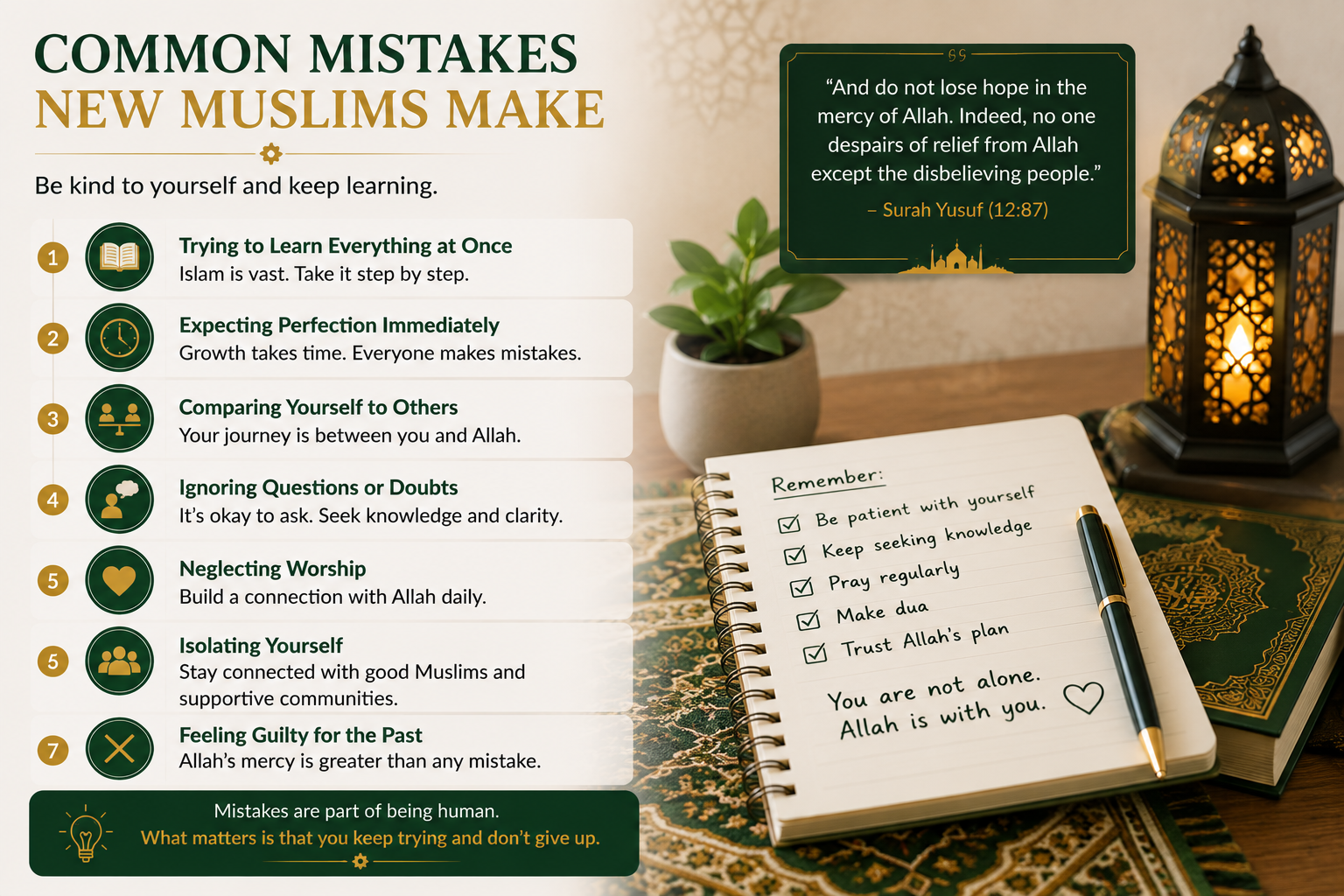
Overhauling diet, clothing, and friendships in week one instead of building sustainable habits over months.
Cutting people off unnecessarily instead of maintaining kind relationships, which Islamic teaching actively encourages.
Doubts and confusion are a normal, expected part of learning any new faith deeply.
A local mosque, qualified teacher, or verified material fills gaps social media alone can leave.
External changes like dress can come gradually alongside genuine understanding.
Common Misconceptions About How to Become Muslim
Converting doesn’t require a mosque ceremony, formal approval, a fee, or paperwork — a sincere Shahada is the entire requirement. It isn’t reserved for any ethnicity or nationality, and an Arabic name is a personal choice, not an obligation. It also doesn’t mean severing ties with non-Muslim family — Islamic teaching instructs kindness toward relatives regardless of faith, and that doesn’t change after conversion.
Telling Family and Friends
There’s no religious requirement to announce your decision immediately or to everyone at once. It often helps to lead with what hasn’t changed — your character, your relationships, your care for them — rather than everything that’s different. Many converts find it useful to have already learned the basics and found a support community before harder conversations, so they can answer questions calmly.
If revealing your decision could put you at risk of violence, homelessness, or serious harm, prioritize your safety first. Confide only in people you trust, and reach out to a local mosque or Muslim community organization — many have experience helping new Muslims navigate this safely.
Frequently Asked Questions
How do I know if I’m ready to become Muslim? +
Readiness isn’t about having every question answered — it’s about genuinely believing the core message: one God, and Muhammad ﷺ as His final messenger.
Is there a cost or fee to convert to Islam? +
No. Saying the Shahada costs nothing. A mosque conversion certificate is usually free or a small administrative charge at most.
Do I have to go to a mosque to convert? +
No. You can say the Shahada anywhere, including at home, and it’s fully valid. A mosque visit afterward is recommended for community, not required.
Can I become Muslim by myself, at home? +
Yes. Saying the Shahada sincerely and with understanding is what counts — no one else needs to be present.
What if I don’t know Arabic — can I still say the Shahada? +
Yes. Saying it with sincere belief in a language you understand is valid, though many new Muslims later learn the Arabic wording for prayer.
Will my family have to know right away? +
No. Sharing the news is a personal decision with no religious deadline attached.
What if I still have doubts after converting? +
That doesn’t mean you’ve failed — it’s a normal part of learning any faith deeply. Write down what’s confusing you and discuss it with a knowledgeable teacher.
What should I do immediately after saying the Shahada? +
Many new Muslims start by learning wudu, finding a local mosque or teacher, and beginning to learn the five daily prayers, one at a time. Steady progress matters more than speed.
Do I need to start praying five times a day and fasting immediately? +
The five daily prayers are obligatory and a new Muslim should begin learning and performing them as soon as possible — with patient guidance rather than pressure to master everything on day one.
Can a woman convert without her husband’s or family’s permission? +
Yes. Becoming Muslim is a personal decision between an individual and Allah — no one else’s permission is religiously required.
Is there an official certificate of conversion? +
Many mosques can issue one on request. It’s not required for your faith to count, but it can be useful later, such as for a nikah.
What’s the difference between “convert” and “revert”? +
Both describe the same act. “Revert” reflects the teaching that every person is born with an inclination toward belief in one God.
Do I need to stop eating certain foods right away? +
Dietary changes like avoiding pork and alcohol are part of Islamic practice, but most teachers advise easing into them — sincerity and steady effort matter more than instant perfection.
If you came here searching how to become Muslim, here’s the short version: one sincere sentence, said with belief, is all it takes. Ghusl, names, community, and learning to pray matter for what comes after — but none of it stands between you and the Shahada itself.
Sources
- Quran 2:256 — Surah Al-Baqarah, on there being no compulsion in religion (quran.com/2/256)
- Quran 33:40 — Surah Al-Ahzab, on Muhammad ﷺ as the Messenger of Allah and Seal of the Prophets (quran.com/33/40)
- Sahih al-Bukhari 50 / Sahih Muslim 8, Book of Faith — the Hadith of Jibril, on the six articles of iman (sunnah.com/bukhari:50)
- Sahih Muslim 121, Book of Faith — hadith of Amr ibn al-As on Islam, hijrah, and Hajj erasing prior sins (sunnah.com/muslim:121)
- Sahih Muslim 2658 — hadith on the fitrah (sunnah.com/muslim:2658)
- Quran 33:5 — Surah Al-Ahzab, on retaining lineage and family names (quran.com/33/5)
- Quran 2:185 — Surah Al-Baqarah, on Allah intending ease and not hardship (quran.com/2/185)
Procedural matters covered in this guide — including the language used to say the Shahada, witnesses, ghusl, naming, certificates, and circumcision — reflect general, widely-held scholarly guidance rather than a single citable primary text for each point, and readers are encouraged to consult a knowledgeable local scholar for their specific circumstances.
Continue Your Islamic Learning
New to the faith and not sure where to start next? We’ve laid out the basics in order.
How to Learn Islam Properly →