
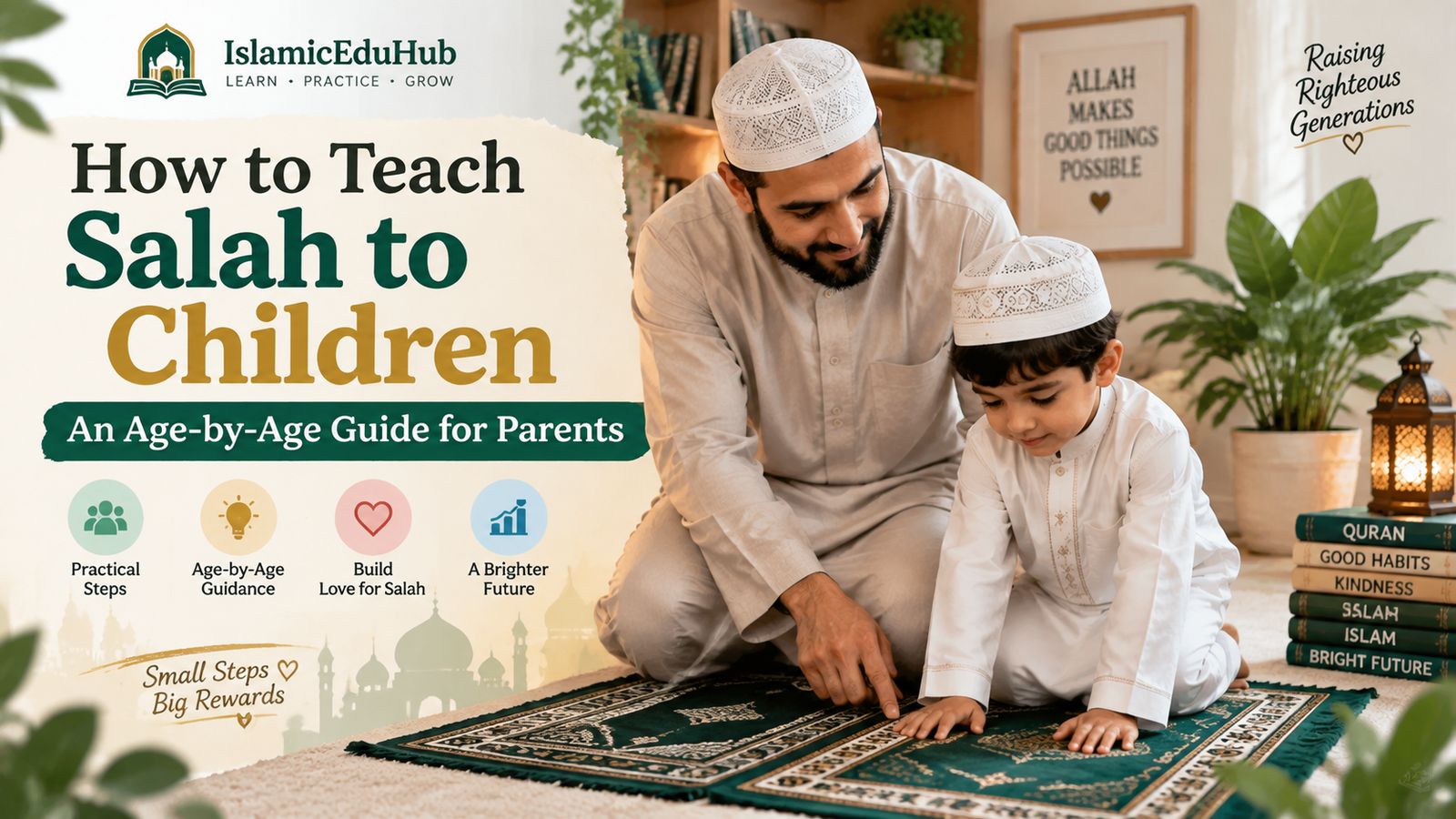
A practical, age-by-age guide to teaching a child Salah, from a toddler watching you pray to a ten-year-old praying independently, grounded in what the hadith actually says and how to apply it day to day.
The best way to teach Salah to children is a gradual, age-based process: let toddlers watch and copy (ages 2-4), introduce simple practice (5-6), start gently commanding and teaching properly from age 7, and support full independence by age 10. Lead by example, keep it positive, and teach the physical movements before expecting perfect recitation.
If you’re teaching prayer to children for the first time and not sure where to begin: start with exposure (age 2-4), not instruction. Kids’ salah training only really begins in earnest around age 7. Jump to Ages 2-4 if your child is young, or straight to Ages 7-9 if it’s time to start real teaching.
If any of this sounds familiar, you’re not alone. These come up constantly for parents teaching kids to pray:
- Not knowing what age to actually start, or feeling like you’ve already started “too late”
- A child who prays happily at 5 but resists by 8
- Wanting to be consistent without turning Salah into a source of daily conflict
- Confusion about what the “hit them at ten” hadith actually means in practice
On this page
- What the Hadith Actually Says
- Ages 2-4: Watch and Copy
- Ages 5-6: Gentle Introduction
- Ages 7-9: The Command Age
- Making Wudu Click
- Age 10+: Consistency and Independence
- How Long Does It Take?
- Understanding the “Age Ten” Instruction
- Making Salah Something They Want, Not Just Do
- If Your Child Resists or Loses Interest
- A Note on Girls and Modesty
- Verses and Hadith Worth Sharing
- Common Mistakes to Avoid
- FAQ
What the Hadith Actually Says
Salah is one of the Five Pillars of Islam, which is part of why teaching it well matters so much to parents. Almost every article on this topic references the same hadith, so it’s worth reading the actual text before anything else.
“Command your children to pray when they are seven years old, and discipline them for it (if they neglect it) when they are ten, and separate their beds.”
Sunan Abi Dawud 495; also Jami’ at-Tirmidhi 407. Scholars differ on this exact narration’s chain of transmission, with some grading it weak and others authenticating it through supporting narrations; the underlying principle of graduated, age-based teaching is widely accepted regardless.Notice what the hadith actually structures: gentle command and teaching starts at seven, not birth. Nothing here demands a toddler pray five times a day correctly, and nothing here suggests harsh treatment is the starting point. The three most important words for a parent to focus on are “command” (age 7), not “force” or “punish.” That’s why the rest of this guide focuses on what parents can actually do, day by day, instead of treating the hadith as a complete instruction manual on its own.
Every reliable source on this topic, hadith included, points the same direction: positive, consistent teaching is the actual method. The later clause about discipline only becomes relevant after years of that positive teaching, and for most families who start early and stay consistent, it never needs to be invoked at all.
Ages 2-4: Watch and Copy
At this age, there’s no formal teaching required, just exposure. A toddler standing next to you during Salah, copying your movements playfully, or hearing the Adhan in the background is doing exactly what this stage calls for. Some parents keep a small prayer mat next to their own so a toddler has “their spot” without any expectation attached to it.
Playing the Adhan out loud at each prayer time, even if you’re praying at home rather than hearing it from a mosque, helps a toddler start recognizing the sound as a signal that something familiar is about to happen. Letting them copy your bowing and prostration, even imperfectly or out of sync with your own timing, is actually part of how this stage works, not a distraction from it.
Beyond the prayer itself, building a broadly Islamic environment at home (Quran recitation playing in the background, Islamic books within reach, hearing “Bismillah” and “Alhamdulillah” used naturally in daily conversation) does more at this age than any structured lesson could. A toddler absorbs rhythm and atmosphere long before they absorb instructions.
Ages 5-6: Gentle Introduction
This is where structured practice can begin, without pressure. Having a child join you occasionally, on their own small mat, builds familiarity before it becomes an obligation for them. This is also a reasonable age to start naming the parts of Salah in simple language: standing, bowing, the two prostrations, sitting. You’re not testing correctness yet; you’re building recognition. A child at this age often enjoys having their own small prayer mat, chosen by them, since ownership over the physical object tends to make the whole practice feel more like theirs.
Ages 7-9: The Command Age
This is the age the hadith specifically names. From seven, gently and consistently command and encourage regular prayer, and start real teaching: Wudu step by step, the correct physical postures, and short daily recitations starting with Surah Al-Fatihah. As their recitation grows beyond a few short surahs, our guide on how to read the Quran correctly is a natural next step. Our full guide to praying Salah correctly is worth keeping open alongside this stage, since it covers each step in more depth than a parenting guide needs to. The emphasis at this stage is still gentle and consistent, not punitive. A seven-year-old learning wrong is completely normal; a seven-year-old learning at all is the actual goal.
- Teach Wudu as its own skill first. A child who can confidently perform Wudu feels ready for Salah in a way that skipping straight to prayer doesn’t achieve.
- Focus on movements before recitation. Getting the standing, bowing, and prostration right, even with imperfect Arabic, is a completely reasonable starting point.
- Pray together, out loud, where they can hear you. Children pick up recitation through repetition far more than through flashcards.
- Celebrate the attempt, not just the accuracy. A rushed, imperfect prayer said consistently beats a perfect prayer said once a month.
Making Wudu Click Before Salah Does
Wudu often gets treated as a formality to rush through on the way to Salah, but for a young child it’s truly its own skill to master, and rushing it tends to produce a child who skips steps for years afterward. A step stool at the sink, a simple rhyme or counting method for the order of washing, and letting a child practice Wudu on its own (without immediately moving into Salah afterward) all help it become a habit in its own right rather than an obstacle before the “real” part starts.
Week 1-2: Teach Wudu alone, no Salah expectation yet. Week 3-4: Add Salah movements without full recitation, said alongside you. Month 2: Introduce Surah Al-Fatihah and one short surah. Month 3 onward: Build toward independent prayer for one daily prayer before expecting all five.
Age 10+: Consistency and Independence
By this stage, most of the learning curve should be behind you, and the focus shifts to consistency: praying without being reminded every single time, understanding why Salah matters (not just how to perform it), and gradually taking full ownership of it. This is also the age some families introduce separate sleeping arrangements for siblings, per the second half of the hadith above.
Track it all on one page. This free printable checklist covers every stage above, so you can check off milestones as your child moves through them.
Download the Checklist (Free PDF)How Long Does It Take a Child to Learn Salah?
There’s no single answer, because “learning Salah” actually covers several separate skills that develop at different speeds. Most children can learn the physical movements reasonably well within a few months of consistent practice starting around age 7. Memorizing Surah Al-Fatihah and a short surah for recitation typically takes a similar few months alongside that. Full independence, praying all five daily prayers consistently without reminders, is a longer process; many families see this solidify somewhere between ages 9 and 12, which is exactly why the hadith gives a three-year window (7 to 10) rather than expecting mastery on day one.
The honest answer for most parents asking this question is: expect the physical steps within months, and expect true independence within years. Neither timeline is a race against other children, and a child who takes longer on any part of it is not behind some external standard, just moving through their own version of the same three-year process the hadith itself describes.
Understanding the “Age Ten” Instruction
This is the part of the hadith that generates the most anxious questions from parents, so it deserves direct treatment rather than being glossed over. Classical scholars who accept this narration are consistent on several limits: any physical response described here is meant to be light, symbolic, never on the face, never causing injury, and used only as an absolute last resort after years of gentle, consistent teaching have already been tried. It is not a first response, not a daily tool, and not something the hadith presents as effective parenting on its own, separate from everything that should have already happened between ages seven and ten.
Many contemporary scholars and Islamic parenting educators place far more weight on the “command” at seven than the “discipline” at ten, on the reasoning that a child who has been taught gently, consistently, and with real explanation for three years rarely reaches age ten needing this clause invoked at all. If you’re looking for the practical, day-to-day approach that actually gets a child praying, it’s everything in the sections above and below, not this clause.
This is a sensitive area of religious guidance, and family circumstances vary. Parents wanting a specific ruling for their own situation should seek guidance from a qualified local scholar or imam rather than relying on a general article like this one.
Making Salah Something They Want, Not Just Do
- Lead by example, visibly. Children absorb far more from watching a parent truly value Salah than from being told to value it
- Connect it to meaning, not just mechanics. Explaining that Salah is a direct conversation with Allah lands differently than “it’s what we do”
- Use positive reinforcement. Simple praise, a sticker chart, or a small routine (like a special after-Fajr breakfast) works better than punishment-based motivation
- Tell them stories. Stories about the prophets and their devotion to prayer give children something to aspire to, not just a rule to follow
- Let imperfection be okay. A child rushing through Salah or forgetting a step is not a crisis; it’s a normal part of learning something over years, not weeks
None of this needs to happen perfectly or on a fixed timeline. Families move through these stages at different speeds, and a child who takes an extra year to reach full independence isn’t falling behind anything measurable; they’re just moving at their own pace through a process the hadith itself frames in years, not weeks.
If Your Child Resists or Loses Interest
A child who prayed happily at six and resists at nine is common, not a sign that something has gone wrong. Before assuming defiance, check the practical reasons first: are they overtired at the prayer time you’re asking for, is the mat uncomfortable, do they actually understand what’s being asked of them, or has Salah started to feel like a punishment attached to bad behavior rather than its own thing? Reconnecting with the “why” (through a story, a conversation, or simply praying together again instead of sending them alone) usually does more than repeating the instruction louder.
It also helps to separate two different problems that can look identical from the outside: a child who has truly forgotten why Salah matters, and a child going through an ordinary phase of pushing boundaries on everything, not just prayer. The second kind of resistance usually fades on its own with patience and consistency; the first kind is where a real conversation about meaning, not just routine, tends to make the difference.
A Note on Girls and Modesty
As girls approach the age where Salah becomes obligatory, appropriate covering (hijab) during prayer becomes part of the practical teaching, even before it’s expected outside of prayer. Introducing a simple prayer garment early, without making it feel like a sudden new rule, tends to ease this transition. Families vary in exactly when they introduce this, and it’s worth discussing with a local teacher or imam if you’re unsure of the timing that fits your child.
Verses and Hadith Worth Sharing With Older Children
For children old enough to understand a short explanation, a few sources beyond the age-7/age-10 hadith help build a child’s own sense of why Salah matters, rather than it only being a parental instruction.
“Indeed, prayer prohibits immorality and wrongdoing, and the remembrance of Allah is greater.”
Surah Al-Ankabut (29:45)“Indeed, the first deed by which a servant will be called to account on the Day of Resurrection is his Salat. If it is complete, he is successful and saved, but if it is defective, he has failed and lost.”
Jami’ at-Tirmidhi 413Neither of these needs to be delivered as a lecture. A single sentence, said once and revisited occasionally rather than repeated daily, tends to land better with a child than a verse quoted every time Salah comes up. As children get older, introducing them to how to make dua alongside Salah rounds out their sense of a personal connection with Allah, not just a set of movements.
How to Teach Salah to Children: Common Mistakes to Avoid
The core hadith cited above is given with its exact collection and number, cross-referenced with Sunnah.com. Where scholarly opinion actually differs (on the chain of transmission, and on how the “discipline” clause should be understood and applied today), that difference is stated directly rather than presented as one settled view.
- Hadith citations: collection and hadith number given directly above each quotation; verify exact wording against Sunnah.com before teaching or publishing from it.
Last reviewed for references: September 2026.
Frequently Asked Questions
What age should I start teaching my child Salah?
Exposure can start as early as toddlerhood through watching and copying, but structured teaching typically begins around age 5-6, with the hadith specifically naming age 7 as when to start gently commanding regular prayer.
Does the “hit them at ten” hadith mean I have to physically discipline my child?
No. Scholars who accept this narration describe strict limits: light, symbolic, never on the face, never causing harm, and only as an absolute last resort after years of gentle teaching. Most practical Islamic parenting guidance focuses on the positive teaching from age 7 onward, which is what actually determines whether this clause ever becomes relevant.
What if I feel like I started too late?
There’s no cutoff that makes teaching Salah “too late.” A ten or twelve-year-old who hasn’t been taught yet still benefits enormously from starting today, using the same gentle, consistent approach described for younger ages.
Should boys and girls be taught differently?
The core teaching process is the same for both. The main practical difference is introducing appropriate covering for prayer as girls approach the age Salah becomes obligatory for them.
My child knows the movements but rushes through them. Is that okay?
For a child still learning, yes. Consistency and gradual improvement matter more at this stage than a perfectly unhurried prayer; that refinement comes with years of practice, not immediate correction.
How do I keep my child motivated once the novelty wears off?
Praying together as a family rather than sending a child to pray alone, connecting Salah to stories and meaning rather than just rules, and noticing effort out loud all help sustain motivation past the initial excitement.
Should I make my child repeat a prayer if they got a step wrong?
Generally no, for a child still learning. Gently correcting afterward, in a calm moment rather than mid-prayer, tends to preserve their confidence better than stopping and restarting.
What if my older child (10+) still isn’t praying consistently?
Revisit the same building blocks used for younger ages: connection over correction, understanding the meaning, and praying together rather than only reminding. A child who missed the earlier stages can still build the habit, just with more patience required.
Keep building your family’s foundation
Want the full step-by-step Salah guide to teach from, or a printable activity to reinforce it at home?