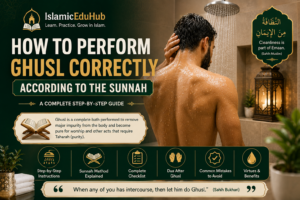
A day-by-day roadmap for your first month as a Muslim — what to learn, in what order, and how to pace yourself without feeling overwhelmed.
- What’s Normal Right Now
- Ghusl After Becoming Muslim
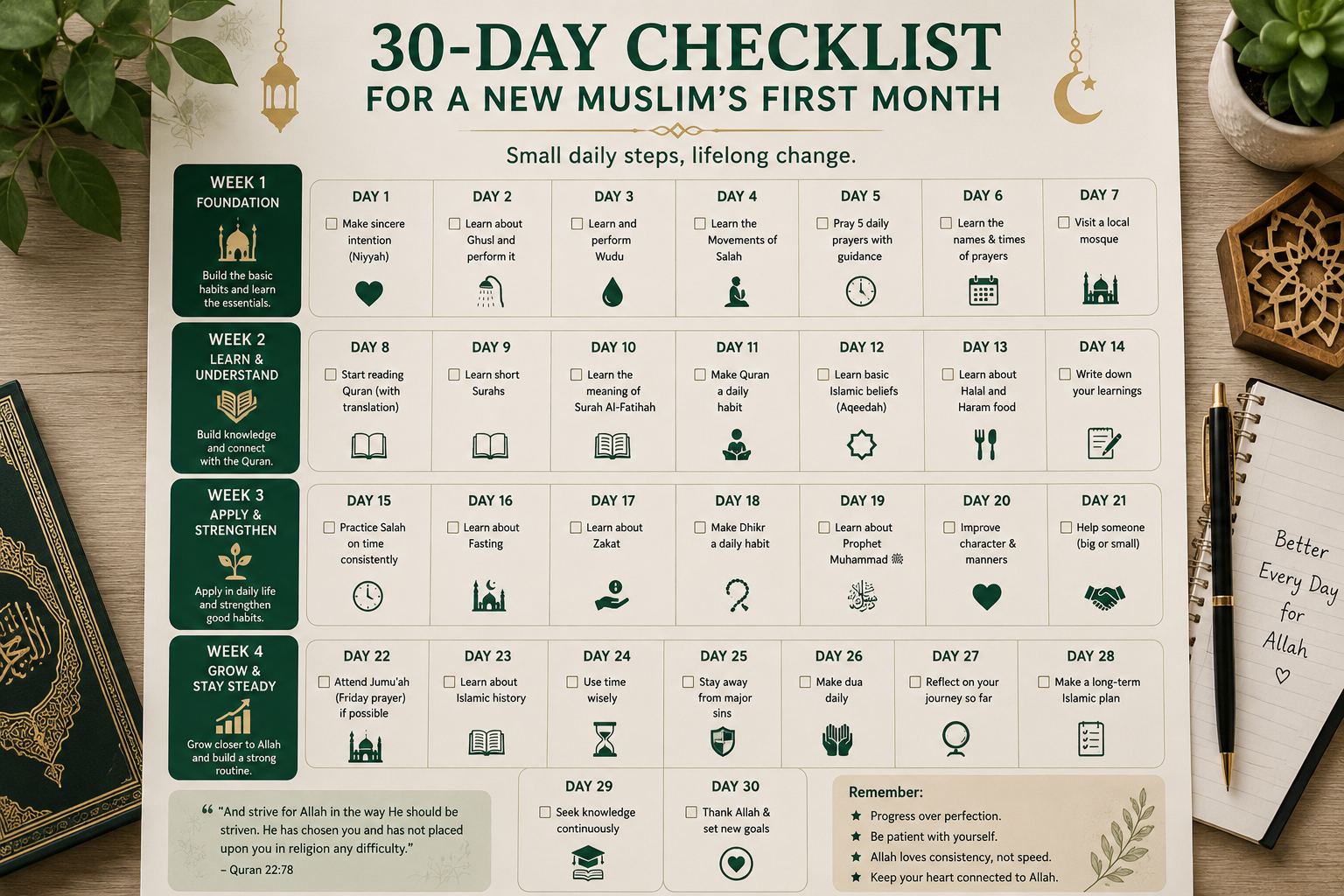
- Days 1–3: Purification & First Prayer Steps
- Days 4–7: Learning All Five Prayers
- Days 8–14: Strengthening & the Quran
- Days 15–21: Community & Knowledge
- If Family Doesn’t Support You
- Days 22–30: Steadying Your Practice
- The Emotional Side of This Month
- Common Mistakes in the First 30 Days
- What Happens After Day 30
- FAQ
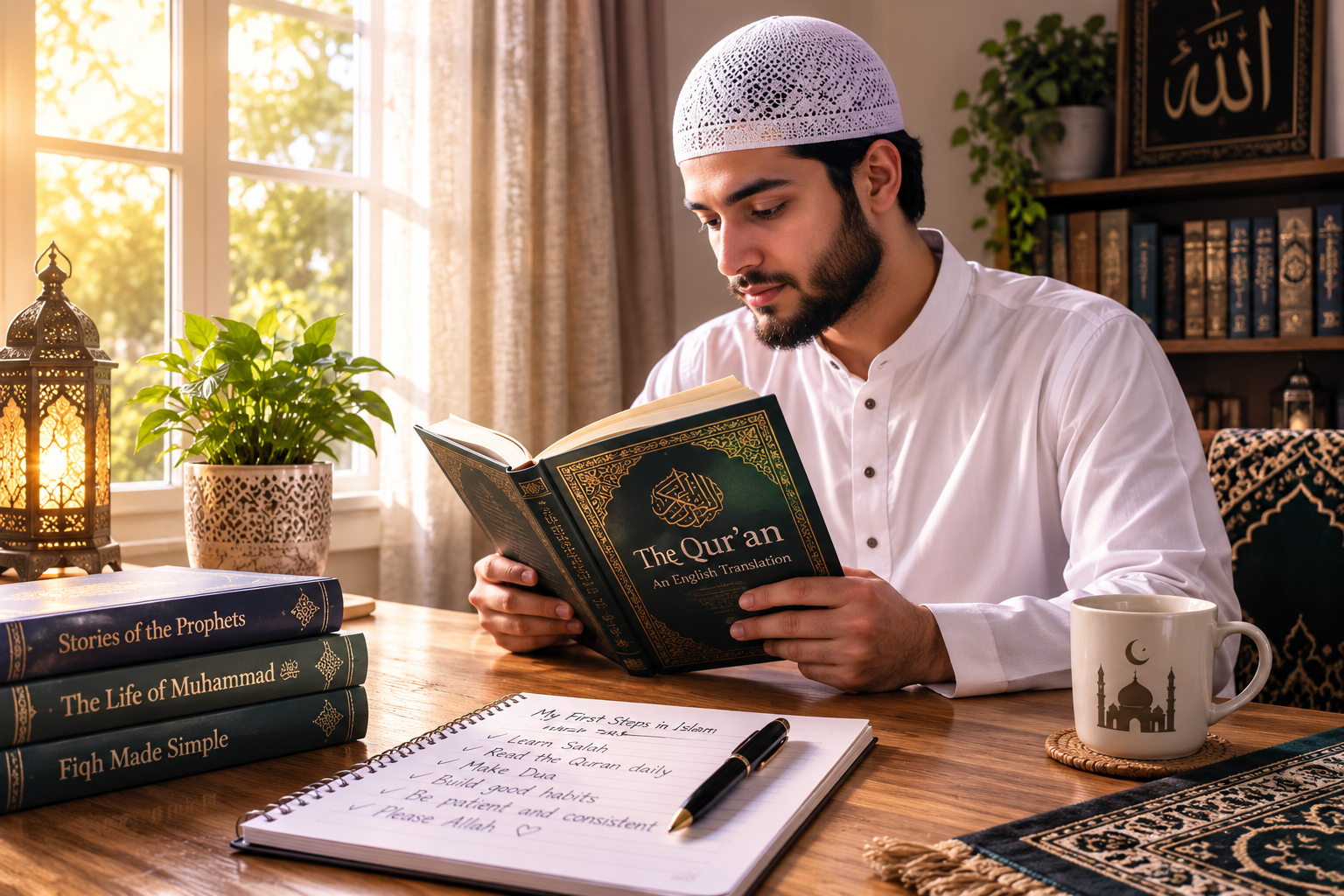
So you’ve said the Shahada — now what? This is a question many new Muslims have in their first few days, usually somewhere between joy and the slight panic of not knowing where to start. Islam doesn’t expect you to learn everything at once — it rewards steady, ordered progress, and that’s exactly what this guide gives you: a simple day-by-day plan built around what actually needs to come first.
Nothing here is a rigid rulebook — your first 30 days might move faster or slower, and that’s fine. What follows starts with what’s obligatory, learns it correctly, then widens out.
The five daily prayers are obligatory from the moment you become Muslim — they are not something to delay. In your first 30 days, focus on learning wudu and all five prayers correctly as quickly as you’re able, ideally with help from a knowledgeable teacher (Days 1–14), starting the Quran in translation and connecting with a mosque or local Muslim community (Days 8–21), and steadying your habits while learning the rulings around ghusl, fasting, and zakat as they become relevant to you (Days 22–30).
What’s Normal Right Now
You may feel a mix of excitement and uncertainty, and that’s ordinary. A common worry is: “I don’t know where to begin.” You’re not behind — there’s no clock running and no test you can fail this month.
The one thing worth doing early is making dua — even in your own words — thanking Allah for guiding you here and asking for help to learn well. That single habit, more than any checklist, will carry you through harder days ahead.
The Prophet ﷺ is reported to have said: “Make things easy and do not make them difficult, cheer people up and do not repel them.”
Ghusl After Becoming Muslim: What You Need to Know
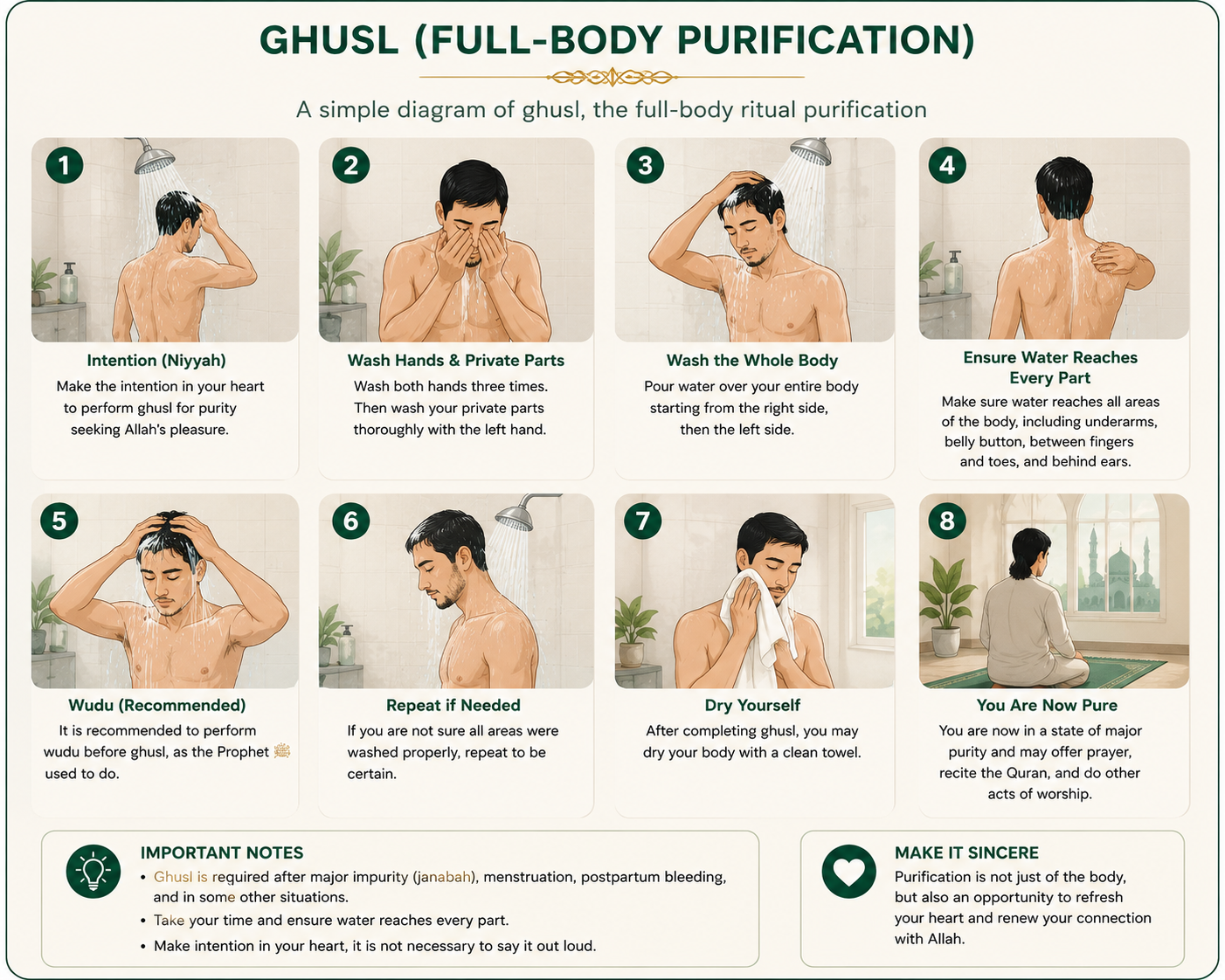
Ghusl is a full-body ritual purification. It’s an established practice many new Muslims perform right after Shahada, though scholars differ on whether it’s strictly obligatory upon entering Islam or recommended (mustahabb) as a symbolic fresh start. Either way, ghusl isn’t a condition for your Shahada’s validity — never delay accepting Islam because ghusl isn’t immediately possible. Separate rulings apply to ghusl connected to states like janabah or menstruation; a knowledgeable teacher can walk you through specifics.
Days 1–3: Purification & First Prayer Steps
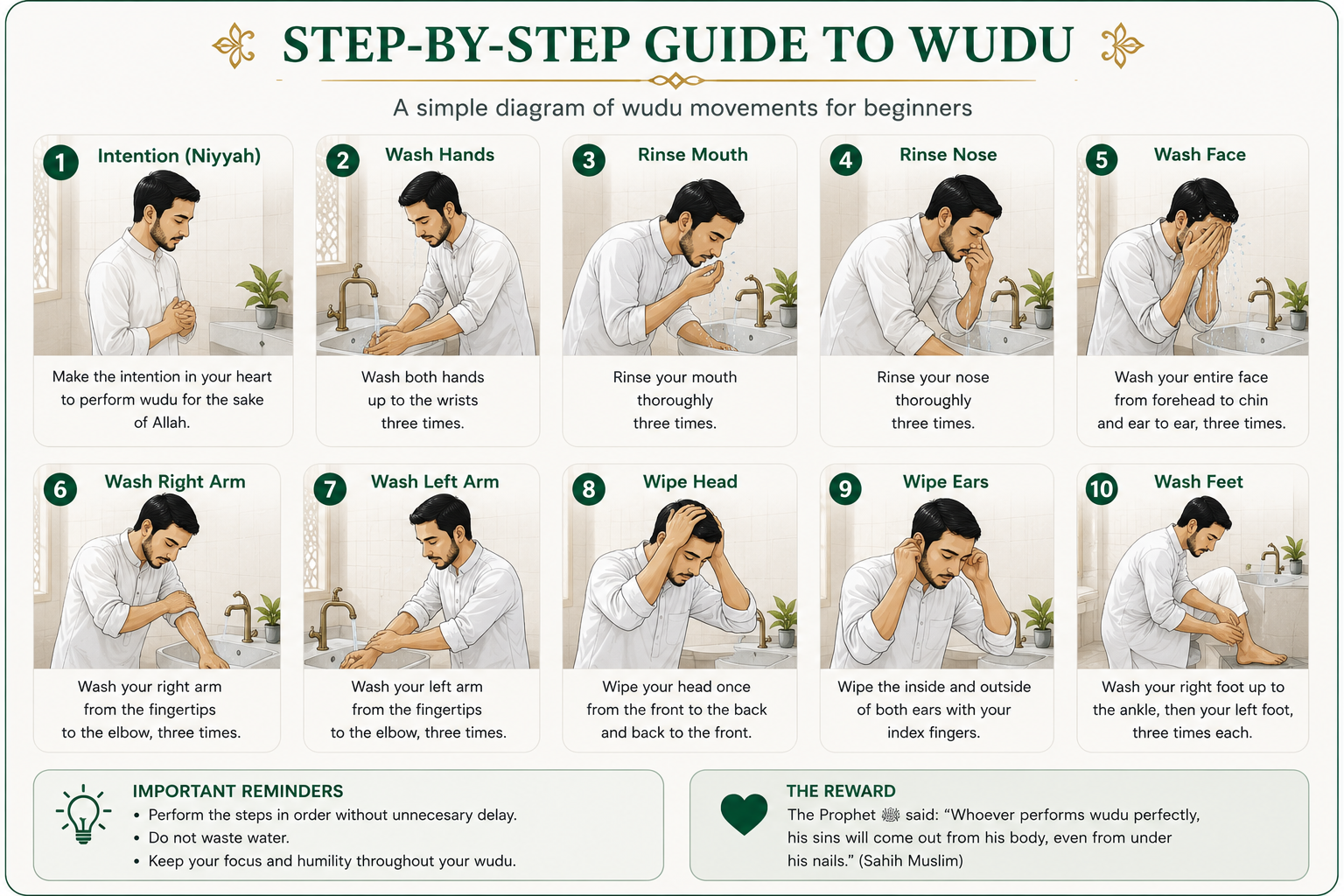
The five daily prayers are obligatory for every Muslim from Shahada onward — this isn’t something you work up to over weeks. What takes time is learning to perform them correctly, and that’s the task of your first few days: begin learning wudu, then start on prayer’s movements, ideally with a teacher.
A simple shape for Days 1–3:
- Day 1 Perform ghusl if you’re able to, then learn wudu — the washing routine before prayer. Practice it a few times so the sequence feels familiar. See our full guide on how to perform wudu correctly.
- Days 2–3 Begin learning the movements of prayer with a teacher or reliable guide. You should aim to start learning all five prayers as soon as you’re able — if learning everything at once feels difficult, you can practice one prayer’s movements at a time while continuing to learn the others alongside it. This is a learning strategy, not a delay in the obligation to pray. Our guide to praying Salah correctly walks through all five.
Days 4–7: Learning All Five Prayers
By this point you should be actively learning all five daily prayers, not just one. Keep working with your teacher or guide on each prayer’s movements and recitation — small mistakes are easy to fix early and harder to unlearn later.
A simple shape for Days 4–7:
- Days 4–5 Continue learning the remaining prayers, paying attention to the number of rak’ahs, the prayer times, and the required recitations for each one.
- Days 6–7 Memorize Surah Al-Fatihah, the short chapter recited in every unit of prayer, and start using a prayer time calculator so you know when each prayer begins.
Days 8–14: Strengthening Your Routine & the Quran
By now you should be attempting all five prayers, even if they don’t feel smooth yet. This second week is about steadying that routine and starting to read. Keep expectations modest about polish — correctness matters more than speed right now.
- Keep working with a teacher or guide to correct your prayer movements and recitation as you gain confidence.
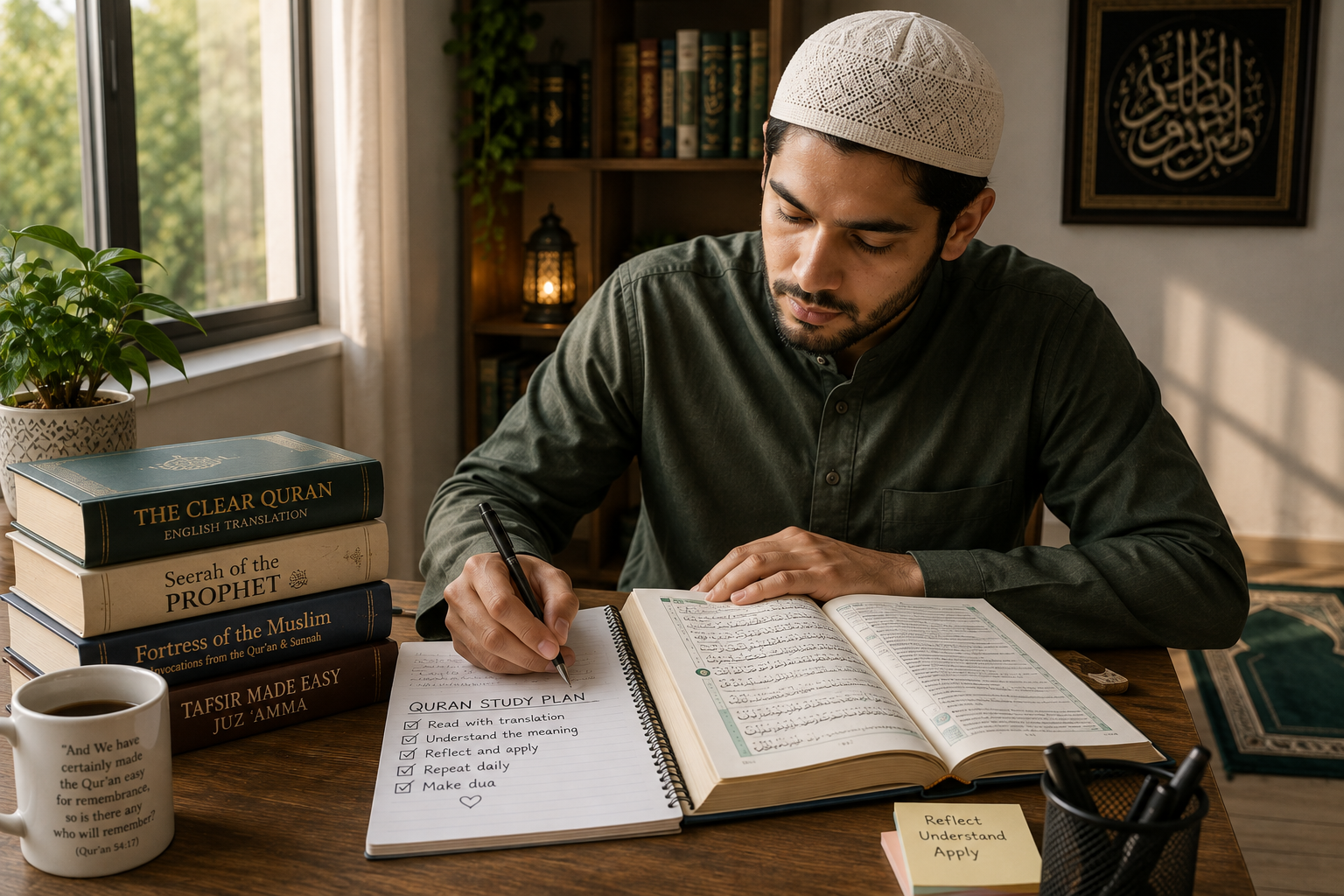
- Start reading the Quran in translation. You don’t need Arabic to begin understanding the message — our guide on how to read the Quran correctly can help you pick a reliable translation and a simple daily rhythm.
- Begin learning the basic halal and haram food rules. If you need a simple starting point, learn to avoid pork and alcohol first, then work through the other rules relevant to your daily life at a pace you can sustain.
“Allah does not burden a soul beyond what it can bear.”
Why This Order, Specifically?
It’s a fair question — why ghusl and prayer before Quran, and Quran before mosque visits? Prayer is the daily obligation from day one, so correct guidance on it comes first. Reading the Quran deepens the belief behind it, so that’s next. Community works best once you already have real questions to bring. None of this changes what’s obligatory — it’s simply a reasonable learning order teachers commonly recommend.
Days 15–21: Community & Knowledge
By this stage, prayer and reading should feel routine. This phase shifts outward — toward people who can actually answer your questions in real time, which no article or video fully replaces.
- Visit a local mosque if you haven’t already. Most have new-Muslim classes or someone willing to answer questions.
- Find one person, not just one source. A local teacher, imam, or knowledgeable friend is worth more than a dozen bookmarked articles.
- Be careful with social media as your only teacher. It’s fine for quick answers but can leave gaps — a real person you can ask follow-ups is safer.
- Keep a running list of questions as they come up, rather than trying to remember them all at once.
If your family or living situation makes visiting a mosque difficult right now, online new-Muslim communities and one-on-one calls with a teacher are a reasonable substitute. Be cautious with people you only know online — treat money requests, pressure to join a group quickly, or marriage pressure as red flags, and lean on a local mosque for vetted contacts instead.
If Your Family Does Not Support Your New Faith
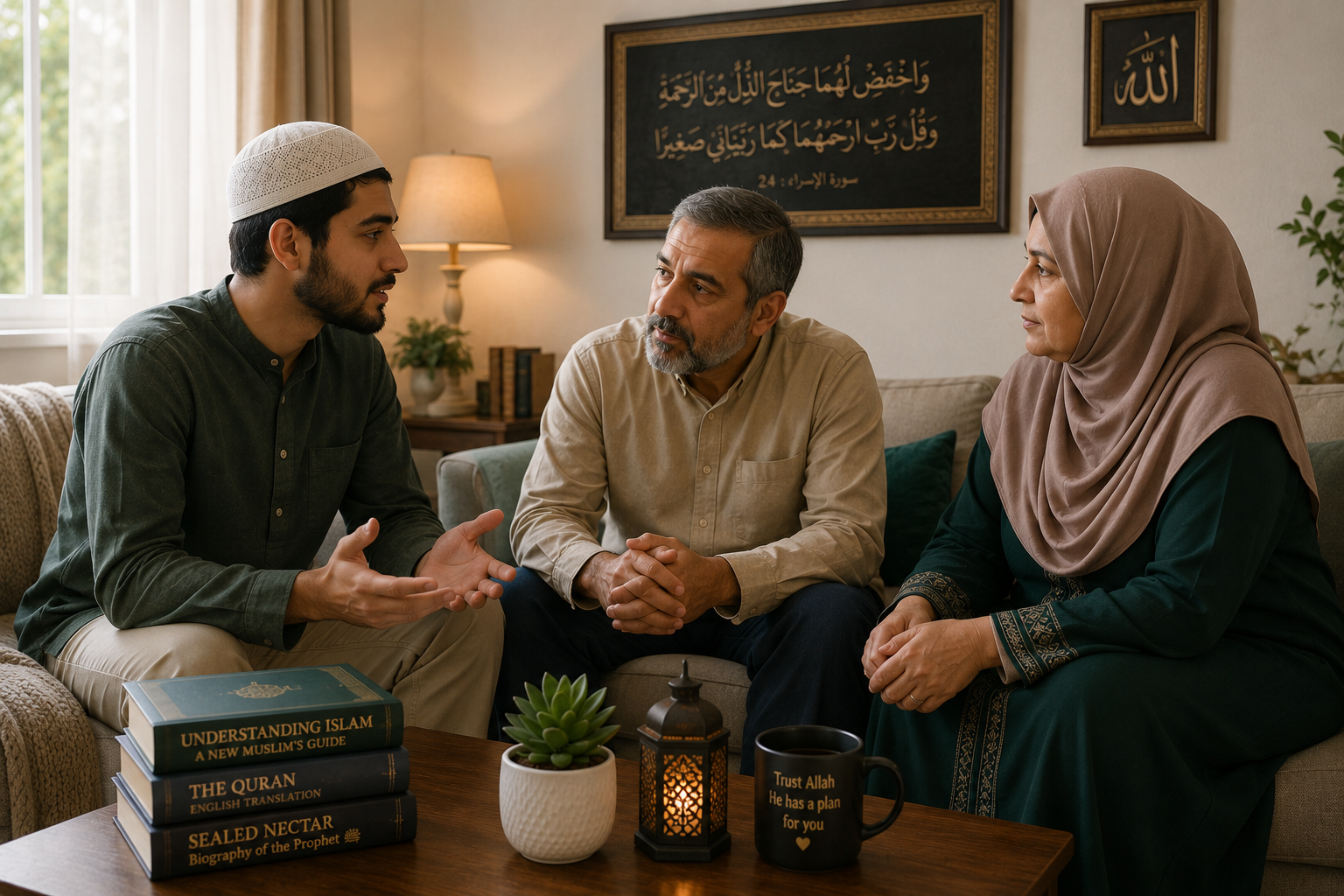
This is one of the hardest parts of the first month, and it deserves its own space rather than a footnote. A few things worth holding onto:
- You don’t have to announce it immediately or to everyone at once. There’s no religious deadline.
- Lead with what hasn’t changed — your character, your love for them, your role in the family.
- Prioritize safety first if disclosure could put you at risk of harm or homelessness. Confide only in people you trust, and reach out to a local mosque or Muslim community organization for support.
- Kindness toward non-Muslim family isn’t optional — it’s part of the religion. The Quran instructs kindness to parents even amid serious disagreement over faith (Quran 31:15), and justice and kindness toward those who don’t fight believers over religion (Quran 60:8).
- Avoid arguments about religion early on if things are tense — calm conversations go further than debates.
Days 22–30: Steadying Your Practice
The final stretch isn’t about adding something new — it’s about making the previous weeks feel stable rather than fragile.
- Learn about Jumu’ah (Friday prayer). If it’s applicable to you and you’re able to attend, our guide to Jumu’ah prayer explains what to expect and who it’s obligatory for.
- Let dress and lifestyle changes continue gradually. There’s no deadline for this — sincerity and steady effort matter more than an instant transformation.
- Build a small dua habit beyond the prayer itself — even one or two duas you say after each prayer, using our guide to making dua as a starting point.
- Review the 5 Pillars of Islam so you understand where fasting, charity, and pilgrimage fit into the bigger picture, even though neither is urgent yet — see our overview of the Five Pillars.
The Emotional Side of This Month
Nobody talks about this part enough: the first month after Shahada is rarely a straight line. You may have days that feel peaceful and almost effortless, followed by days that feel confusing, lonely, or exhausting for no obvious reason. Both are normal, and neither one means you made a mistake or that your faith isn’t real.
If a specific worry keeps circling back — family reaction, a missed prayer, a habit you haven’t dropped yet — write it down rather than carrying it silently. Bring it to your teacher or the friend you connected with. Doubts and slip-ups are part of learning any faith deeply, not evidence that you’re failing.
It also helps to notice which days are harder and why. Some find Fridays or family gatherings harder because old routines clash with new ones; others find a quiet weekday evening hardest, once the initial excitement fades. If you’re working during the day, figure out where you can pray — a quiet corner, your car, an empty room. If your family doesn’t know yet, you may need a private time and place to practice. Naming the pattern, even just to yourself, makes it easier to plan around.
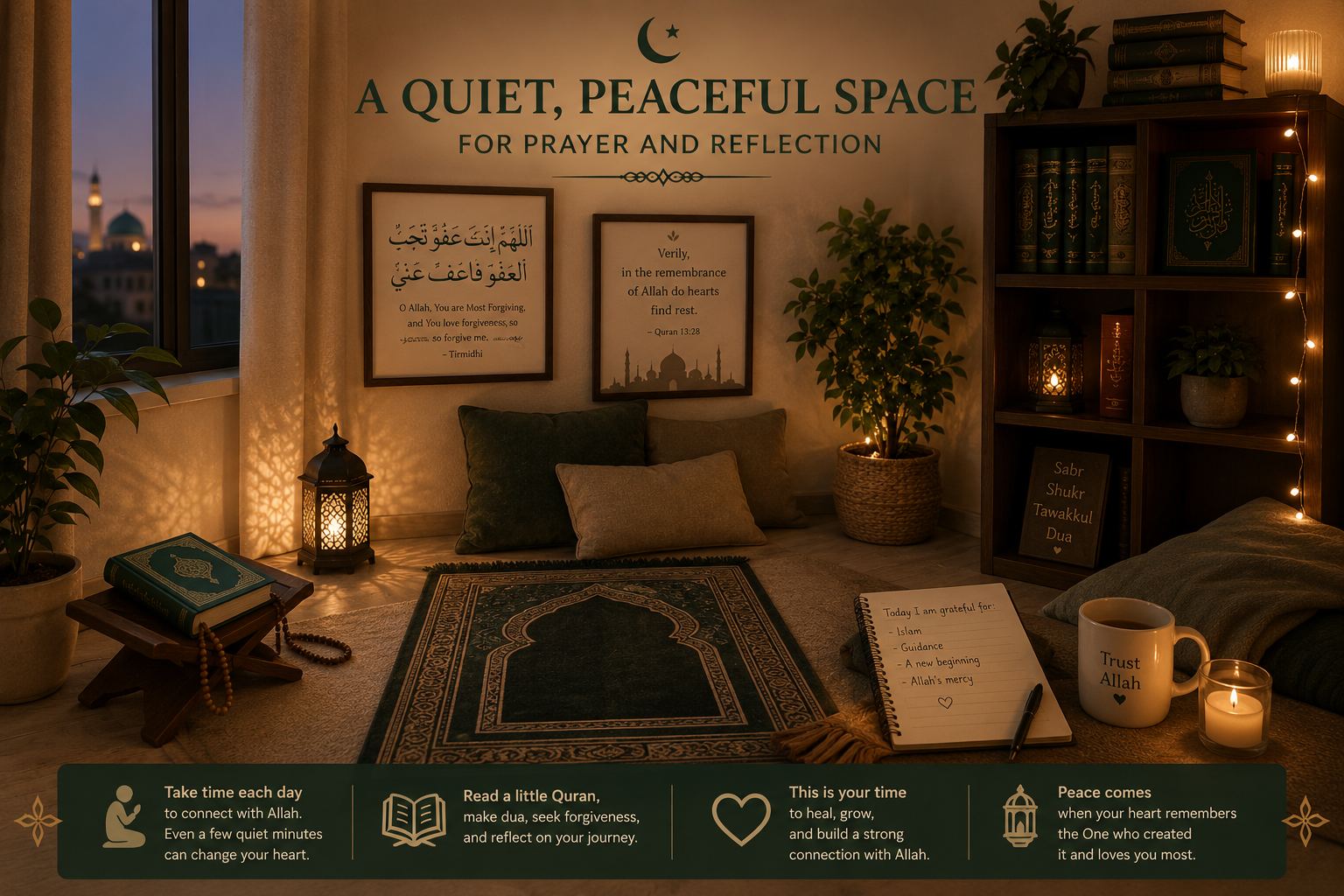
The Prophet ﷺ said: “Actions are judged by intentions, and everyone will get what was intended.”
Common Mistakes in the First 30 Days
Waiting to feel fully ready isn’t required — start learning immediately and let correctness improve with practice.
Short videos work for quick answers, but can’t replace a real person you can ask follow-up questions.
Sustainable change happens gradually — trying to change everything at once is the most common reason people burn out.
Islamic teaching instructs kindness toward relatives regardless of faith — cutting people off isn’t required or healthy.
Questions and confusion are a normal, expected part of learning — hiding them out of guilt only makes them harder to resolve.
What to Do After Becoming Muslim: What Happens After Day 30
By the end of your first month, prayer should feel familiar even if it’s not perfect, you should have a translation of the Quran you’re working through, and ideally at least one real person you can turn to with questions. The goal is not to know everything perfectly in one month — it’s to have a steady foundation you can keep building on.
From here, the work continues at whatever pace suits you: deepening your understanding of the Quran, learning more duas, and learning the rulings of fasting and zakat as they become relevant — timing depends on the Islamic calendar and, for zakat, whether you meet its conditions. Islam is a lifelong process of learning, and every Muslim, born into the faith or new to it, is still somewhere on that path.
Month two is a reasonable time to start learning a little Arabic — even just the letters or the meaning of words you already say in prayer — and to explore Islamic history and the life of the Prophet ﷺ if that interests you. It’s not a race; most Muslims born into the faith are still learning decades in.
Frequently Asked Questions
What is the very first thing to do after becoming Muslim? +
Make dua thanking Allah, then start learning wudu — purification comes before prayer.
Do I need to pray five times a day starting immediately? +
The five daily prayers are obligatory. If you’re new and still learning, start learning them immediately and seek help from a knowledgeable teacher so you can establish all five prayers as quickly and correctly as you’re able.
Can I complete this 30-day plan on my own, without a mosque? +
Yes, though connecting with even one knowledgeable person — in person or online — makes questions get answered faster than searching alone.
What if I miss a prayer or make a mistake in the first month? +
Don’t let one missed prayer make you give up. Turn back to Allah, ask a knowledgeable teacher what applies to your specific situation, and keep learning and praying — early mistakes don’t undo your Shahada or your progress.
Do I need to learn Arabic in the first 30 days? +
No. You need Al-Fatihah and a few short chapters for prayer, and your teacher can help you learn these with correct pronunciation. Full Arabic fluency is not required to be a practicing Muslim — it’s a worthwhile long-term goal, not a first-month requirement.
How do I handle family members who don’t support my decision? +
Lead with what hasn’t changed about your character and relationship with them. If safety is a concern, prioritize that first and lean on a local mosque or Muslim community organization for guidance.
Should I change my diet completely right away? +
Start with avoiding pork and alcohol, then let other dietary habits shift gradually — sincerity and steady effort matter more than an instant switch.
What should I do if I feel overwhelmed partway through the month? +
Pause on adding anything new, keep what’s already working, and reach out to your local teacher or community — feeling overwhelmed is common and doesn’t mean you’re falling behind.
Is fasting or paying Zakat something I need to worry about in the first month? +
Both are important pillars, but learn their specific rulings when they become relevant to your circumstances — fasting depends on the Islamic calendar, and zakat only becomes due once you meet its specific conditions. Your first 30 days can reasonably focus on prayer, purification, and building community.
What if my first month doesn’t go exactly according to this plan? +
That’s normal, and it’s still a success. Some weeks move faster, some slower, and unexpected things — work, family events, illness — will shift the schedule. What matters over the first month is direction, not a perfect checklist.
What to do after becoming Muslim comes down to this: learn wudu and all five prayers correctly as fast as you’re able, start reading the Quran, and find real people who can guide you. Thirty days won’t make you an expert — it’s meant to give you a foundation steady enough to build on for life.
Sources
- Quran 4:103 — Surah An-Nisa, on prayer being enjoined upon believers at specified times (quran.com/4/103)
- Sahih al-Bukhari 8 / Sahih Muslim 16 — hadith on Islam being built upon five pillars, including establishing prayer (sunnah.com/bukhari:8)
- Sahih al-Bukhari 756 / Sahih Muslim 394 — hadith on there being no valid prayer without reciting Al-Fatihah (sunnah.com/bukhari:756)
- Quran 62:9 — Surah Al-Jumu’ah, on hastening to the remembrance of Allah when the Friday prayer is called (quran.com/62/9)
- Quran 2:183 — Surah Al-Baqarah, on fasting being prescribed for believers (quran.com/2/183)
- Quran 2:286 — Surah Al-Baqarah, on Allah not burdening a soul beyond its capacity (quran.com/2/286)
- Quran 31:15 — Surah Luqman, on treating parents with kindness even amid serious disagreement over faith (quran.com/31/15)
- Quran 60:8 — Surah Al-Mumtahanah, on dealing justly and kindly with those who don’t fight believers over religion (quran.com/60/8)
- Sahih al-Bukhari 69 — hadith on making things easy, not difficult (sunnah.com/bukhari:69)
- Sahih al-Bukhari 1 / Sahih Muslim 1907 — hadith on actions being judged by intentions (sunnah.com/bukhari:1)
This guide reflects general, practical guidance rather than a fixed ruling on every point — the five prayers and Shahada’s validity are settled obligations, but ghusl’s status upon entering Islam, who Jumu’ah applies to, and the timing/conditions for fasting and zakat involve scholarly nuance. Consult a knowledgeable local teacher for your specific situation.
Continue Your Islamic Learning
Ready to go deeper after your first month? This guide walks through the basics in order.
How to Learn Islam Properly →