
Reviewed By: IslamicEduHub Editorial Team (Qualified Scholar Review)
- Last Updated: July 2026
- Reviewed Date/Version: v2.2
- Sources: Qur’an, Sahih al-Bukhari, Sahih Muslim, Riyad as-Salihin
- Editorial Policy: How we review our content
If you’ve ever sat down after a long day, opened a random Islamic page online, and thought, “I don’t even know where to start,” you’re not alone. Most beginners feel exactly this way — overwhelmed by hundreds of scattered videos, contradictory opinions, and half-finished lecture series. The good news is that learning Islam properly isn’t complicated. If you’re wondering how to learn Islam properly without burning out, it just needs the right order, the right sources, and a habit you can actually stick to.
This guide walks you through exactly how to learn Islam properly — step by step, in plain language, using only what’s grounded in the Qur’an and authentic Sunnah.
Quick Answer: How to Learn Islam Properly
To learn Islam properly, start with a sincere intention (niyyah), read the Qur’an daily with a trusted translation, study a small collection of authentic Hadith (Sahih al-Bukhari and Sahih Muslim), learn directly from a qualified scholar whenever possible, and apply one lesson at a time instead of rushing through many topics. Consistency over years matters far more than intensity over a few weeks.
Table of Contents
- Why the Order You Learn In Actually Matters
- Step 1: Fix Your Intention Before You Fix Your Schedule
- Step 2: Build Your Foundation With the Qur’an
- Step 3: Study Hadith the Right Way
- Step 4: Find a Real Teacher, Not Just a Screen
- Step 5: Turn Knowledge Into Daily Practice
- 5 Mistakes That Quietly Stall Most Beginners
- How to Avoid Information Overload
- Signs You Are Actually Making Progress
- Self-Study Alone vs. Self-Study + Teacher
- Trusted Books & Websites to Learn From
- A Simple 20-Minute Daily Routine You Can Start Tomorrow
- Common Questions New Muslims Ask
- Quick Recap: The 5-Step Checklist
- Frequently Asked Questions
- People Also Ask
- References
A structured, step-by-step approach helps beginners learn Islam properly without feeling overwhelmed.
Why the Order You Learn In Actually Matters
Most people don’t fail at learning Islam because they lack information — the internet is full of it. They fail because they consume information in the wrong order: jumping into complex fiqh debates before they’ve even finished reading the Qur’an once, or memorizing rulings without understanding the wisdom behind them. If you want to know how to learn Islam properly, understanding the right sequence matters just as much as the content itself.
Allah describes the Qur’an itself as a book sent down with purpose and clarity, not to create confusion:
“[This is] a blessed Book which We have revealed to you, [O Muhammad], that they might reflect upon its verses and that those of understanding would be reminded.” (Qur’an 38:29)
A beginner who studies in sequence — belief, then worship, then character, then deeper rulings — retains far more than someone who studies at random. Think of it the way you’d learn a language: you don’t start with grammar exceptions before you can hold a basic conversation.
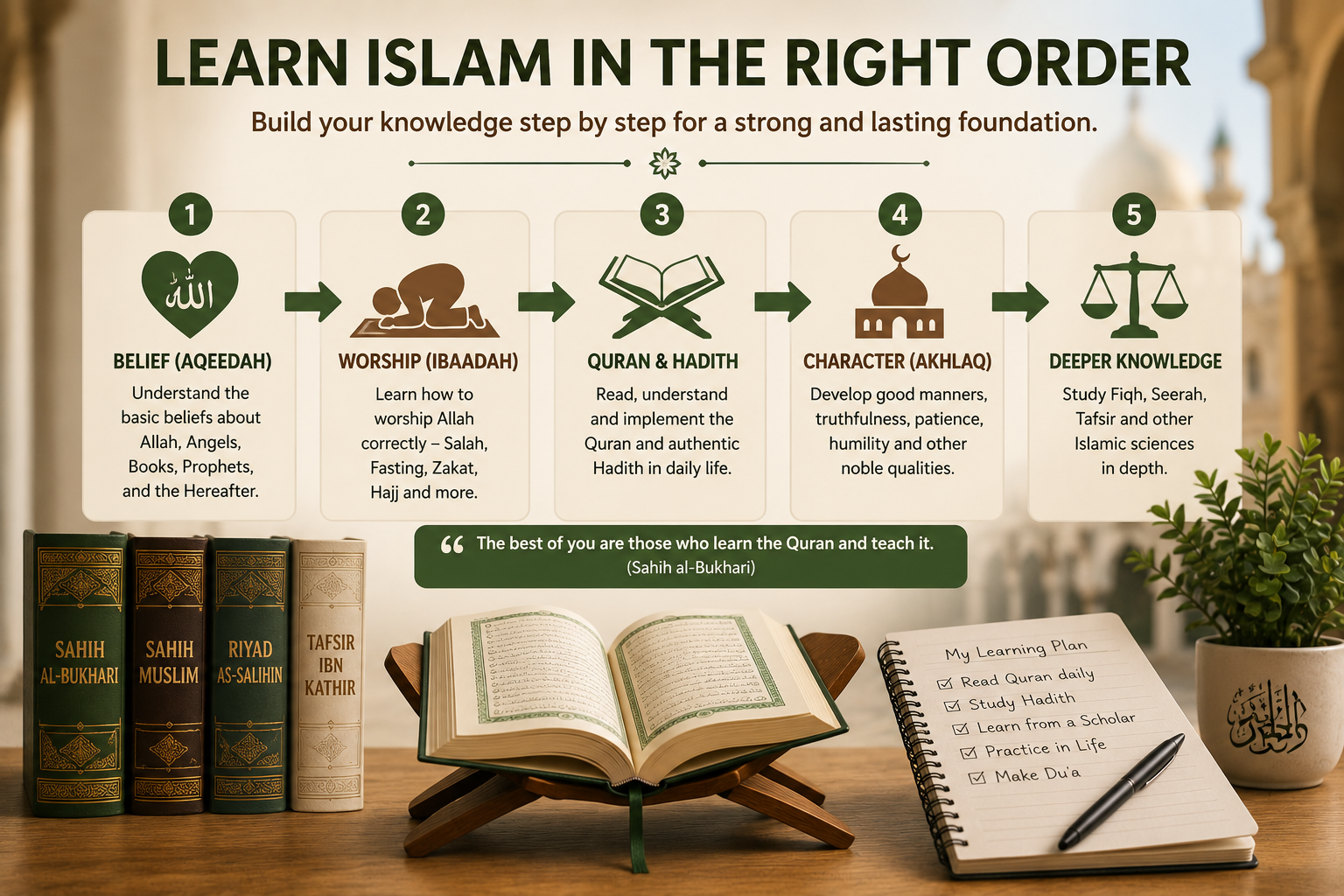
A quick example: A new revert once described spending her first two months bouncing between five different YouTube channels, each with a different opinion on the same topic, until she felt more confused than when she started. What actually helped was pausing everything, going back to the Qur’an and one small Hadith collection, and only adding a second source once the first felt solid. Within a few weeks the constant confusion was gone — not because she knew more facts, but because she was finally learning in a sequence that made sense.
1. Fix Your Intention Before You Fix Your Schedule
Before opening a single book, pause and ask yourself why you’re doing this. The Prophet Muhammad (ﷺ) said:
“Actions are judged by intentions, and every person will get the reward according to what they intended.” (Sahih al-Bukhari, Hadith 1, Book of Revelation)
Learning for the sake of Allah — not to win arguments, not to impress others online — is what makes knowledge actually beneficial. This single mindset shift changes how you absorb everything that follows, and it’s the real starting point of how to learn Islam properly. Once your prayer (Salah) becomes part of that daily intention, our guide on how to pray Salah correctly is a natural next step.
2. Build Your Foundation With the Qur’an
The Qur’an isn’t just a starting point — it stays your primary reference for life, and it’s usually the first real test of how to learn Islam properly with patience. Allah calls it a guide and a healing for those who reflect on it:
“O mankind, there has come to you instruction from your Lord and healing for what is in the breasts and guidance and mercy for the believers.” (Qur’an 10:57)
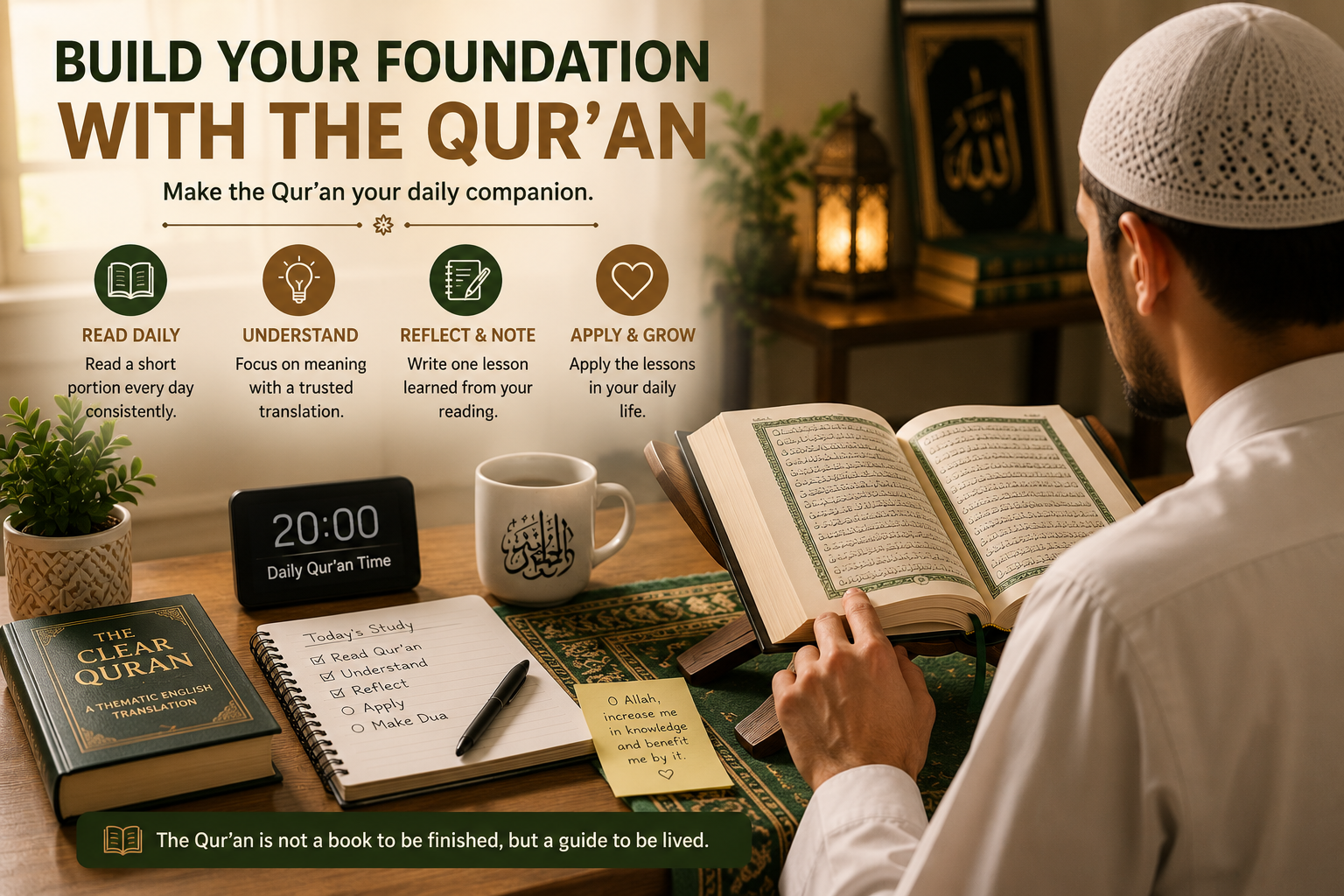
Here’s a realistic approach for someone new who is figuring out how to learn Islam properly through its main source:
- Read a short passage daily with a reliable English translation (Saheeh International or Dr. Mustafa Khattab’s The Clear Quran are both beginner-friendly).
- Don’t rush to finish the whole book. Understanding three verses deeply beats skimming three pages.
- Keep a small notebook nearby and jot down one lesson per sitting — this single habit does more for retention than re-reading ever will.
- Start learning Tajweed gradually, even just a few rules per week, so your recitation improves alongside your understanding.
Over months, this slow, steady approach builds a relationship with the Qur’an that a rushed 30-day “khatm challenge” rarely does. If reading fluently still feels difficult, our guide to reading the Qur’an correctly breaks it down further.
A short daily Qur’an reading habit builds a stronger foundation than rushing to finish the whole book.
3. Study Hadith the Right Way
Hadith explains how the Prophet (ﷺ) actually lived out the Qur’an’s instructions. Without it, you’d know Islam commands prayer — but not how to pray. That’s why authenticity here matters enormously when you’re trying to learn Islam properly.
Stick to verified collections: Sahih al-Bukhari, Sahih Muslim, and beginner-friendly compilations like Riyad as-Salihin. Avoid screenshots and unsourced quotes circulating on social media — a huge number of them are weak or entirely fabricated. If a Hadith is shared without a reference (book name and number), treat it with caution until you can verify it on a site like Sunnah.com. Getting this step right is one of the most overlooked parts of learning Islam properly, since a single fabricated narration can quietly shape a wrong belief for years.
4. Find a Real Teacher, Not Just a Screen
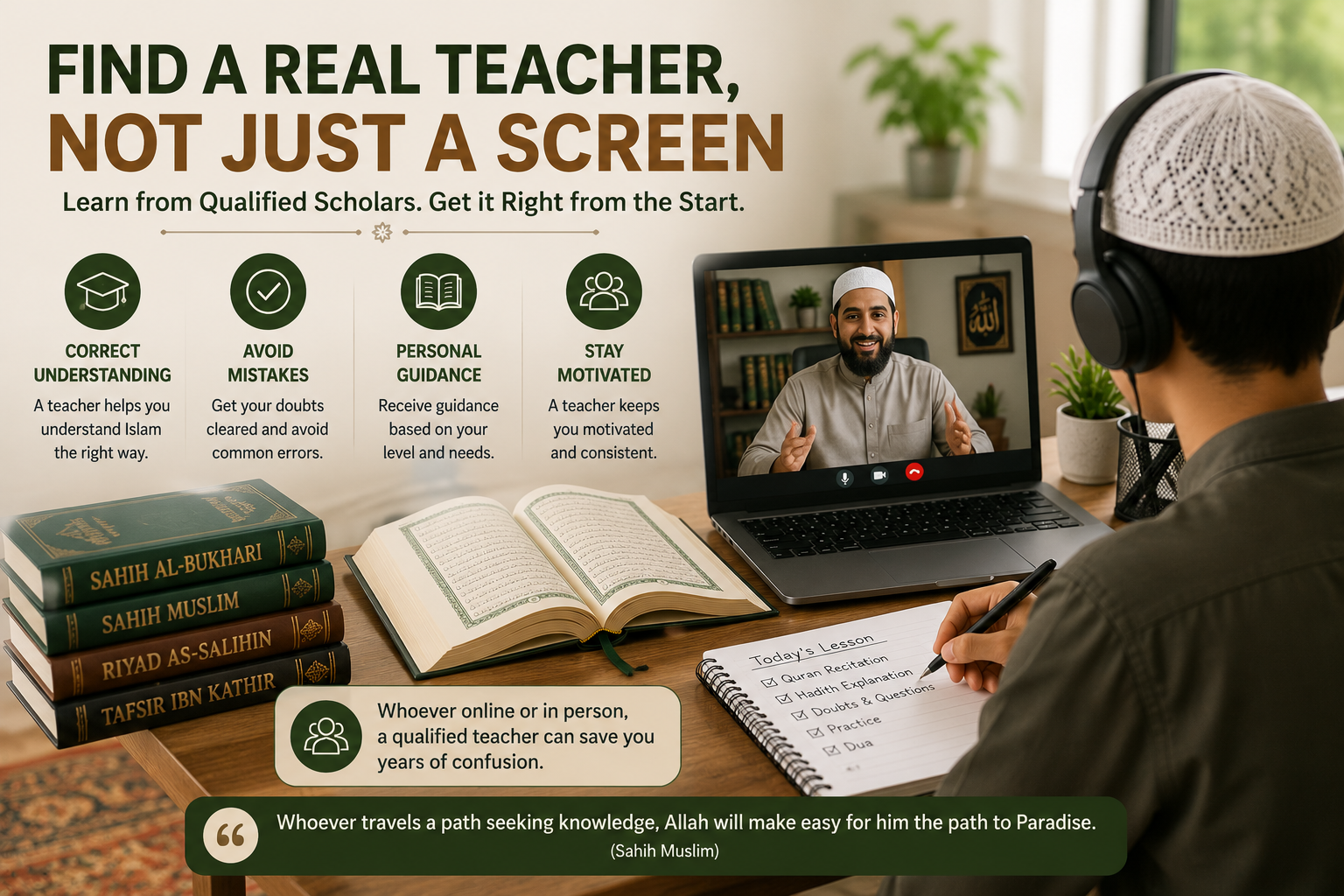
Self-study matters, but it has a ceiling. A qualified teacher — someone with a verified chain of learning (isnad) or recognized Islamic education — can correct your mistakes in real time, something no video or article can do.
If you don’t have access to a local scholar, look for structured online courses run by accredited Islamic institutions rather than random individual content creators. Ask about their teacher’s credentials before committing months of your time to their material. You can also explore our Online Quran Classes for Kids & Adults for guided, one-on-one learning with a qualified teacher — a step that makes learning Islam properly far more reliable than piecing things together alone.
5. Turn Knowledge Into Daily Practice
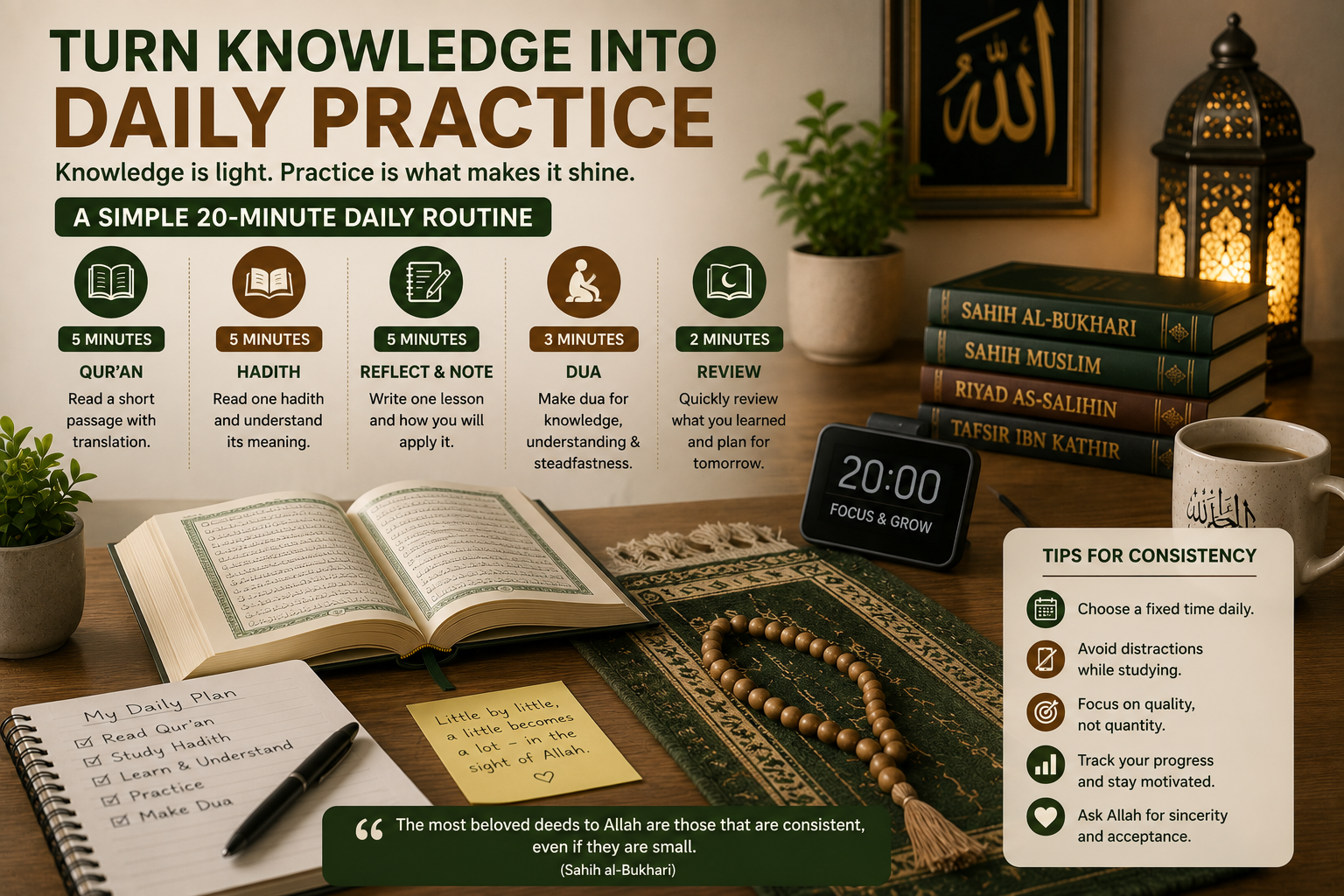
Knowledge that never leaves the notebook doesn’t transform anyone. After each lesson, ask one question: “What’s one thing I can actually do differently today because of what I just learned?”
Maybe it’s praying two extra minutes with more focus, or finally getting your Wudu steps right before Salah. Maybe it’s being more patient with a family member. Small, consistent applications compound into real character change over years — which is the entire point of how to learn Islam properly in the first place.
5 Mistakes That Quietly Stall Most Beginners
Knowing how to learn Islam properly also means knowing what to avoid. Most people who quit didn’t lack sincerity — they simply fell into one of these five patterns without noticing. Here are the five mistakes that hold most beginners back:
- Learning primarily from social media clips. Short videos strip away context and nuance, and algorithms often reward confident-sounding content over accurate content.
- Trying to consume everything at once. Jumping between ten topics in a week leaves you with fragments of knowledge instead of a solid foundation in any single one.
- Never asking questions. Staying silent when something is confusing lets misunderstandings quietly harden into wrong beliefs.
- Treating knowledge as a competition. Learning to win debates online is a very different goal from learning to become a better Muslim — and it shows in how people behave.
- Skipping character for content. Memorizing rulings while neglecting honesty, patience, and kindness misses the actual purpose of the knowledge.
Avoiding these five habits helps beginners build a stronger, more lasting foundation and stay on track with how to learn Islam properly.
How to Avoid Information Overload
One of the quietest reasons beginners quit isn’t lack of interest — it’s simply having too many tabs open, literally and mentally. Managing this well is a quiet but essential part of how to learn Islam properly without losing motivation. Here’s how to keep that from happening to you:
- Pick one primary source per topic. One trusted tafsir, one Hadith collection, one teacher for a given subject — not five competing voices at once.
- Set a weekly learning boundary. Decide in advance that you’ll go deep on one topic this week rather than skimming ten.
- Unfollow noise, not just bad content. Even accurate accounts can overwhelm you if you’re following fifty of them. Trim the list down to a handful you actually trust.
- Revisit before you add. If you can’t summarize last week’s lesson in two sentences, don’t move on to a new one yet — go back and solidify it first.
- Give yourself permission to say “I don’t know yet.” You don’t need an opinion on every debated issue in your first year. Depth on fewer things beats a shallow take on everything.
Signs You Are Actually Making Progress
Because Islamic knowledge builds slowly, it’s easy to feel like nothing is happening even when a lot is. These are the realistic markers that show you’ve actually understood how to learn Islam properly, rather than just collecting facts — not perfection, just direction:
- You pause before reacting. Situations that used to trigger an instant angry response now come with a beat of reflection first.
- You recognize weak information faster. A quote without a source now makes you cautious instead of making you share it immediately.
- Your Salah feels less mechanical. You start noticing what you’re actually saying in prayer instead of just going through the motions.
- You ask better questions. Early questions are often about rulings; later questions start being about wisdom and intention — a sign of real depth.
- You’re gentler with other beginners. Once you remember how confusing this stage was for you, you naturally become more patient with people just starting out.
None of these show up overnight. They show up after months of the small, boring consistency described throughout this guide.
Self-Study Alone vs. Self-Study + Teacher
Here’s a quick side-by-side look at why pairing self-study with guidance tends to produce faster, more accurate progress on how to learn Islam properly:
| Aspect | Self-Study Alone (Common Mistake) | Self-Study + Qualified Teacher (Correct Approach) |
|---|---|---|
| Correcting mistakes | Errors in Tajweed or fiqh can go unnoticed for months | Corrected in real time by someone with verified knowledge |
| Source verification | Easy to absorb weak or fabricated Hadith from social media | Guided toward authentic, referenced sources |
| Pace | Often rushed or inconsistent, driven by motivation spikes | Structured, paced learning with accountability |
| Understanding context | Rulings learned in isolation, without underlying wisdom | Explained with reasoning, not just conclusions |
Continue building your foundation:
How to Pray Salah Correctly How to Perform Wudu Correctly Join Our Online Quran ClassesTrusted Books & Websites to Learn Islam Properly
Books for Beginners
- The Qur’an — with an authentic English translation (Saheeh International or The Clear Quran)
- Tafsir Ibn Kathir (abridged versions are available for beginners)
- Riyad as-Salihin — Imam An-Nawawi
- The Sealed Nectar (Ar-Raheeq Al-Makhtum) — biography of the Prophet (ﷺ)
- Hisn al-Muslim (Fortress of the Muslim) — daily supplications
Websites Worth Bookmarking
- Quran.com — Qur’an with translations and tafsir
- Sunnah.com — searchable, authentic Hadith collections
- IslamQA.info — evidence-based answers to common questions
Want personal guidance instead of self-study alone? Visit our homepage to see our Online Quran Classes for kids and adults, or read more on our blog for beginner-friendly Islamic lessons. Have a question first? Contact us and our team will help.
A Simple 20-Minute Daily Routine You Can Start Tomorrow
You don’t need hours to learn Islam properly. You need consistency, and this routine is the most practical answer to how to learn Islam properly on a busy schedule. Here’s a routine that fits into almost any schedule:
- 5 minutes: Read a short Qur’an passage with translation.
- 5 minutes: Read one authentic Hadith and its brief explanation.
- 5 minutes: Write one line in a journal — what you learned, and one way to apply it today.
- 5 minutes: Make dua asking Allah to make the knowledge beneficial and easy to act upon.
Do this for 90 days without missing more than a couple of days, and you’ll notice a real shift — not just in what you know, but in how you carry yourself.
A simple 20-minute daily checklist beginners can follow consistently.
Common Questions New Muslims Ask
These come up constantly in the first year, so it helps to see them addressed plainly rather than piecing together answers from scattered forum posts — another practical piece of how to learn Islam properly as a new Muslim specifically.
Do I need to change my name?
No. Unless your current name has a meaning that directly contradicts Islamic belief (for example, referring to another deity), keeping your name is completely fine.
What if my family doesn’t understand or support this?
This is one of the hardest parts for many new Muslims. Be patient, keep your character strong at home, and lean on a local community or teacher for support rather than trying to handle it entirely alone.
How soon should I start praying five times a day?
As soon as you’re able to learn the basic movements and words, even imperfectly. Start with what you know and improve gradually — don’t wait until it feels “perfect” to begin.
Is it normal to still have doubts or questions after becoming Muslim?
Yes, completely normal. Doubt isn’t the same as disbelief — bring your questions to a knowledgeable source instead of suppressing them or searching randomly online.
Do I need new Muslim friends immediately?
Not immediately, but building at least a small support network of practicing Muslims — even online at first — makes consistency significantly easier long term.
Frequently Asked Questions About How to Learn Islam Properly
Beginners ask these questions the most, so here are direct answers to help you understand how to learn Islam properly without second-guessing every step.
Can I learn Islam by myself, without a teacher?
You can start alone — reading the Qur’an and authentic Hadith is always a valid beginning. But self-study has limits. Pairing it with a qualified teacher, even occasionally, helps you catch mistakes early and understand context you might otherwise miss.
How long does it take to learn Islam properly?
There’s no finish line — even scholars who’ve studied for decades describe themselves as lifelong students. For a solid beginner foundation in belief, basic worship, and character, most people need consistent daily study for at least one to two years before topics start feeling natural rather than overwhelming.
Which book should a total beginner read first?
Start with the Qur’an itself, alongside a reliable translation. Once you have a rhythm going, add a short biography of the Prophet (ﷺ), such as The Sealed Nectar, to understand the context behind the Qur’an’s teachings.
Is it okay to learn Islam from YouTube or online courses?
Yes, as long as the source is accredited and evidence-based. Check whether the speaker cites the Qur’an and authentic Hadith directly, rather than simply sharing opinions. Avoid channels that never reference their sources.
What’s the single biggest key to staying consistent?
Lowering the bar on bad days. Five honest minutes of study on a hard day beats an ambitious plan you abandon after a week. Consistency, not intensity, is what actually builds lasting knowledge.
People Also Ask
What is the correct order to learn Islam in as a beginner?
Most scholars recommend starting with belief (Aqeedah) and the pillars of worship, then moving to character and daily practice, and only later into detailed fiqh rulings — rather than jumping straight into complex debates.
Do I need to learn Arabic to learn Islam properly?
Not at first. A reliable English translation is enough to begin. Learning Qur’anic Arabic and Tajweed gradually alongside your studies deepens understanding over time, but it isn’t a prerequisite to start.
How do I know if an Islamic source online is trustworthy?
Trustworthy sources cite the Qur’an and authentic Hadith with references (book name and number) rather than sharing unsourced quotes or opinions without evidence.
References
- Qur’an 10:57 — on the Qur’an as guidance and healing
- Qur’an 38:29 — on the Qur’an being revealed for reflection and understanding
- Sahih al-Bukhari, Hadith 1, Book 1 (Revelation) — “Actions are judged by intentions”
- Sahih Muslim, Book 13, Hadith 1631 — on knowledge that continues to benefit after death
- Riyad as-Salihin, Imam An-Nawawi, Book 1, Chapter 1 (Sincerity and Intention)
- Tafsir Ibn Kathir, abridged edition, introduction to Qur’anic exegesis method
- The Sealed Nectar (Ar-Raheeq Al-Makhtum), Safi-ur-Rahman al-Mubarakpuri
Quick Recap: The 5-Step Checklist for Learning Islam Properly
If you only remember one part of this guide, remember this checklist. Print it, save it, or copy it into your notes app — it condenses how to learn Islam properly into something you can glance at on a hard day:
- Intention first. Before opening any book, remind yourself you’re doing this for Allah, not for an audience.
- Qur’an daily, in small amounts. A few verses with translation, understood deeply, beats pages skimmed quickly.
- Hadith from verified sources only. Sahih al-Bukhari, Sahih Muslim, and Riyad as-Salihin — nothing unsourced.
- A real teacher, even occasionally. Self-study alone has a ceiling that only a qualified teacher can raise.
- One applied lesson per day. Knowledge that changes behavior is the whole point of learning Islam properly.
Keep this checklist visible somewhere you’ll actually see it — a phone lock screen, a sticky note, the front of your journal. The goal isn’t to memorize the list itself; it’s to let it quietly steer your habits until the steps stop feeling like a checklist and start feeling like how you naturally live.
Final Thoughts
Learning Islam properly isn’t about consuming as much content as possible — it’s about building a foundation slowly, checking your sources, and letting what you learn actually change how you live. If you were unsure how to learn Islam properly before reading this, start today with something small: one verse, one Hadith, one honest intention. That’s genuinely enough to begin.
A Simple Dua to Begin With
“O Allah, benefit me with what You have taught me, and teach me what will benefit me.”
If this guide helped clarify how to learn Islam properly, explore more beginner-friendly resources on our IslamicEduHub homepage, check out our About Us page to learn about our mission, or browse our blog for more guides like this one.