
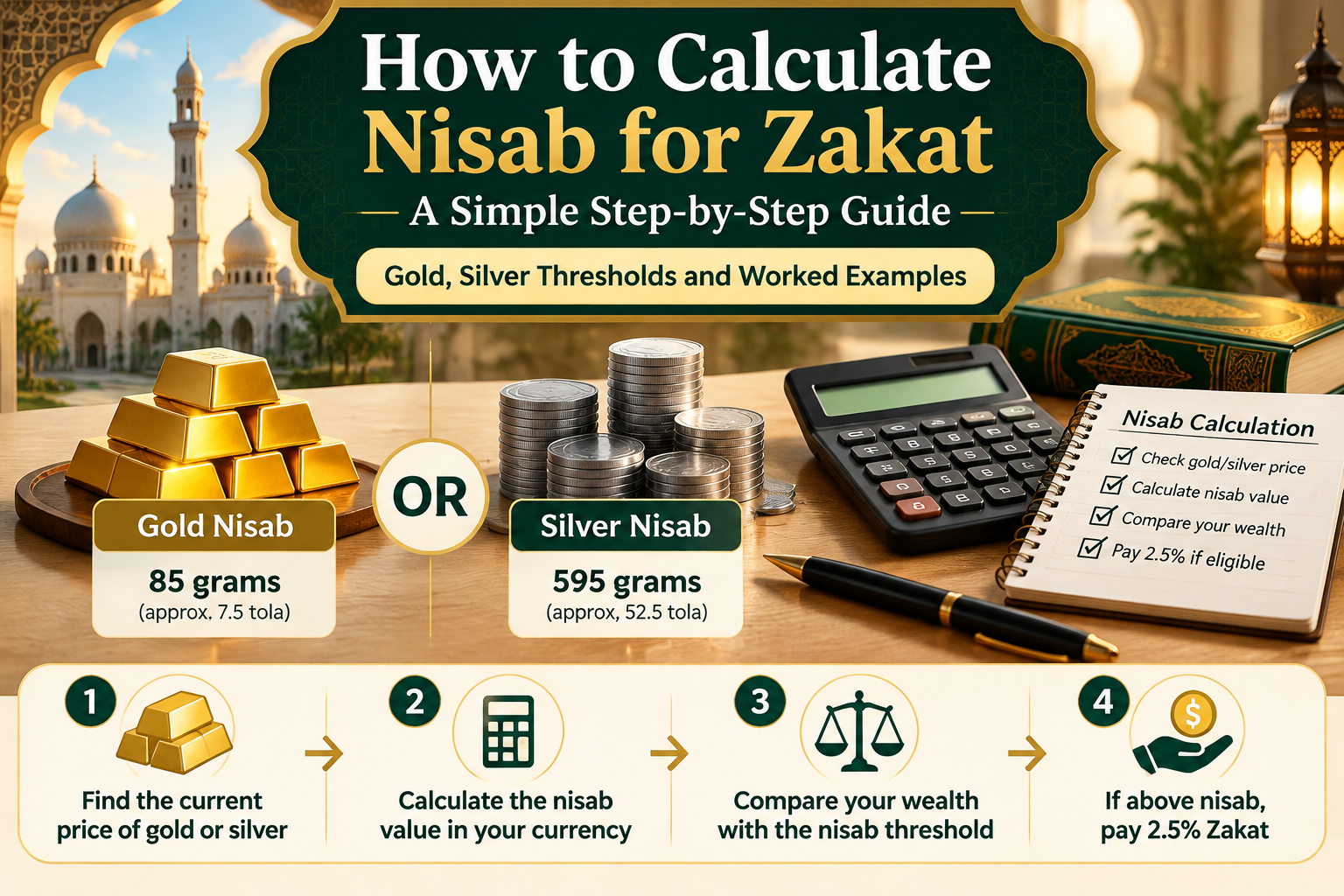
How to Calculate Nisab for Zakat: 4 Simple Steps With Worked Examples
Nisab is the minimum wealth threshold that makes Zakat obligatory. If you do not know how to calculate nisab in your own currency, you cannot be sure whether Zakat is due at all. This guide walks you through the 4 steps to calculate nisab, explains why the gold and silver thresholds give different results, shows worked examples in multiple currencies, and includes a built-in converter so you can check your own figure in under a minute.
- Gold vs silver nisab
- 4-step method
- Multi-currency examples
- Built-in converter
- Scholarly differences noted
How to calculate nisab is the question that comes before every Zakat calculation: does my wealth even reach the threshold? Most people know Zakat is 2.5%, but if your savings sit below the nisab, no Zakat is due that year. If they sit above it, you owe 2.5% of the whole amount. So the nisab decides whether the obligation falls on you at all.
Where the confusion starts is that the Prophet ﷺ set the nisab using gold and silver weights, not a fixed currency amount. You have to convert those weights into your own currency at today’s metal price, and because prices move daily, the number changes too. Add in the fact that the gold nisab and silver nisab produce very different results, and it is easy to see why people put this off.
To calculate nisab, pick the metal standard you follow (gold or silver), find today’s price per gram of that metal in your currency, and multiply it by the weight: about 85 grams for gold or about 595 grams for silver. The result is your nisab in local money. If your total zakatable wealth equals or exceeds that figure and you have held it for one lunar year, Zakat (2.5%) is due. For a full explanation of how Zakat itself is calculated, see our complete Zakat calculation guide.
What Is Nisab and Why Does It Matter?
Nisab is the minimum amount of wealth that makes Zakat obligatory on a Muslim. Think of it as a threshold line: if your total zakatable wealth sits below it, you owe no Zakat that year. If your wealth reaches or crosses it and stays there for one full lunar year (hawl), you owe 2.5% of the whole amount.
The nisab exists to protect people with modest means. Without a threshold, even someone barely covering their own expenses would owe a portion of their limited savings. The nisab draws that line: only those with genuine surplus are asked to give.
Nisab applies to Zakat al-Mal (Zakat on wealth), which is the main yearly obligation. It does not apply to Zakat al-Fitr, which is a separate, smaller charity at the end of Ramadan with its own rules.
The Hadith Basis for Nisab
The Prophet ﷺ set the nisab using two metals: gold and silver. These are the foundational texts that scholars refer to.
Abu Sa’id Al-Khudri reported that the Messenger of Allah ﷺ said: “There is no Zakat on less than five awaq of silver.”
Five awaq equal 200 dirhams, which is the silver nisab. For gold, the threshold is twenty dinars:
“No Zakat is due on gold until it reaches twenty dinars.”
These two measures, 200 dirhams of silver and 20 dinars of gold, are the starting point. Everything else in this guide is about converting them into grams and then into your currency.
Gold and Silver: The Two Nisab Thresholds
| Standard | Prophetic measure | Approximate modern weight |
|---|---|---|
| Gold nisab | 20 dinars (mithqal) | About 85 grams (some scholars: 87.48g) |
| Silver nisab | 200 dirhams | About 595 grams (some scholars: 612.36g) |
In the time of the Prophet ﷺ, 20 gold dinars and 200 silver dirhams were roughly equal in purchasing power. Today that is no longer the case. Gold has become far more valuable relative to silver, which means the gold nisab in modern currency is many times higher than the silver nisab. This gap is what creates the scholarly discussion about which standard to follow, covered in the section below.
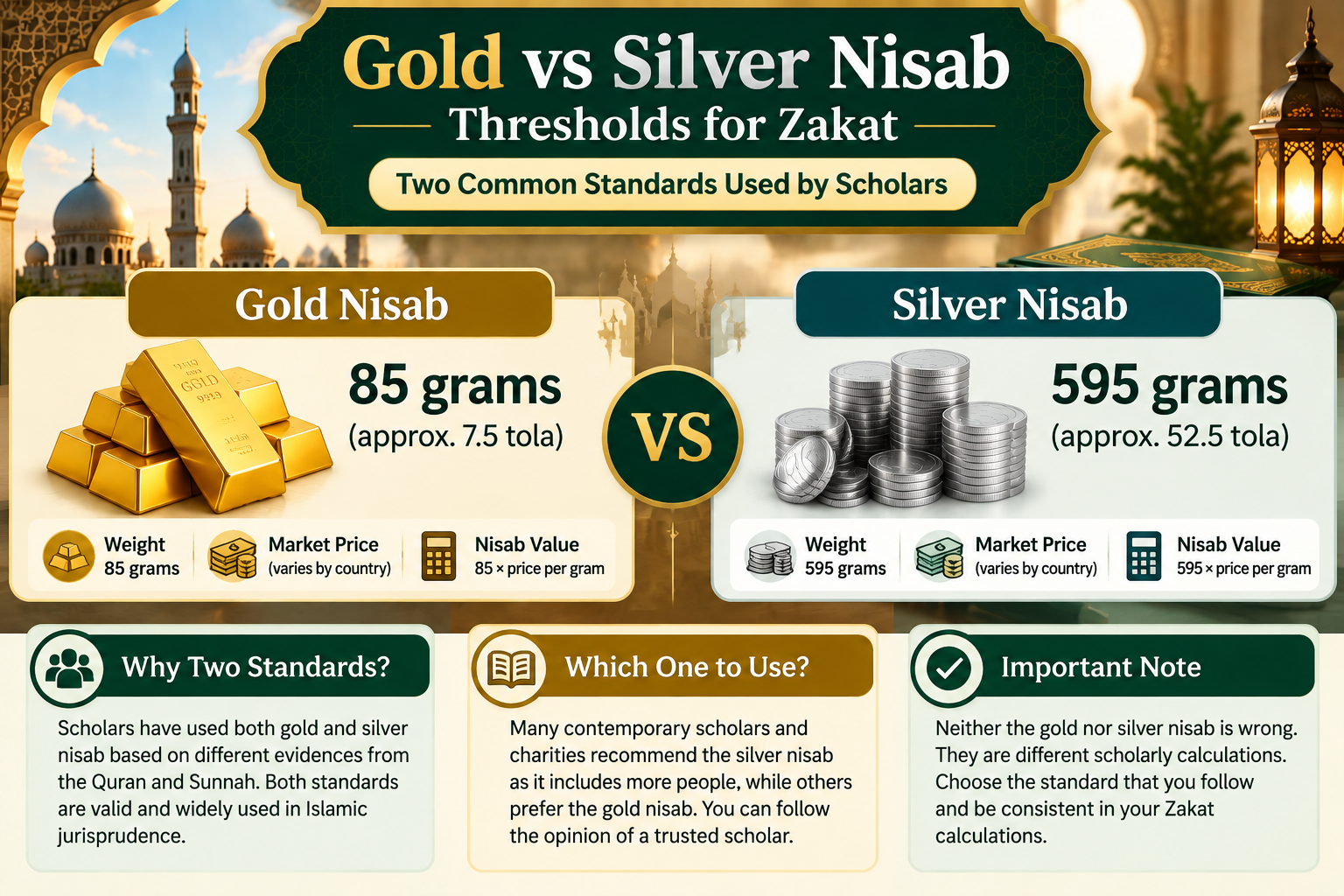
Why Do the Weights Differ? 85g vs 87.48g Explained
If you have looked at different Zakat websites, you have probably noticed some say 85 grams of gold while others say 87.48 grams, and some say 595 grams of silver while others say 612.36 grams. Both sets of figures are used by respected scholars, and the difference comes down to the weight assigned to the original coin.
For gold, the unit is the mithqal (the weight of one gold dinar). Most scholars round it to 4.25 grams, giving 20 × 4.25 = 85 grams. A more precise traditional figure used by some Hanafi scholars is 4.374 grams per mithqal, giving 20 × 4.374 = 87.48 grams.
For silver, the unit is the dirham. At 2.975 grams per dirham, 200 dirhams = 595 grams. The stricter figure of 3.0618 grams per dirham gives 200 × 3.0618 = 612.36 grams.
| Metal | Unit | Common weight | Result | Stricter weight | Result |
|---|---|---|---|---|---|
| Gold | Mithqal | 4.25 g | 85 g | 4.374 g | 87.48 g |
| Silver | Dirham | 2.975 g | 595 g | 3.0618 g | 612.36 g |
Both figures are held by respected scholars; the difference comes down to which surviving historical coins were used for the conversion. In practice, the gap is small enough that it rarely changes whether Zakat is due. If you are near the borderline, the lower weight (85g / 595g) keeps you on the safer side.
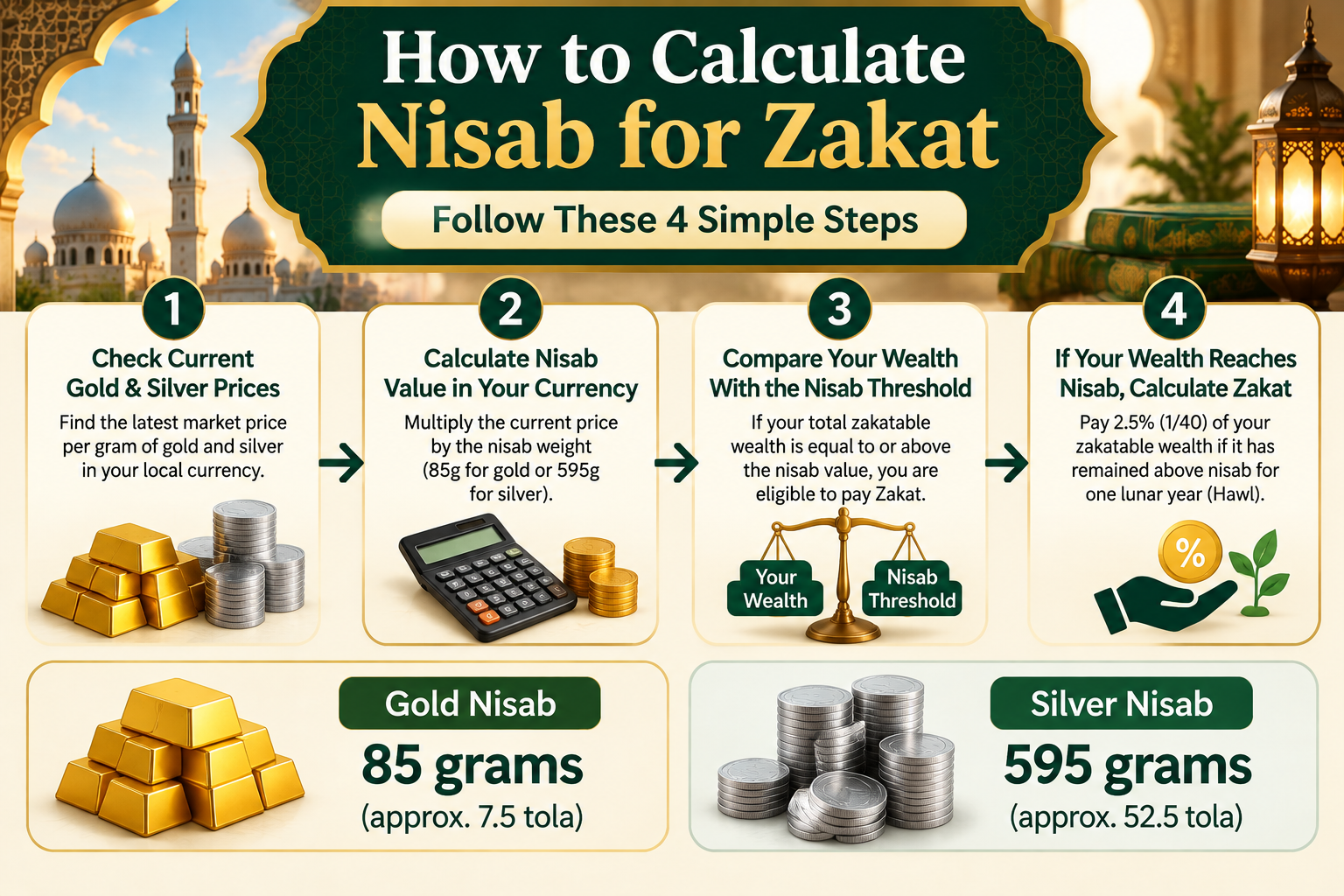
How to Calculate Nisab: 4 Steps
Once you understand the weights, the actual calculation takes less than a minute.
Step 1: Choose Gold or Silver
Decide which metal standard you will follow. If you are unsure, see the gold-vs-silver section below. Many contemporary scholars and charities recommend the silver nisab for cash savings, as it sets a lower threshold and includes more people in the obligation.
Step 2: Find Today’s Price Per Gram
Look up the current spot price per gram of pure gold (24 karat) or pure silver in your currency. Use a financial news site, your local gold market, or a trusted price feed. The price you need is for pure metal, not for jewellery (which includes making charges).
Step 3: Multiply by the Nisab Weight
Multiply the price per gram by the relevant weight. For gold: price × 85 (or 87.48). For silver: price × 595 (or 612.36). The result is your nisab value in your local currency.
Step 4: Compare to Your Zakatable Wealth
If your total zakatable wealth (cash, savings, gold, silver, business stock, investments, minus debts due now) equals or exceeds the nisab, and you have held this wealth for one full lunar year, Zakat is due at 2.5%.
Gold nisab = Current gold price per gram × 85 (or 87.48)
Silver nisab = Current silver price per gram × 595 (or 612.36)
Use the price on your Zakat date. The nisab changes whenever the metal price changes, so always check it fresh.
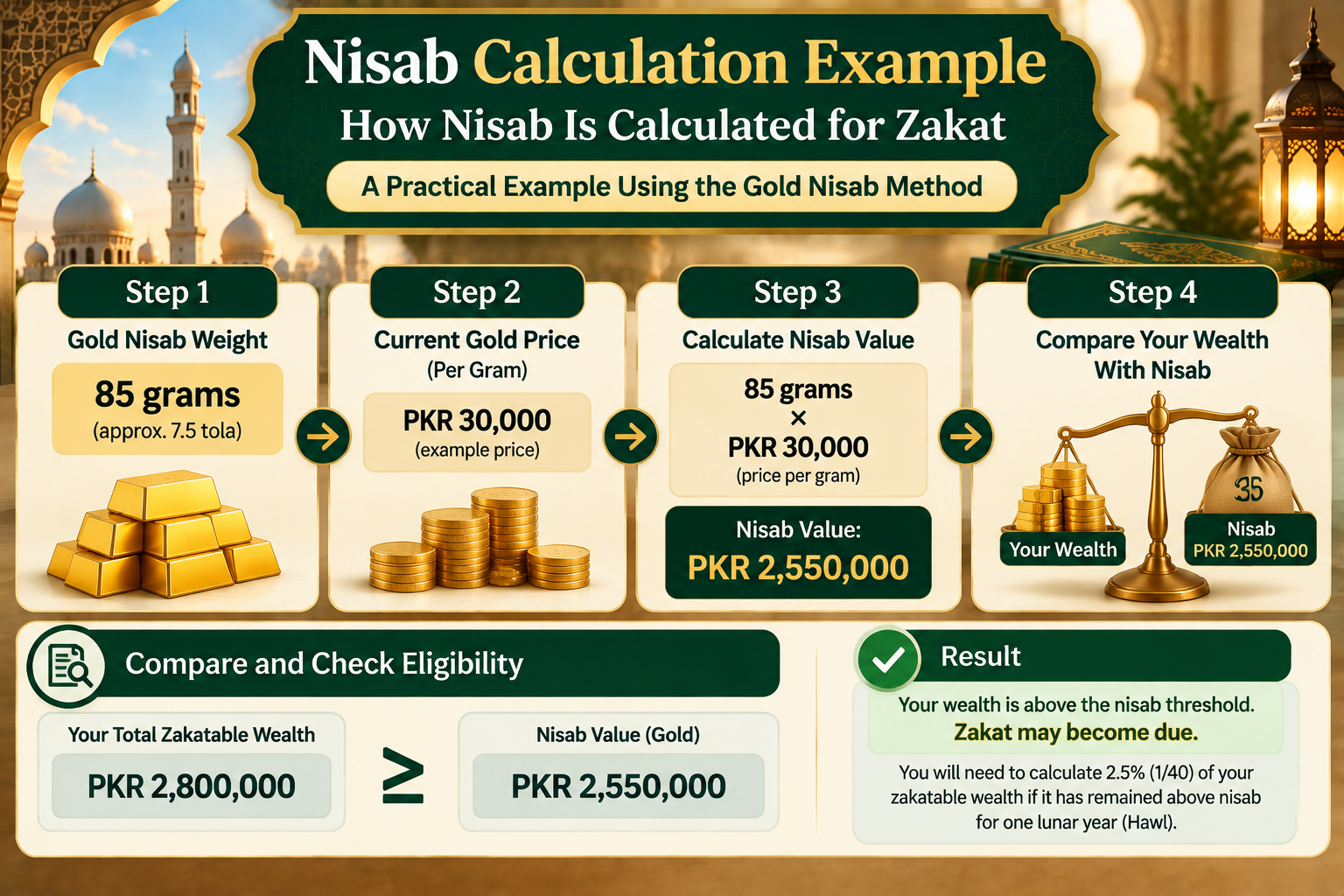
Worked Examples in Multiple Currencies
Prices below are illustrative only, chosen to show the method clearly. Always use the actual metal price on your own Zakat date.
Example 1: Pakistani Rupees (PKR)
Suppose the gold price is PKR 28,500 per gram and the silver price is PKR 250 per gram on your Zakat date.
| Gold nisab | 28,500 × 85 = PKR 2,422,500 |
| Silver nisab | 250 × 595 = PKR 148,750 |
Notice the gap: the gold nisab is over PKR 24 lakh, while the silver nisab is under PKR 1.5 lakh. Someone with PKR 2,00,000 in savings would owe Zakat on the silver standard but not on the gold standard. This is why choosing your nisab standard matters.
Example 2: US Dollars (USD)
Suppose gold trades at $100 per gram and silver at $1.90 per gram.
| Gold nisab | 100 × 85 = $8,500 |
| Silver nisab | 1.90 × 595 = $1,130.50 |
Example 3: British Pounds (GBP)
Suppose gold trades at £80 per gram and silver at £1.50 per gram.
| Gold nisab | 80 × 85 = £6,800 |
| Silver nisab | 1.50 × 595 = £892.50 |
The method is always the same: price per gram × weight = nisab in your currency. The only thing that changes between countries is the metal price in local money.
The nisab weight (85g or 87.48g) refers to pure gold (24 karat). When looking up the gold price for your nisab calculation, use the 24K price. The 22K or 18K prices you see at jewellery shops include a lower gold content and making charges, which is relevant when valuing your own jewellery for Zakat, but not for setting the nisab threshold. For the nisab, it is always the pure-gold spot price.
Gold or Silver Nisab: Which Should You Use?
Once people learn how to calculate nisab, this is the question that follows almost immediately. Both standards are valid, but they lead to different results, and scholars hold different positions on which to use.
The case for the silver nisab
- It sets a lower threshold, so more people qualify and more wealth reaches the poor.
- Many contemporary scholars and Islamic charities (such as Islamic Relief) favour it for cash and savings, since it brings more people into the obligation.
- A number of Hanafi scholars advise that for cash (as opposed to physical gold), the lower of the two nisabs should be used, since this is more beneficial for those in need.
The case for the gold nisab
- Gold is a more stable measure of real wealth. Silver has lost much of its historical monetary role, so the silver nisab may be unrealistically low for today.
- Some scholars take the view that the gold nisab better protects people with modest savings from being burdened by an obligation that was never intended for them.
- Scholars within the Shafi’i and Hanbali traditions have been noted to lean toward the gold standard for this reason.
A common practical approach: use the silver nisab for cash and savings (lower threshold, includes more people), and apply your school’s ruling for physical gold and silver. If you have not settled on a school, pick one standard, stay consistent year to year, and ask a trusted scholar when the chance comes up.
Nisab Converter Tool
Enter today’s metal price in your currency and see your nisab instantly. This tool only does the arithmetic from this guide. For complex cases, speak to a scholar.
Nisab Converter
Enter the current price per gram of pure gold or silver in your currency.
Do Gold, Silver and Cash Have Separate Nisabs?
No. You do not maintain three separate piles. All your zakatable wealth is combined into one total: cash, savings, the market value of any gold and silver you own, business stock, investments, and reliable money owed to you. You compare that single total to one nisab threshold.
There is one exception. If someone holds only gold (no cash, no other assets), the gold nisab (85g) is the threshold for that gold. If someone holds only silver, the silver nisab (595g) applies. But the moment gold, silver and cash are mixed together, the widely followed view is that you convert everything to one currency value and use a single nisab standard. That is why the gold-vs-silver choice matters most when your wealth is mainly cash and savings.
What If Your Wealth Drops Below Nisab Mid-Year?
Scholars differ on what happens if your wealth falls below the nisab during the year and then rises back above it before your Zakat date.
- Hanafi view: What matters is whether you were at or above the nisab at the start of your hawl (lunar year) and on your Zakat date. Brief dips during the year do not restart the clock, as long as you meet the nisab at both ends.
- Other schools (Shafi’i, Hanbali): If your wealth drops below the nisab at any point, the hawl resets and you start counting from when it next crosses the threshold again.
Most people whose wealth stays comfortably above the nisab will never face this issue. It mainly affects those near the borderline. If you are in that position, ask a scholar which ruling applies to you.
5 Common Nisab Mistakes
Frequently Asked Questions
How do I calculate nisab for Zakat?
Choose your metal standard (gold or silver), find today’s spot price per gram of that pure metal in your currency, and multiply by the weight (about 85g for gold or 595g for silver). The result is your nisab. If your total zakatable wealth equals or exceeds that figure and you have held it for one lunar year, Zakat is due at 2.5%.
What is the current nisab value in Pakistan?
The nisab value in Pakistan depends on the current gold or silver rate in PKR. To calculate it, multiply the pure gold price per gram (24K) by 85 for the gold nisab, or the silver price per gram by 595 for the silver nisab. Because prices change daily, check the rate on your Zakat date rather than relying on a fixed figure.
Should I use the gold nisab or the silver nisab?
Both are valid. The silver nisab is lower, so more people qualify and more reaches those in need; many scholars favour it for cash. The gold nisab is higher and more stable as a measure of surplus wealth. Pick whichever your scholar or school recommends and stay consistent.
Why is the gold nisab so much higher than the silver nisab?
In the Prophet’s time, 20 gold dinars and 200 silver dirhams were roughly equal in value. Over the centuries, gold became far more valuable relative to silver, so converting them to modern currency produces very different numbers. This is the root of the gold-vs-silver nisab debate among scholars.
Is the nisab 85 grams or 87.48 grams of gold?
Both figures are used by respected scholars. The difference comes from how the historical mithqal coin is converted to modern grams: 4.25g per mithqal gives 85g, while a more precise 4.374g per mithqal gives 87.48g. In practice, the difference is small. Use the figure your scholar or school recommends.
Do I combine all my wealth when checking the nisab?
Yes. Cash, savings, the market value of your gold and silver, business stock, investments, and reliable money owed to you are all added together. You then compare that single total to one nisab threshold, not multiple separate checks.
Do I need to check the nisab every year?
Yes. Because the nisab is linked to gold or silver prices, it changes whenever those prices change. Recalculate it fresh on your Zakat date each year using the current metal price.
What if my wealth is just barely above the nisab?
If your wealth is at or above the nisab, even by a small amount, Zakat is due on the entire zakatable total, not just the excess above the nisab. For example, if the nisab is 1,000 and your wealth is 1,050, you pay 2.5% of 1,050, not 2.5% of 50.
Is nisab the same as the Zakat amount?
No. Nisab is only the threshold that determines whether Zakat is obligatory. The Zakat amount itself is 2.5% of your total zakatable wealth (not 2.5% of the nisab). The nisab answers the question “do I owe Zakat?” while the 2.5% answers “how much do I owe?”
Where can I find the current gold and silver price?
Financial news sites, commodity price trackers, and your local gold market all publish daily spot prices. For Pakistan, check local sarafa markets or financial news in PKR. For international prices, sites like Kitco or GoldPrice publish gold and silver per gram in multiple currencies. Use the pure-metal spot price, not a jewellery retail price.
Related Guides
Sources and Methodology
- Hadith references checked: every hadith is confirmed on Sunnah.com with its collection number
- Scholarly differences reviewed: where scholars disagree (gold vs silver nisab, coin-weight conversions, mid-year dip), both positions are presented rather than one silently chosen
- Metal prices are illustrative: all currency examples use round, invented figures to show the method, not to state current market prices
- Content updated annually: reviewed each year for accuracy; last reviewed September 2026
Hadith references: Sahih al-Bukhari 1447 (the silver nisab of 200 dirhams / five awaq) and Sunan Abi Dawud 1573 (the gold threshold of 20 dinars), both confirmed on Sunnah.com. The metric conversions (about 85g of gold and 595g of silver) follow the standard mithqal (4.25g) and dirham (2.975g) values used widely in fiqh literature; the stricter figures (87.48g and 612.36g) follow the 4.374g and 3.0618g values cited in Hanafi jurisprudence sources including Al-Hidaya and Fatawa Al-Mahmudiyyah.
What is settled: the existence of the nisab threshold, that it is set by gold and silver weights from the Prophet ﷺ, and that Zakat of 2.5% falls on wealth at or above it after one lunar year. What involves scholarly difference: which metal to use for cash, the exact gram-weight of the historical coins, and what happens when wealth dips below the nisab mid-year. For your specific situation, consult a qualified scholar. This guide is educational and does not replace personalised religious or financial advice.
IslamicEduHub Editorial Team writes practical guides on worship, Zakat, and Islamic basics for beginners. Every hadith is checked on Sunnah.com, and points of scholarly difference are noted rather than hidden. Editorial team members review content according to our publishing guidelines before it goes live.
Last reviewed: September 2026.
Found an error? Contact IslamicEduHub. Follow us on Facebook.