
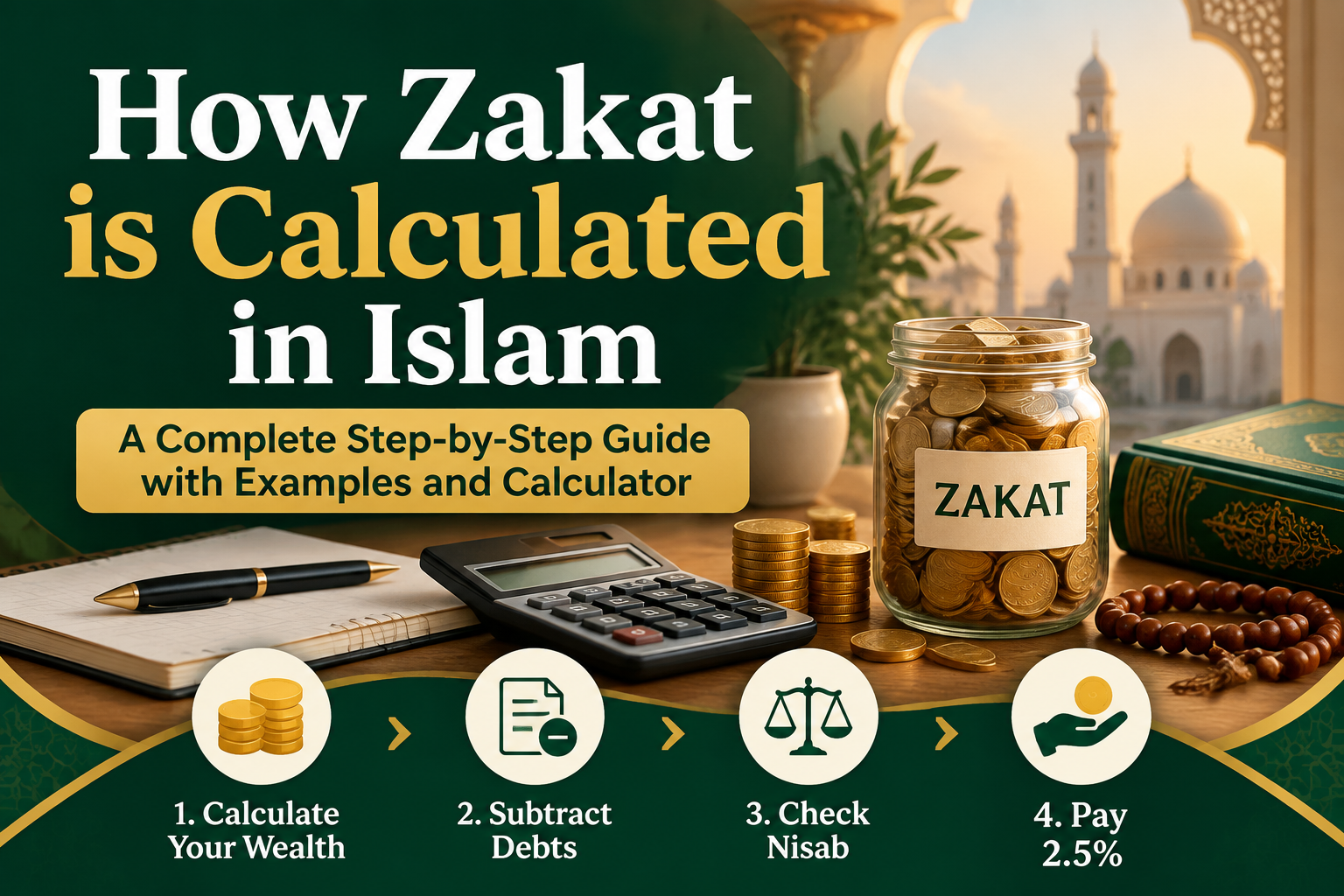
Learning how Zakat is calculated in Islam is simpler than it looks: once your wealth reaches the nisab threshold and a lunar year has passed, you give 2.5% of your zakatable assets. By the end of this guide, you will know exactly how to calculate your Zakat step by step: the conditions, the nisab, what counts as zakatable wealth, modern assets like shares and pensions, who can receive it, and several worked examples.
- The 2.5% rate
- Nisab explained
- Modern assets covered
- 4 worked examples
- Built-in calculator
Zakat calculation in Islam is something most people put off until the last minute. If you have ever sat down to work out your Zakat, you probably know the feeling: bank app open, a rough list in your head, and a worry about getting it wrong. Does the gold in the drawer count? What about the pension, or those shares from last year? Can I knock off my credit card bill first? The questions pile up, and the fear of underpaying an act of worship makes it worse.
Here is the part that calms most of it down. The rule at the centre of Zakat calculation in Islam never changes: 2.5% of your qualifying wealth, once you have held it for an Islamic year. Everything else is just working out which of your money that 2.5% applies to. Once you have your list, the yearly calculation takes about fifteen minutes.
In short, Zakat calculation in Islam works out to 2.5% of your total zakatable wealth, once two conditions are met: your wealth reaches the nisab (a threshold worth about 85 grams of gold or 595 grams of silver), and it has been in your possession for one lunar year (hawl). Add up your cash, savings, gold, silver, business stock and investments, subtract debts due now, and if the remainder is at or above the nisab, you give one fortieth (2.5%) of it.
What Is Zakat and Why Calculate It Carefully?
Zakat is the obligatory yearly charity that stands as the third of the five pillars of Islam. Although many people call Zakat a donation, it is more accurately an obligatory act of worship and a fixed right the poor hold over the surplus of everyone who has more than they need, closer to a due than a gift. That is why the figure matters. Short-change it and a duty is left unpaid, and the whole point, cleansing your wealth and yourself, slips away.
خُذْ مِنْ أَمْوَالِهِمْ صَدَقَةً تُطَهِّرُهُمْ وَتُزَكِّيهِم بِهَا
Meaning: “Take from their wealth a charity by which you purify them and cause them to increase.”
Surah At-Tawbah 9:103 (Quran.com)
The word Zakat literally means purification and growth. As you add up your accounts, keep that in mind: you are not hunting for loopholes, you are setting aside a portion you should be glad to see leave your hands clean.
Many families choose to calculate Zakat in Ramadan, because they are already reviewing their savings and charity plans that month. That works well, as long as it matches your own Zakat date, which depends on when your hawl completes (more on that below).
Zakat al-Mal, Zakat al-Fitr and Sadaqah: The Difference
First, clear up a mix-up that catches almost every beginner. The word “Zakat” gets used for two different obligations, and neither one is the same as ordinary charity. Confuse them and you can end up paying the wrong thing at the wrong time.
| Type | What it is | Amount | When |
|---|---|---|---|
| Zakat al-Mal | Zakat on your wealth (the subject of this guide) | 2.5% of zakatable wealth | After a lunar year, once at nisab |
| Zakat al-Fitr | A small charity of food per person at the end of Ramadan | About one sa’ (~2.5 to 3 kg) of staple food, or its value, per household member | Before the Eid al-Fitr prayer |
| Sadaqah | Voluntary charity, any time, any amount | Whatever you wish | Whenever you like |
Zakat al-Fitr is a separate, much smaller obligation with its own basis:
Ibn Umar reported that the Messenger of Allah ﷺ enjoined Zakat al-Fitr as one sa’ of dates or one sa’ of barley upon every Muslim, slave or free, male or female, young or old, and ordered that it be paid before the people go out to the Eid prayer.
Sahih al-Bukhari 1503; Sahih Muslim 984
The rest of this guide is about Zakat al-Mal, the 2.5% Zakat on wealth. Wherever “Zakat” appears below, that is what is meant.
The 3 Conditions Before Zakat Is Due
Do not reach for the calculator yet. First find out whether Zakat is even due on you this year, because three conditions have to line up together. Miss one and you may owe nothing at all.
1. Full Ownership of the Wealth
The wealth must be fully yours and freely at your disposal. Money you are owed and reasonably expect back generally counts; money that is truly lost does not, until it actually reaches your hands.
2. Reaching the Nisab Threshold
Your total zakatable wealth must reach the nisab, the minimum level below which no Zakat is owed. The next section explains exactly what that threshold is and how to work it out in today’s money.
3. The Passing of One Lunar Year (Hawl)
The wealth must have stayed in your possession, at or above the nisab, for one full lunar (Hijri) year. The Prophet ﷺ taught that there is no Zakat on wealth until a year passes over it (reported by Abu Dawud and others). What matters is the base amount across the year: a brief dip that recovers usually still counts, as long as you did not fall below the nisab and stay there.
What Is Nisab? Gold and Silver Thresholds
Nisab is the minimum amount of wealth that makes Zakat obligatory. The Prophet ﷺ set it using two metals, gold and silver.
| Standard | Prophetic measure | Approximate weight |
|---|---|---|
| Gold | 20 dinars (mithqal) | about 85 grams (some scholars say 87.48g) |
| Silver | 200 dirhams | about 595 grams (some scholars say 612.36g) |
“There is no Zakat on less than five awaq (of silver),” and five awaq equal 200 dirhams.
Sahih al-Bukhari 1447
No Zakat is due on gold until it reaches twenty dinars.
Sunan Abi Dawud 1573
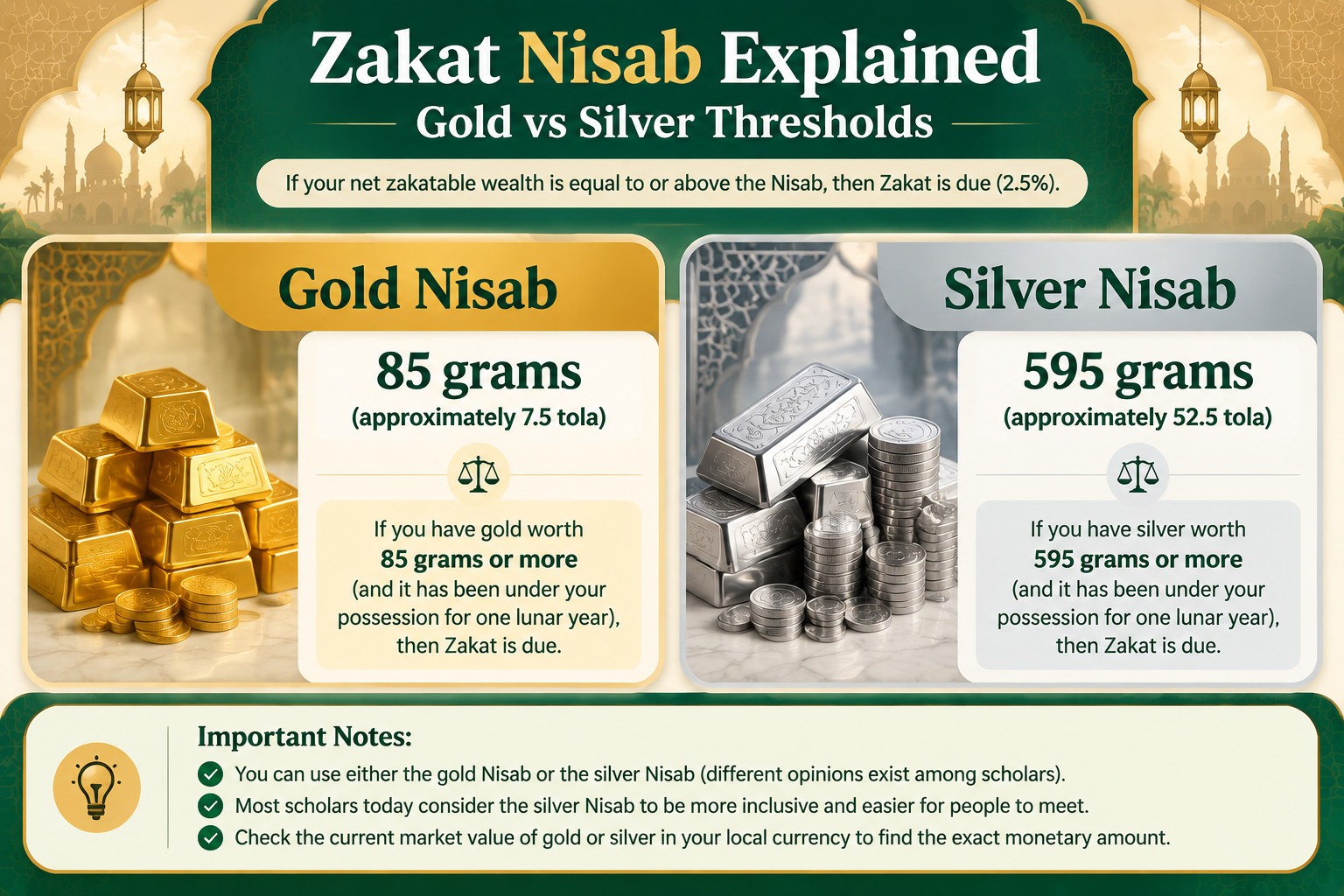
Turning the nisab into today’s money. For cash and Zakat on savings, convert one metal weight into your currency at the current market price. If silver trades at 0.80 per gram, the silver nisab is roughly 595 × 0.80 = 476 (use this as an illustrative figure only; check the actual silver price on the day you calculate). Do the same with 85 grams and the gold price for the gold nisab. Prices move daily, so always check them for the year you are calculating.
In the Prophet’s time, 20 dinars of gold and 200 dirhams of silver were roughly equal in value. Today the silver nisab comes out much lower than the gold nisab, so there is a genuine choice:
- Silver nisab (lower threshold): more people qualify, so more reaches the poor. Many contemporary scholars and charities favour it for cash savings, as the more cautious option.
- Gold nisab (higher threshold): some scholars prefer it as a steadier measure of genuine surplus wealth, so those with modest savings are not burdened.
Both are held by respected scholars. A common, cautious approach is to use the silver nisab when your wealth is mostly cash. If unsure, follow a trusted local scholar and check current prices.
What Wealth Is Zakatable (Including Modern Assets)?
Not everything you own is subject to Zakat. The principle: Zakat falls on “growing” or surplus wealth, not on the things you use for daily living.
| Zakatable (include) | Not zakatable (leave out) |
|---|---|
| Cash in hand and in the bank | The home you live in |
| Savings and money set aside | Your personal car and furniture |
| Gold and silver | Clothing and household items |
| Business stock and goods for sale | Tools and machines used to earn (not for resale) |
| Money owed to you that you expect back | Debts you must pay now |
| Zakat Calculation Quick Comparison | Counted? |
|---|---|
| Savings account | Yes |
| Cash in hand | Yes |
| Gold and silver | Yes (jewellery: depends on school, see below) |
| Business stock | Yes |
| Money owed to you (reliable) | Yes |
| Shares held long-term | Depends (zakatable portion only) |
| The home you live in | No |
| Personal car | No |
| Debts due now | Subtracted, not added |
Modern assets people ask about
Shares, pensions and crypto did not exist in the Prophet’s time, so scholars apply older principles to them and do not always agree. Use the points below as a starting guide, and check your own case with a scholar or a reliable Zakat calculator:
- Shares and stocks: bought to trade, their full market value on your Zakat date is zakatable like business stock. Held long-term for dividends, most scholars charge Zakat only on the company’s zakatable portion (its cash and stock, not its buildings); a calculator or a fixed percentage of the share value is the usual shortcut.
- Pensions and retirement funds: a widely used view is that Zakat falls on money you can actually access and withdraw, while locked funds are treated as not yet zakatable. Schemes vary, so check yours.
- Cryptocurrency: most contemporary scholars treat crypto you hold as zakatable at its market value, paid at 2.5%, much like currency.
- Rental property: a property bought to rent out is not itself zakatable, but the rental income you have saved by your Zakat date is. A property bought to flip and resell counts as trade stock, so its value is zakatable.
Agricultural produce and livestock have their own separate thresholds and rates (which can differ from 2.5%), so they are calculated on their own and sit outside this cash-and-savings guide.
A practical note: people who own property in countries like Pakistan often ask whether rental income from a family plot counts. It does. The saved rental income on your Zakat date is zakatable, even if the land itself is not.
Interest you have earned is unlawful wealth: it is not part of your zakatable savings, nor is it given as Zakat. Instead, scholars advise giving it away entirely to the poor as general charity, separately, to be rid of it. Zakat is paid from lawful wealth; purifying haram income is a different obligation. Financial handling of interest can get complicated depending on your accounts and jurisdiction, so consult a qualified scholar for your specific situation.
Zakat Calculation in Islam: Step by Step
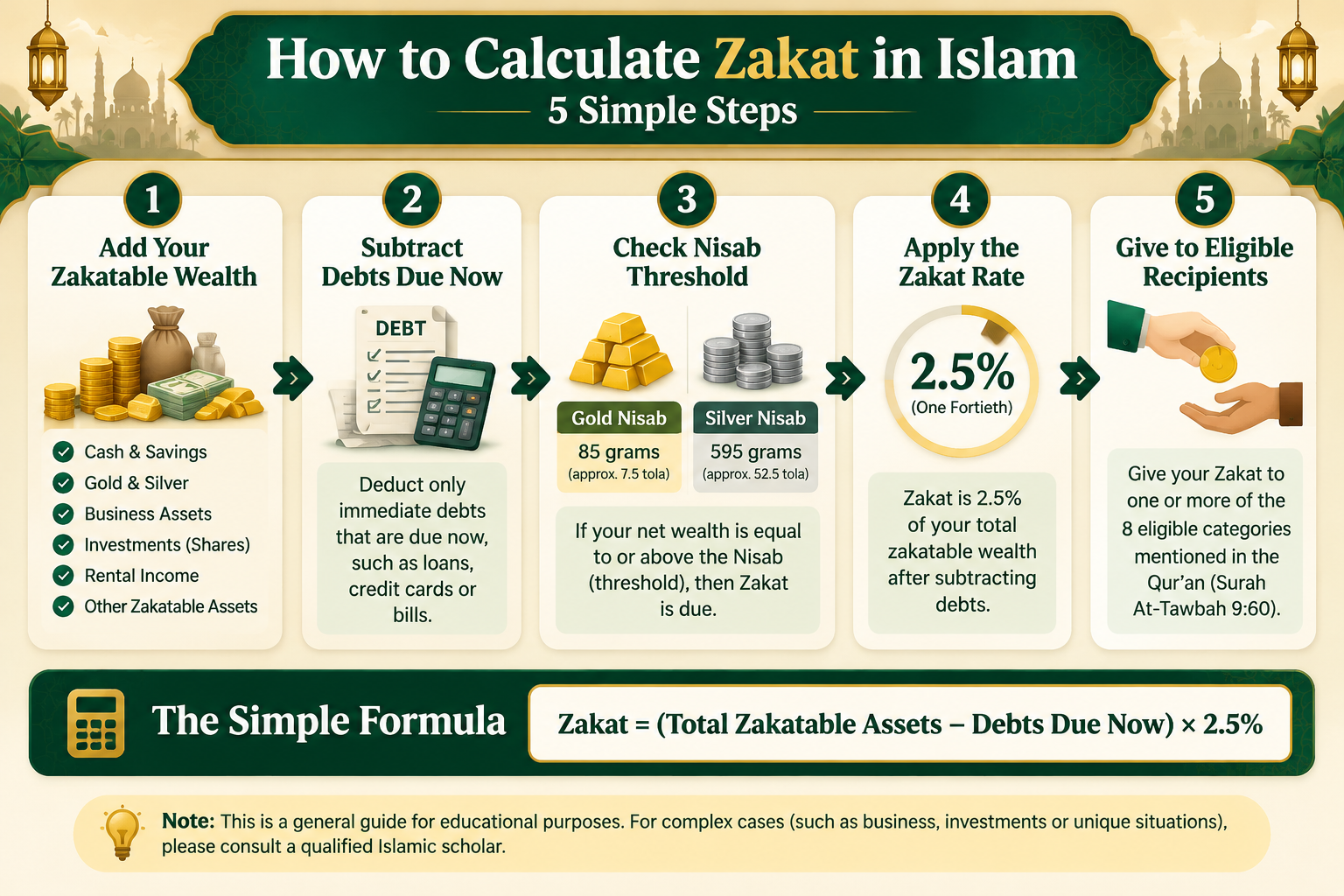
Once the three conditions are confirmed, the calculation itself is short. Work through these five steps.
Step 1: Pick and Keep a Zakat Date
Your Zakat date is the day your hawl completes: the date you first held wealth at or above the nisab, counted in the lunar calendar. Once you know it, calculate on that same date every year and write it down so you never have to guess. Many people choose Ramadan because it is a memorable time, and that is fine if it matches your own hawl. If it does not, follow your own date, or ask a scholar how to adjust.
Step 2: Add Up All Zakatable Assets
Total your cash, bank savings, the current value of your gold and silver, business stock, zakatable investments, and reliable money owed to you. Value gold and shares at that day’s market price, not what you paid.
Step 3: Subtract Debts Due Now
Deduct debts currently due, such as this month’s bills, rent, or an overdue payment. On long-term debts like a mortgage, scholars differ: some deduct only the instalment due now, while a common charity-guidance view allows up to twelve months’ upcoming instalments. Either way, you never deduct the entire future balance.
Step 4: Compare the Total to the Nisab
Work out the current value of the gold or silver nisab for your date. If your net zakatable wealth is below it, no Zakat is due this year. If it is at or above the nisab, move to the final step.
Step 5: Take 2.5%, With a Sincere Intention
Multiply your net zakatable wealth by 0.025 (one fortieth, the “quarter of a tenth” the hadith describes). Make the intention (niyyah) that what you are giving is Zakat, since it is an act of worship, then pay it to eligible recipients.
Zakat = (Total zakatable assets − debts due now) × 2.5%, provided that net figure is at or above the nisab and a lunar year has passed.
A Full Worked Example
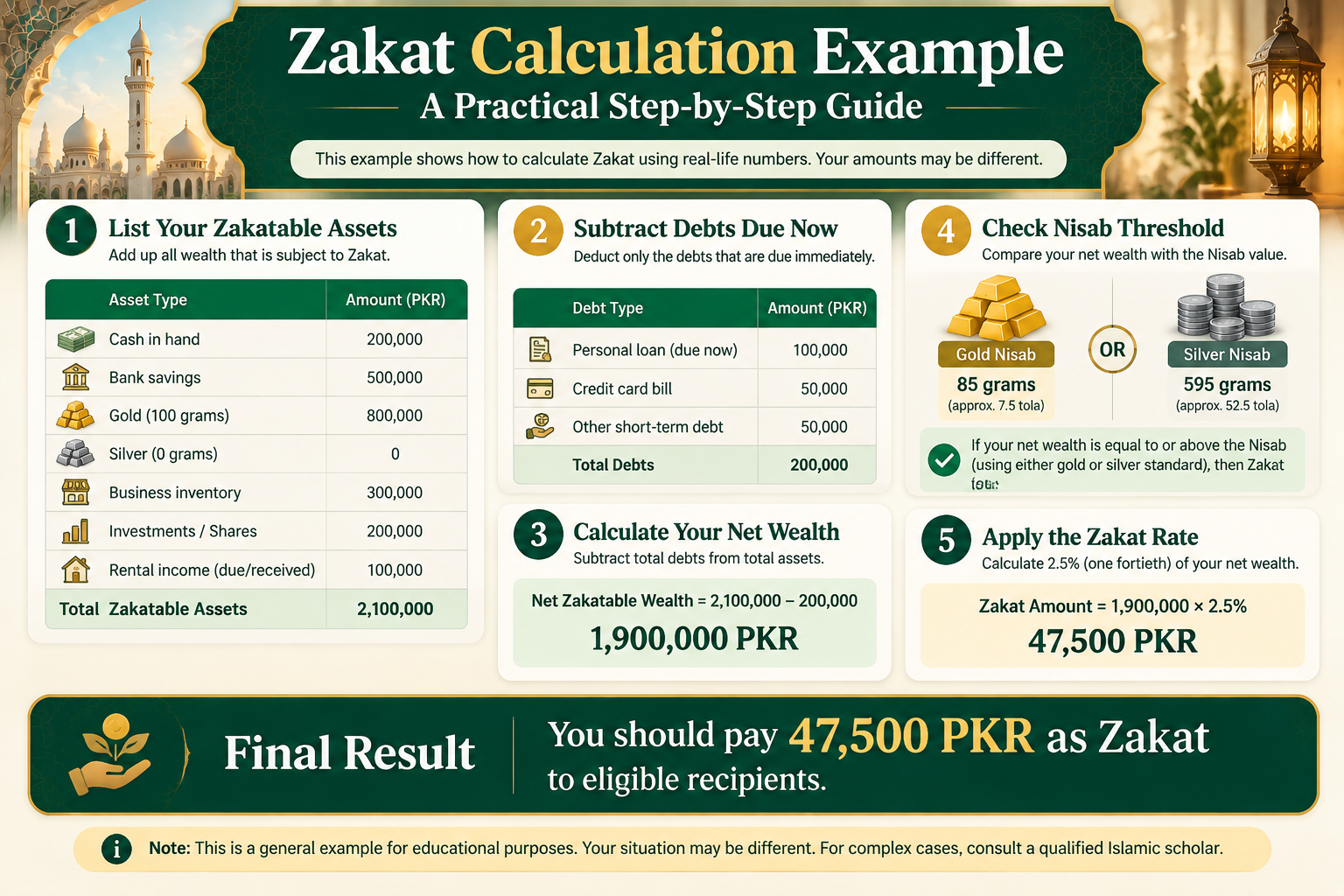
Meet Aisha. She reaches her Zakat date and sits down to add everything up. She checks the current silver price and finds the silver nisab for her date is about 476 in her local currency (illustrative; check the actual rate on your date), so any net wealth above that makes Zakat due.
| Cash and bank savings | 5,000 |
| Gold jewellery (current market value) | 2,000 |
| Business stock for sale | 3,000 |
| Money a friend will repay | 500 |
| Subtotal of zakatable assets | 10,500 |
| Less: bills and loan payment due now | −1,500 |
| Net zakatable wealth | 9,000 |
| Zakat due (9,000 × 2.5%) | 225 |
Her net wealth of 9,000 sits well above the nisab, so Zakat is due, and 2.5% of 9,000 is 225. That is what Aisha gives to eligible recipients. The same method works in any currency: Pakistani rupees, US dollars, British pounds. Total up, subtract debts due now, check the nisab, then take 2.5%.
Three More Examples: Student, Business Owner, Family
Every household looks different, so here are three more illustrative scenarios (invented for teaching, not real people). All use the same illustrative silver nisab of about 476 and the same five steps.
Example 1: The Student With Savings Only
Yusuf is a university student with no gold and no business. Over the year he has kept part of his allowance and part-time earnings in a savings account.
| Savings account balance | 1,200 |
| Less: rent and phone bill due now | −150 |
| Net zakatable wealth | 1,050 |
| Zakat due (1,050 × 2.5%) | 26.25 |
On the silver nisab, Yusuf’s 1,050 is above 476, so a small Zakat is due once his hawl is complete. If he followed the gold nisab, he would fall below it and owe nothing this year, which is exactly why a student with modest savings should check which standard a trusted scholar recommends.
Example 2: The Business Owner With Inventory
Bilal runs a small clothing shop. Most of his wealth sits in stock on the shelves, not in the bank.
| Cash and bank balance | 4,000 |
| Inventory for sale (at current selling-cost value) | 12,000 |
| Customers’ payments he expects to receive | 1,500 |
| Less: supplier invoices due now | −2,500 |
| Net zakatable wealth | 15,000 |
| Zakat due (15,000 × 2.5%) | 375 |
Notice what Bilal leaves out: the shop counter, shelves and his till are tools of the trade, not goods for sale, so they are not counted. Only the stock, cash and reliable receivables are. Many business owners value stock at its current market or selling price; if your business is larger, an accountant familiar with Zakat can help.
Example 3: The Family With Jewellery, Savings and Debts
Maryam and her husband have savings, a set of gold jewellery she wears at weddings, and some bills due this month.
| Family savings | 4,000 |
| Gold jewellery (current market value) | 3,000 |
| Less: bills and loan instalment due now | −1,000 |
| Net (if jewellery is counted, Hanafi view) | 6,000 |
| Zakat due (6,000 × 2.5%) | 150 |
| Net (if worn jewellery is exempt, other schools) | 3,000 |
| Zakat due (3,000 × 2.5%) | 75 |
This family’s answer depends on the school of thought they follow for worn jewellery, as explained in the gold and silver section below. Both figures show the method clearly; they should follow the scholar or school they rely on, and choosing the higher figure when unsure is the more cautious option.
Try the Quick Zakat Calculator
Want to test your own numbers? Enter your figures below. This tool only does the arithmetic from this guide, so use the current price per gram and your own valuations. For complex assets, still speak to a scholar.
Quick Zakat Calculator
Uses the same formula: (assets − debts due now) × 2.5%, if at or above the nisab. Enter all amounts in one currency.
Zakat on Gold and Silver
Gold and silver are counted at their current market value, not the price you paid. Weigh your gold, multiply by today’s price per gram, add it to your total, and apply the same Zakat percentage of 2.5%.
One scholarly difference is worth knowing: Zakat on jewellery a woman wears regularly. The Hanafi school holds it zakatable like any gold or silver; the Maliki, Shafi’i and Hanbali schools generally exempt jewellery kept for personal adornment. Follow the school or scholar you rely on, and when in doubt, paying is the more cautious choice. Gold that is broken, stored, or held as investment is zakatable by all.
Who Can Receive Your Zakat?
Calculating the amount is only half the task; Zakat must reach the right people. The Quran names eight eligible categories, which is why it is a structured obligation rather than open-ended giving:
إِنَّمَا الصَّدَقَاتُ لِلْفُقَرَاءِ وَالْمَسَاكِينِ وَالْعَامِلِينَ عَلَيْهَا وَالْمُؤَلَّفَةِ قُلُوبُهُمْ وَفِي الرِّقَابِ وَالْغَارِمِينَ وَفِي سَبِيلِ اللَّهِ وَابْنِ السَّبِيلِ
Meaning: “Zakat is only for the poor, the needy, those employed to collect it, those whose hearts are to be reconciled, freeing captives, those in debt, in the cause of Allah, and the stranded traveller.”
Surah At-Tawbah 9:60 (Quran.com)
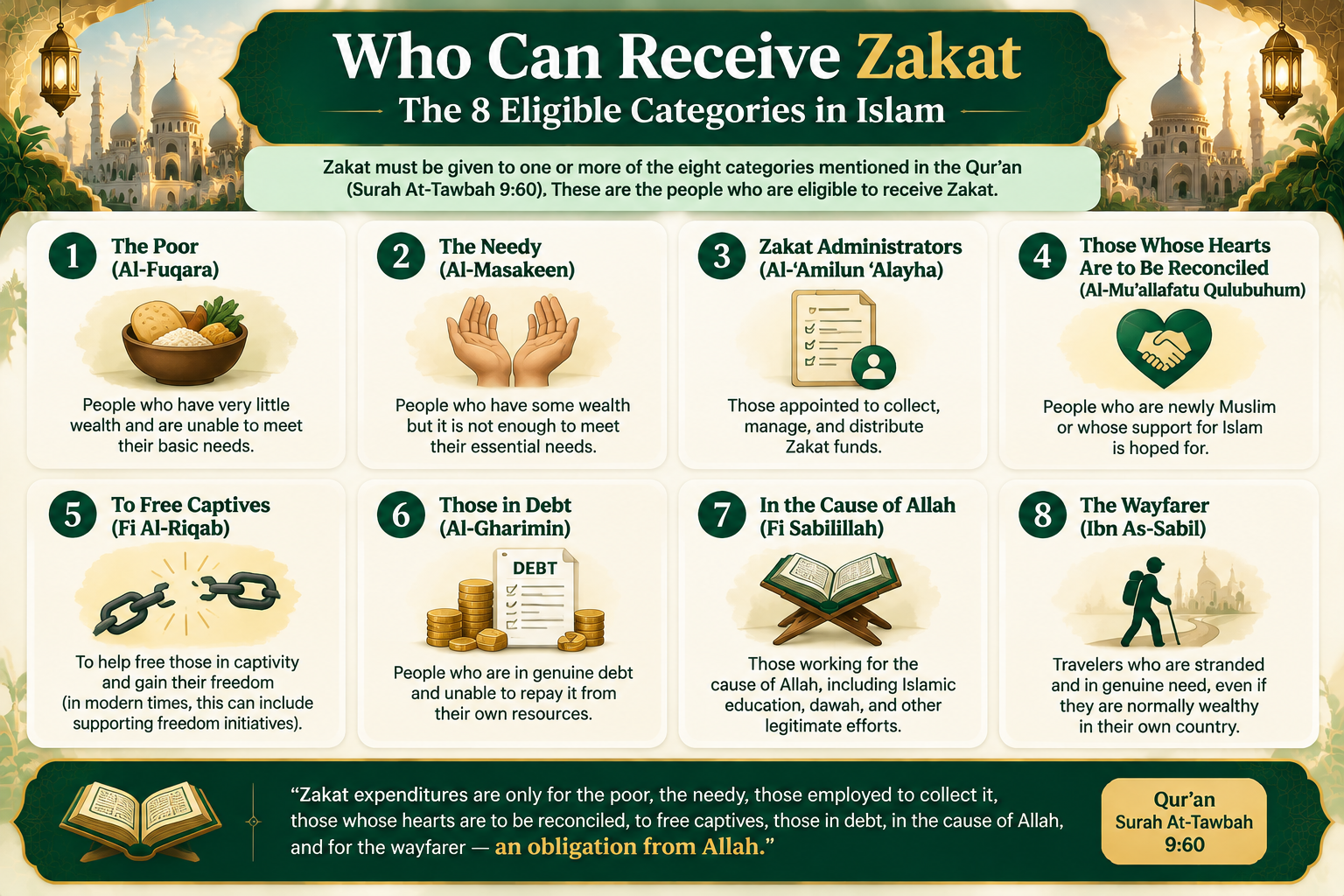
Who cannot receive your Zakat. You cannot give it to those you are already obliged to support, such as your spouse, children or parents, since that is a separate duty, nor to someone already wealthy above the nisab. Many scholars hold that Zakat al-Mal goes to eligible Muslims, while voluntary Sadaqah may be given more broadly; ask a scholar about specific cases.
What If You Missed Zakat in Past Years?
If you realise you missed Zakat in earlier years, you are not alone, and it can be put right. Many people simply were not taught when exactly Zakat became due for them, or the question of assets like savings accounts was never properly explained.
Unpaid Zakat does not quietly expire. Scholars treat it as a debt that stays on your account until you clear it. So go back year by year, work out as honestly as you can what your zakatable wealth was on your Zakat date each time, and pay 2.5% for each year. If the old statements are gone, a careful, good-faith estimate beats leaving it undone. Do it alongside sincere repentance, and when the years stack up or your finances were tangled, a scholar can help you settle on a fair method.
Common Zakat Calculation Mistakes
Prefer a full-page tool, or want to keep learning?
Open the Full Zakat Calculator Learn the 5 PillarsFrequently Asked Questions
How does Zakat calculation in Islam work, step by step?
Zakat calculation in Islam follows five steps: pick a fixed Zakat date, add up all zakatable assets at current market value, subtract debts due now, compare the net figure to the nisab, and if you are at or above it, pay 2.5% with a sincere intention.
How much Zakat do I pay in Islam?
The standard rate is 2.5% of your net zakatable wealth (cash, savings, gold, silver, business stock and investments, minus debts due now), once it reaches the nisab and a lunar year has passed. Agricultural produce and livestock follow separate rates.
What is the nisab for Zakat?
The nisab is the minimum threshold: about 85 grams of gold or 595 grams of silver (some scholars cite 87.48g and 612.36g). For cash, convert one weight to money at the current market price. Many scholars use the silver nisab so more reaches the poor.
Should I use the gold or silver nisab?
Both are valid and scholars differ. The silver nisab is lower, so more people qualify and more reaches the needy; many contemporary scholars favour it for cash. The gold nisab is higher. Follow a trusted scholar and check current prices.
Do I pay Zakat on my house and car?
No. Your home, personal car, furniture and everyday items are not zakatable. Zakat is due on surplus, growing wealth such as cash, savings, gold, silver, and business stock, not the essentials you use for living.
Is Zakat calculated on income or on savings?
On savings and accumulated wealth, not on income as it arrives. Total the zakatable wealth you still hold on your Zakat date after a lunar year, then give 2.5%. Money already spent during the year is not counted.
Is Zakat calculated on salary?
Zakat is not calculated on your monthly salary as it arrives. It is calculated on the wealth you have saved and still hold when your Zakat date comes around, after a full lunar year. So if your salary comes in and is spent on living costs during the year, that portion is not zakatable. What remains in your savings on your Zakat date, along with your other assets, is what you calculate 2.5% on.
Can I pay Zakat monthly?
Yes, you can spread your Zakat across the year in monthly payments; many people find this easier than one lump sum. The key point is that you first calculate your full Zakat amount on your Zakat date (once your hawl is complete), and then pay it in instalments if you wish. You should complete the full payment before your next Zakat date arrives.
How do I calculate Zakat in Pakistan?
The method is exactly the same as anywhere else: total your zakatable assets (savings, gold, silver, business stock, investments), subtract debts due now, check whether the total meets the nisab, and pay 2.5%. In Pakistan, many people use the silver nisab converted to Pakistani rupees at the current silver price. Check the silver rate in PKR on your Zakat date, multiply by 595 grams to get the nisab in rupees, and compare your net wealth to that figure. If you are above it and a lunar year has passed, 2.5% is due.
How do I calculate Zakat on gold?
Weigh your gold, multiply by the current market price per gram, add it to your other zakatable wealth, and give 2.5% of the total. Use today’s price, not what you originally paid.
Is Zakat obligatory on gold jewellery?
Zakat is obligatory on gold that is stored, held as investment, or broken and kept for its value, and all schools agree on that. For jewellery a woman wears regularly, scholars differ: the Hanafi school counts it as zakatable, while the Maliki, Shafi’i and Hanbali schools generally exempt jewellery kept for personal adornment. Either way, the gold must reach the nisab (in your total wealth) and a lunar year must pass. Follow the school or scholar you rely on, and when unsure, paying is the more cautious choice.
Do I pay Zakat on shares, crypto or my pension?
Shares bought to trade are zakatable at market value; shares held long-term are zakatable on a portion, so a calculator or scholar helps. Cryptocurrency you hold is generally zakatable at 2.5%. For pensions, many scholars say Zakat is due on funds you can actually access.
Do I deduct my debts before calculating Zakat?
You deduct debts due now, such as current bills or an overdue payment. For long-term debts like a mortgage, a common approach is to deduct only the instalment due now, not the whole balance.
What if I forgot to pay Zakat for past years?
Unpaid Zakat remains a debt you still owe. Estimate your zakatable wealth for each missed year as honestly as you can, pay 2.5% for each year, and pair it with sincere repentance. A scholar can help if the years are many or complex.
Is an online Zakat calculator accurate?
An online calculator is only as accurate as the figures and current metal prices you enter. It can correctly apply the 2.5% formula and check your total against the nisab, but it cannot rule on complex cases, such as worn jewellery, locked pension funds, or long-term shares, where scholars differ. Treat the result as a general estimate and confirm anything unclear with a qualified scholar.
What information do I need before calculating Zakat?
Gather the current value of your cash and bank savings, the market value of any gold or silver you hold, the value of business stock or investments, any reliable money owed to you, the current price of gold or silver per gram (to work out the nisab), and a list of debts or bills due right now. With these figures ready, the calculation itself takes only a few minutes.
Who can I give my Zakat to?
To the eight categories named in the Quran (9:60), chiefly the poor and needy. You cannot give it to those you must already support, such as your spouse, children or parents, nor to someone already wealthy above the nisab.
Calculate With Confidence, Give With Sincerity
At its core, Zakat calculation in Islam comes down to five checks: the three conditions, your total, debts due now, the nisab, then 2.5%. Only the nisab you follow, how you handle long-term debts, and modern assets like shares and pensions need extra care. After the first calculation, future years usually become much easier, because you mostly just update your numbers.
Related Guides
Sources and Methodology
- Quran references verified: every verse is checked against Quran.com before inclusion
- Hadith references checked: every hadith is confirmed on Sunnah.com with its collection number
- Scholarly differences reviewed: where scholars disagree (nisab standard, jewellery, long-term debts), both positions are noted rather than one silently chosen
- Content updated annually: reviewed each year for accuracy; last reviewed September 2026
Quran verses are referenced to Quran.com and every hadith was checked against its collection number on Sunnah.com: Sahih al-Bukhari 1447 (the silver nisab), Sunan Abi Dawud 1573 (the gold threshold), Sahih al-Bukhari 1503 and Sahih Muslim 984 (Zakat al-Fitr), and Sunan Abi Dawud 1572-1574 (the 200-dirham and 20-dinar thresholds and the lunar-year requirement). Quran references: Surah At-Tawbah 9:60 and 9:103. The metric weights (about 85g of gold and 595g of silver) follow the standard mithqal and dirham conversions; some scholars cite 87.48g and 612.36g.
What is settled: the 2.5% rate on gold, silver, cash and trade goods, the requirement of nisab and a lunar year, the eight categories of recipients, and that daily essentials are not zakatable. What involves scholarly difference: whether to use the gold or silver nisab for cash, how to treat long-term debts, worn jewellery, and the exact treatment of modern assets such as shares and pensions. For your specific situation, especially complex assets or missed years, consult a qualified scholar. This guide is educational and does not replace personalised religious or financial advice.
IslamicEduHub Editorial Team writes practical guides on worship, Zakat, and Islamic basics for beginners. Every Quran reference is checked against Quran.com, every hadith is checked on Sunnah.com, and points of scholarly difference are noted rather than hidden. Editorial team members review content according to our publishing guidelines before it goes live.
Last reviewed: September 2026.
Found an error? Contact IslamicEduHub. Follow us on Facebook.