

By the twenty-first night you may be short on sleep and behind on your Quran target. The last 10 days of Ramadan still ask the most of you, because Laylatul Qadr is hidden inside them. This guide gives a baseline for every night, extra effort for the odd nights, and answers on I’tikaf, charity and Zakat al-Fitr.
- Baseline plan for all ten nights
- Extra effort on the odd nights
- I’tikaf options
- Quranic & Prophetic Duas
- Night checklist
When the last 10 days of Ramadan began, the Prophet ﷺ changed gear.
Aisha reported that when the last ten days of Ramadan began, the Prophet ﷺ would tighten his waist-wrapper, stay up at night, and wake his family.
The wording describes someone rolling up his sleeves: more effort, fewer distractions, and his household included. In Abu Dharr’s report, he calls his family and wives to join the night prayer on one of the last nights, until they feared missing suhoor (Tirmidhi 806). The reason for the extra effort is a night hidden inside these ten.
The last 10 days of Ramadan begin with the night of the 21st, counted from sunset on the 20th day. A workable plan: keep a baseline every night (Isha, Taraweeh where you can, a short night prayer with dua, Witr if you have not prayed it, Fajr in congregation) and add extra effort on the odd nights (the 21st, 23rd, 25th, 27th and 29th). Give charity as you are able and pay Zakat al-Fitr before the Eid prayer.
What Makes the Last 10 Days of Ramadan Different
Every night of Ramadan carries reward. The last ten carry something extra: Laylatul Qadr, hidden somewhere among them. The Prophet ﷺ practised I’tikaf in the last ten nights and told people to look for the night in them (Bukhari 2020), and he kept up I’tikaf every year until he died (Bukhari 2026). Since you do not know which night is being offered, this is where you spend your best effort. What the sources say about the night itself, and which night it may be, is in our guide to Laylatul Qadr signs; this guide is about how to spend the nights.
Which Nights Are the Odd Nights?
The odd nights are the 21st, 23rd, 25th, 27th and 29th. The Islamic day begins at sunset, so the 21st night starts at Maghrib on the 20th day of Ramadan, and that is also when the last ten nights begin. The 27th night starts at Maghrib on the 26th day and runs until Fajr.
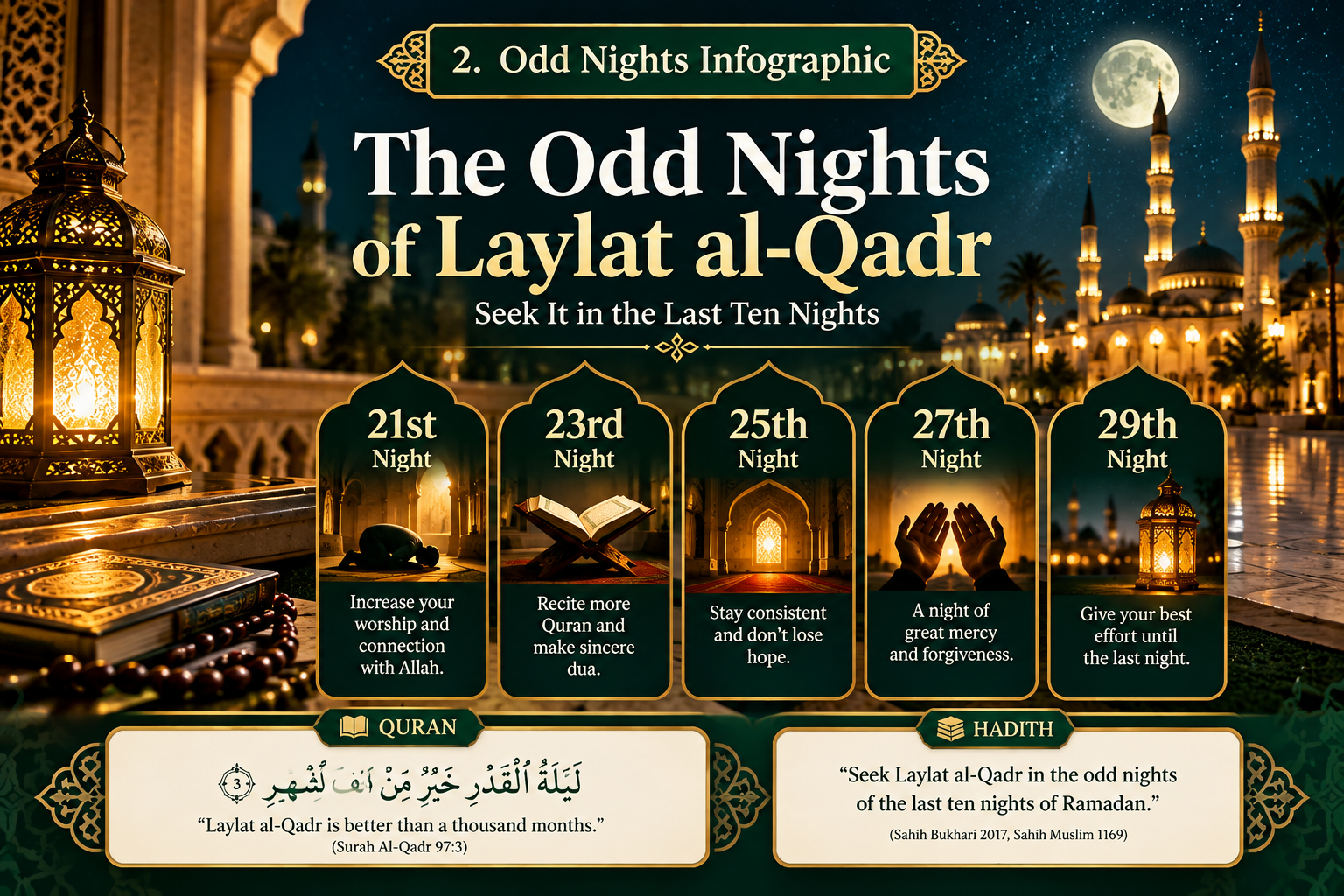
The sources do not name which of these five nights is Laylatul Qadr; the evidence is laid out in our Laylatul Qadr guide, so this plan covers all five. Ramadan can begin a day apart in different countries, so count your odd nights from the date your local masjid follows. If you can only manage a few strong nights, choose the odd ones.
What Should I Do Tonight?
First check where tonight falls in the last ten nights, counting from your local masjid’s date. Keep your baseline every night, and if it is an odd night, raise your effort. Then pick the version that fits your energy.
- Running on empty: Isha, plus Taraweeh if you can. Before sleep, two rak’ahs and Witr (if not yet prayed), then your dua list. Fajr in congregation.
- A normal night: the baseline below, plus a page of Quran, and charity if you can.
- An odd night with energy: sleep after Taraweeh, wake for the last third of the night, and give it your longest Tahajjud and dua.
A Night Plan: Baseline Every Night, Extra on the Odd Nights
The Prophet ﷺ pushed hard through these nights (Bukhari 2024) and Laylatul Qadr is sought most in the odd ones (the evidence is in our Laylatul Qadr guide). So keep a baseline on every night and add extra effort on the odd nights. The times below are examples; slide them to fit your own Isha and Fajr.
To find the last third of the night, divide the time from Maghrib to Fajr by three. If Maghrib is at 6:30pm and Fajr at 5:30am, the night is eleven hours and the last third starts at about 1:50am.
Baseline: every night, all ten
| After Maghrib | Break your fast with dates and water, then eat light. |
| Isha and Taraweeh | Pray Isha in congregation and, where you can, Taraweeh with the imam until he finishes. The Prophet ﷺ said that whoever stands with the imam until he finishes has the whole night recorded for him (Tirmidhi 806). If you cannot get to a masjid, pray at home with your family or in the way that suits your situation. See the Isha guide. |
| Before sleep or before suhoor | Two rak’ahs of night prayer, ten minutes of dua and a page of Quran. Make Witr the last prayer of the night (Bukhari 998): if you have not already prayed it with the imam, finish with it according to the practice you follow. See the Tahajjud guide and the Witr guide. |
| Fajr | Pray in congregation (Fajr guide). Sahih Muslim reports Isha in congregation as like standing half the night and Fajr in congregation as like standing the whole night (Muslim 656). Tirmidhi words it as Isha and Fajr together being like the whole night (Tirmidhi 221). |
Extra effort: odd nights (21, 23, 25, 27, 29)
| During the day | Keep the day light and nap if you can, so the night has energy behind it. |
| After Taraweeh | Go home and sleep. Set an alarm for the start of the last third of the night. |
| Last third of the night | Pray Tahajjud in pairs of rak’ahs, without hurrying, and read through your dua list between sets. In the last third of the night Allah descends to the lowest heaven, in a manner that befits Him, and asks who will call on Him, who will ask of Him, and who will seek His forgiveness (Bukhari 1145). |
| Before Fajr | Eat suhoor, read Quran with reflection and keep asking. The duas below are a good place to start. |
The reports about standing with the imam, and about Isha and Fajr in congregation, describe a share of the night within reach of a tired person. The baseline in this plan is our practical suggestion, not a fixed religious minimum. The Prophet ﷺ did more, so add what you can.
Three Situations, Three Adjustments
- You have small children. Split the night with your spouse: one sleeps from Taraweeh until the last third while the other stays up, then swap. Older children can join a few rak’ahs.
- You work 9 to 5 or have exams. Nap at lunch, study or work before Isha rather than in the last third, and keep the shortest version of the baseline on weekdays.
- Your period starts. You cannot pray or fast, but dua, dhikr, istighfar and charity stay open to you. Ask a trusted scholar about staying in a masjid or I’tikaf.
When You Are Already Tired
By now, three weeks of fasting and short sleep have caught up with you. Nap for 20 to 30 minutes after Dhuhr, keep iftar light, and have tea or coffee early in the evening, not late at night. And look after your health: if you feel dizzy or unwell, rest and speak to a doctor.
I’tikaf: The Full Version and a Realistic One
I’tikaf means staying in a masjid with the intention of devoting yourself to worship. The Quran speaks of those “staying for worship in the mosques” and forbids marital relations during it (Quran 2:187). The Prophet ﷺ did it in the last ten days every year until he died, and his wives continued it after him (Bukhari 2026). Scholars generally describe it as a confirmed sunnah, not an obligation, unless someone has vowed it.
The full version. If you can take leave and your family can manage, the full ten days follows the Prophet’s practice. Scholars differ on when to enter. The majority view is to be in the masjid before sunset on the 20th, so you are already there when the 21st night begins, and to stay until the month ends. Some earlier scholars start after Fajr on the 21st, based on Aisha’s report that the Prophet ﷺ prayed Fajr and then entered his place (Bukhari 2033); the majority read this as him withdrawing to his private spot after already being in I’tikaf. Follow your imam on the exact time, and leave only for necessary needs.
A shorter stay. If ten days is not possible, ask your imam about a shorter voluntary I’tikaf, since scholars differ on the minimum length. You can also spend the hours from Isha to Fajr at the masjid and go home in the morning. Whether that counts as voluntary I’tikaf depends on your intention and the view you follow, but it keeps you in worship through the night.
For women. Aisha reports that the Prophet’s wives kept I’tikaf after him, so it is established for women too. Scholars differ on where: Hanafi sources describe a woman observing it in the designated prayer area of her home, while other schools differ on the place. They also discuss conditions such as a husband’s permission, so ask a qualified scholar about your situation.
Duas for the Last 10 Nights
Two duas from the Sunnah suit these nights: Sayyid al-Istighfar, and a Quranic dua that was the Prophet’s ﷺ most frequent. Add your own list too: family, debts, sins, and what you cannot fix yourself. See the guides to making dua and istighfar. The dua taught specifically for Laylatul Qadr is in our Laylatul Qadr guide.
اللَّهُمَّ أَنْتَ رَبِّي لاَ إِلَهَ إِلاَّ أَنْتَ، خَلَقْتَنِي وَأَنَا عَبْدُكَ، وَأَنَا عَلَى عَهْدِكَ وَوَعْدِكَ مَا اسْتَطَعْتُ، أَعُوذُ بِكَ مِنْ شَرِّ مَا صَنَعْتُ، أَبُوءُ لَكَ بِنِعْمَتِكَ عَلَيَّ، وَأَبُوءُ لَكَ بِذَنْبِي فَاغْفِرْ لِي، فَإِنَّهُ لاَ يَغْفِرُ الذُّنُوبَ إِلاَّ أَنْتَ
Allahumma anta Rabbi la ilaha illa anta, khalaqtani wa ana ‘abduka, wa ana ‘ala ‘ahdika wa wa’dika mastata’tu, a’udhu bika min sharri ma sana’tu, abu’u laka bini’matika ‘alayya, wa abu’u laka bidhanbi faghfir li, fa innahu la yaghfirudh-dhunuba illa anta
“O Allah, You are my Lord, there is none worthy of worship but You. You created me and I am Your servant, and I keep Your covenant and promise as best I can. I seek refuge in You from the evil I have done. I acknowledge Your favour upon me and I acknowledge my sin, so forgive me, for none forgives sins except You.”
Sahih al-Bukhari 6306 (Sayyid al-Istighfar)
رَبَّنَا آتِنَا فِي الدُّنْيَا حَسَنَةً وَفِي الْآخِرَةِ حَسَنَةً وَقِنَا عَذَابَ النَّارِ
Rabbana atina fid-dunya hasanatan wa fil-akhirati hasanatan wa qina ‘adhaban-nar
“Our Lord, give us good in this world and good in the Hereafter, and protect us from the punishment of the Fire.”
Quran 2:201; the Prophet’s most frequent dua (Bukhari 6389)
Charity and Zakat al-Fitr in the Last 10 Days of Ramadan
Ibn Abbas said the Prophet ﷺ was the most generous of people, most of all in Ramadan (Bukhari 6). One practical way to follow that through the last ten nights is a small gift on each one, with a standing order or a phone reminder to keep you going. This is not a prescribed nightly sunnah; it is simply a way to make sure you give throughout the period.
If your Zakat is due this Ramadan, work out the amount before these nights begin, using our guide to calculating Zakat and the Zakat Calculator.
Zakat al-Fitr is separate, and it is obligatory. The Prophet ﷺ ordered that it be given before people go out to the Eid prayer (Bukhari 1503), and Ibn Umar reported that the Companions gave it a day or two before Eid (Bukhari 1511). For earlier payment, follow the guidance of your local scholar or masjid. Check the amount your masjid announces this year and arrange it a day or two before Eid.

If You Feel You Wasted the First Twenty Days
Maybe you fasted but skipped Taraweeh, or did not fast well at all. The guilt is real, but the Prophet ﷺ directed us to seek Laylatul Qadr in the last ten nights, and those are still ahead of you.
Three things help:
- Make tawbah now. Stop, feel the regret, resolve not to return, and put right what you owe to others. See the guide to repenting in Islam.
- Plan to make up any obligatory fasts you missed. The Quran says to complete the same number of days later (Quran 2:184). If another Ramadan arrives first, or you missed fasts without a valid excuse, ask a scholar what else is due.
- Put whatever energy you have into the odd nights.
Treat the last ten nights as an opportunity that sits beside tawbah and make-up fasts, not a replacement for them.
Eid Preparation Without Losing the Nights
Eid shopping and cooking can swallow the nights that matter. Buy clothes and gifts before the last ten, and share the cooking so one person is not left with all of it. The Eid prayer guide covers the day itself.
Your Last 10 Nights Checklist
Before the 21st night
- Decide on I’tikaf
- Write your dua list
- Calculate Zakat if it is due
- Find out the Zakat al-Fitr amount
- Finish Eid shopping
Every night, all ten
- Isha, plus Taraweeh where you can
- Two rak’ahs of night prayer, dua and a page of Quran
- Witr, if not already prayed with the imam
- Fajr in congregation
- A small charity (optional)
Odd nights, extra
- Sleep early; alarm for the last third
- Tahajjud and your dua list
- Quran and istighfar before Fajr
Mistakes That Cost You the Nights
Frequently Asked Questions
When do the last 10 days of Ramadan start?
At sunset on the 20th day of Ramadan, which starts the 21st night. Ramadan can begin a day apart in different countries, so follow your local masjid’s calendar.
Do I have to stay awake all night?
No. The Prophet ﷺ said that whoever stands with the imam until he finishes has the whole night recorded for him (Tirmidhi 806). Muslim reports Isha in congregation as like standing half the night and Fajr as like the whole night (656), and Tirmidhi says Isha and Fajr together are like the whole night (221). Add Tahajjud and dua in the last third of the night if you can.
Should I pray Witr in the last ten nights?
Yes, as on any night. The Prophet ﷺ said to make Witr the last prayer of the night (Bukhari 998). If you already prayed it with the imam, follow your school’s guidance if you wake later for Tahajjud.
What is I’tikaf, and is it compulsory?
I’tikaf is staying in a masjid to devote yourself to worship. The Prophet ﷺ did it in the last ten days every year (Bukhari 2026). Scholars generally describe it as a confirmed sunnah, not an obligation, unless someone has vowed it. Ask a qualified scholar how it applies to you.
When should I pay Zakat al-Fitr?
Before the Eid prayer (Bukhari 1503). The Companions gave it a day or two before Eid (Bukhari 1511). For earlier payment, follow your local scholar or masjid, and ask them for this year’s amount.
What duas should I make in the last 10 days of Ramadan?
Start with Sayyid al-Istighfar (Bukhari 6306) and “Rabbana atina fid-dunya hasanah” (Quran 2:201; Bukhari 6389), and add your own duas from a written list. The dua taught for Laylatul Qadr itself is in our Laylatul Qadr guide.
What if my period starts during the last ten nights?
You cannot pray or fast, but dua, dhikr, istighfar and charity stay open to you. Ask a trusted scholar about staying in a masjid or I’tikaf.
Related Guides
Sources and Methodology
- Quran references linked to Quran.com
- Hadith references linked to Sunnah.com with their collection numbers
- Scholarly differences noted where schools disagree
Hadith references: Sahih al-Bukhari 6, 998, 1145, 1503, 1511, 2020, 2024, 2026, 2033, 6306 and 6389; Sahih Muslim 656; Jami’ at-Tirmidhi 221 and 806. Quran references: 2:184, 2:187 and 2:201. The views on when to enter I’tikaf are summarized from fatwa answers published by IslamWeb, IslamQA and SeekersGuidance (Hanafi).
What is settled: I’tikaf for men is observed in a masjid, and Zakat al-Fitr is due before the Eid prayer. Scholars differ on when to enter I’tikaf, where and on what conditions a woman may observe it, the minimum length of voluntary I’tikaf, how early Zakat al-Fitr may be paid, and whether feeding the poor is also due when make-up fasts are delayed. The times in the night plan are examples, not rulings. For your own situation, ask a trusted scholar. This guide is educational and does not replace personal religious advice.
IslamicEduHub Editorial Team writes practical guides on worship, Ramadan and Islamic basics. Hadith references link to Sunnah.com, and points where scholars differ are stated openly.
Last reviewed: October 2026.
Found an error? Contact IslamicEduHub. Follow us on Facebook.