
How to Pray Fajr Prayer Correctly: Step-by-Step Guide for Beginners (2026)
How many rakats Fajr has, exactly when it starts and ends, the full step-by-step method, and practical tips for actually waking up for it — everything a beginner needs for the dawn prayer, explained clearly in one place. Suitable for beginners, new Muslims, and anyone who wants to improve their Fajr prayer according to the Quran and authentic Sunnah.
Here’s how to pray Fajr prayer correctly, step by step: Fajr has 4 rakats total — 2 Sunnah, then 2 Fard, prayed between true dawn and sunrise. Make Wudu, face the Qiblah, and pray it like any other Salah — intention, Takbir, recitation, bowing, and prostration.
In This Guide
- What Is Fajr Prayer?
- Quranic Evidence
- Authentic Hadith on the Virtue of Fajr
- When Fajr Prayer Starts and Ends
- How Many Rakats in Fajr
- Before You Start: Prerequisites
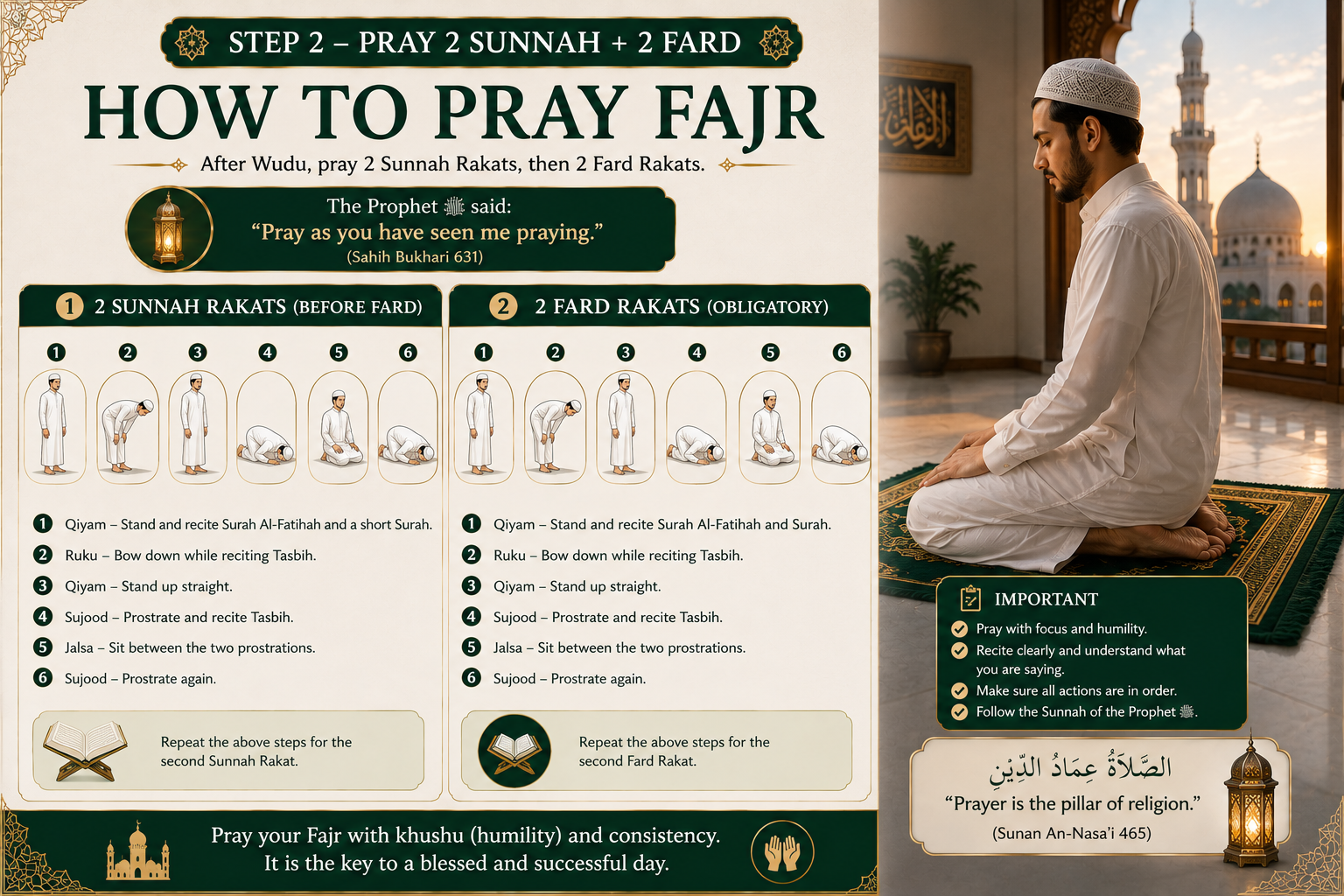
- Step-by-Step Guide to Pray Fajr
- Common Mistakes
- Practical Tips for Waking Up on Time
- The Wisdom Behind Fajr
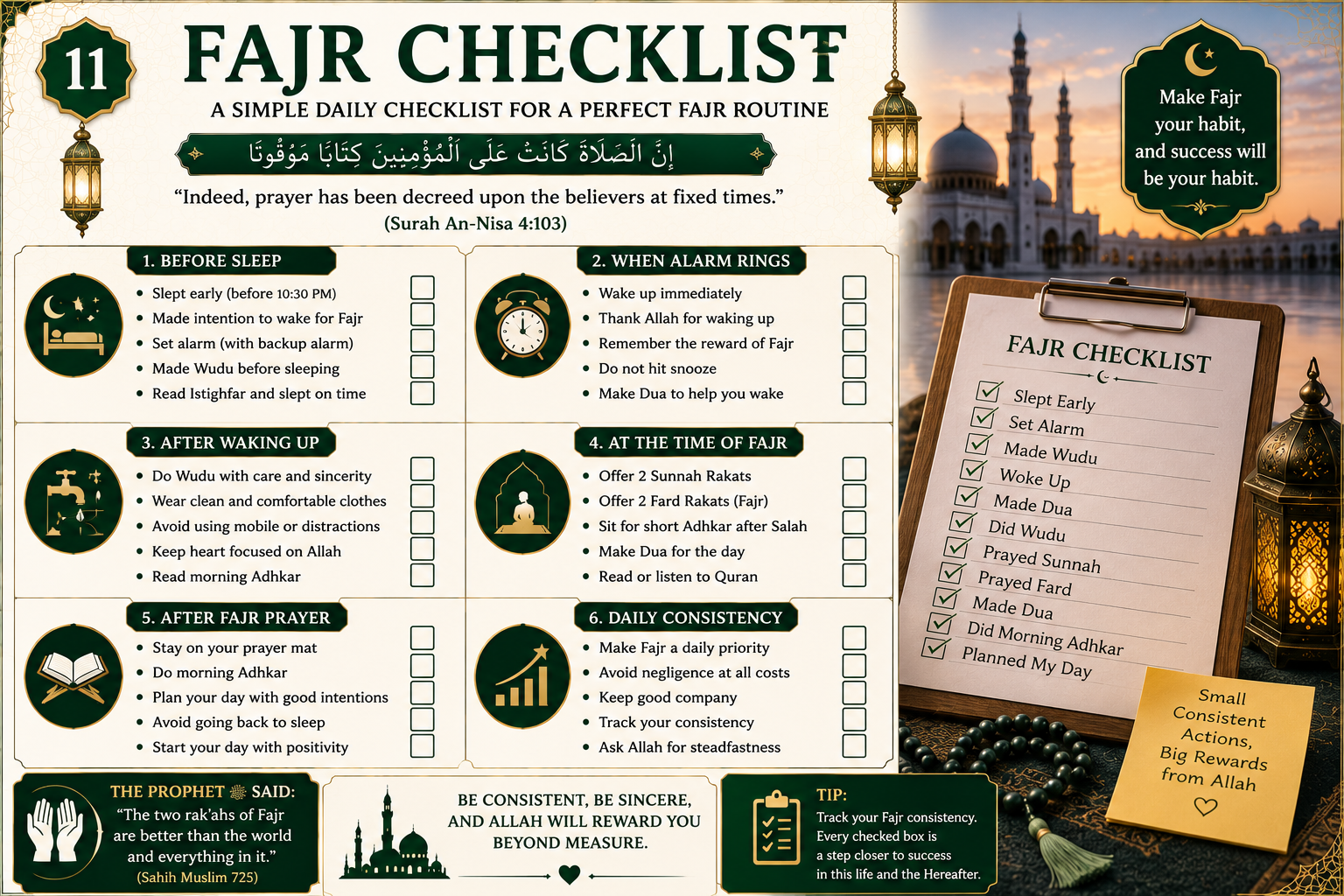
- Fajr Checklist for Beginners
- Fajr Prayer FAQ
- References
If you’ve ever opened your eyes just minutes before sunrise, wondering whether you’ve already missed Fajr, you’re not alone. Many Muslims sincerely want to pray Fajr every day but struggle with waking up on time or remembering the correct steps. This guide is written to make Fajr simple, clear, and easy to follow — whether you’re a beginner, a new Muslim, or someone rebuilding the habit after missing prayers.
Many beginners already know the general shape of Salah but hesitate specifically on Fajr — how many rakats in Fajr, whether the 2 Sunnah rakats are required, and exactly when the window for it closes. That hesitation is usually just a gap in the details, not a gap in intention.
Fajr is also the prayer most people struggle to keep consistent, not because the method is hard, but because it asks something no other prayer does: waking up for it. This guide covers how to pray Fajr prayer correctly, step by step, clearly enough that the method is never the obstacle, and closes with practical tips aimed at the part that actually is.
What Is Fajr Prayer?
Fajr is the first of the five daily obligatory prayers, prayed at dawn before sunrise. The word itself means “dawn” in Arabic, and the prayer is named for the time it occupies — the quiet window between true first light and the sun actually rising.
Understanding how to pray Fajr correctly starts with understanding what makes it distinct from the other four daily prayers: it’s prayed in darkness or near-darkness, it’s the shortest window of the five prayer times, and it carries a specific, repeated emphasis in the Sunnah that the other prayers don’t carry in quite the same way.
For many Muslims, Fajr is the prayer that takes the longest to become consistent — not because it’s difficult to perform, but because waking up before sunrise takes patience and discipline.
If Wudu still feels uncertain, it’s worth getting comfortable with that first — Fajr, like every prayer, depends on it being done correctly.

Quranic Evidence
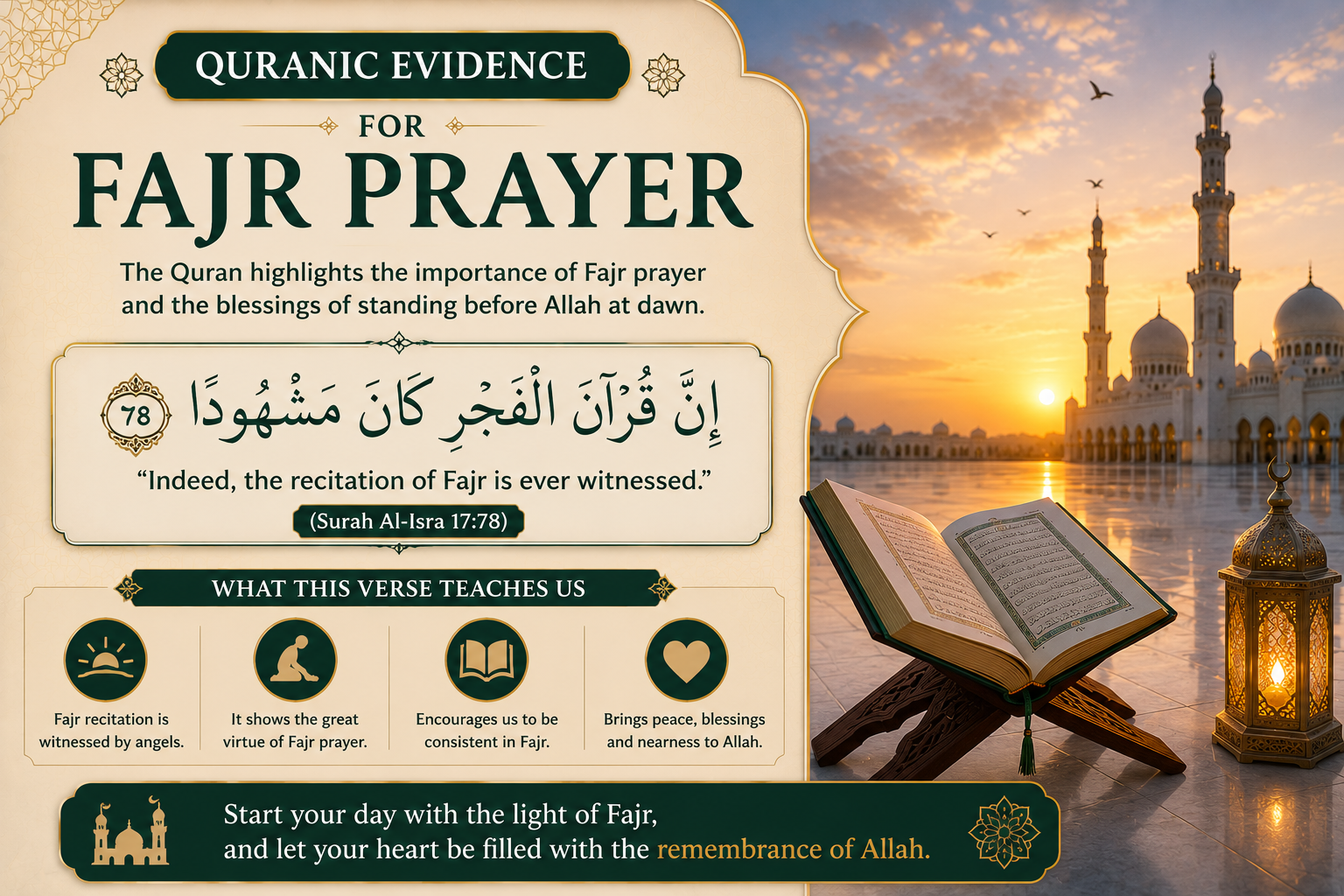
Fajr is directly named in the Quran, distinct from the general command to establish the five daily prayers — a mark of the emphasis placed on it specifically.
“Establish prayer at the decline of the sun until the darkness of the night, and the recitation of dawn. Indeed, the recitation of dawn is ever witnessed.” — Surah Al-Isra, 17:78
The phrase “witnessed” in this verse is understood by scholars to mean that the angels of the night and the angels of the day are both present at Fajr, making it a prayer that’s observed twice over. This is part of why how to pray Fajr correctly is treated with a level of detail and encouragement that goes beyond the baseline obligation shared by all five prayers.
Authentic Hadith on the Virtue of Fajr
Under the Protection of Allah
Jundub ibn Abdullah narrated that the Prophet ﷺ said that whoever performs the Fajr prayer is under the protection of Allah, a narration recorded in Sahih Muslim (hadith 657) that scholars point to as one of the clearest statements on the weight given specifically to this prayer.
Better Than the World and Everything In It
Aisha narrated that the Prophet ﷺ said the two Sunnah rakats before Fajr are better than the world and everything in it, a narration recorded in Sahih Muslim (hadith 725) that forms much of the basis for why the Sunnah rakats are treated as more than optional in practice, even though they aren’t obligatory.
When Fajr Prayer Starts and Ends
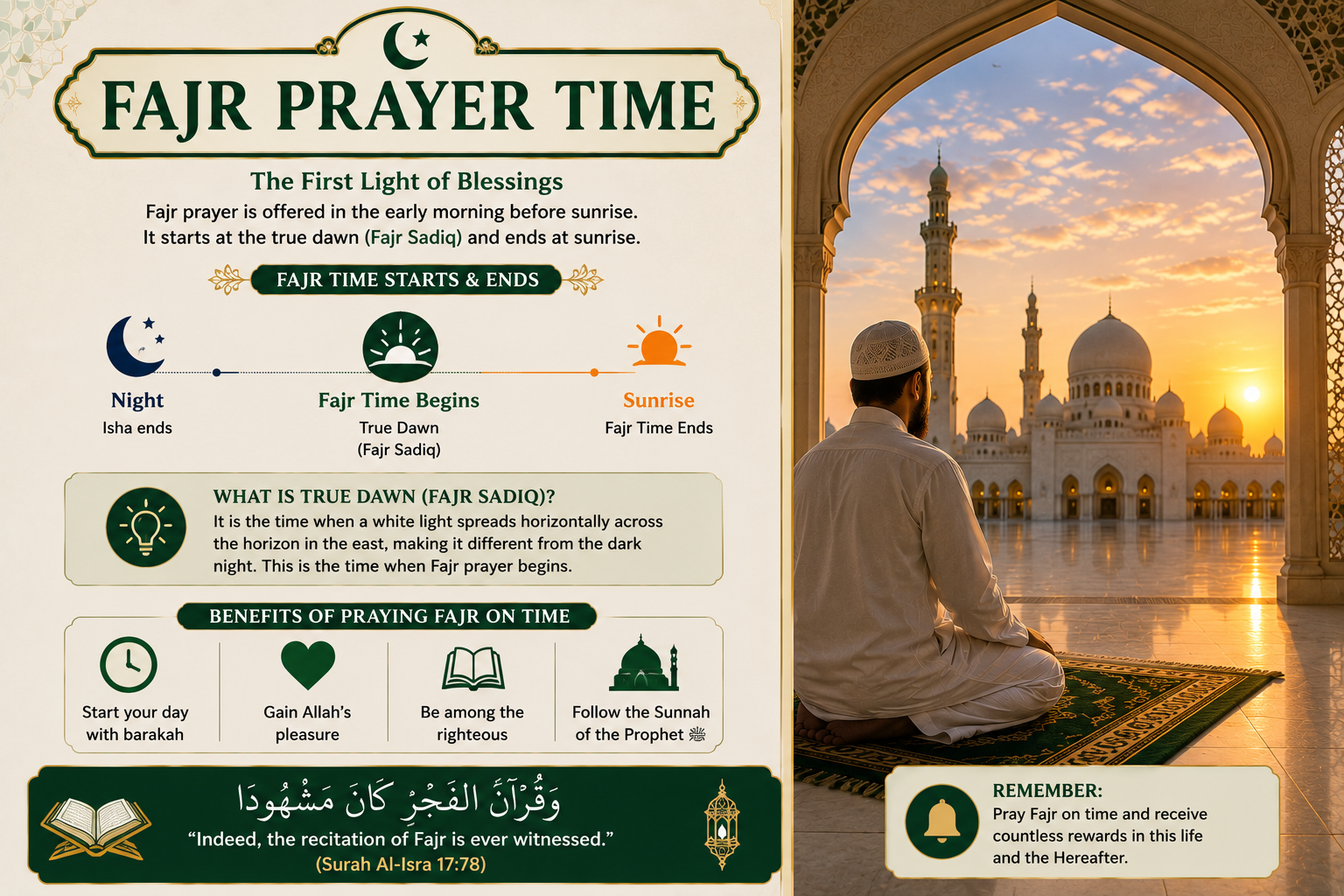
Fajr time begins at Subh Sadiq — true dawn, when a clear band of light spreads horizontally across the horizon — and ends the moment the sun begins to rise. This is a narrower window than the other four prayers, which is part of why timing matters more here than almost anywhere else in the daily prayers.
Subh Sadiq (true dawn)
The point where a horizontal band of light appears across the horizon, distinct from the earlier, vertical “false dawn” (Subh Kadhib) that some people mistake for it.
Sunrise
The moment the edge of the sun becomes visible above the horizon. Fajr prayed at this point or after is considered missed and made up as Qada.
How Many Rakats in Fajr
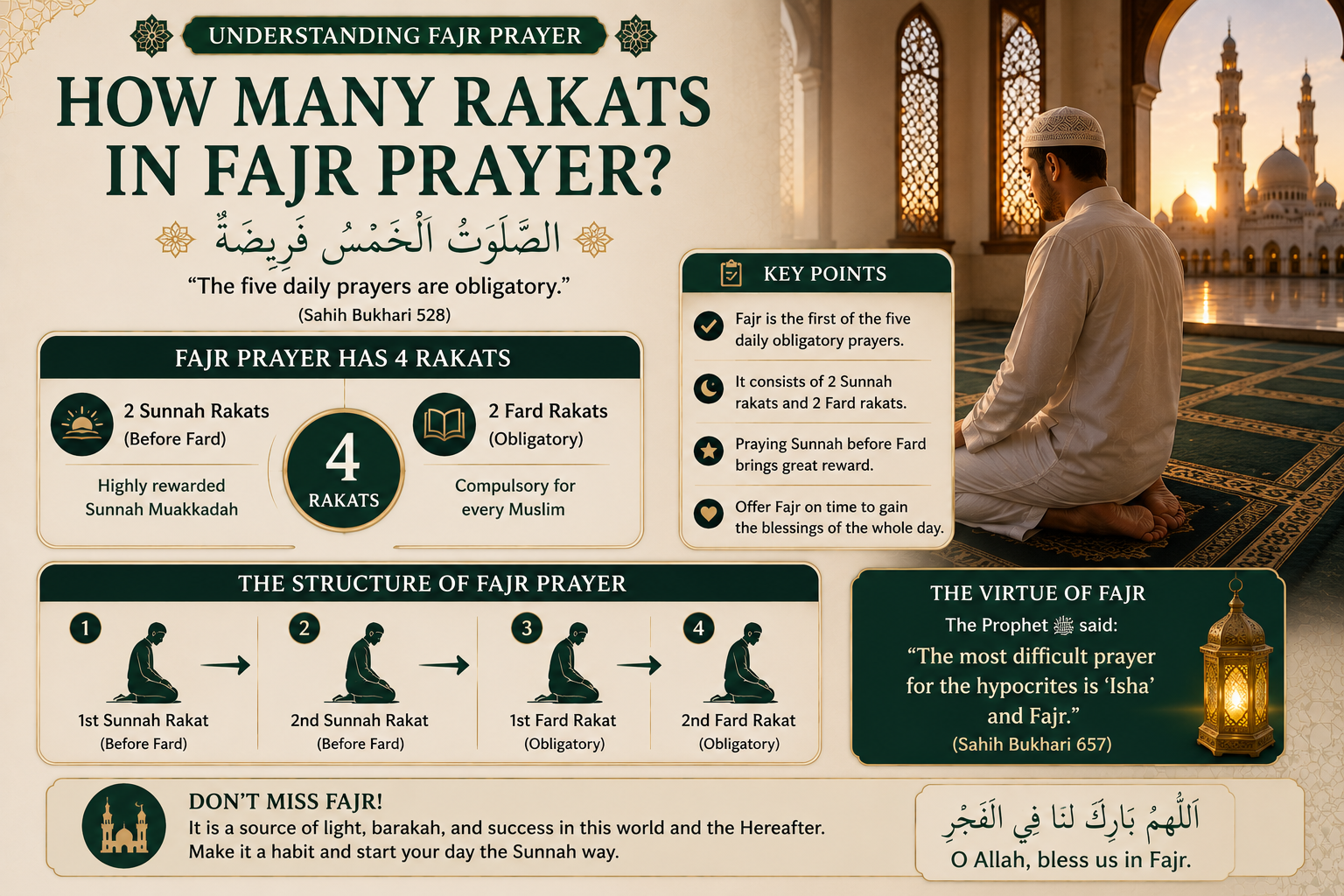
How many rakats in Fajr is one of the most common beginner questions, and the answer is simpler than it looks once the Sunnah and Fard portions are separated out.
| Rakats | Type | Status |
|---|---|---|
| 2 | Sunnah (before the Fard) | Strongly recommended, not obligatory — but rarely left out by the Prophet ﷺ |
| 2 | Fard (obligatory) | Required — this is the actual Fajr prayer that fulfills the daily obligation |
So the full Fajr routine most people follow is 4 rakats total: 2 Sunnah first, prayed individually, followed by 2 Fard, ideally prayed in congregation at the mosque where that’s possible. The Fard rakats are what counts toward the five daily prayers; the Sunnah rakats are what the Prophet ﷺ was reported to guard more closely than almost any other voluntary prayer.
Before You Start: Prerequisites
- Wudu (or Tayammum if water isn’t an option). Purification is required before any Salah, Fajr included.
- Clean body, clothing, and prayer space. Free of visible impurity.
- Covering (Awrah). Appropriately covered according to the rulings that apply.
- Facing the Qiblah. Towards the Kaaba in Makkah — most prayer apps and mosques make this simple to confirm.
- Correct timing. Confirming Fajr time has genuinely started, using a reliable local timetable.
Every prayer, Fajr included, depends on Wudu being done correctly first — start there if you want the full foundation.
Read the Wudu Guide →
Step-by-Step Guide to Pray Fajr
This is exactly how to pray Fajr prayer correctly, step by step, following the general structure taught for how to perform Fajr prayer, from the Sunnah rakats through to the Fard.
- Make Wudu. Complete purification before anything else.
- Pray the 2 Sunnah rakats first, individually, facing the Qiblah, following the standard structure of Salah — intention, Takbir, recitation, bowing (Ruku), and two prostrations (Sujud) per rakat.
- Make the intention (niyyah) in your heart for the Fard Fajr prayer.
- Say the opening Takbir (“Allahu Akbar”) and begin the first rakat with Surah Al-Fatiha, followed by another surah or verses from the Quran.
- Complete the bowing and prostration sequence for the first rakat, then stand for the second.
- Repeat the recitation, bowing, and prostration for the second rakat.
- Sit for the final Tashahhud, then complete the prayer with the Salam to the right and left, ending the 2 Fard rakats.
Don’t worry if you don’t remember every dua perfectly at first. Every practicing Muslim starts somewhere, and Allah rewards sincere effort as well as consistency.

Common Mistakes
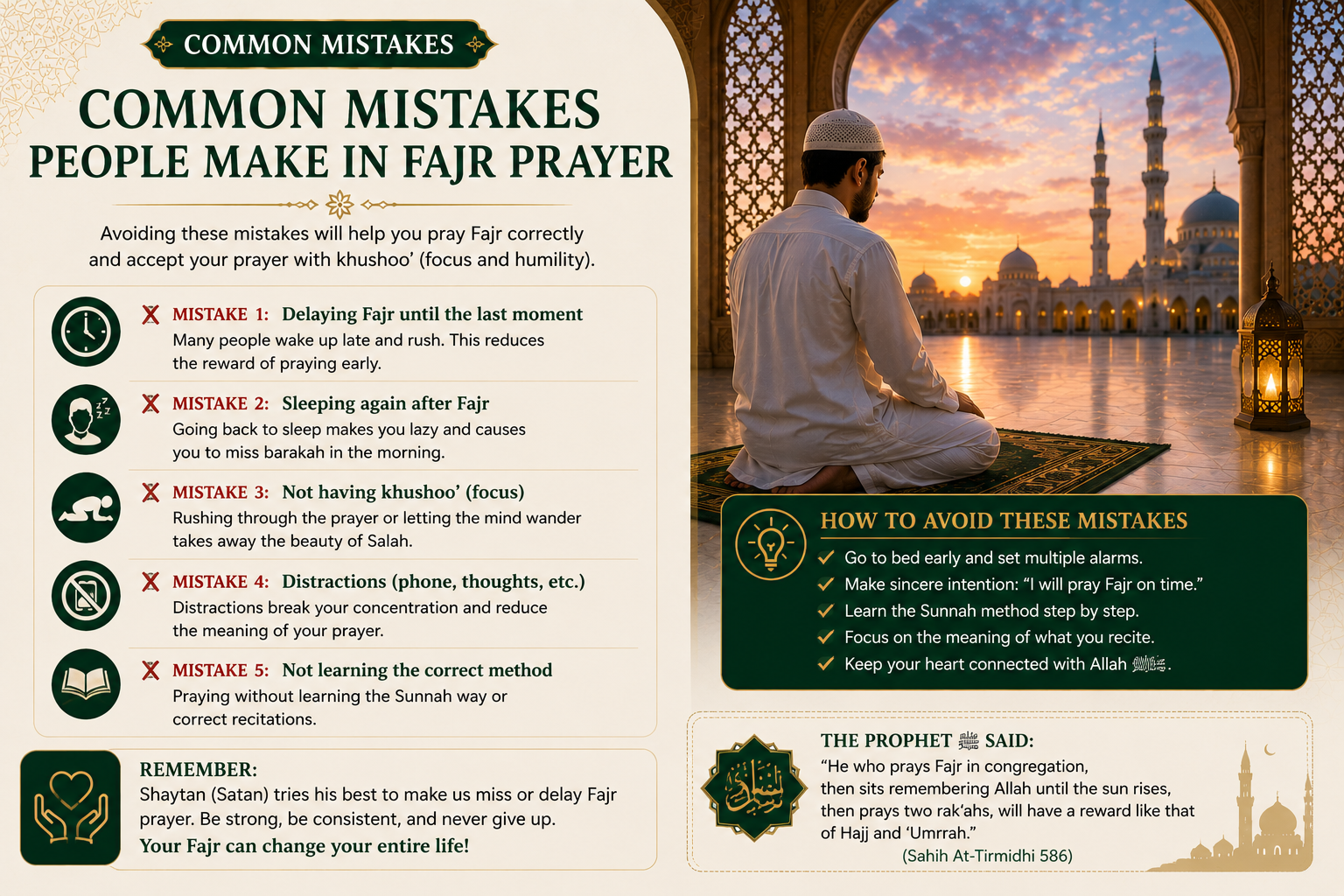
These are the mistakes that most often stand between someone and how to pray Fajr prayer correctly:
- Skipping the Sunnah rakats out of time pressure. They’re recommended, not obligatory, but skipping them regularly out of habit rather than genuine necessity means losing something the Prophet ﷺ rarely left out.
- Confusing false dawn with true dawn. Praying too early, before Subh Sadiq has genuinely started, is a common error without a reliable timetable.
- Delaying past sunrise. Once the sun starts rising, the window has closed and the prayer becomes Qada (made up later) rather than on-time.
- Rushing the recitation to fit it in before sunrise. Fajr is traditionally prayed with a longer recitation than the other prayers — rushing it to squeeze it in usually means the alarm needs to move earlier, not the prayer shorter.
- Treating a missed Fajr as unrecoverable. A missed Fajr is made up as Qada as soon as possible after waking — it isn’t simply skipped for the day.
None of these come from a lack of intention — Fajr is simply the prayer most affected by sleep, timing, and habit, which makes small, fixable mistakes more common here than anywhere else in the five daily prayers.
Making mistakes while learning is completely normal. What matters most is your sincere intention to improve. Every prayer is another opportunity to become closer to Allah.
Practical Tips for Waking Up on Time
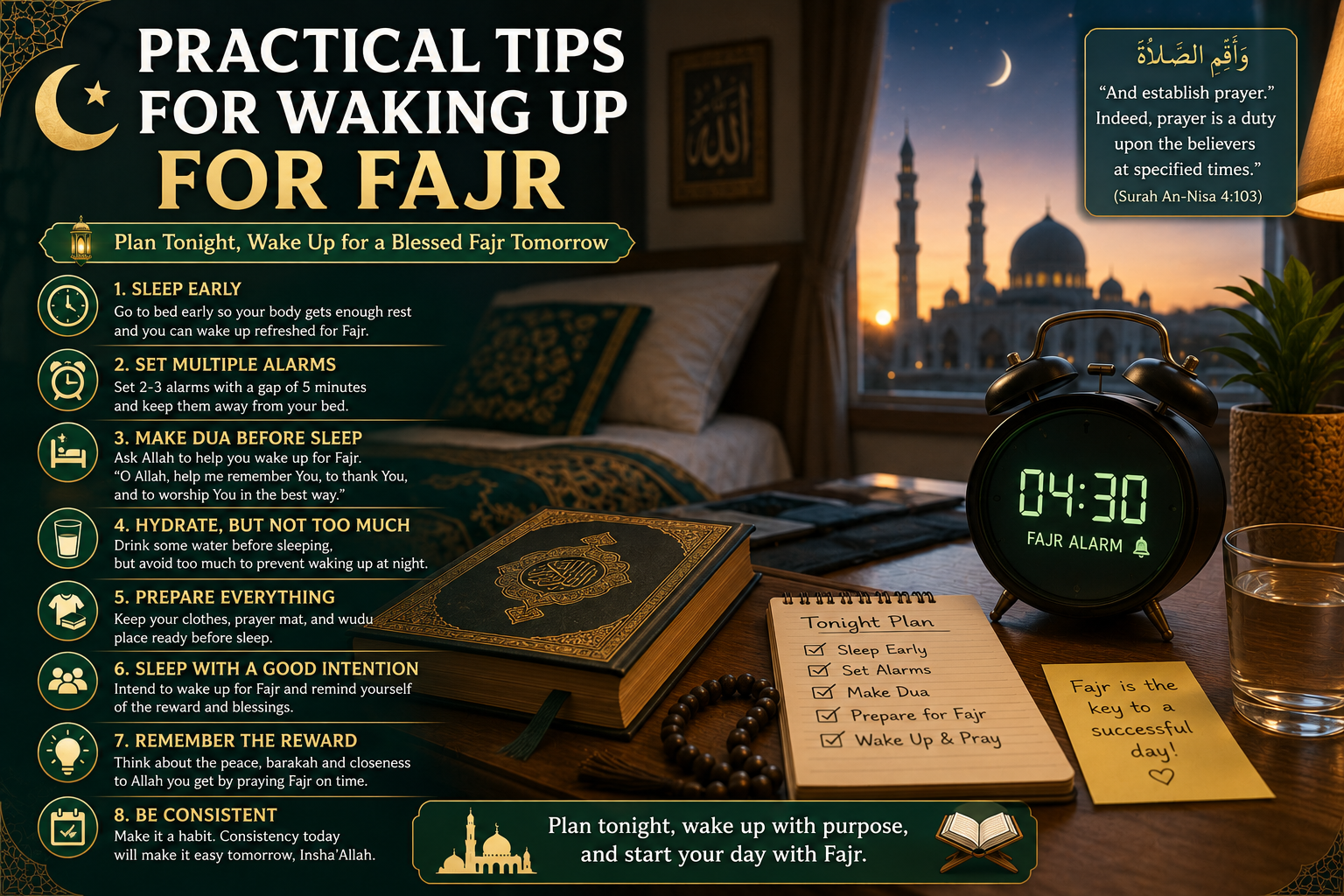
For most people, how to pray Fajr correctly isn’t really a method problem — it’s a waking-up problem. These are the adjustments that tend to help most:
Work backward from Fajr time
Set a consistent bedtime that gives a full night’s sleep before the Fajr alarm, rather than treating Fajr as an interruption to a late night.
Keep it out of arm’s reach
A phone or alarm clock across the room forces getting up to turn it off, which does most of the work of actually waking up.
Turn on a light, then make Wudu
Light signals the body it’s time to be awake, and Wudu itself is refreshing enough to finish waking most people up before the prayer even starts.
Consistency over perfection
A missed Fajr made up shortly after waking is far better than giving up on the habit entirely after a difficult morning — consistency builds gradually.
Many people struggle with Fajr, especially after long workdays or late nights. Don’t become discouraged if you miss it sometimes. Build the habit gradually, sleep a little earlier each night, and ask Allah to help you remain consistent. Small improvements every day lead to lasting change.
The Wisdom Behind Fajr
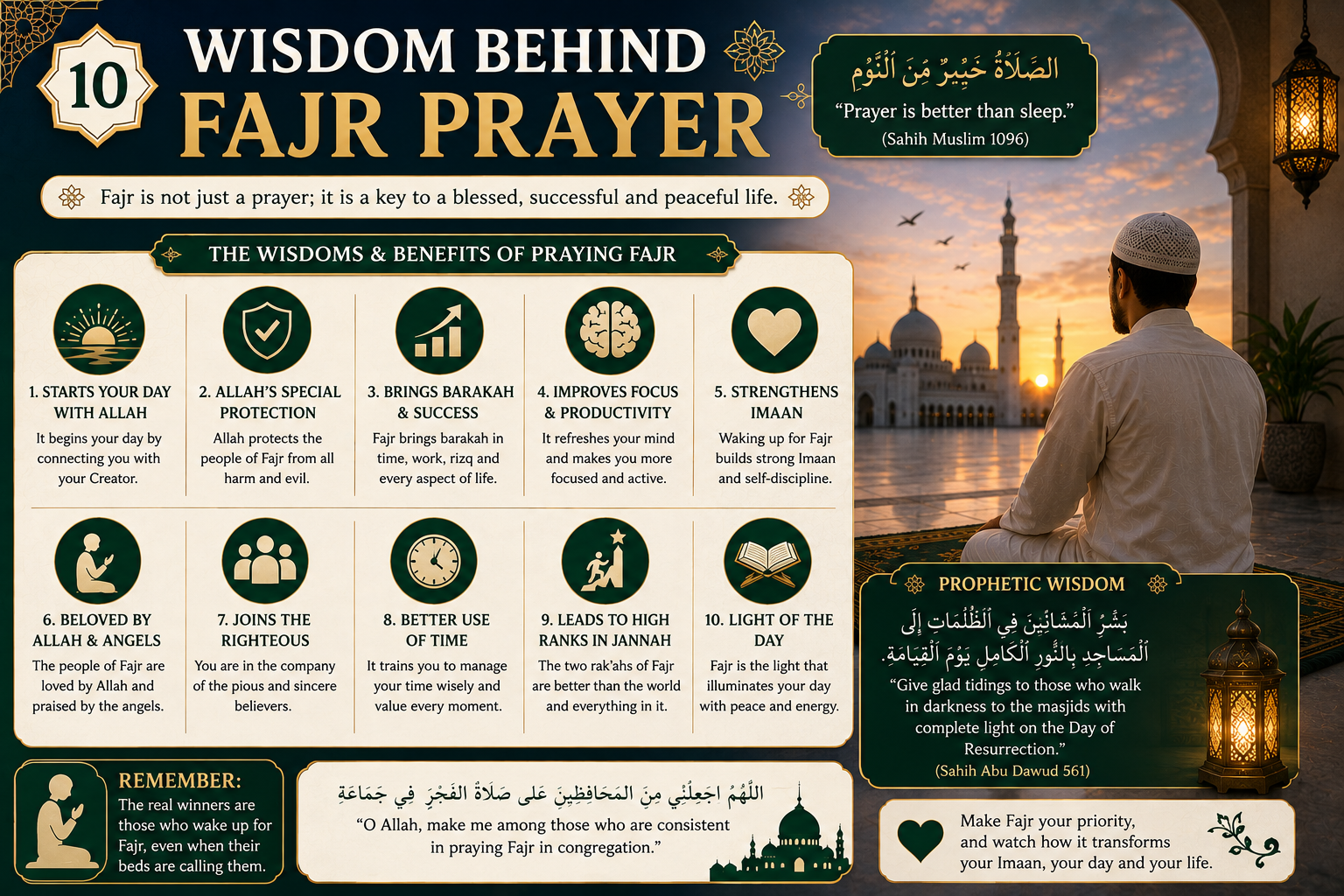
Fajr asks for something the other four prayers don’t: leaving a warm bed while the world is still asleep. That’s not incidental to its virtue — it’s central to it. A prayer that costs something tends to carry more weight than one that doesn’t.
The repeated emphasis on Fajr throughout the Sunnah — being singled out as “witnessed,” carrying its own promise of protection, its Sunnah rakats described as better than the world itself — reflects the same idea from a different angle: starting the day in remembrance of Allah before anything else claims your attention sets a tone the rest of the day tends to follow.
Build the Full Salah Foundation
Wudu, Salah, and the purification guides together cover everything you need before and during prayer — explore the full set of guides. Every journey starts with one prayer. Keep learning, keep improving, and ask Allah to make it easy for you.
Read the Salah GuideFajr Checklist for Beginners
Use this quick checklist to confirm you know how to pray Fajr prayer correctly before you start:
- Check a reliable local Fajr timetable rather than guessing based on the sky.
- Set the alarm early enough to make Wudu, pray 2 Sunnah rakats, and still complete the Fard before sunrise without rushing.
- Keep the alarm out of reach so turning it off means actually getting up.
- Pray the Sunnah rakats first, then the Fard — don’t skip straight to the obligatory portion out of habit.
- If you oversleep, make it up as Qada as soon as you wake, rather than skipping it for the day.
Don’t aim for perfection on day one. A consistent Fajr routine is built one morning at a time.
Fajr Prayer FAQ
Here are answers to the most common questions people ask about how to pray Fajr prayer correctly:
How many rakats in Fajr in total?
4 rakats total: 2 Sunnah (recommended) prayed first, followed by 2 Fard (obligatory), which is the portion that fulfills the daily prayer requirement.
Can I skip the 2 Sunnah rakats if I’m short on time?
They aren’t obligatory, so the Fard prayer remains valid without them, but they’re strongly recommended — the Prophet ﷺ was reported to rarely leave them out, even while travelling.
What happens if I wake up after sunrise and miss Fajr?
The prayer is made up as Qada as soon as you wake, in the same 2-rakat Fard structure — it isn’t skipped for the day, and most scholars hold the Sunnah rakats can be prayed alongside it too.
How do I tell true dawn from false dawn?
True dawn (Subh Sadiq) appears as a horizontal band of light spreading across the horizon, while false dawn (Subh Kadhib) is a brief vertical glow that fades — in practice, a reliable local prayer timetable removes the guesswork entirely.
Is Fajr prayed differently if I’m praying alone versus in congregation?
The rakats and structure are the same either way; the main difference is that recitation is typically said aloud in congregation and can be either silent or aloud when praying alone.
Do I need to repeat Wudu if I already have it from before sleeping?
Only if something has broken it since, such as sleep itself according to some schools, or using the bathroom — if your Wudu is still intact by the ruling you follow, it doesn’t need to be repeated.
Why is Fajr considered harder to keep consistent than other prayers?
It’s the only daily prayer that requires waking up from sleep rather than pausing an already-awake day, which is why most of the practical difficulty with Fajr is about the alarm, not the prayer itself.
Can women pray the Fajr Sunnah and Fard at home instead of the mosque?
Yes — praying at home is valid and, for women, is commonly considered preferable by many scholars, though praying in congregation at the mosque is also permitted and rewarded.
What should I recite during the Fajr rakats as a beginner?
Surah Al-Fatiha is required in every rakat, followed by any surah or set of verses you’ve memorized — starting with shorter, familiar surahs is completely acceptable while you’re still building up memorization.
Does traveling change how Fajr is prayed?
No — unlike the four-rakat prayers, which can be shortened while travelling, Fajr stays at 2 Fard rakats regardless of travel status.
Can I pray Fajr without going to sleep first?
Yes — if you’re still awake when Fajr time begins, you pray it as normal before sleeping; there’s no requirement to have slept beforehand. The “waking up” difficulty only applies to those who go to sleep before Fajr and need to wake for it.
Can I follow the steps from my phone while praying Fajr?
It’s fine to check a translation or the steps before you begin, but avoid holding or reading from a phone during the prayer itself, since Salah requires facing the Qiblah with focus and minimal movement — memorize the sequence first, then pray.
References
- Quran 17:78 (Surah Al-Isra) — Quran.com
- Hadith on the protection of Allah for whoever prays Fajr — Sahih Muslim 657 — Sunnah.com
- Hadith on the 2 Sunnah rakats of Fajr being better than the world — Sahih Muslim 725 — Sunnah.com
- IslamQA.info — fiqh questions on Fajr timing and rulings
Final Thought
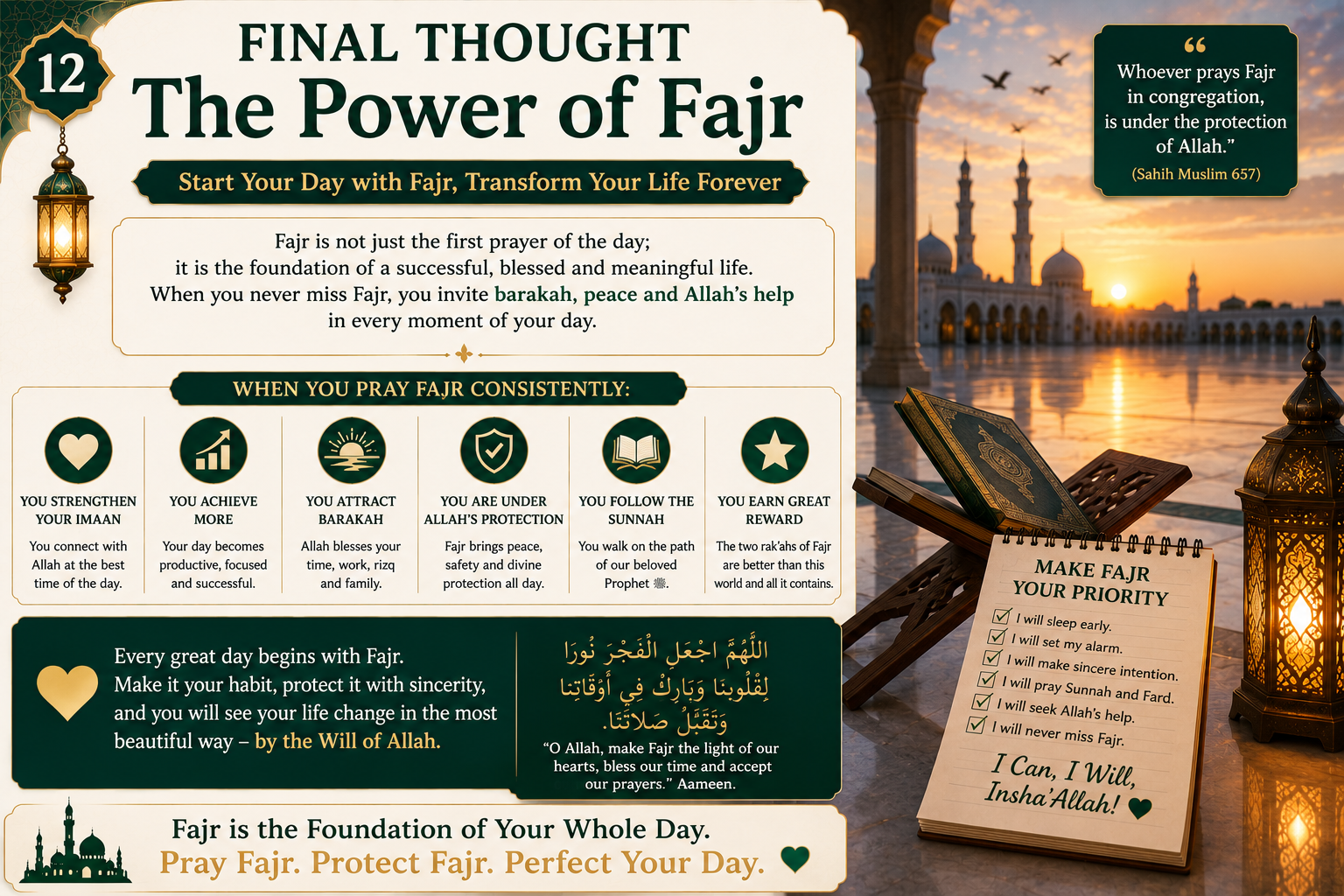
Once the rakats, the timing, and the step-by-step method are clear, the only real variable left with Fajr is getting up for it — and that’s a habit, not a knowledge gap. That’s what this Fajr Salah guide is meant to leave you with: not just how to pray Fajr prayer correctly, but a realistic starting point for actually doing it consistently.
If you’ve missed Fajr more mornings than not, that’s not a reason to give up on it — it’s simply where today’s habit starts from.
One Fajr prayer can change the direction of your entire day. Don’t wait until you feel perfect before becoming consistent. Start with tomorrow’s Fajr, ask Allah for help, and keep going — even if progress feels slow.
For everyday reference, Quran.com and Sunnah.com are reliable places to revisit the verses and hadith referenced in this guide, and IslamQA.info is useful for specific fiqh questions that fall outside general guidance like this.
Complete the Daily Prayer Foundation
Wudu, Salah, and the purification guides together — read them all to have every part of daily prayer covered.
Read the Salah GuideYou May Also Like
Trust & Verification
- Reviewed By
- IslamicEduHub in-house Fiqh panel
- Last Updated
- August 2026
- Reviewed Date / Version
- v1.0 — August 2026
- Sources
- Quran.com, Sunnah.com, IslamQA.info
- Quran References
- Surah Al-Isra 17:78
- Hadith References
- Sahih Muslim 657 (protection of Allah); Sahih Muslim 725 (virtue of the Sunnah rakats)
- Reading Level
- Beginner Friendly
Pingback: - IslamicEduHub
Pingback: What Is Hadith? Complete Meaning & Authenticity Guide (2026)