
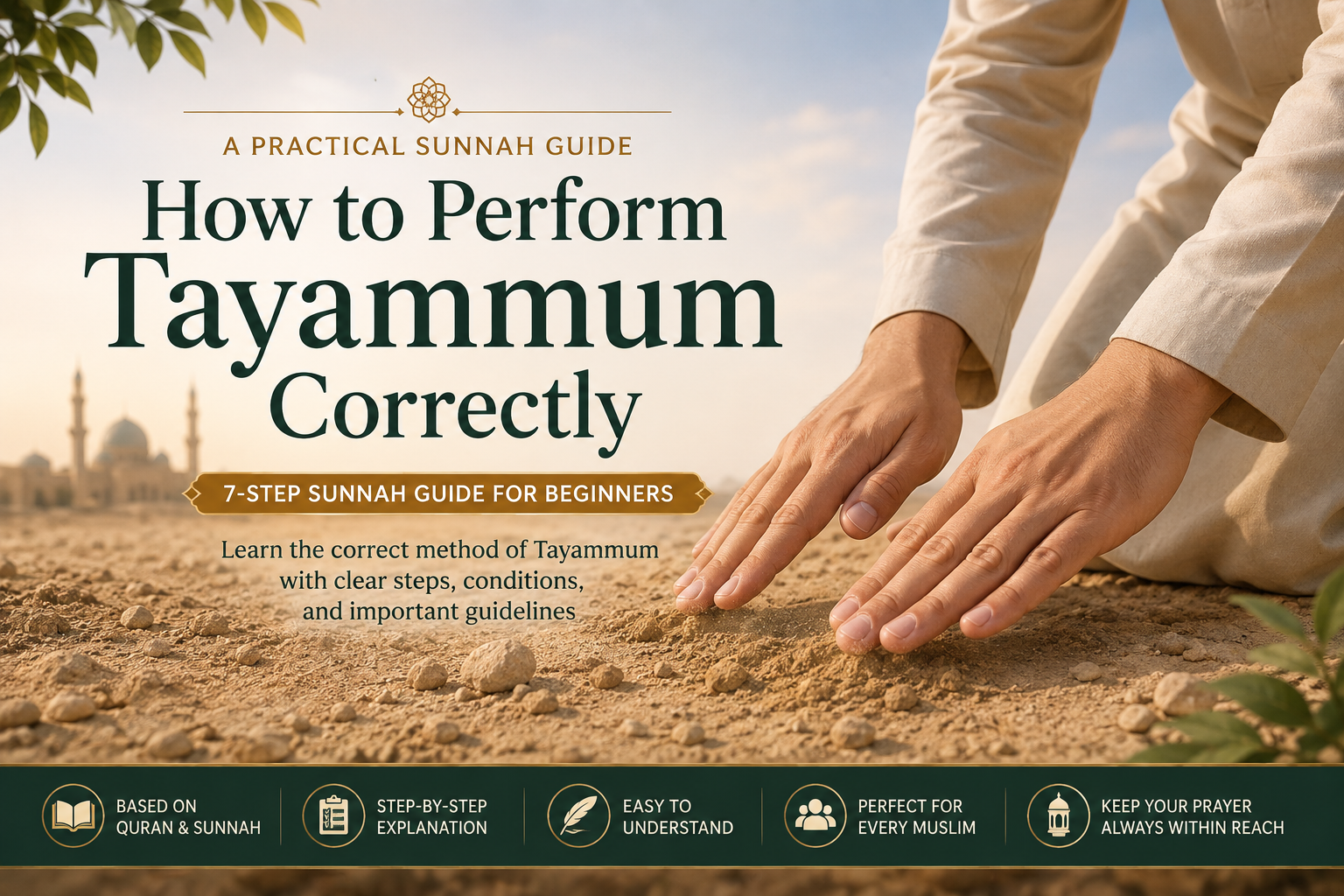
When Tayammum is allowed, when it isn’t, the materials it requires, and the full 7-step Sunnah method — everything a beginner needs to purify for prayer when water isn’t an option, explained clearly in one place.
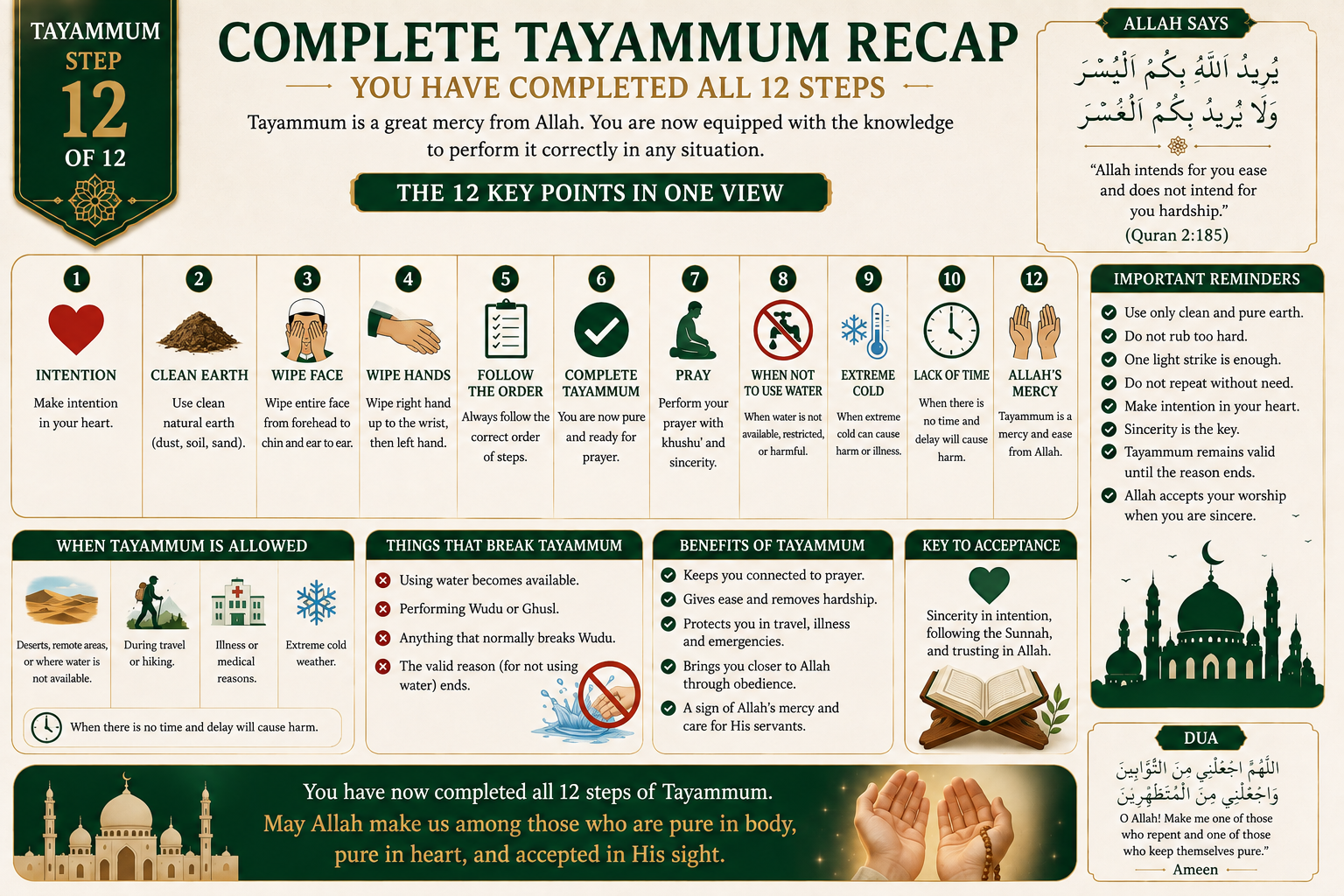
Here’s how to perform Tayammum correctly in short: make the intention, strike both palms once on clean earth, dust, sand, or stone, blow off the excess, wipe the entire face, strike the palms a second time, then wipe the hands up to the wrists. Tayammum is allowed as a substitute for Wudu or Ghusl when water is unavailable, too far away, or would cause harm through illness, injury, or extreme cold.
In This Guide
- What Is Tayammum?
- Quranic Evidence
- Authentic Hadith
- When Tayammum Is Allowed
- When Tayammum Is Not Allowed
- Conditions of Tayammum
- Materials That Can Be Used
- The 7-Step Sunnah Method
- Common Mistakes
- Tayammum vs Wudu
- Tayammum vs Ghusl
- The Wisdom Behind Tayammum
- Practical Tips and a Checklist
- Tayammum FAQ
- References
Knowing how to perform Tayammum correctly matters most in exactly the moment you’re least prepared for it — no water nearby, a flight about to land, an IV line in your arm, or freezing weather with no way to warm water safely. This guide covers dry ablution in Islam from the ground up, so that moment doesn’t catch you off guard.
Many Muslims only learn Tayammum when they suddenly need it during travel or illness. That often leads to confusion and unnecessary worry, right at a moment when the last thing anyone wants is to second-guess whether their prayer will even count.
Tayammum often gets treated as a rare, edge-case ruling — something you vaguely remember exists but never actually learned properly. That’s exactly why doubts show up later: is a dusty car seat clean enough? Does it cover the arms or just the hands? What happens once water becomes available again? This guide answers each of those directly, with the conditions clearly separated from the Sunnah method, so you know exactly what’s required and what strengthens the act further.
What Is Tayammum?
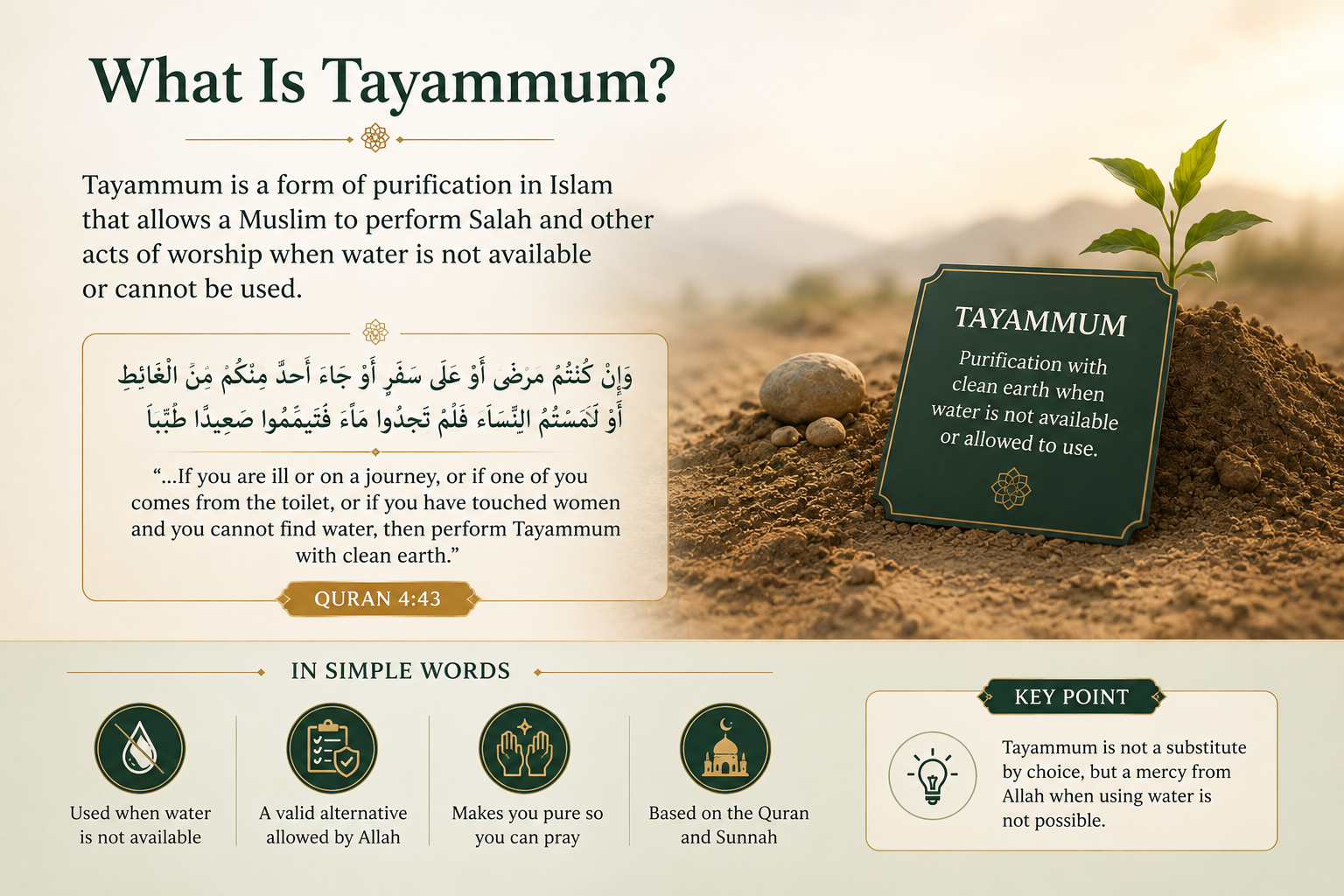
Tayammum is dry ablution in Islam — purification performed with clean earth, dust, sand, or stone in place of water, used as a substitute for both Wudu and Ghusl. It removes the same ritual impurity that Wudu or Ghusl would, but only for as long as the excuse that permitted it remains in place.
Understanding how to perform Tayammum correctly starts with understanding why it exists at all: it’s a rukhsah, a concession, not a lesser form of worship or a loophole. Islam doesn’t ask anyone to delay prayer indefinitely while searching for water, risk their health to use cold water when ill, or use water needed for drinking. Tayammum exists so prayer stays possible in exactly those situations.
Many people only look this up the first time they’re genuinely stuck — mid-flight, in a hospital bed, or out camping with no water source nearby. Learning how to perform Tayammum correctly ahead of time removes that scramble and the uncertainty that comes with it.
Quranic Evidence
Tayammum isn’t a later scholarly workaround — it’s directly established in the Quran, in the same verse that lays out Wudu and Ghusl.
“If you find no water, then turn to clean earth and wipe your faces and hands with it.” — Surah Al-Ma’idah, 5:6
The same ruling appears earlier in the Quran as well, in the context of illness and travel — two of the most common real-world reasons Tayammum is needed.
“If you are ill, travelling, or unable to find water, then perform Tayammum with clean earth.” — Surah An-Nisa, 4:43
These two verses are why Tayammum is treated as a genuine act of worship in its own right, not an improvised fallback — the Quran names it specifically, alongside water-based purification, not as an afterthought to it. This is one of the clearest examples of tayammum in islam being rooted directly in revelation, which is also why how to perform Tayammum correctly is treated as a matter of real fiqh, not folk practice.
Any reliable explanation of how to perform Tayammum correctly has to start here, with revelation rather than opinion — everything covered further down in this guide builds directly on these two verses.
Authentic Hadith
The Earth Made a Means of Purification
The Prophet ﷺ is reported to have said that the earth was made a place of prostration and a means of purification for his nation, a narration recorded in Sahih al-Bukhari (Hadith 335) that scholars point to as establishing that clean earth itself carries purifying value, not just water.
Two Strikes, Face and Hands
Ammar ibn Yasir narrated that the Prophet ﷺ taught Tayammum as striking the ground once, then wiping the face and hands — a description recorded in Sahih al-Bukhari (Hadith 347) and Sahih Muslim (Hadith 368) that forms the basis of how to perform Tayammum correctly according to the widely followed Sunnah method outlined later in this guide.
Together, these two narrations are why how to perform Tayammum correctly is taught as a precise, teachable method rather than a vague idea — the Sunnah method below follows this hadith closely.
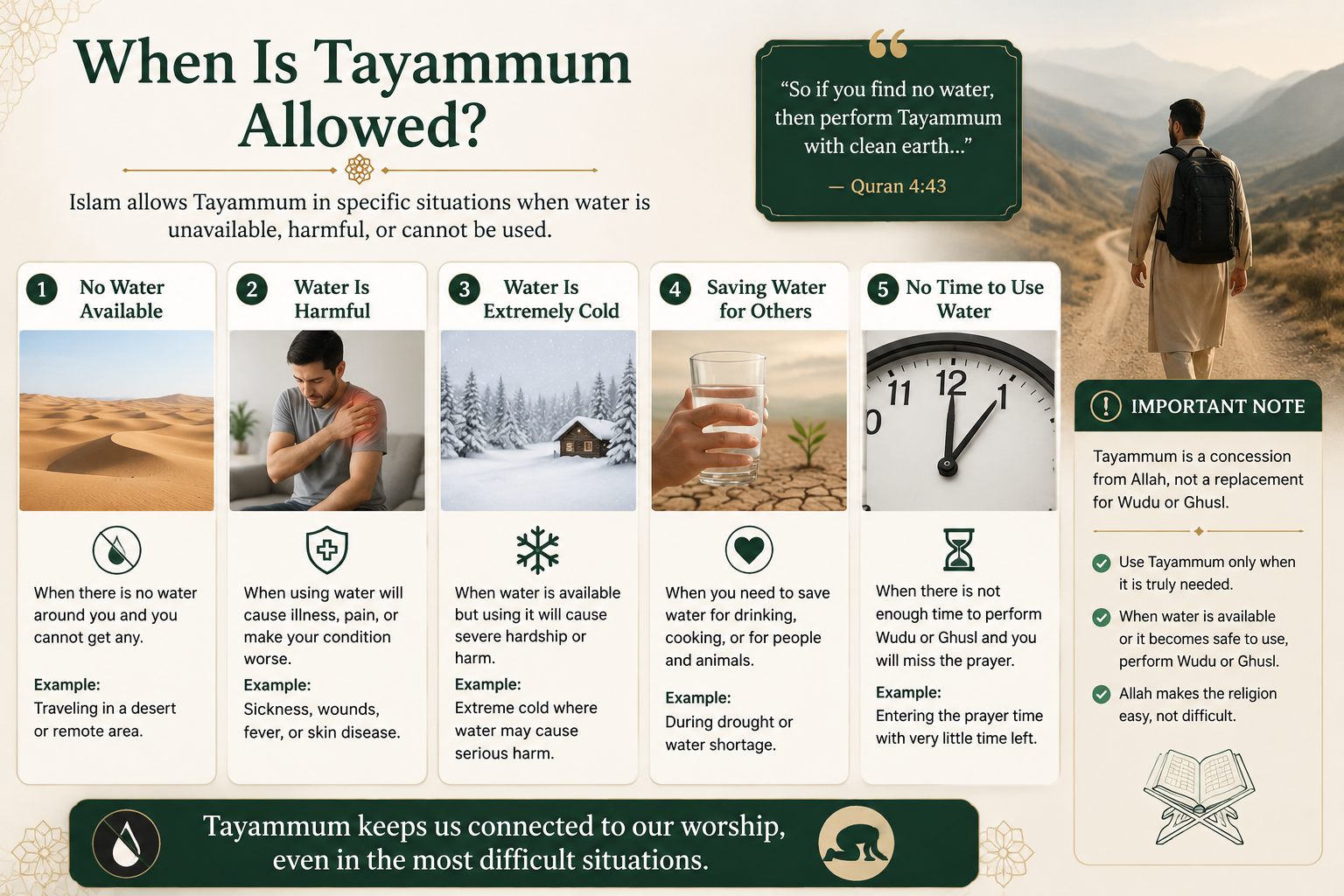
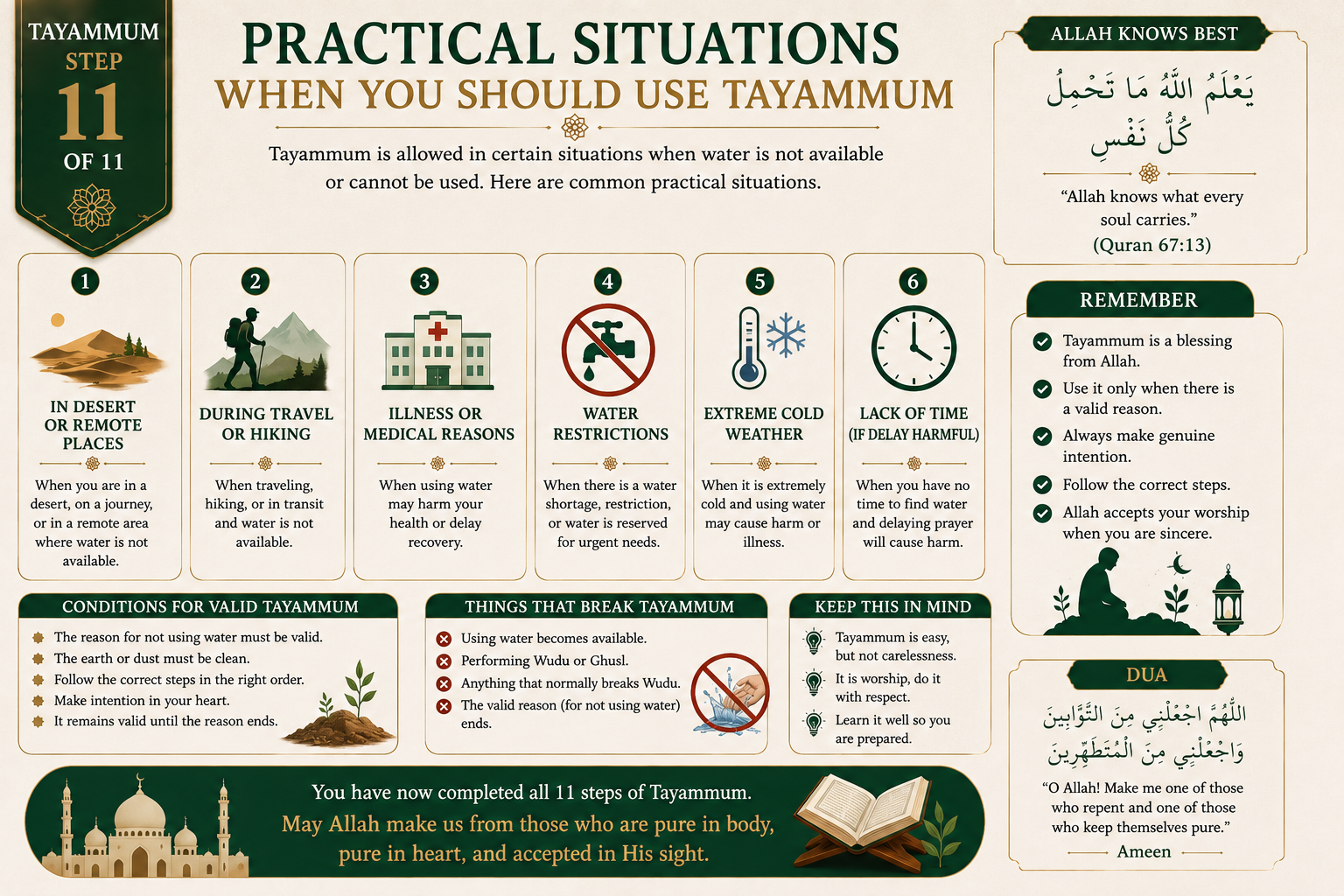
When Tayammum Is Allowed
Knowing when Tayammum is allowed is the practical half of knowing how to perform Tayammum correctly — the method itself is simple, but using it in the wrong situation is a common source of confusion.
None nearby, or too far
Water simply isn’t present, or reaching it would mean missing the prayer time, travelling an unreasonable distance, or facing real danger to get to it.
Illness or injury
A reliable indication, medical advice, or a wound, cast, IV line, or skin condition that water would worsen, delay healing, or otherwise physically harm.
No safe way to warm water
Water is available but dangerously cold, and there’s no reasonable way to warm it or protect yourself while using it.
Drinking or survival needs
The available water is needed for drinking, cooking, or the wellbeing of people or animals, and using it for purification would put that at risk.
A lot of people picture Tayammum as something only relevant in a desert or a warzone, but in practice it comes up in far more ordinary moments — a delayed flight, a hospital stay, a hiking trip that ran longer than planned. Recognizing your own situation as one of these is often the harder part, more than the method itself.
When Tayammum Is Not Allowed
- Water is available and safe to use. If water is within reach and using it wouldn’t cause harm, Tayammum isn’t a valid substitute — this is the single most common misunderstanding.
- Skipping Wudu or Ghusl purely out of convenience. Being in a rush or not wanting to get up isn’t a valid excuse on its own.
- Treating it as a permanent replacement. Tayammum is tied to the excuse that permitted it — once water becomes available and usable, purification with water is required again for the next prayer that needs it.
Knowing when Tayammum is not allowed is just as important as knowing when it is — this is where most of the genuine confusion around how to perform Tayammum correctly actually comes from.
Conditions of Tayammum
A small set of conditions make Tayammum valid, and together they define how to perform Tayammum correctly from start to finish. Miss one, and it doesn’t count — everything else beyond this list strengthens the act but isn’t strictly required for validity.
| Condition | What It Means in Practice |
|---|---|
| Niyyah (Intention) | A sincere intention in the heart to perform Tayammum for purification, made before striking the earth |
| A valid excuse is present | One of the situations covered above genuinely applies at the time |
| Clean earth or dust | The surface struck must be clean — free of visible impurity — not necessarily bone dry or literal soil |
| Covering the face and hands | The entire face and the hands (to the wrists, or to the elbows depending on the school followed) must be wiped, with no dry patch left |
| Sequence (Tartib) | Following the order of the method — face before hands — as with Wudu |
These five conditions are the real test of how to perform Tayammum correctly — memorising the 7-step method matters less than making sure every one of these is actually met.
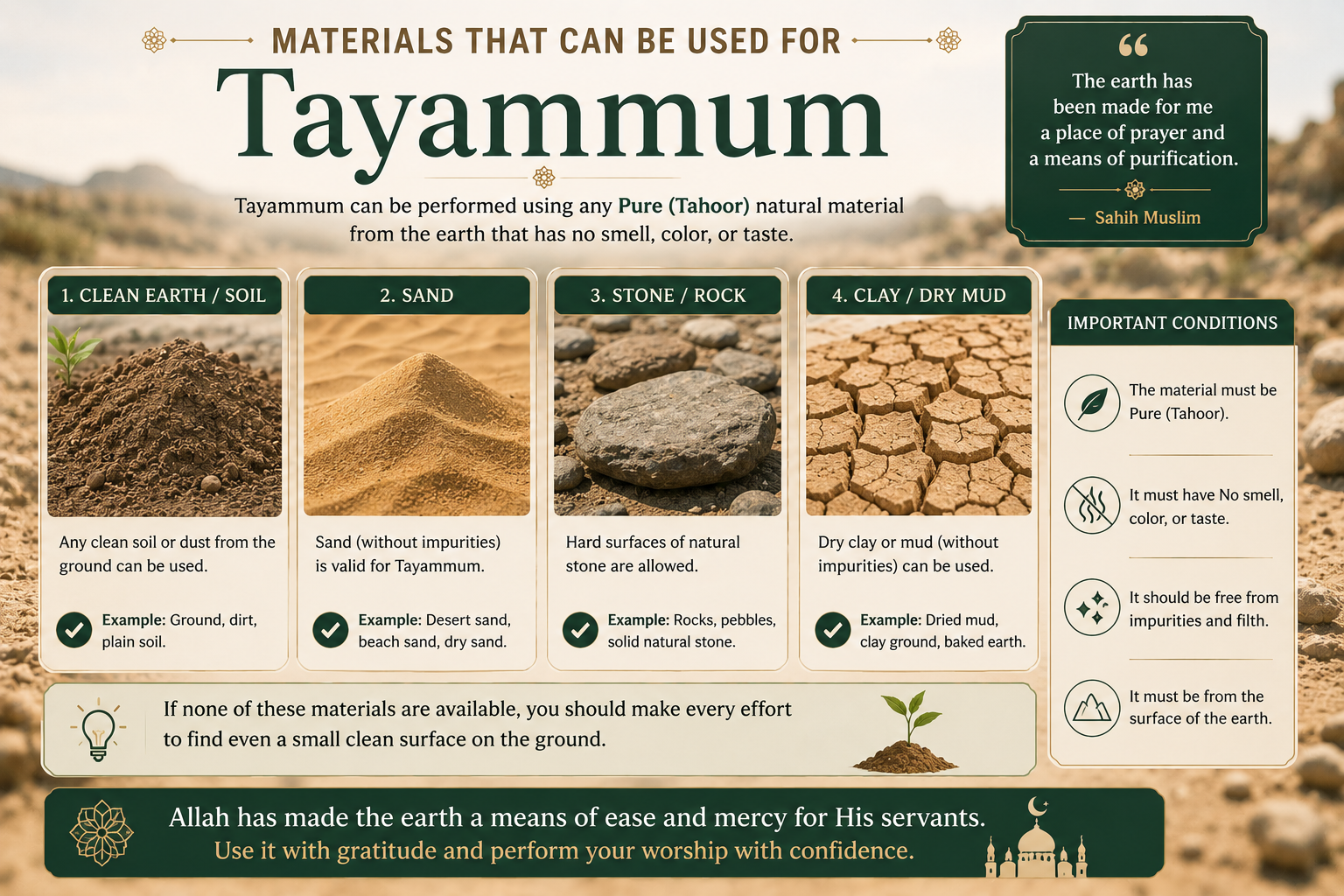
Materials That Can Be Used
The materials accepted for Tayammum are broader than most people assume, and this is one area where the schools of fiqh genuinely differ.
Earth, sand, and dust
Clean soil, sand, and dust are accepted across all major schools as the primary material for Tayammum.
Stone, rock, and clean surfaces
The Hanafi school extends this to anything from the earth’s surface — stone, rock, a clean wall, or a dusty car dashboard — as long as it’s clean.
Dust that visibly transfers
Some schools require dust fine enough to actually cling to and transfer onto the hands during the strike, which a polished stone or smooth wall may not provide.
Visibly impure or unclean surfaces
Anything visibly dirty with impurity, or a surface that’s purely decorative (like glass or metal with no dust), doesn’t qualify.
Because this is one of the areas scholars differ on most, it’s worth confirming which school your local scholar follows if you want precision — but a dusty, clean patch of ground or a sandy surface is accepted by every major school without dispute, which makes how to perform Tayammum correctly far less restrictive in practice than most beginners expect.
Not Sure If Wudu Still Feels Uncertain?
Tayammum only makes sense once Wudu is second nature — start there if you want the full foundation first.
Read the Wudu GuideThe 7-Step Sunnah Method
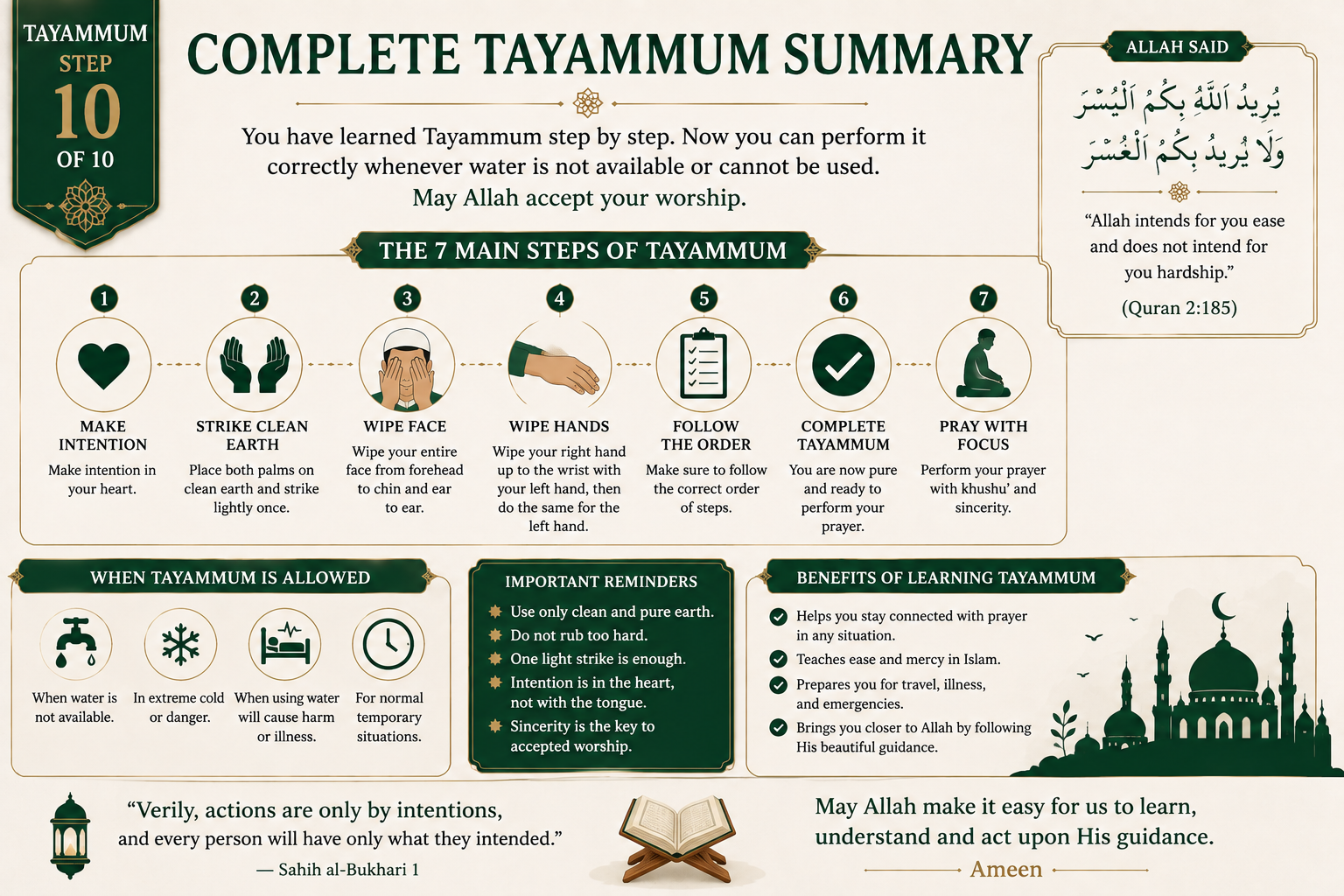
This is the full Tayammum step by step, as taught in the authentic Sunnah — the most thorough and widely recognized way to perform Tayammum correctly.
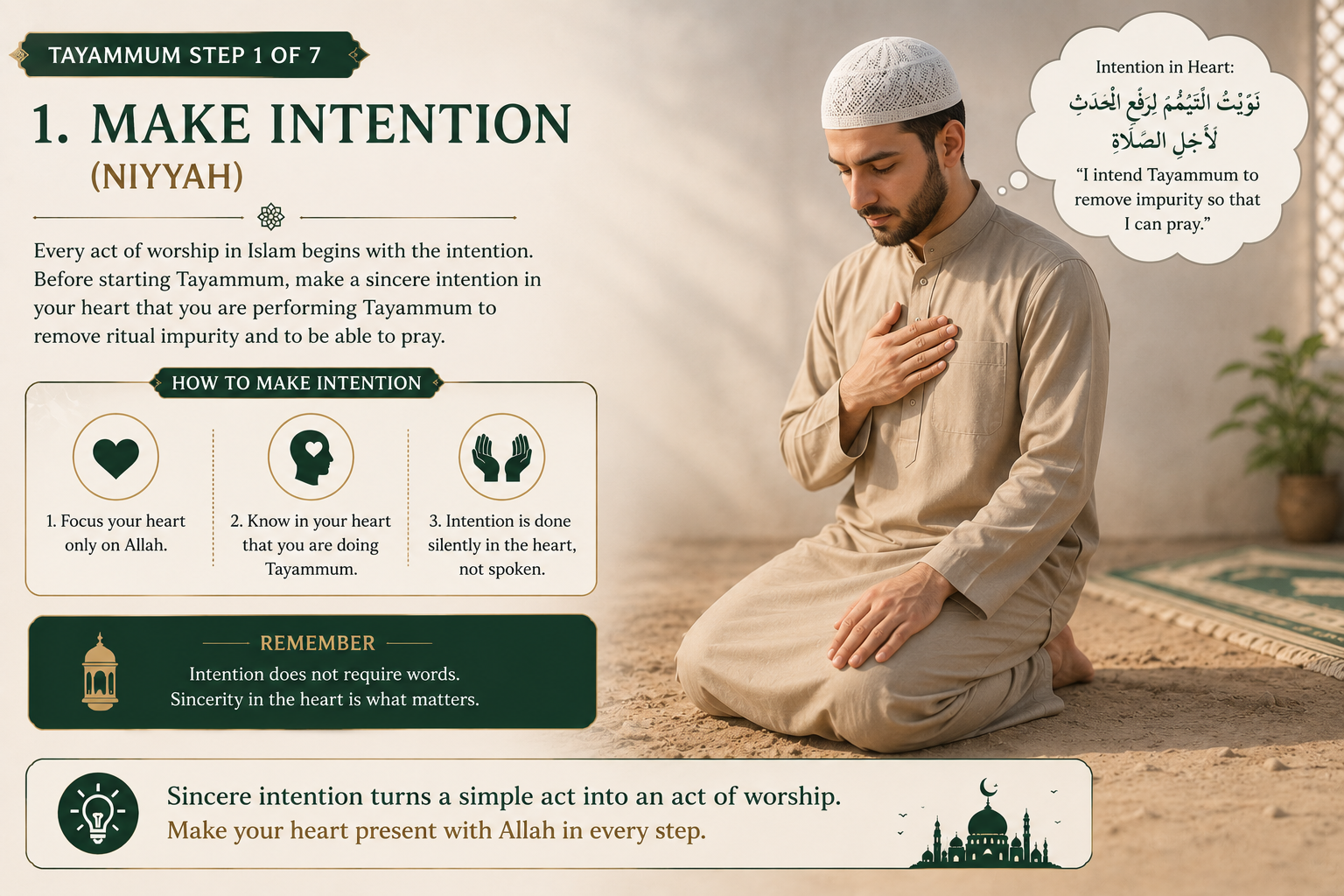
- Make the niyyah. Silently intend in your heart that this Tayammum is to purify for prayer in place of Wudu or Ghusl.
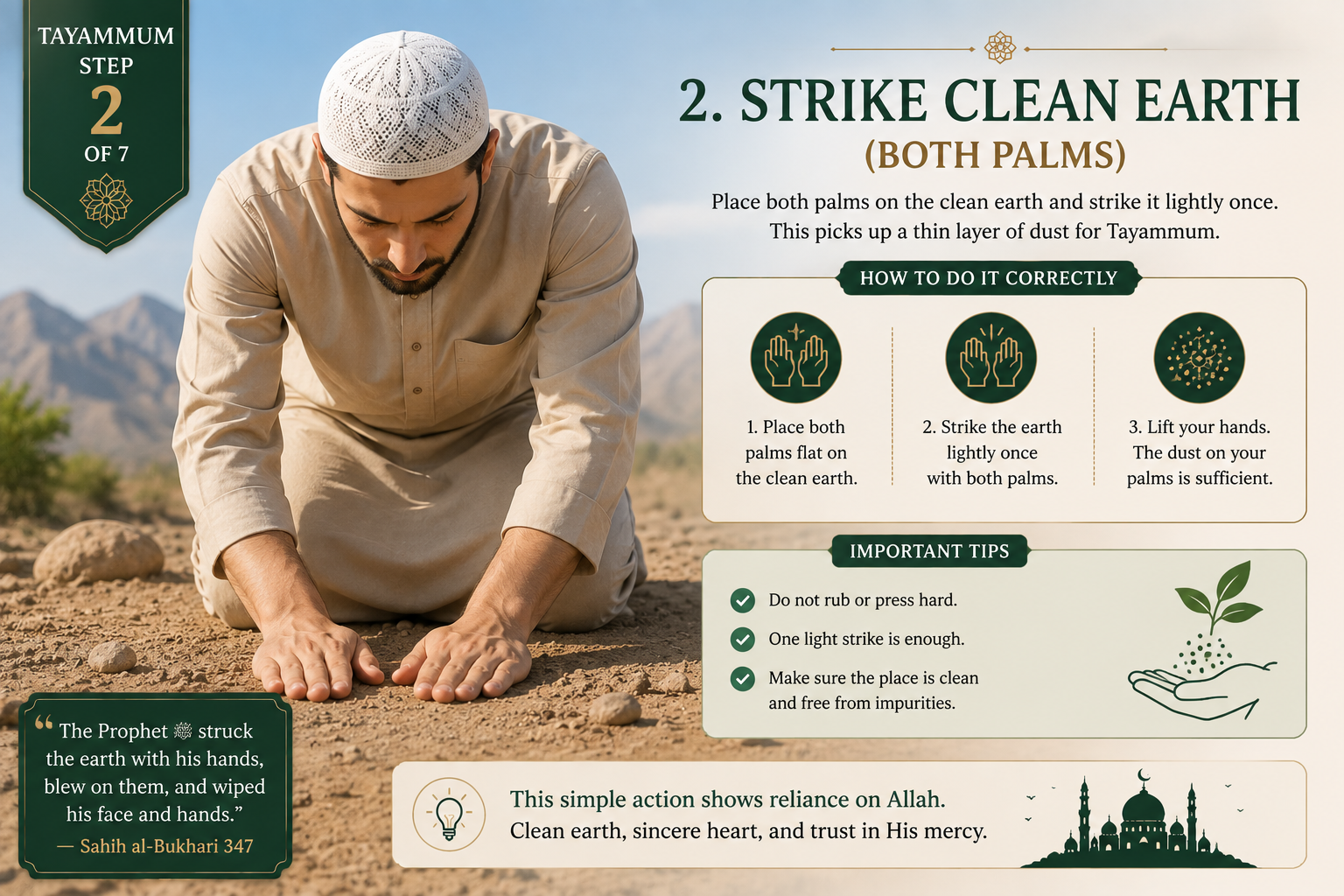
- Say Bismillah before striking the earth.
- Strike both palms once on clean earth, sand, dust, or stone, with the fingers spread slightly apart.
- Blow or lightly shake off any excess dust from the palms, so a thick layer isn’t left caked on.
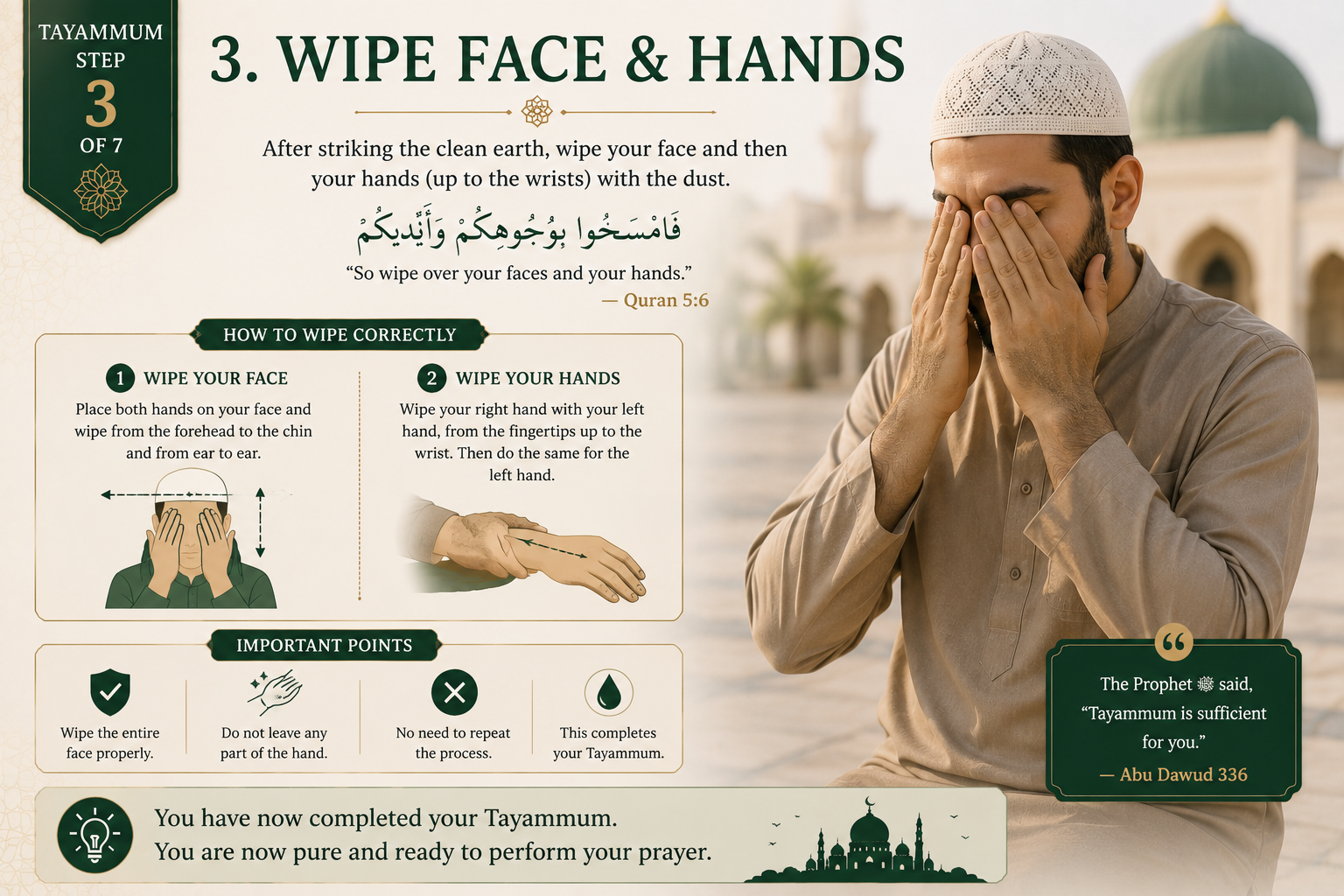
- Wipe the entire face once with both palms, making sure the whole face is covered, including near the hairline and jaw.
- Strike the palms on the earth a second time.
- Wipe the hands — the right hand with the left, then the left hand with the right — up to the wrists (or to the elbows, depending on the school followed).
Common Mistakes
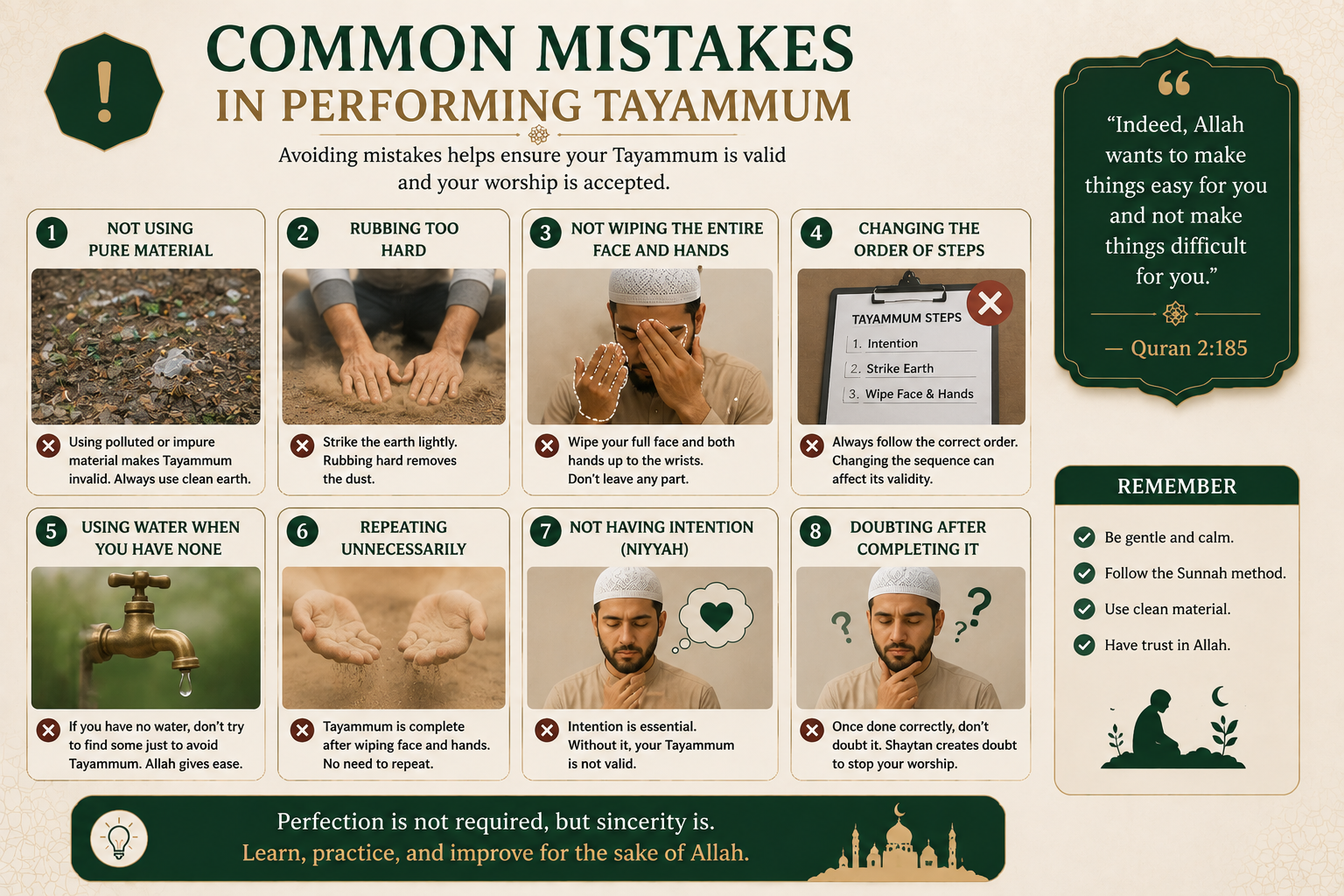
These are the mistakes that most often stand between someone and how to perform Tayammum correctly:
- Using Tayammum when water was genuinely available. This is the single most common mistake — reaching for Tayammum out of convenience rather than a real excuse.
- Skipping the niyyah entirely. Striking the earth out of habit without forming the intention means the act performed isn’t a valid Tayammum.
- Missing patches on the face or hands. A thick layer of dust can actually prevent full contact — the goal is a light, even coating, not caked-on earth.
- Confusing the wrist and elbow rulings. Not knowing which school’s ruling applies leads to inconsistent practice — pick one school’s method and stay consistent.
- Assuming Tayammum stays valid indefinitely. Once water becomes available and the excuse no longer applies, Tayammum needs to be redone with water for the next prayer that requires it.
None of these mistakes come from bad intentions — they almost always come from having learned how to perform Tayammum correctly once, quickly, and never revisiting it. A few minutes spent getting it right now saves that same hesitation from showing up again next time.
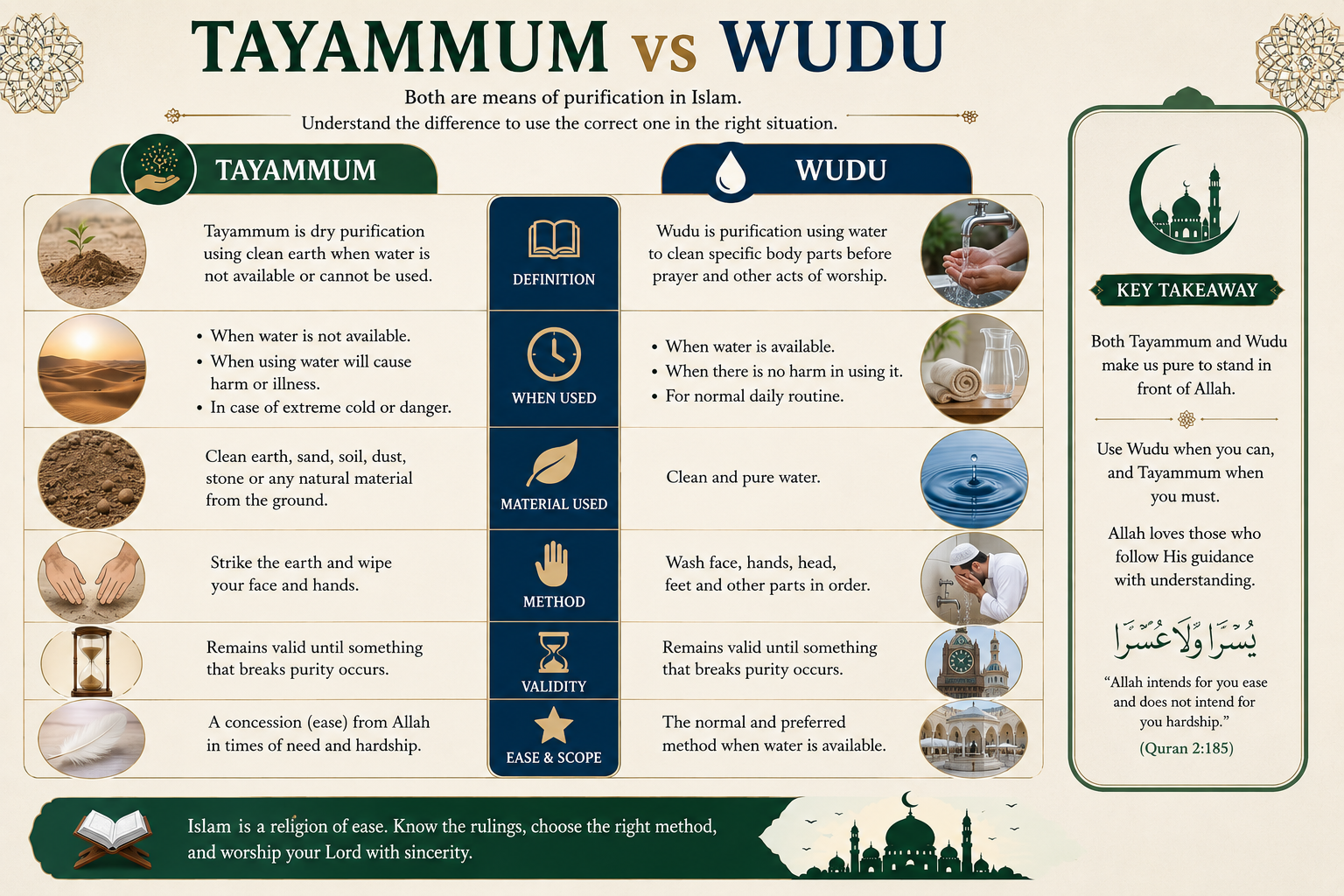
Tayammum vs Wudu
Tayammum and Wudu remove the same category of minor impurity, but they aren’t interchangeable by choice — Tayammum only steps in when Wudu genuinely isn’t possible.
| Tayammum | Wudu |
|---|---|
| Material used | Clean earth, sand, dust, or stone |
| Number of steps | 7 (niyyah through wiping the hands) |
| When it’s used | Only when a valid excuse applies |
| How long it stays valid | Tied to the excuse — ends once water becomes available and usable |
In short: Wudu is the default, and Tayammum is the mercy that steps in exactly when Wudu can’t be done — never the other way around by preference.
Tayammum vs Ghusl
The same logic extends to Ghusl. When a valid excuse for avoiding water applies — illness, injury, extreme cold, or no water at all — Tayammum stands in for Ghusl exactly as it does for Wudu, using the same 7-step method rather than a separate one.
The one difference worth knowing: Ghusl is required for major impurity (janabah, the end of menstruation or nifas), while Wudu covers minor impurity. Tayammum doesn’t change based on which one it’s replacing — the method stays identical either way, which makes how to perform Tayammum correctly simpler to remember than it might first sound.
So whether Tayammum is standing in for Wudu or Ghusl, how to perform Tayammum correctly stays the same: the same niyyah, the same two strikes, and the same wiping sequence apply.
The Wisdom Behind Tayammum
It’s easy to think of Tayammum purely as a technical workaround, but there’s real wisdom in why it exists. It reflects a broader principle in Islam: worship is meant to remain within reach, not become a burden that pushes someone away from prayer altogether.
Someone recovering from surgery, travelling through a desert region, or stuck on a long-haul flight isn’t excused from prayer — they’re given a dignified, valid way to still perform it. That’s really the heart of a tayammum guide like this one: not just the mechanics of how to perform Tayammum correctly, but the reassurance that there’s always a way to stay connected to prayer, regardless of circumstance.
Seen this way, knowing how to perform Tayammum correctly isn’t a lesser option — it’s proof that prayer was never meant to depend on perfect conditions.
Build the Full Purification Foundation
Wudu, Ghusl, and Tayammum together cover every situation you’ll face before prayer — explore the full set of guides.
Read the Ghusl GuidePractical Tips and a Checklist
These practical tips make it easier to remember how to perform Tayammum correctly the moment you actually need it — a quick mental version of the Tayammum step by step method above:
- Confirm the excuse first. Before anything else, make sure a genuine reason applies — no water nearby, harm from using it, or extreme cold with no safe way to warm it.
- Look for a light, even dust surface rather than thick, caked earth — a clean car interior, a stone, or a sandy patch all work.
- Don’t overthink the amount of dust. A light film transferring onto the palms is enough; excess should be shaken or blown off before wiping.
- Pick one school’s ruling on wrists vs elbows and stay consistent, rather than mixing methods from different opinions.
- Redo purification with water once it’s available for the next prayer that needs it — Tayammum isn’t meant to be kept indefinitely once the excuse passes.
Keep this checklist in mind and how to perform Tayammum correctly stops being a source of doubt — it becomes a routine you can rely on whenever water genuinely isn’t an option.
Tayammum FAQ
How do I make Tayammum if I only have a dusty car seat or dashboard?
As long as the surface is clean and has enough dust to transfer onto the palms when struck, it’s accepted by several schools — this is one of the more practical, commonly cited examples of how to perform Tayammum correctly while travelling.
Does Tayammum need to be repeated for every prayer?
Most scholars hold that Tayammum, like Wudu, stays valid until something breaks it or the excuse that permitted it ends — it isn’t automatically limited to a single prayer, though some schools differ on this point.
Can Tayammum be used for both minor and major impurity?
Yes — the same Tayammum method substitutes for both Wudu (minor impurity) and Ghusl (major impurity); the method itself doesn’t change based on which one it’s replacing.
What if I can’t find any earth, sand, or dust at all?
If absolutely no valid material is available, most scholars hold that the person prays as they are and repeats the prayer later once purification becomes possible — this situation is rare in practice.
How to do Tayammum if I have a cast or bandage on my hand?
Wipe over the cast or bandage itself as part of the hand-wiping step, rather than trying to remove it — this is one of the exact situations Tayammum, or wiping in combination with it, is designed for.
Does Tayammum expire once I get home to water?
Part of knowing how to perform Tayammum correctly is knowing when it ends: the excuse ending — arriving somewhere with usable water — means Tayammum should be redone with water for the next prayer that requires purification, rather than continuing to rely on it once water is genuinely available.
How to make Tayammum correctly if I’m unsure which school to follow?
Any of the major schools’ methods are valid — the safest approach for a beginner is to follow the sequence taught in this guide consistently, or ask a local scholar which school is commonly followed in your community.
Is Tayammum valid for someone who is simply too lazy to fetch water?
No — a valid excuse must genuinely apply. Using Tayammum purely out of convenience when water is realistically reachable doesn’t meet the conditions required for it to count.
Can Tayammum be performed indoors on a carpeted floor?
Only if the carpet or surface actually has clean dust on it that transfers to the palms — a clean, dust-free carpet with nothing to strike doesn’t work on its own; a dusty windowsill, plant pot, or a small container of clean sand kept nearby is a more reliable option indoors.
Do children need to be taught Tayammum as well as Wudu?
Yes — since Tayammum is part of the same purification system, teaching it alongside Wudu and Ghusl once a child is old enough to learn prayer helps avoid the same confusion adults often run into later.
References
- Quran 5:6 (Surah Al-Ma’idah) — https://quran.com/5/6
- Quran 4:43 (Surah An-Nisa) — https://quran.com/4/43
- Hadith of the earth as a means of purification — Sahih al-Bukhari 335 — https://sunnah.com/bukhari:335
- Hadith of Ammar ibn Yasir on the method of Tayammum — Sahih al-Bukhari 347 — https://sunnah.com/bukhari:347
- Hadith of Ammar ibn Yasir on the method of Tayammum — Sahih Muslim 368 — https://sunnah.com/muslim:368
- General fiqh reference — https://islamqa.info/
Final Thought
Once the conditions and the 7-step method are clear, Tayammum stops feeling like a rare exception and becomes just another tool you know how to use when the situation calls for it. That’s really what this tayammum guide is meant to leave you with — not a vague memory of “you can skip Wudu sometimes,” but a clear, confident grasp of exactly when and how.
No one gets every detail right the first time either — if you realize a past Tayammum may have skipped a step, simply carry the correct method forward from today.
For everyday reference, Quran.com and Sunnah.com are reliable places to revisit the verses and hadith referenced in this guide, and IslamQA.info is useful for specific fiqh questions that fall outside general guidance like this.
Complete the Purification Foundation
Wudu, Ghusl, and Tayammum together — read all three guides to have every situation covered before prayer.
Read the Salah GuideTrust & Verification
- Reviewed By
- IslamicEduHub in-house Fiqh panel
- Last Updated
- August 2026
- Reviewed Date / Version
- v1.0 — August 2026
- Sources
- Quran.com, Sunnah.com, IslamQA.info
- Quran References
- Surah Al-Ma’idah 5:6; Surah An-Nisa 4:43
- Hadith References
- Sahih al-Bukhari 335 (the earth as a means of purification); Sahih al-Bukhari 347 and Sahih Muslim 368 (Ammar ibn Yasir on the method of Tayammum)
- Scholar Review
- Reviewed by IslamicEduHub’s Fiqh panel