
How to Perform Wudu Correctly: 11 Simple Steps for Beginners
Last updated: 2026
Knowing how to perform Wudu correctly is something every Muslim assumes they already know — until a small detail makes them stop and wonder if they’re doing it exactly the way the Prophet Muhammad ﷺ taught it.
Most of us learn Wudu as children, often from a parent who showed us quickly, once or twice, and expected it to stick. Over the years, small Sunnah details get dropped without us even noticing. Maybe you’ve recently embraced Islam and want to learn how to perform Wudu correctly, right from scratch.
Whatever brought you here, this guide walks through every step of Wudu in a simple, authentic way — rooted in the Quran and Sunnah, not shortcuts.
Table of Contents
- What Is Wudu and Why Does It Matter?
- Why Was Wudu Prescribed?
- 7 Benefits of Performing Wudu Every Day
- Conditions for a Valid Wudu
- Step-by-Step Guide: How to Perform Wudu Correctly
- Fard vs Sunnah Acts of Wudu — Quick Comparison
- Wiping Over Socks (Mas’h ala al-Khuffain)
- Wudu for People with Medical Conditions
- What Breaks Wudu?
- Common Mistakes Beginners Make During Wudu
- Simple Tips to Build a Consistent Wudu Habit
- Etiquettes (Adaab) of Wudu
- Wudu Before Salah: Why Timing and Care Matter
What Is Wudu and Why Does It Matter?
Wudu (also spelled Wudhu or Wuḍūʾ) is the Islamic act of ritual purification performed using clean water before Salah, before handling the Quran, and before several other acts of worship. It involves washing the face, arms, and feet, and wiping the head, in a specific sequence.
But Wudu is more than a physical routine. The Prophet Muhammad ﷺ described its deeper effect when he said:
“When a Muslim or a believer washes his face [in the course of ablution], every sin he contemplated with his eyes will be washed away from his face… until he comes out cleansed of all sins.” (Sahih Muslim)
Picture that for a moment: standing before Allah with a heart and body that have both been purified, one washed by water, the other by intention. That’s the quiet beauty behind Wudu — it’s a small ritual with an outsized spiritual return.
Why Was Wudu Prescribed?
Cleanliness holds a central place in Islamic teaching. The Prophet Muhammad ﷺ put it plainly: “Cleanliness is half of faith” (Sahih Muslim).
Wudu brings that teaching to life. Before a Muslim stands in Salah, five times a day, they’re asked to pause, step away from whatever they were doing, and physically cleanse themselves first.
That built-in pause creates a rhythm across the day. It’s a series of small resets that keep a believer anchored to worship, even on the busiest of schedules. Scholars often point to this repeated act of purification as one reason Salah stays consistent in a person’s life, unlike acts of worship performed only now and then.
7 Benefits of Performing Wudu Every Day
The primary purpose of Wudu is worship, not health. Still, beginners who take the time to learn how to perform Wudu correctly often find it easier to stay consistent once they see the fuller picture of what it offers:
- Spiritual purification: Hadith describe Wudu as a means of having minor sins washed away.
- A mental reset: Stepping away to perform Wudu creates a natural pause between daily tasks and worship, letting the mind shift into focus.
- Better hygiene: Washing the hands, face, mouth, nose, arms, and feet several times a day naturally supports cleanliness.
- Consistency in worship: Since Wudu is required before Salah, it becomes a habit loop that anchors the five daily prayers.
- A moment of humility: Pausing to purify yourself, even mid-task, is a small act of putting worship ahead of routine.
- A sense of readiness: Many Muslims describe feeling more prepared and present in prayer right after Wudu.
- A teaching tool for children: The clear steps make Wudu one of the easiest acts of worship to pass on to the next generation.
Conditions for a Valid Wudu
Before jumping into the steps, it helps to know what makes a Wudu valid in the first place, since knowing how to perform Wudu correctly starts with meeting these conditions. The major schools of Islamic jurisprudence agree on the following:
- Clean water: The water used must be pure, not mixed with impurities.
- Niyyah (intention): You must intend in your heart that you’re performing Wudu for worship. It doesn’t need to be said aloud.
- Removing anything that blocks water: Nail polish, thick paint, or anything else that stops water from reaching the skin should come off first.
- Following the correct order (Tarteeb): The steps should generally follow one another in sequence, without long pauses (Muwalat).

Step-by-Step Guide: How to Perform Wudu Correctly
Below is the complete Sunnah method of Wudu, based on the practice of the Prophet Muhammad ﷺ as recorded in authentic Hadith collections. Each step marks whether it’s Fard (obligatory) or Sunnah (recommended).
Step 1: Make the Intention (Niyyah)
Before touching the water, quietly intend in your heart that you’re performing Wudu to purify yourself for prayer. There’s no specific dua required for this. The intention of the heart is enough.
Step 2: Say Bismillah
Begin by saying “Bismillah” (In the name of Allah). The Prophet ﷺ said, “There is no Wudu for the one who does not mention the name of Allah upon it” (Abu Dawud). Many scholars treat this as an important Sunnah to open with.
Step 3: Wash the Hands
Wash both hands up to the wrists three times. Make sure water reaches between the fingers. This Sunnah step prepares the hands before the obligatory washing begins.
Step 4: Rinse the Mouth (Madmadah)
Take water into your mouth, swish it around, and spit it out. Repeat three times. It clears away food particles and odor before you stand in prayer.
Step 5: Sniff Water into the Nostrils (Istinshaq)
Using your right hand, sniff water gently into your nostrils, then blow it out with your left hand. Repeat three times. Many people combine this step with rinsing the mouth in one smooth motion.
Step 6: Wash the Face (Fard)
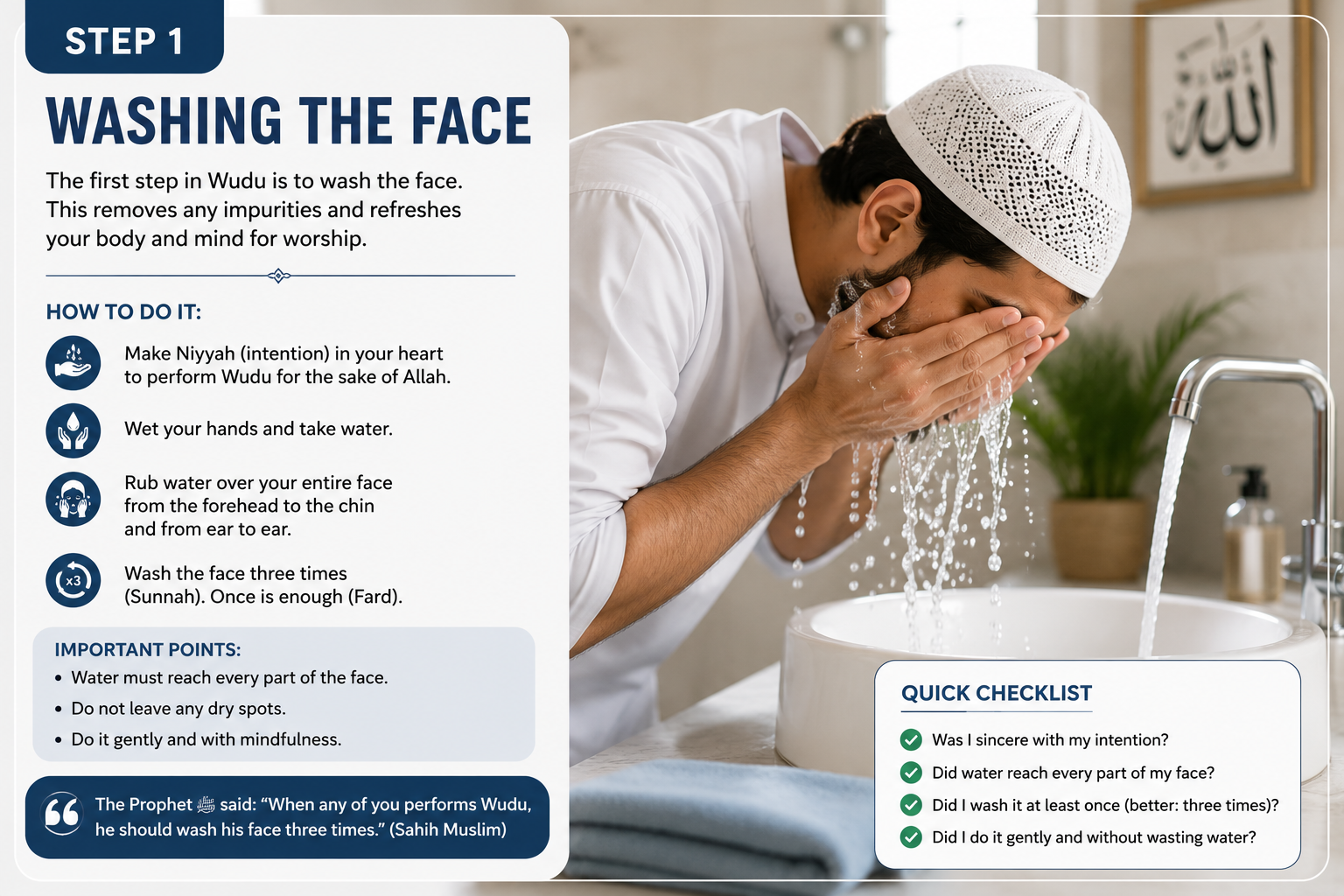
This is the first obligatory step, mentioned directly in the Quran. Wash your entire face from the hairline to the chin, and from ear to ear, three times. If you have a beard, make sure water reaches it, and run wet fingers through it if it’s thick.
Step 7: Wash the Arms up to the Elbows (Fard)
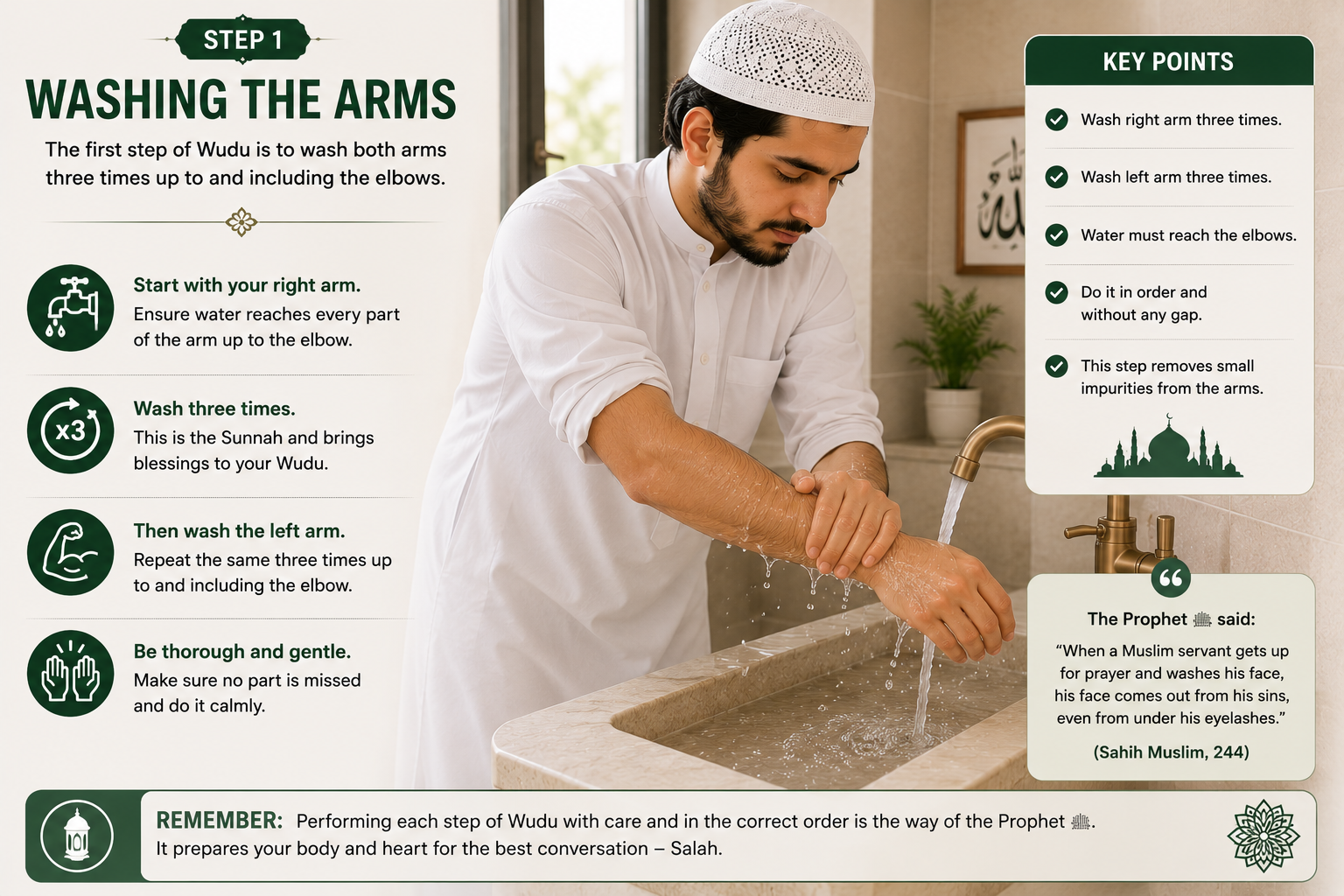
Wash the right arm first, from the fingertips up to and including the elbow, three times. Then repeat with the left arm. The Quran specifically says “to the elbows,” so don’t stop at the forearm — the elbow itself must get water too.
Step 8: Wipe the Head (Fard)
Wet your hands and wipe over your head once, moving from the front hairline to the back, then back to the front. Unlike the face and arms, this step is done once, following the practice of the Prophet ﷺ, not three times.
Step 9: Wipe the Ears (Sunnah)
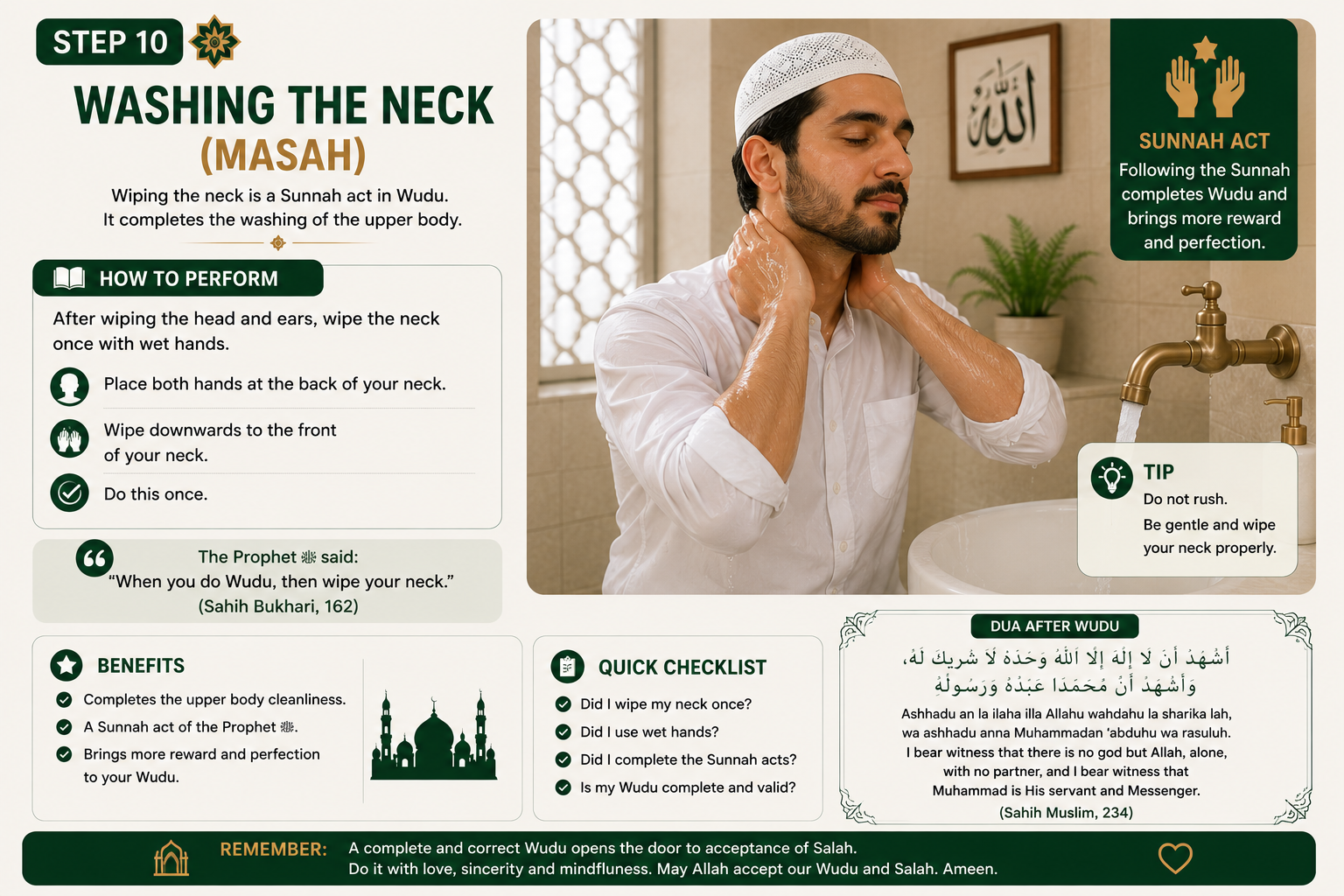
Using the water still on your hands, wipe the inside of your ears with your index fingers and the outside with your thumbs. Do this once, right after wiping the head.
Step 10: Wash the Feet up to the Ankles (Fard)
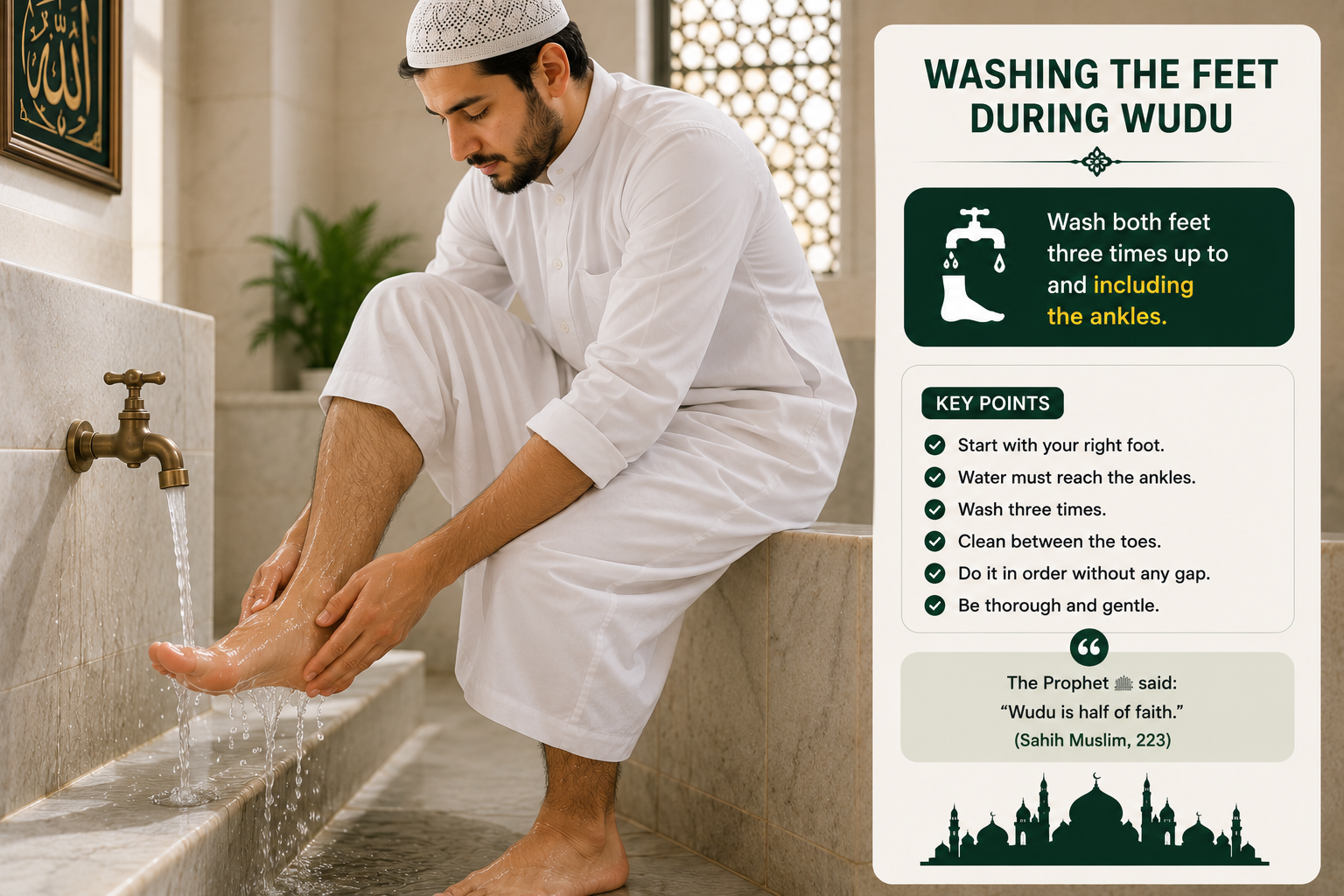
Wash the right foot first, including the ankle, making sure water passes between the toes, three times. Then repeat with the left foot. The Prophet ﷺ warned specifically about dry patches on the heels, saying: “Woe to the heels from the fire!” (Sahih Bukhari) — a sharp reminder to wash thoroughly, not quickly.
Step 11: Recite the Dua After Wudu
Once all the steps are complete, it’s Sunnah to look up towards the sky and recite:
“Ash-hadu an la ilaha illallah, wahdahu la sharika lah, wa ash-hadu anna Muhammadan ‘abduhu wa rasuluh.” (I bear witness that there is no god but Allah alone, without partner, and I bear witness that Muhammad is His servant and messenger.)
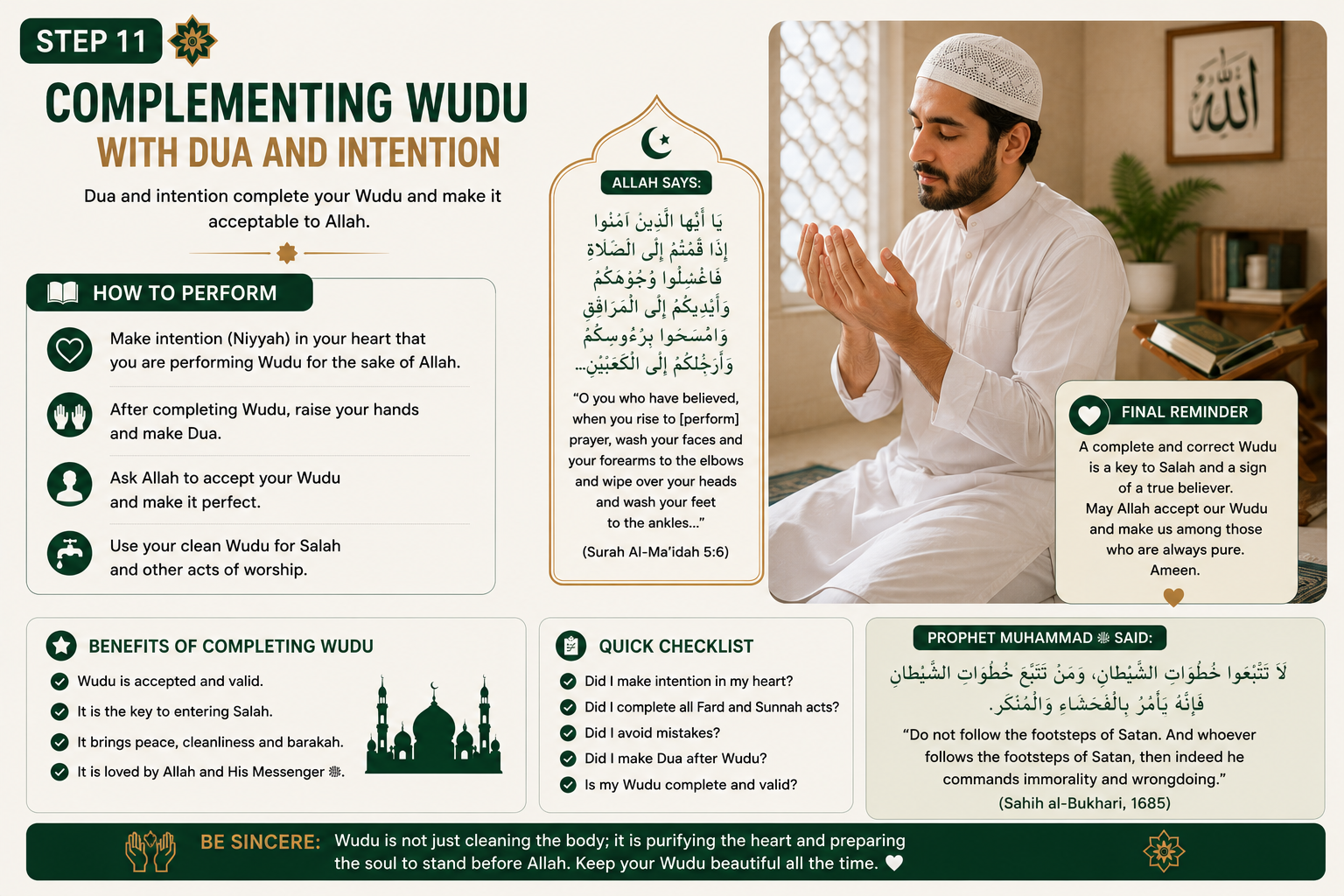
A Hadith in Sahih Muslim promises that whoever recites this after Wudu will find all eight gates of Paradise opened to them, free to enter through whichever one they choose.
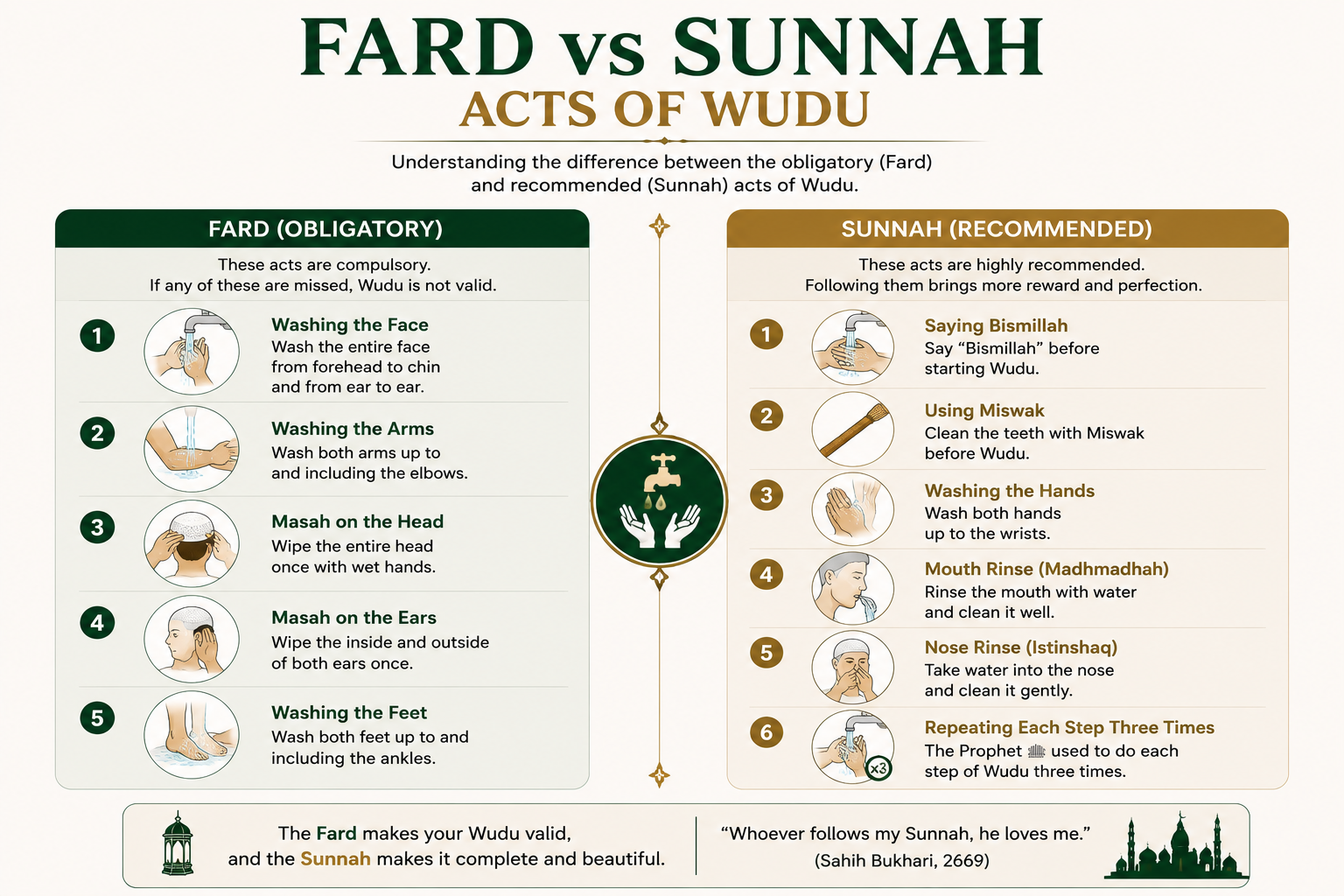
Fard vs Sunnah Acts of Wudu — Quick Comparison
| Fard (Obligatory) | Sunnah (Recommended) |
|---|---|
| Washing the face once | Saying Bismillah before starting |
| Washing both arms up to the elbows | Washing hands before starting |
| Wiping part of the head | Rinsing the mouth and nose |
| Washing both feet up to the ankles | Wiping the ears |
| Following the correct order | Washing each part three times |
| — | Reciting the dua after Wudu |
Why does this table matter? It answers something a lot of beginners quietly worry about: what happens if I forget a step?
Skip a Sunnah act by accident, and your Wudu still stands. Skip a Fard act, though, and it has to be repeated.
That distinction brings real peace of mind, especially to new Muslims. Islam doesn’t expect perfection on the first attempt. It draws a clear line between what’s required and what’s simply encouraged, so a beginner can nail the Fard acts first and layer in the Sunnah practices as they grow more comfortable.
Wiping Over Socks (Mas’h ala al-Khuffain)
Here’s a detail that surprises a lot of beginners learning how to perform Wudu correctly: Islam allows wiping over socks or leather footwear instead of washing the feet, under certain conditions.
If you put on socks or leather socks (Khuffain) while already in a state of Wudu, you can simply wipe the top of the socks with wet hands for your next Wudu, instead of removing them each time.
This concession (Rukhsah) holds for a limited window — commonly cited as one day and night for a resident, three days and nights for a traveler, based on several Hadith. Exact conditions vary slightly between the schools of Fiqh. It’s a practical example of how Islam balances obligation with everyday ease, especially in cold climates or while traveling.
Wudu for People with Medical Conditions
Islam is a practical religion, and knowing how to perform Wudu correctly under difficult circumstances is part of that practicality. It accounts for genuine hardship.
For someone with a continuous medical condition — a constant minor discharge, or an inability to control passing gas — scholars use the concept of “Ma’thur,” the ruling for a person with a valid excuse (Ma’zur). In simple terms, that person performs Wudu once for the time of each prayer and isn’t required to remake it repeatedly for the same ongoing condition during that prayer window.
If a health condition is affecting your ability to perform Wudu normally, ask a knowledgeable local scholar or imam, or consult a trusted resource like IslamQA. The exact ruling can depend on your specific circumstances.
What Breaks Wudu?
Knowing how to perform Wudu correctly is only half the picture. It’s just as important to know what invalidates it. The most common things that break Wudu are:
- Using the toilet (urination or defecation)
- Passing gas
- Deep sleep that removes awareness
- Loss of consciousness, such as fainting
- Blood, pus, or other impurities flowing from the body (according to most scholars)
- Direct skin-to-skin contact between spouses with desire, according to some schools of thought — this is a point of scholarly difference, so it’s worth asking a local scholar which opinion your school of Fiqh follows
On the other hand, touching a woman without desire, minor bleeding from a cut, or eating a normal meal do not break Wudu according to the majority opinion. A few of these points still carry some difference of scholarly opinion across the four major schools.
Common Mistakes Beginners Make During Wudu
Even after learning how to perform Wudu correctly on paper, small errors tend to slip in without anyone noticing. Here are the ones that come up most often:
- Rushing through the steps — Wudu should be calm and deliberate, with water actually reaching every part, not a quick splash.
- Missing dry patches — especially on the heels, between the toes, and around the elbows.
- Forgetting to wipe the ears after wiping the head.
- Nail polish or thick makeup that blocks water from reaching the skin — a common concern for sisters.
- Losing the correct order, especially when distracted or in a rush.
- Wasting water — the Prophet ﷺ advised moderation even at a flowing river, so excess water use is discouraged even though it doesn’t invalidate the Wudu.
- Talking too much during Wudu — it doesn’t invalidate anything, but staying quiet and focused keeps the act reflective rather than mechanical.
- Treating one long rinse as three washes — each repetition should be a deliberate, separate pour or scoop, not one continuous stream.
Simple Tips to Build a Consistent Wudu Habit
For beginners, especially new Muslims or children just learning how to perform Wudu correctly, turning it into a natural habit takes a bit of practice. A few things help:
- Go slowly at first. Speed isn’t the goal. Walk through each step deliberately until the sequence feels second nature.
- Keep a small mirror nearby while learning, to check that water has actually reached the hairline, ears, and heels.
- Say the steps out loud a few times while practicing, especially when teaching children, so the order sticks in memory.
- Fold Wudu into your morning routine, even outside prayer times, so it becomes second nature instead of something rushed only when Salah is due.
- Ask when unsure. Nail polish, a cast on your arm, a specific medical condition — take questions like these to a knowledgeable local imam instead of guessing.

Etiquettes (Adaab) of Wudu
Beyond the Fard and Sunnah acts, learning how to perform Wudu correctly also means picking up a set of general etiquettes that reflect Islam’s broader emphasis on mindfulness and moderation:
- Face the Qiblah if possible — not obligatory, just a preferred practice for some.
- Avoid excessive water use. The Prophet ﷺ used roughly one Mudd of water (about 750ml) for Wudu. Moderation, not excess, was the standard he set.
- Keep the area clean and avoid splashing water in ways that dirty the floor or disturb others nearby.
- Skip unnecessary conversation while performing Wudu, so the mind stays on the act of worship.
- Use the right hand for washing and the left for cleaning, following the general Sunnah of using the right hand for good and pure actions.
None of these etiquettes are obligations in the strict sense. But they capture the spirit behind Wudu: a calm, deliberate act of worship, not a rushed chore squeezed in before prayer.
Wudu Before Salah: Why Timing and Care Matter
Salah cannot be performed without Wudu, unless a person is in a state requiring Tayammum due to lack of water or illness. That’s why understanding how to perform Wudu correctly and building it into a fixed, unhurried pre-prayer routine matters — not as an afterthought squeezed in right before Salah begins.
Some scholars go further and recommend making Wudu even when it isn’t strictly required, such as before sleeping or before reciting Quran. The Prophet ﷺ described staying in a constant state of Wudu as a habit the righteous used to maintain.
Final Thoughts
Wudu is often the very first act of worship a Muslim performs each day, and it sets the tone for the prayers that follow. Learning how to perform Wudu correctly, not just quickly, is a small but meaningful step toward more mindful worship.
The next time you make Wudu, resist the urge to rush. Take a few extra moments, remember Allah as you go, and let your heart settle before you even reach the prayer mat. A small improvement in how you perform Wudu can carry into how present you feel in every Salah that follows.
Whether you’re a new Muslim, a parent teaching your child, or simply revisiting the basics, that little bit of extra care is what turns a daily habit into a genuine act of devotion.
May Allah accept our worship, forgive our shortcomings, and help us perform Wudu and Salah exactly as taught by the Prophet Muhammad ﷺ. Ameen.
If you’d like to continue learning the essentials of Salah, you may also find these guides helpful:
- How to Perform Salah Step-by-Step
- The Importance of Taharah (Purity) in Islam
- Things That Break Wudu Explained in Detail
(Note: These three slugs — /how-to-perform-salah-step-by-step/, /importance-of-taharah-in-islam/, and /things-that-break-wudu-explained/ — are placeholders. Please verify each one is actually published on IslamicEduHub before this article goes live; if any of them aren’t published yet, remove that link or point it to a live page instead, so you don’t create a broken link.)
References
- Quran 5:6 — Surah Al-Ma’idah
- Sahih al-Bukhari
- Sahih Muslim
- Sunan Abu Dawud
Frequently Asked Questions
What is Wudu in Islam?
Wudu is the Islamic ritual of washing specific parts of the body — the face, arms, head, and feet — in a set order before performing Salah, touching the Quran, or other acts of worship. It is a form of physical and spiritual purification required by the Quran.
What breaks Wudu?
Wudu is broken by using the toilet, passing gas, deep sleep, loss of consciousness, and the flow of blood or pus from the body, among other things detailed by the scholars of Fiqh.
Can I perform Wudu without saying the Niyyah out loud?
Yes. Niyyah (intention) is a matter of the heart, not the tongue. You do not need to say it out loud in Arabic or any language — simply intending in your heart to purify yourself for prayer is sufficient.
How many times should each body part be washed in Wudu?
The Sunnah practice is to wash the face, arms, and feet three times each, while wiping the head and ears is generally done once. Washing once is sufficient to fulfill the obligation, but three times is the more rewarded, Sunnah way.
Do I need to repeat Wudu for every prayer?
No, as long as your Wudu has not been broken, one Wudu can be used for multiple prayers. However, renewing Wudu for each prayer carries additional reward according to several Hadith.
Is Wudu valid if I miss one part of the body?
No. Missing any of the four obligatory (Fard) parts — washing the face, washing the arms up to the elbows, wiping part of the head, and washing the feet up to the ankles — invalidates the Wudu, and it must be repeated correctly.
Can I wipe over my socks instead of washing my feet?
Yes, under specific conditions. If you put on socks or leather footwear while already in a state of Wudu, you may wipe over them instead of washing your feet for a limited period, commonly cited as up to one day for residents and three days for travelers, according to Hadith. Consult a local scholar for the exact conditions in your school of thought.
What if I have a medical condition that constantly breaks my Wudu?
Islam provides an exception for individuals with a continuous, uncontrollable condition. Generally, such a person performs Wudu for each prayer’s designated time and is not required to repeat it during that same time period solely because of the ongoing condition. It’s best to ask a knowledgeable scholar about your specific situation.