
Ask ten different people what Islam is really about, and you’ll probably get ten different answers — prayer, fasting, charity, belief, pilgrimage. The truth is, they’re all right, because Islam itself is built on five specific foundations that hold everything else together. These are known as the 5 pillars of Islam, and understanding them properly is the fastest way to actually understand what practicing Muslims do every day and why.
This guide breaks down each of the five pillars of Islam in plain language — what it is, why it exists, and how it’s actually practiced — so you walk away with a real understanding, not just a list of terms.
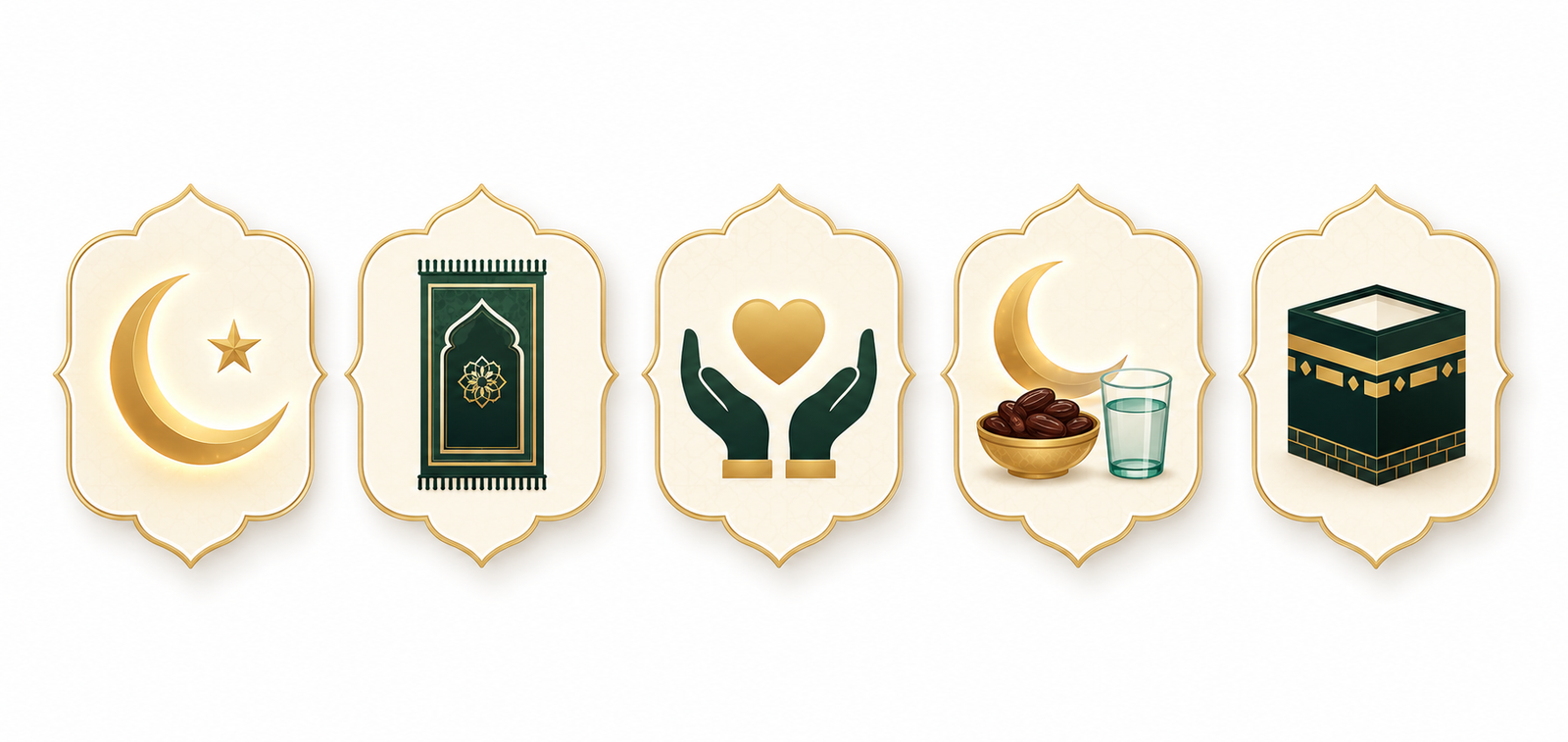
✅ Quick Answer: What Are the 5 Pillars of Islam?
The 5 pillars of Islam are: Shahada (declaration of faith), Salah (five daily prayers), Zakat (obligatory charity), Sawm (fasting during Ramadan), and Hajj (pilgrimage to Mecca, once in a lifetime if able). Together, they form the framework of a practicing Muslim’s relationship with Allah and with their community.
📋 Table of Contents
- What Are the Five Pillars, and Why Do They Exist?
- Pillar 1: Shahada — The Declaration of Faith
- Pillar 2: Salah — The Five Daily Prayers
- Pillar 3: Zakat — Purifying Wealth Through Charity
- Pillar 4: Sawm — Fasting During Ramadan
- Pillar 5: Hajj — The Pilgrimage to Mecca
- How the Five Pillars Work Together
- Why the Five Pillars Still Matter in Modern Life
- Common Misunderstandings About the Five Pillars
- How to Start Practicing the Five Pillars as a Beginner
- Frequently Asked Questions
What Are the Five Pillars, and Why Do They Exist?
“Islam is built upon five pillars: testifying that there is no god but Allah and that Muhammad is the Messenger of Allah, establishing prayer, giving zakat, making pilgrimage to the House, and fasting Ramadan.” — Sahih al-Bukhari & Sahih Muslim
Notice the word “built.” A building without one of its main supports doesn’t just look incomplete — it becomes unstable. That’s exactly how these five acts function in a Muslim’s life: each one supports a different dimension of faith. Shahada anchors belief. Salah anchors daily discipline. Zakat anchors compassion and social responsibility. Sawm anchors self-control. Hajj anchors unity and humility. Together, the 5 pillars of Islam aren’t a checklist — they’re a complete system for living with purpose.
Shahada — The Declaration of Faith
The Shahada is the single sentence that separates belief from disbelief in Islam: “La ilaha illallah, Muhammadur rasulullah” — “There is no god but Allah, and Muhammad is the Messenger of Allah.”
It sounds simple, but it carries enormous weight. The first half rejects every false object of worship — wealth, status, other deities, even one’s own ego — and redirects all worship to Allah alone. The second half accepts Muhammad (ﷺ) as the final messenger, which means accepting the Qur’an and his example (Sunnah) as the complete guide for how to live.
A person becomes Muslim the moment they say this declaration sincerely, with understanding and belief in their heart. But the Shahada isn’t a one-time formality — practicing Muslims renew it mentally with every prayer, every time they hear the call to prayer (adhan), and every time life tests their conviction. It’s the foundation every other pillar of the five pillars of Islam rests on; without genuine belief, the remaining four become empty rituals.
Salah — The Five Daily Prayers
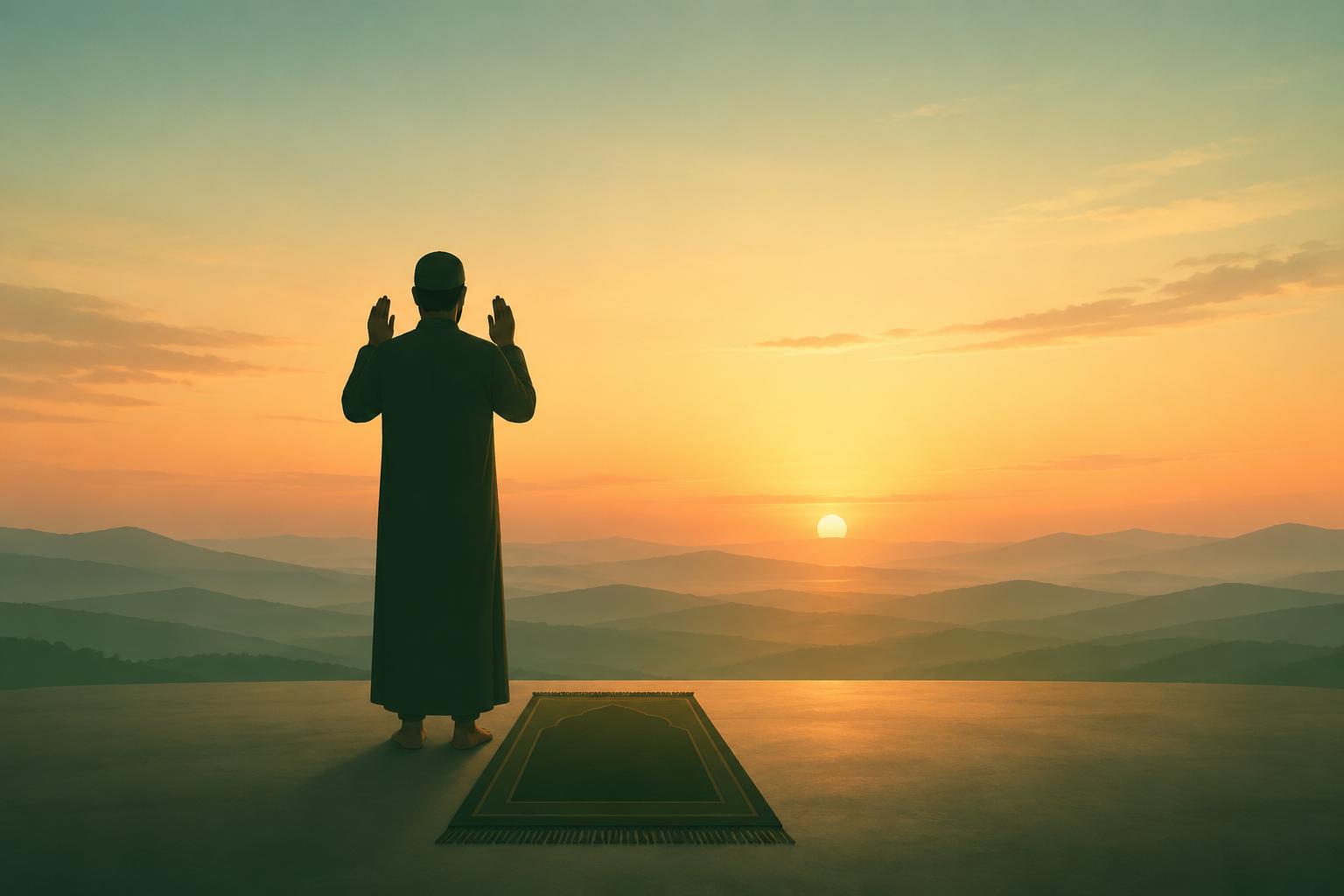
Salah is the second of the 5 pillars of Islam and arguably the most visible in a Muslim’s daily routine. Five times a day — Fajr (dawn), Dhuhr (midday), Asr (afternoon), Maghrib (sunset), and Isha (night) — a Muslim pauses whatever they’re doing to stand before Allah.
Each prayer follows a set structure of standing, bowing, and prostrating, accompanied by specific recitations from the Qur’an. But the physical movements are only half the picture. Salah is designed to interrupt the day at regular intervals, pulling attention away from work, stress, and distraction, and reorienting it toward something larger. That’s why the Qur’an describes prayer as something that “prevents immorality and wrongdoing” (Qur’an 29:45) — not through magic, but through the discipline of showing up five times a day, every day, regardless of mood.
For someone new to Salah, the biggest hurdle usually isn’t memorizing the movements — it’s building the habit. Most beginners start with one prayer, get consistent with it for a few weeks, then add the next. Trying to perfect all five at once from day one is one of the fastest ways to burn out.
Zakat — Purifying Wealth Through Charity
Zakat is often translated as “charity,” but that undersells it. Zakat is an obligatory annual payment — typically 2.5% of a Muslim’s savings and qualifying wealth above a certain threshold (nisab) — given specifically to those in need. It isn’t optional generosity; it’s a structural pillar of the religion, as fundamental as prayer.
The word “zakat” itself comes from a root meaning “to purify” or “to grow.” The idea is that wealth left unchecked tends to breed hoarding, greed, and disconnection from others. Giving a portion away every year purifies what remains and keeps a person’s relationship with money healthy rather than obsessive.
Zakat also functions as a built-in social safety net. In a community where every eligible Muslim pays it consistently, the poor, the indebted, and the vulnerable are cared for as a matter of religious obligation — not charity dependent on mood or convenience. This is one of the clearest examples of how the five pillars of Islam blend personal worship with collective responsibility.
Sawm — Fasting During Ramadan
Sawm refers to fasting, most notably during the month of Ramadan, when able Muslims abstain from food, drink, and marital relations from dawn until sunset for an entire lunar month. It’s one of the most physically demanding of the 5 pillars of Islam, and also one of the most transformative.
The purpose isn’t simply hunger. The Qur’an explains the goal directly: fasting is prescribed “that you may become righteous” (Qur’an 2:183). Removing food and drink — two of the most basic comforts — for hours at a time builds empathy for those who go without by necessity, strengthens self-discipline, and creates space for increased worship, reflection, and gratitude.
Ramadan also reshapes daily rhythm around community: pre-dawn meals (suhoor), breaking the fast together at sunset (iftar), and extra night prayers (taraweeh) turn an individual act of restraint into a shared, month-long experience. Children, travelers, the sick, and those with valid medical reasons are exempted or given alternatives, reflecting the balance Islam places between obligation and mercy.
Hajj — The Pilgrimage to Mecca
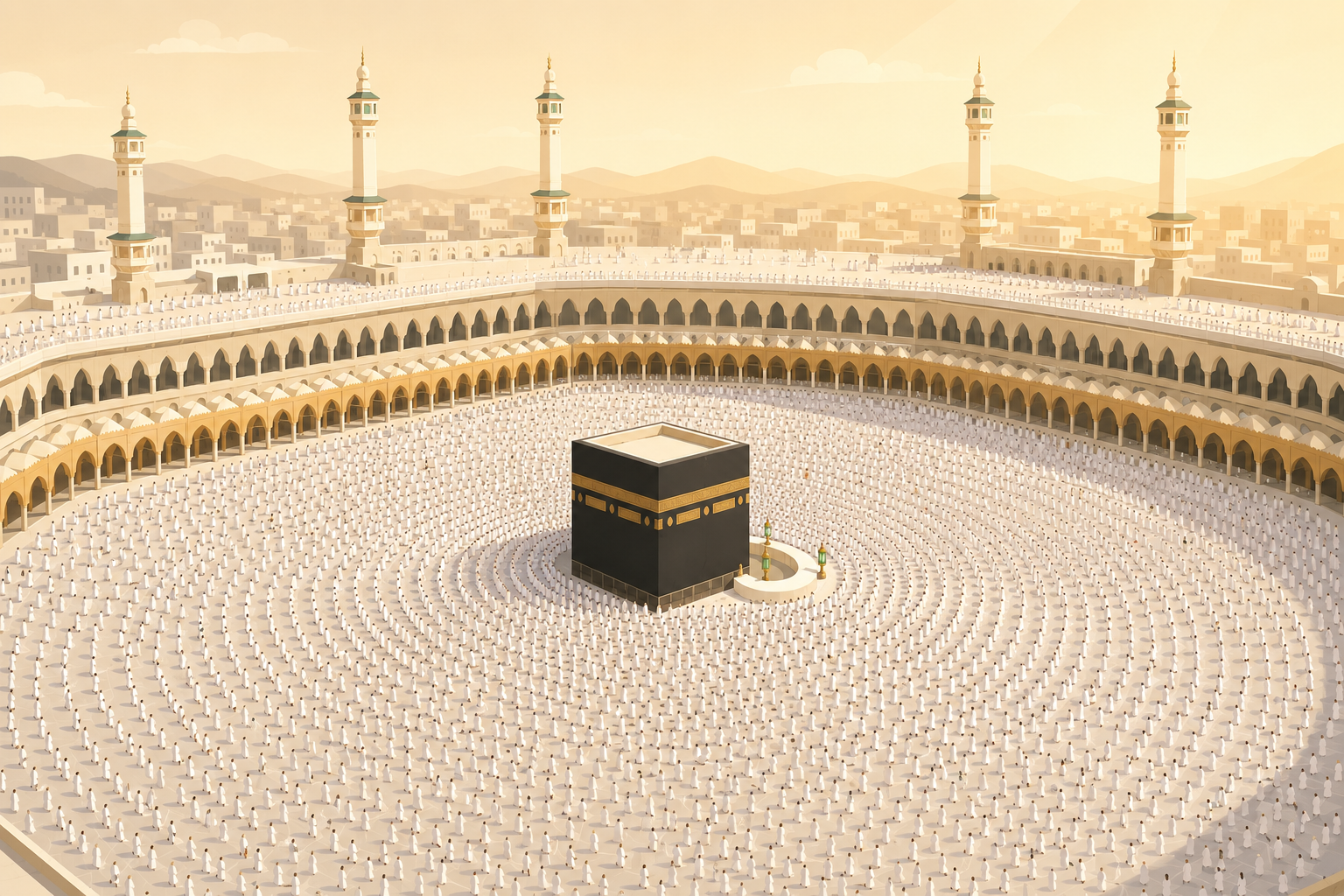
Hajj is the pilgrimage to the holy city of Mecca, required once in a lifetime for every Muslim who is physically and financially able to make the journey. It takes place during a specific set of days in the Islamic calendar and draws millions of Muslims from every corner of the globe to the same sacred sites.
What makes Hajj distinct among the five pillars of Islam is its sheer scale of unity. Pilgrims wear simple white garments (ihram) that erase visible markers of wealth or status — a king and a laborer stand side by side, indistinguishable. The rituals themselves retrace the footsteps of the Prophet Ibrahim (Abraham), his wife Hajar, and the Prophet Muhammad (ﷺ), connecting today’s Muslims to a chain of faith stretching back thousands of years.
For most Muslims, Hajj represents the culmination of a lifetime of preparation — spiritually, financially, and physically. Those who cannot yet perform it are not considered any less complete in their faith; the obligation only applies when a person genuinely has the means.
Many Muslims spend years saving specifically for Hajj, treating it as a long-term goal rather than a spontaneous trip. Preparing early — both financially and by learning the rituals in advance — tends to make the experience far more meaningful than rushing to go the moment funds become available.
How the Five Pillars Work Together
It’s tempting to study the 5 pillars of Islam as five separate boxes to check, but they’re designed to function as a single, interconnected system. Shahada gives you belief. Salah turns that belief into a daily habit. Zakat extends that habit outward into generosity toward others. Sawm strengthens the self-control needed to sustain all of it. Hajj, for those able, brings the entire journey full circle in an act of shared humility with the global Muslim community.
Miss one, and the others start to feel incomplete. A person who prays five times a day but never gives zakat has discipline without compassion. A person who fasts every Ramadan but neglects prayer has restraint without connection. The five pillars of Islam are meant to be lived together, not cherry-picked.
Why the Five Pillars Still Matter in Modern Life
It’s fair to ask why a framework built over 1,400 years ago still holds up in a world of smartphones, remote work, and constant distraction. The honest answer is that the five pillars of Islam were never designed around a particular era — they were designed around unchanging aspects of human nature: the need for belief, the need for discipline, the need for generosity, the need for self-control, and the need for humility and connection to something bigger than yourself.
Modern life, if anything, makes these five pillars more relevant, not less. Salah forces a pause in a culture that rewards nonstop productivity. Zakat pushes back against a culture that measures success purely by accumulation. Sawm builds resistance to instant gratification in a world engineered for it. Hajj strips away status symbols in a culture obsessed with displaying them. Shahada anchors identity in something stable when everything else — trends, algorithms, opinions — shifts constantly.
Practicing Muslims today don’t experience the 5 pillars of Islam as relics of the past. They experience them as a daily counterbalance to exactly the pressures modern life creates.
Common Misunderstandings About the Five Pillars
- Thinking they’re just rituals, not a system. Each pillar has an internal purpose beyond the physical action — missing that purpose turns worship into empty repetition.
- Assuming Zakat is the same as general charity. Zakat has a fixed rate and specific eligible recipients defined in Islamic law; voluntary charity (sadaqah) is separate and unlimited.
- Believing Hajj is required of everyone. It’s only obligatory for those who are physically capable and can afford it without going into debt or neglecting their dependents.
- Trying to master all five perfectly overnight. Long-term consistency in each pillar matters far more than short bursts of intensity followed by burnout.
- Separating the pillars from daily character. The five pillars of Islam are meant to shape honesty, patience, and kindness — not just be performed and set aside.
How to Start Practicing the Five Pillars as a Beginner
- Start with Shahada. Make sure your understanding and belief behind the declaration is solid — this is the foundation everything else builds on.
- Build Salah one prayer at a time. Start with a single daily prayer, get consistent, then gradually add the rest.
- Learn Zakat’s basics before your first payment is due. Understand the nisab threshold and calculation so you’re prepared when the time comes.
- Prepare for your first Ramadan gradually. If fasting is new to you, speak with a knowledgeable person about exemptions and gentle ways to build up your fasting stamina.
- Treat Hajj as a long-term goal, not an immediate pressure. Save gradually and plan for it as a milestone rather than a rushed obligation.
For a broader roadmap on where to begin your learning journey overall, see our guide on how to learn Islam properly, which covers building a solid foundation of knowledge before diving into practice.
Frequently Asked Questions About the 5 Pillars of Islam
What are the 5 pillars of Islam in order?
The five pillars, in the order they’re traditionally taught, are: Shahada (declaration of faith), Salah (five daily prayers), Zakat (obligatory charity), Sawm (fasting during Ramadan), and Hajj (pilgrimage to Mecca).
Which pillar of Islam is considered the most important?
Shahada is considered foundational, since it’s the declaration of belief that makes the remaining four pillars meaningful. Without genuine belief, the other acts of worship lose their spiritual purpose.
Do all Muslims have to perform Hajj?
No. Hajj is only obligatory once in a lifetime for Muslims who are physically able and can afford the journey without financial hardship or neglecting their family’s needs.
What happens if someone can’t fast during Ramadan for health reasons?
Islam provides exemptions for the sick, elderly, pregnant or nursing mothers, travelers, and those with valid medical conditions. Depending on the circumstance, they may make up missed days later or provide compensation (fidyah) instead.
Is Zakat the same as regular charity?
No. Zakat is a specific, obligatory payment calculated on qualifying wealth above a set threshold, given to defined categories of recipients. General charity (sadaqah) is voluntary and has no fixed amount or recipient restrictions.
Can a new Muslim start practicing all five pillars immediately?
There’s no requirement to master everything overnight. Most scholars and teachers recommend building each pillar gradually — starting with a solid understanding of Shahada, then adding Salah one prayer at a time, and learning about Zakat, Sawm, and Hajj as life circumstances make each one relevant.
Keep Building Your Foundation
The 5 pillars of Islam aren’t abstract theology — they’re a practical framework for living with belief, discipline, generosity, self-control, and humility woven into daily life.