
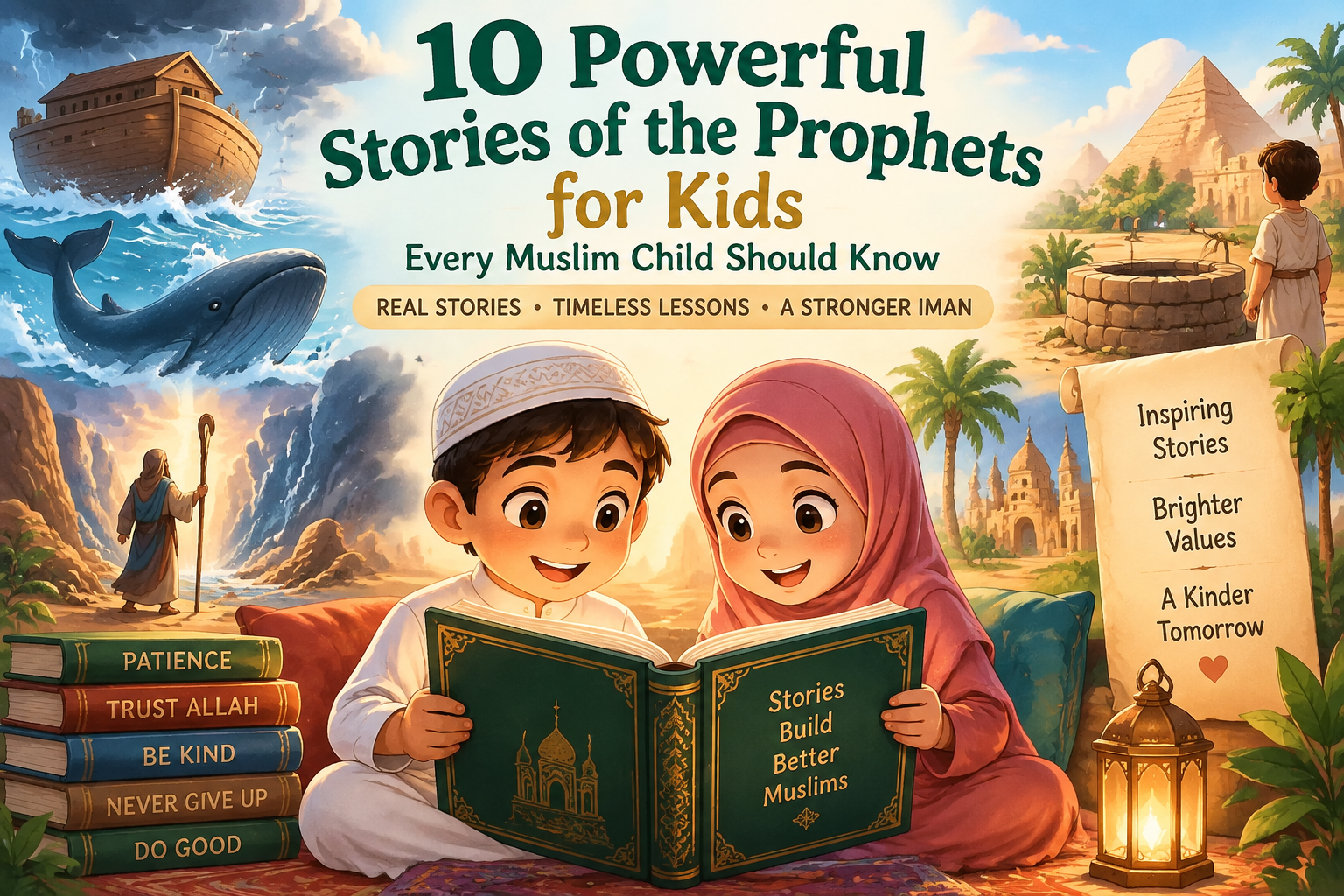
10 Powerful Stories of the Prophets for Kids Every Muslim Child Should Know
Looking for meaningful Islamic bedtime stories your children will actually remember? These 10 prophet stories teach patience, honesty, courage, and trust in Allah, each one simplified, with a clear lesson and its source in the Quran.
These 10 stories of the prophets for kids cover Adam, Nuh, Ibrahim, Ismail, Yusuf, Musa, Dawud, Sulaiman, Yunus, and Ayyub. Each story is simplified for children, ends with one clear lesson, and includes its source in the Quran so you can read further if a child asks.
If any of this sounds familiar, you’re not alone. These come up constantly for parents and teachers:
- Wanting to tell a prophet’s story but not remembering all the details correctly
- Not knowing which parts are appropriate to simplify for a young child
- Struggling to land on a clear, single takeaway a child will actually remember
- Wanting a source to point to if a child (or a curious older sibling) asks “where does this come from?”
On this page
- 1. Adam (AS): The First Human
- 2. Nuh (AS): The Great Flood
- 3. Ibrahim (AS): Breaking the Idols
- 4. Ismail (AS): The Test of Obedience
- 5. Yusuf (AS): Patience and Forgiveness
- 6. Musa (AS): The Baby in the River
- 7. Dawud (AS): Defeating Jalut
- 8. Sulaiman (AS): The King Who Understood Animals
- 9. Yunus (AS): Inside the Whale
- 10. Ayyub (AS): Patience Through Illness
- Parent Discussion Questions
- Short Quran Verses for Kids to Memorize
- Tips for Telling These Stories to Kids
- Common Mistakes to Avoid
- FAQ
Adam (AS): The First Human
Before angels, before anything else on Earth, Allah created Adam (AS) from clay and taught him the names of things, knowledge even the angels didn’t have. Adam and his wife lived in Paradise, but Shaytan tricked them into eating from a tree Allah had told them to avoid. They felt sorry immediately, asked Allah for forgiveness (see our guide on how to repent in Islam for what sincere repentance looks like), and Allah forgave them.
Nuh (AS): The Great Flood
Nuh (AS) spent hundreds of years inviting his people to worship Allah alone, but almost no one listened, not even his own son. Allah told him to build a large ship, something his people mocked him for doing on dry land, far from any sea. When the flood came, Nuh (AS), the believers with him, and pairs of animals were saved, while the floodwaters covered everything else.
Ibrahim (AS): Breaking the Idols
Everyone around Ibrahim (AS) worshipped statues, even though he could see plainly that they couldn’t hear, see, or help anyone. One day, while the town was away at a festival, he broke every idol in the temple except the largest one. When his people demanded to know who did it, he pointed to the one idol left standing, forcing them to ask why a god that couldn’t even defend itself deserved worship at all. Furious, they threw Ibrahim into a huge fire, but Allah made the fire cool and safe for him, and he walked out unharmed.
Ismail (AS): The Test of Obedience
A dream came to Ibrahim (AS): he was sacrificing his son Ismail (AS). He told Ismail exactly what he’d seen, and Ismail, still young, agreed without hesitation to whatever Allah commanded. Just as Ibrahim was about to carry it out, Allah stopped him and sent a ram to sacrifice instead. Muslims remember this every year during Eid al-Adha.
Yusuf (AS): Patience and Forgiveness
Yusuf’s (AS) own brothers, jealous of their father’s love for him, threw him into a well and sold him into slavery. In Egypt, he was falsely accused and imprisoned for years, even though he had done nothing wrong. While in prison, he interpreted dreams for two other inmates, and years later that same skill led him to interpret the king’s dream and rise to a position of real power. When his brothers came to him for help years later, not recognizing him, he forgave them completely.
Musa (AS): The Baby in the River
To protect baby Musa (AS) from a ruler who was killing newborn boys, his mother placed him in a basket and set him on the river, trusting Allah to keep him safe. He was found and raised in the ruler’s own palace, growing up without anyone realizing where he’d truly come from. Musa later grew up to challenge that same ruler, and when Pharaoh’s army cornered his people at the sea, Allah split the water so they could cross safely to the other side.
Dawud (AS): Defeating Jalut
Dawud (AS) was part of Talut’s army when they faced the powerful forces of Jalut (Goliath). Most of the army felt they had no chance, but a small group of believers trusted that Allah could grant victory regardless of numbers. Dawud, still young at the time, killed Jalut in the battle, and Allah then gave him kingship and wisdom. He later became known for his beautiful voice reciting the Zabur (Psalms).
Sulaiman (AS): The King Who Understood Animals
Son of Dawud, Sulaiman (AS) could understand the speech of animals and birds, on top of the wisdom he was known for as a ruler. In one story, an ant warns other ants to get out of the way so Sulaiman’s army wouldn’t accidentally crush them. Hearing this, Sulaiman smiled and thanked Allah for the gift of understanding a language most people would never even notice.
Yunus (AS): Inside the Whale
Frustrated that his people wouldn’t listen, Yunus (AS) left his city before Allah told him to. He boarded a ship caught in a storm, was thrown overboard, and was swallowed by a huge whale. Inside the whale, he turned to Allah, sincerely asking for forgiveness, and Allah had the whale release him safely onto the shore.
Ayyub (AS): Patience Through Illness
Wealth, children, years of health, Ayyub (AS) lost nearly everything a person could lose, including his health to a long illness. Through all of it, he never stopped being grateful to Allah or lost hope. When he finally turned to Allah in sincere dua (our guide on how to make dua covers this in more depth), Allah healed him and restored what he had lost. His name is still closely tied to the idea of patience itself.
Parent Discussion Questions
A quick question after each story does more for retention than the story alone. Here’s one per story to get a conversation going, not a quiz to grade:
- Adam: What do you think Adam felt right after he made his mistake?
- Nuh: How would you feel if you were the only one who believed something for years?
- Ibrahim: Have you ever had to stand up for something everyone else disagreed with?
- Ismail: What made it possible for Ismail to trust his father so completely?
- Yusuf: Why do you think Yusuf chose to forgive his brothers instead of punishing them?
- Musa: What do you think Musa’s mother was feeling as she let the basket go?
- Dawud: Why do you think the smaller group won?
- Sulaiman: What does the ant story tell you about how Sulaiman treated even small creatures?
- Yunus: What does it mean to “turn back” to Allah after a mistake?
- Ayyub: How do you think Ayyub managed to stay thankful during such a hard time?
Short Quran Verses for Kids to Memorize
If a child is ready to memorize something short alongside a story, these two verses pair naturally with the lessons above and are commonly taught early:
Tips for Telling These Stories to Kids
Stories of the prophets for kids work best as a habit, not a one-time event. A few minutes at bedtime or after a weekend class tends to land better than a single long session covering several stories at once.
- Read one story at a time. Ten in a row is a lot for most children to absorb or remember
- Ask the child to repeat the lesson back in their own words afterward, rather than just moving on
- For younger children, skip harder details (like the specific cruelty Yusuf’s brothers showed) and focus on the outcome and the lesson
- Let older children look up the Quranic reference themselves if they’re curious. It builds the habit of checking sources
- Revisit a favorite story every few months. Repetition is part of how these lessons actually stick
Who Benefits Most From These Stories
Parents reading at bedtime, Sunday school and weekend Islamic class teachers, and homeschooling families all use stories of the prophets for kids differently. A parent might read one story slowly over several nights, pausing to talk about it. A classroom teacher might use one story as a five-minute opener before a lesson. Both approaches work; the format below is written to flex either way.
Stories of the Prophets for Kids: Common Mistakes to Avoid
Each story above is a simplified retelling for children, based on the account referenced in the Quran citation given beside it. Details have been kept to the core, well-documented events of each story rather than embellished for effect.
- Quran citations: Surah and verse range given directly below each story; read the full account in context at Quran.com.
- Translation basis: meanings and simplified retellings draw on standard English translations (Sahih International and comparable) as displayed on Quran.com, not a single proprietary translation.
Last reviewed for references: September 2026.
Frequently Asked Questions
What age are these prophet stories suitable for?
Roughly ages 5 to 11. Younger children may need simpler wording and fewer details; older children can usually handle the full version as written here.
How many prophets are there in total?
Twenty-five prophets are traditionally counted as named in the Quran. This guide covers 10 of the most commonly taught to children.
Can I read one of these stories directly from the Quran instead?
Yes. Each story includes its Quran reference specifically so you can read the fuller account together if a child is ready for it.
Why isn’t the Prophet Muhammad’s ﷺ story included here?
His life (Seerah) is significant enough to deserve its own dedicated guide rather than a short summary alongside these. See our full guide on the Life of Prophet Muhammad.
Is it okay to simplify these stories for young children?
Yes, simplifying language and softening especially difficult details is common and appropriate for young children, as long as the core events and the lesson stay accurate.
What’s the best way to help a child remember the lesson, not just the story?
Ask them to explain the lesson back in their own words right after hearing it, and bring the same lesson up again later when a similar situation comes up in daily life.
How accurate are these stories compared to the Quran?
Each story is a simplified retelling built around the core, well-documented events in its Quran citation. Details have been kept close to the source rather than embellished, and every citation on this page has been checked against Quran.com.
What are the best prophet stories for children?
Stories with a clear, concrete lesson tend to land best with kids: Yusuf (forgiveness), Ayyub (patience through hardship), and Yunus (returning after a mistake) are usually the ones children remember longest.
Keep building on these stories
Want the full Prophet Muhammad ﷺ story, or a printable activity to go along with story time?