A practical Islamic guide to steady spiritual growth: sincerity, prayer, Quran, character, and what to do when you slip.
- Find Your Weakest Area
- Your 4-Week Growth System
- What This Actually Means
- 1. Start With Sincerity
- 2. Strengthen Your Salah
- 3. Build a Daily Quran Habit
- 4. Seek Knowledge Steadily
- 5. Work on Your Character
- 6. Find Righteous Company
- 7. Balance With Daily Life
- 8. When You Slip Up
- Common Mistakes
- FAQ
- If You Can Only Do 5 Things

“How do I become a better Muslim?” is one of the most common questions Muslims ask themselves. It rarely comes from a place of crisis. Usually it’s just a quiet feeling that practice has gone a bit flat: you catch yourself scrolling through Isha instead of praying it properly, or you realize it’s been weeks since you opened the Quran instead of just meaning to. The good news is that Islam doesn’t ask for a dramatic overhaul. It asks for sincerity and consistency, applied to a few areas that make a meaningful difference.
Use the system below to identify the area that needs the most attention right now, fix it first, then build from there over four weeks. It also gives you a practical way to respond when you fall short.
How to become a better Muslim comes down to a system, not a list: honestly identify your weakest area among sincerity, Salah, Quran, knowledge, character, company, and daily balance, fix that one area first, add a second once it’s steady, and repeat the cycle. Small, consistent focus on your actual weak point beats trying to improve everything at once.
Find Your Weakest Area First
A generic list of tips leaves you to figure out where to actually start, which is usually what causes people to stall. Before reading further, take two minutes and rate yourself honestly on each area below: 1 (almost never), 2 (inconsistent), 3 (sometimes consistent), 4 (mostly consistent), 5 (stable and intentional).
- Sincerity — Are you consciously seeking Allah’s pleasure in what you do, or is it mainly habit, praise, or appearance?
- Salah — Are all five prayers consistent, or does at least one regularly slip?
- Quran — Have you opened it in the last week, beyond hearing it recited somewhere?
- Knowledge — Could you explain the basics of your daily practices, or are you following habit alone?
- Character — Are you patient and honest with the people closest to you, not just strangers?
- Company — Do you have anyone around you who actively supports this effort?
- Daily balance — Does work, study, or your phone regularly crowd out worship?
Tawbah, the eighth step in this guide, isn’t part of this score. It’s not a habit you build up over time. It’s how you respond whenever you fall short, so it applies at every stage rather than being its own category.
Use your score as a practical starting point, not a religious ranking. Obligatory acts like the five daily prayers stay a priority regardless of score — a low Salah score means urgent attention, not “this can wait.” Among the non-obligatory areas, the lowest score is usually where the most immediate progress is available.
Your 4-Week Muslim Growth System
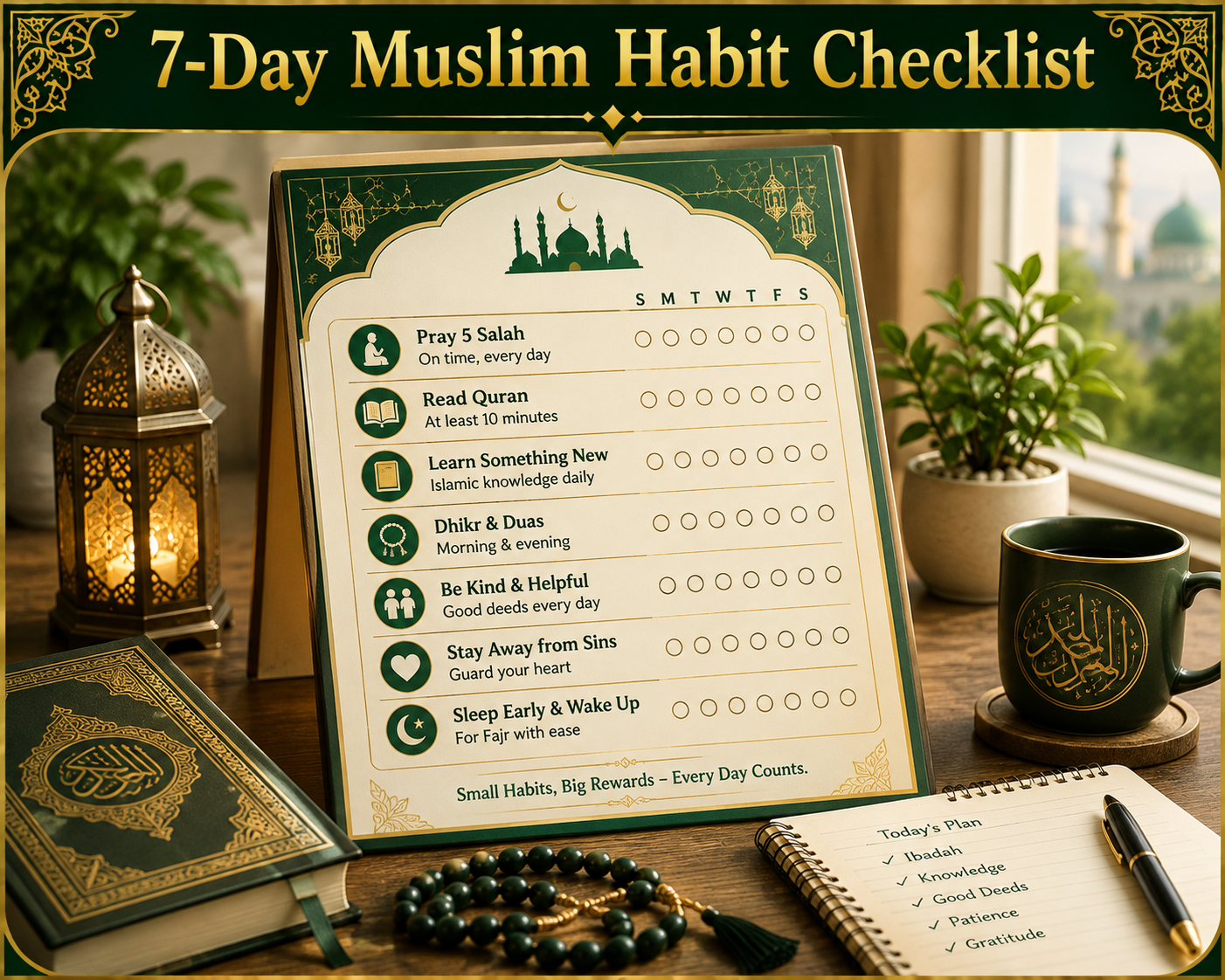
This isn’t a tips list to skim. It’s a four-week structure, not a rigid day-by-day script, built around the self-check above: fix your weakest area, add one more once the first is holding, then review.
The Prophet ﷺ said: “The most beloved of deeds to Allah are the most consistent, even if small.”
A simple shape for your first month:
- Week 1 — Your weakest area Pick whatever scored lowest above and give it your full attention. If it’s Salah, that means solving your specific obstacle to praying all five, not choosing just one. If it’s Quran, read ten minutes daily. Don’t add a second focus yet.
- Week 2 — Add one more area Once week one’s habit feels steady, not perfect, add your second-lowest score. Keep the first one running in the background.
- Week 3 — Character check-in Notice how you’re treating the people closest to you this week specifically. Keep both earlier habits going alongside this.
- Week 4 — Review and adjust Re-score yourself on all seven areas, pick your new lowest score, and repeat the cycle.
By the end of four weeks, you won’t have transformed everything. Nobody does in a month. But you’ll have a working system you can keep repeating indefinitely, instead of a list of tips you tried once and forgot.
Use this to compare your score at the start and again after four weeks:
| Area | Start | Week 4 |
|---|---|---|
| Salah | __ | __ |
| Quran | __ | __ |
| Knowledge | __ | __ |
| Character | __ | __ |
| Company | __ | __ |
| Daily balance | __ | __ |
How to Become a Better Muslim: What This Actually Means
Becoming a better Muslim isn’t a finish line you cross once. It’s closer to a direction you keep walking in, with genuine setbacks along the way. That framing matters, because a lot of people quietly give up after one bad week, assuming the whole effort failed. It didn’t. Islam explicitly treats this as an ongoing process, not a one-time achievement.
It also helps to separate two questions that often get mixed together: “Am I doing enough?” and “Am I doing this sincerely?” The first can spiral into guilt with no clear answer. The second has a real answer you can check honestly, and it’s the one that matters most. This guide assumes you’re already Muslim and working on daily practice. If you’re earlier in the journey, our guide on how to become Muslim covers that first step.
One distinction worth keeping in mind: sincerity, the obligatory prayers, and repentance are Islamic principles, not up for negotiation. The self-scoring system and weekly structure are practical strategy for living those principles out, not religious requirements in themselves. It’s also worth being clear that more Islamic activity isn’t automatically the same as being a better Muslim — doing your existing obligations with more presence and better character can matter more than simply adding tasks.
“Indeed, Allah will not change the condition of a people until they change what is in themselves.”
This verse is broader than personal habit-building — here it serves as a reminder that meaningful change involves a person’s own effort, not a productivity formula.
1. Start With Sincerity
Before any specific practice, the condition that makes it count is sincerity (ikhlas): doing it for Allah, not for how it looks to others. Two people can pray identically, standing side by side, and differ entirely in what their prayer is worth, based on intention alone.
The Prophet ﷺ said: “Actions are judged by intentions, and everyone will get what was intended.”
A practical habit: before a prayer, a donation, or even a hard conversation, pause and ask yourself who it’s really for. That single check quietly reshapes daily actions, since sincerity is between you and Allah, not a performance for anyone watching.
2. Strengthen Your Salah
The five daily prayers are obligatory. If consistency is a struggle, identify the practical obstacle affecting you most and work on removing it rather than treating any prayer as optional. For many people, Fajr can be particularly challenging because of sleep and morning routines.
If you’re working during the day, the real obstacle is often logistics, not willpower: finding a quiet corner, a car, or knowing which prayer times overlap with your lunch break. Solving that practical problem first tends to matter more than motivation alone. A person who misses Fajr regularly may get more out of fixing their sleep routine, going to bed earlier, moving the phone out of reach, than out of adding five new voluntary practices on top of an already-struggling foundation.
Set a physical trigger for whichever prayer is hardest for you: an alarm, a spot you always pray in, a sticky note on your desk. This is a strategy for building consistency across all five prayers, not a plan to delay any of them.
Our step-by-step guide to praying Salah correctly and guide to wudu cover the mechanics, and a prayer time calculator removes the guesswork around timing.
3. Build a Daily Quran Habit
You don’t need a long session. Ten minutes after Fajr, read consistently, tends to do more over a year than an occasional hour-long read. Many people alternate between reading intensely for a few days, then not touching it for weeks. A fixed, modest daily amount outlasts that pattern by a wide margin.
If you’re newer to reading regularly, our guides on how to read the Quran correctly and how to understand the Quran can help you build a rhythm that holds up over weeks, not just the first few days.
4. Seek Knowledge Steadily
Good intentions paired with incorrect information still lead to mistakes. You don’t need to become a scholar, but a habit of learning, even thirty minutes a week from a reliable source, closes real gaps over time. A lot of guilt people carry comes from misunderstanding a ruling, not from genuinely disobeying it.
Our guide to learning Islam properly lays out a structured path if you want somewhere to start, and our guide to what hadith is helps you tell an authentic source from an unreliable one.

5. Work on Your Character
Worship and character aren’t separate tracks. Islam treats good character as part of faith itself, not an optional add-on for people who have extra time.
The Prophet ﷺ said: “The most complete of the believers in faith are those with the best character.”
In practice, this covers more ground than people expect: honesty, patience with anger, avoiding backbiting, keeping promises, mercy, humility, and how you treat family specifically. A useful test: think of the one person you find hardest to stay patient with, maybe a parent who keeps bringing up the same old argument, and notice how you actually speak to them.
For the next seven days, pick one character issue, anger, backbiting, impatience, or broken promises, and write down one moment each day when you handled it better than usual.

6. Find Righteous Company
Who you spend regular time with shapes your habits more than willpower alone usually can. This doesn’t mean cutting off people who aren’t religious. It means making sure you also have at least a few people around you who make faith easier to maintain, not harder. A local mosque, a study circle, or even one consistent friend who texts “did you pray yet?” can do this. It’s also not a reason to judge Muslims who practice differently than you. Kindness and respect toward everyone remains part of this.

7. Balance Islam With Work, Study, and Phone Time
A lot of practical struggle isn’t a faith problem. It’s a scheduling and attention problem: prayer skipped because a meeting ran long, Quran unread because the last thirty minutes before bed go to a phone screen instead.
Two habits help most: a small buffer around prayer times instead of scheduling meetings right up against them, and trading one low-value phone habit for something else, even five minutes of Quran instead of another scroll. Caring well for parents, a spouse, or children is itself part of practicing Islam, alongside honest work, keeping commitments, and rest — not something extra worship should come at the cost of. A simple rule: before accepting a recurring commitment, check whether it regularly conflicts with your prayer times.
8. When You Slip Up
You will fall short sometimes. Everyone does. What matters is what happens next.
“Indeed, Allah loves those who turn to Him in repentance, and He loves those who purify themselves.”
A missed prayer, a slip in speech, a bad week. None of it erases the progress before it. Turning back (tawbah) is treated as an active, valued part of the process. Sincere repentance covers matters between you and Allah; if the slip involved wronging another person — a harsh word, a broken trust, unpaid debt — making that right with them is a separate, necessary step. If a specific mistake keeps repeating, it’s worth naming to yourself honestly and bringing to a knowledgeable teacher.
Scholars commonly summarize the core of sincere tawbah as genuine regret, stopping the sin, and sincerely intending not to return to it. When another person’s rights are involved, restoring those rights is also required, as noted above. You can make it right where you are, in your own words, the moment you notice the slip, even sitting in your car after a rough conversation you wish had gone differently. Our full guide to repentance in Islam covers this in more depth.

Common Mistakes
Overhauling prayer, diet, speech, and habits simultaneously usually collapses within days.
Everyone starts from a different point; the only meaningful comparison is with where you were last month.
A missed prayer or a harsh word doesn’t erase the effort before it.
Practices feel arbitrary and hard to sustain when the underlying belief hasn’t been understood first.
Trying to grow entirely alone makes the process harder than it needs to be.
Motivation fluctuates day to day — fixed habits and triggers hold up better than waiting to feel inspired.
Fine for quick answers, but they can flatten nuance a longer, sourced explanation would catch.
Learning a ruling and never applying it changes very little.
An hour of optional reading doesn’t make up for a repeatedly missed obligatory prayer — obligations come first.
Frequently Asked Questions
Where should I start if I want to become a better Muslim? +
Start by protecting your obligatory acts, especially the five daily prayers. Then use the self-check near the top of this guide to identify which other area needs the most attention.
How long does it take to become a better Muslim? +
There’s no fixed timeframe — it depends on the person. Islam treats this as an ongoing, lifelong process rather than something with a finish line.
What if I keep falling back into old habits? +
That doesn’t cancel out the effort you’ve already made. Turn back through sincere repentance and continue — starting over is always available.
Is it more important to focus on worship or character? +
Both matter and reinforce each other — Islam treats good character as part of faith, not separate from worship like prayer.
Can I become a better Muslim without a teacher or community? +
Some growth is possible alone, but a teacher or community makes the process faster and less discouraging, especially when questions come up.
What should I do if I feel guilty about my past? +
Sincere repentance is meant to genuinely close the matter, not leave it hanging over you. Ongoing guilt about something already repented for is worth discussing with a knowledgeable teacher.
How much Quran should I read every day? +
There’s no fixed daily amount required — a small, consistent portion you can sustain, even ten minutes, matters more than an ambitious amount you abandon after a few days.
What should I focus on first if I struggle with several parts of my Islam? +
Protect your obligatory worship first, then use the self-assessment above to identify which practical obstacle needs attention most.
What if I already pray, read Quran, and study Islam regularly? +
Then don’t assume you need more activities just because you’re already consistent. Look deeper at sincerity, character, relationships, and the quality of your worship — improvement can mean doing existing obligations with more presence, not simply adding tasks.
How do I know whether I’m actually improving? +
Re-score yourself on the same seven areas after a few weeks and compare honestly. Improvement often shows up more in how you handle a hard moment than in a feeling of having “arrived.”
If You Can Only Do 5 Things This Week
If the full system above feels like too much, here’s the version that fits in your head:
The minimum viable plan:
- 1 Keep working to establish the five daily prayers, and return to them right away whenever you fall short.
- 2 Read a small amount of Quran daily, even ten minutes.
- 3 Learn one thing this week from a reliable source: a short lesson on Salah, one Quran verse explained, one authentic hadith with context, or one basic fiqh topic.
- 4 Improve one specific character problem, not all of them.
- 5 Repent and restart whenever you fall, without waiting for a “better” moment to begin again.
This is the version worth memorizing. Everything else in this guide is detail on how to actually do these five well.
Choose one area from this article, not all eight. Write down the smallest action you can repeat for the next seven days, then build from there.
How to become a better Muslim comes down to this: sincerity, the five daily prayers, a daily Quran habit, steady knowledge, better character, good company, realistic balance, and turning back honestly when you fall short. Small and steady beats big and temporary. Start with one of these eight, not all at once.
Sources
- Sahih al-Bukhari 1 / Sahih Muslim 1907 — hadith on actions being judged by intentions (sunnah.com/bukhari:1)
- Sahih al-Bukhari 6465 / Sahih Muslim 782 — hadith on the most beloved deeds to Allah being the most consistent, even if small (sunnah.com/bukhari:6465)
- Quran 13:11 — Surah Ar-Ra’d, on change and the condition of a people (quran.com/13/11)
- Sunan Abu Dawud 4682 — hadith on the most complete believers having the best character (sunnah.com/abudawud:4682)
- Quran 2:222 — Surah Al-Baqarah, on Allah loving those who repent and purify themselves (quran.com/2/222)
The religious claims directly sourced above are: the role of intention, the value of small consistent deeds, the status of good character, and Allah’s love for repentance. Practical suggestions, like habit-building tips and pacing, reflect general recommended guidance rather than a single citable text. Readers are encouraged to consult a knowledgeable local teacher for personalized guidance.
Ready to Work on One Area at a Time?
If your weakest area was returning to Allah after a slip, start here.
How to Repent in Islam →Last updated: August 2026
Sources: Quran and authentic hadith collections (see Sources section above)
Found an error? Contact IslamicEduHub