
How to Understand the Quran: A Beginner’s Guide to Tafsir, Translation & Reflection
A practical starting point for moving from reading the Quran to actually understanding it — translation, Tafsir, context, reflection, reliable sources, and a simple study routine you can start today.
Home › Quran & Recitation › How to Understand the Quran
If you’re wondering how to understand the Quran as a beginner: pair a reliable translation with a trusted Tafsir, learn the context each verse was revealed in, study a few verses at a time rather than rushing, and build a short daily habit instead of trying to “finish” the meaning in one sitting.
In This Guide
- 1. What Does It Mean to Understand the Quran?
- 2. Why Reading and Understanding Are Different
- 3. Can Beginners Understand the Quran?
- 4. Translation vs Tafsir — What’s the Difference?
- 5. What Is Tafsir?
- 6. Why Context Matters When Reading the Quran
- 7. How to Choose a Reliable Quran Translation
- 8. How to Start Studying Tafsir
- 9. How Hadith Helps Explain the Quran
- 10. Reflection vs Interpretation: Why Tafsir Isn’t a Solo Project
- 11. Makki and Madani Verses
- 12. Understanding the Occasion and Context of Revelation
- 13. How to Study One Surah Step by Step
- 14. A 15-Minute Daily Quran Study Routine
- 15. How to Take Notes While Studying the Quran
- 16. Common Mistakes Beginners Make
- 17. How to Apply Quranic Lessons to Daily Life
- 18. How to Deal With Difficult Verses
- 19. Recommended Beginner-Friendly Resources
- Frequently Asked Questions
You can read every word of the Quran and still feel that you haven’t fully understood what Allah is teaching you. For many beginners, the difficult part isn’t opening the Quran or reading its Arabic — or even reading a translation. It’s knowing where to begin when they want to understand the meaning, context, and message behind the verses.
This guide is meant as a starting point for how to understand the Quran, not a shortcut. It won’t turn anyone into a scholar in an afternoon, but it will give you a practical way to move from reading words to actually engaging with what they mean, using the tools Muslims have relied on for centuries: translation, Tafsir, context, and a habit of reflection.
1. What Does It Mean to Understand the Quran?
Understanding the Quran means being able to explain, in your own words, what a verse is telling you — its meaning, its situation, and what it asks of the reader. That’s different from recognizing the Arabic letters or reciting fluently: a person can recite beautifully and still not know what a verse means, and a person who barely reads Arabic can still understand a passage deeply through translation and study.
Understanding has levels: the surface meaning, the context (why was this revealed, to whom?), and the application (what does this ask of me?). A beginner doesn’t need all three at once — the first two is enough to build on.
2. Why Reading and Understanding Are Different
Reading the Quran — reciting its Arabic, even completing it cover to cover — is an act of worship in its own right, and Muslims are encouraged to do it regardless of whether every word is understood in the moment. But reading and understanding serve different purposes. Reading connects you to the words of the Quran directly; understanding connects you to their meaning.
If you’re just starting out and haven’t yet learned to recognize the Arabic letters, our guide on learning to read the Quran with Noorani Qaida covers that first step. If you’ve already worked on your recitation — see our guide on how to read the Quran correctly — and want the natural next step, understanding is it. The two aren’t in competition — most Muslims do both, often in the same sitting: reciting a passage, then slowing down to look at what it means.
3. Can Beginners Understand the Quran?
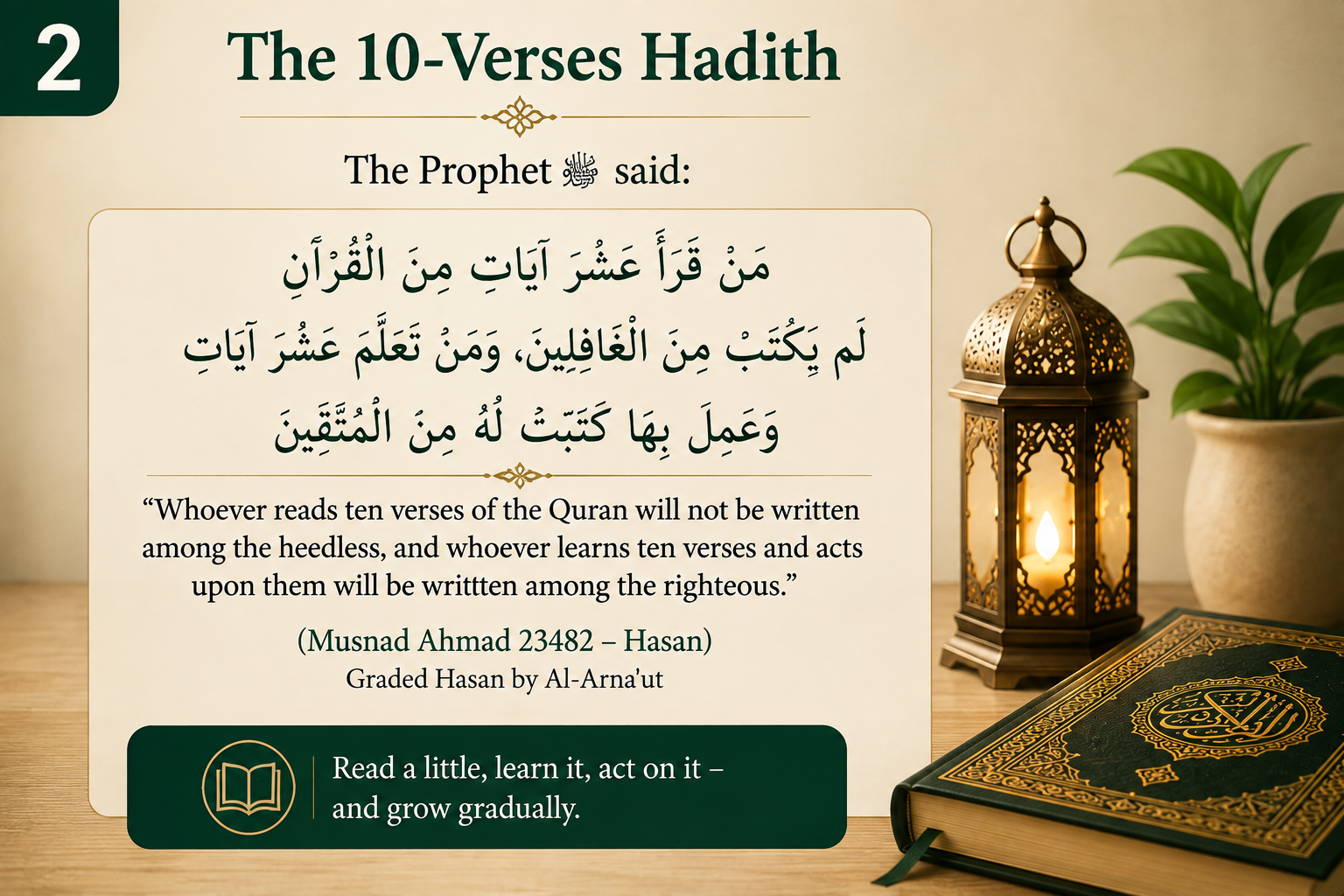
Yes — and there’s a well-known account from the early Muslim community that makes the point directly. Companions of the Prophet ﷺ are reported to have learned the Quran ten verses at a time, and would not move on until they understood the knowledge and actions those verses required. As they put it, they learned the Quran’s knowledge and its practice together, not one before the other (Musnad Ahmad 23482; graded Hasan by Al-Arna’ut).
That approach — small portions, real understanding, before moving forward — is exactly what this guide recommends for a beginner today. You don’t need years of Arabic study to start understanding the Quran. You need a reliable translation, a trustworthy explanation, and the patience to go slowly.
4. Translation vs Tafsir — What’s the Difference?
A translation gives you the closest equivalent of the Quran’s words in another language. A Tafsir goes further, explaining historical background, how scholars have understood a phrase, and what practical lesson is drawn from it.
Translation
A word-for-word or meaning-for-meaning rendering. Useful for a quick read, but can’t capture every layer of meaning in the original Arabic.
Tafsir
A scholarly explanation of a verse’s meaning and context, drawing on the Quran, Hadith, early generations’ understanding, and Arabic linguistics.
Beginners need both. A translation alone can occasionally mislead, since Arabic nuance doesn’t always survive translation. A Tafsir without the Quran’s own wording loses the direct connection to the text — read them side by side.
5. What Is Tafsir?
Tafsir (تفسير) means “explanation.” It’s a field of Islamic scholarship explaining the Quran’s meaning verse by verse, built through Qur’anic cross-references, Prophetic reports, early-generation explanations, and Arabic-language evidence — not one scholar’s unaided impression.
A well-known example shows this in practice. When a verse describing believers who “do not mix their belief with wrong” (Qur’an 6:82) was revealed, the companions grew worried, assuming “wrong” meant any sin.
The Prophet ﷺ clarified it meant something specific: shirk, associating others with Allah — pointing them to Luqman’s words elsewhere in the Quran, “joining others in worship with Allah is a great wrong” (Qur’an 31:13), as recorded in Sahih al-Bukhari 32. Quran, Sunnah, and cross-reference, working together.
Tafsir isn’t personal opinion of what a verse “feels like” it means. The strongest works are built on textual evidence and a documented chain of scholarly understanding — why a reputable, well-known Tafsir matters more than whichever explanation is easiest to find online.
6. Why Context Matters When Reading the Quran
The Quran was revealed gradually over roughly 23 years — a deliberate pace the Quran itself describes as suited to how it was meant to be received (Qur’an 17:106) — in response to real events, questions, and circumstances the early Muslim community faced. A verse read in isolation can sound different from the same verse read with its context — who it addressed, what situation prompted it, and what surrounding verses say.
One common beginner mistake is to read a verse in isolation and miss the surrounding context. The same verse can become much clearer once you consider the verses around it, the circumstances of revelation, and how a reliable Tafsir explains it — and a verse that seems obvious in translation can become much more nuanced this way. That’s not a flaw in the verse or in you; it’s simply how layered the text can be.
7. How to Choose a Reliable Quran Translation
Not all translations are equal — some prioritize literal accuracy, others readable modern English. A few widely used, well-regarded options: Saheeh International, “The Clear Quran” by Dr. Mustafa Khattab, and the older but still respected translations by Abdullah Yusuf Ali and Muhammad Asad — each with a different style, worth sampling before settling on one.
Look for: does the translator explain their methodology? Are footnotes provided for ambiguous phrases? Is it widely used and reviewed, rather than obscure? When in doubt, ask a local scholar or teacher which translation they’d recommend for your reading level.
8. How to Start Studying Tafsir
Don’t start with the most academically dense Tafsir available. Begin with a beginner-accessible one — something written in plain, modern language rather than dense classical Arabic scholarship — and read it alongside the verses, not as a separate book to finish later.
Pick a starting Surah
A short, well-known one — Al-Fatihah, or a short Makki Surah — rather than jumping into a long, legally dense Madani chapter.
Read the translation first
Get the surface meaning before adding layers of explanation.
Read the Tafsir for the same verses
Notice what it adds: context, clarified meaning, cross-references.
Summarize it in your own words
If you cannot explain the main point in your own words, it may be worth going back and reading the passage again.
9. How Hadith Helps Explain the Quran
The Prophet ﷺ is the Quran’s first and most authoritative interpreter — he lived it, applied it, and explained it to his companions in real situations. Authentic Hadith often preserve exactly this: what a verse meant in practice, why it was revealed, or how the Prophet ﷺ applied a general instruction to a specific case.
This is one reason Tafsir and Hadith study aren’t separate tracks — a good Tafsir is full of Hadith citations precisely because Hadith is one of its core sources. If you’re new to how Hadith itself is collected and graded for authenticity, our guide on what Hadith is and how it’s authenticated covers that groundwork.
10. Reflection vs Interpretation: Why Tafsir Isn’t a Solo Project
This isn’t a blanket rule against reflecting on the Quran yourself — Muslims are encouraged to do exactly that. The Quran repeatedly calls on readers to reflect (tadabbur) on its verses. That personal reflection — what a verse means for your own life — is different from producing a Tafsir: a scholarly account of what a verse establishes as its meaning.
The Quran describes some verses as clearly established (muhkamat) and others as less immediately clear (mutashabihat), cautioning that people “in whose hearts is deviation” chase the less clear ones looking for a particular conclusion rather than accepting what the verse establishes (Qur’an 3:7). Elsewhere it gives the remedy directly: ask people with knowledge if you don’t know (Qur’an 16:43). Neither verse puts reflection off-limits — both point toward checking your reading against people qualified to weigh it.
Tafsir has its own tools and standards, not just an opinion about a verse. Classical mufassirun built their explanations on a hierarchy of evidence: the Quran explaining itself, authentic Hadith, the transmitted understanding of the companions and the generation after them, and Arabic linguistic analysis.
Ibn Kathir states this method directly in his own introduction — Quran explained by Quran first, then Sunnah, then early-generation reports — weighing narration authenticity rather than repeating it uncritically (see the English translation of Tafsir Ibn Kathir and its methodology summary).
Al-Tabari’s Jami’ al-Bayan works differently: he gathers transmitted interpretations for a verse, then applies linguistic and contextual analysis to judge which reading the evidence best supports — weighing evidence (tarjih), not offering a personal impression (see the full translated Jami’ al-Bayan and this academic comparison of both methods).
This is also where tafsir bil-ra’y — interpretation leaning more on reasoning than transmitted material — becomes nuanced. It isn’t automatically illegitimate; reasoned interpretation grounded in Arabic language and consistency with the Quran and Sunnah has always had a role. What’s cautioned against is interpretation untethered from that groundwork — a personal conclusion presented as an established meaning.
For a beginner: reflecting on what a verse means to you is welcomed. But for what a verse actually establishes, lean on recognized Tafsir built on this sourced methodology, not a first impression.
11. Makki and Madani Verses
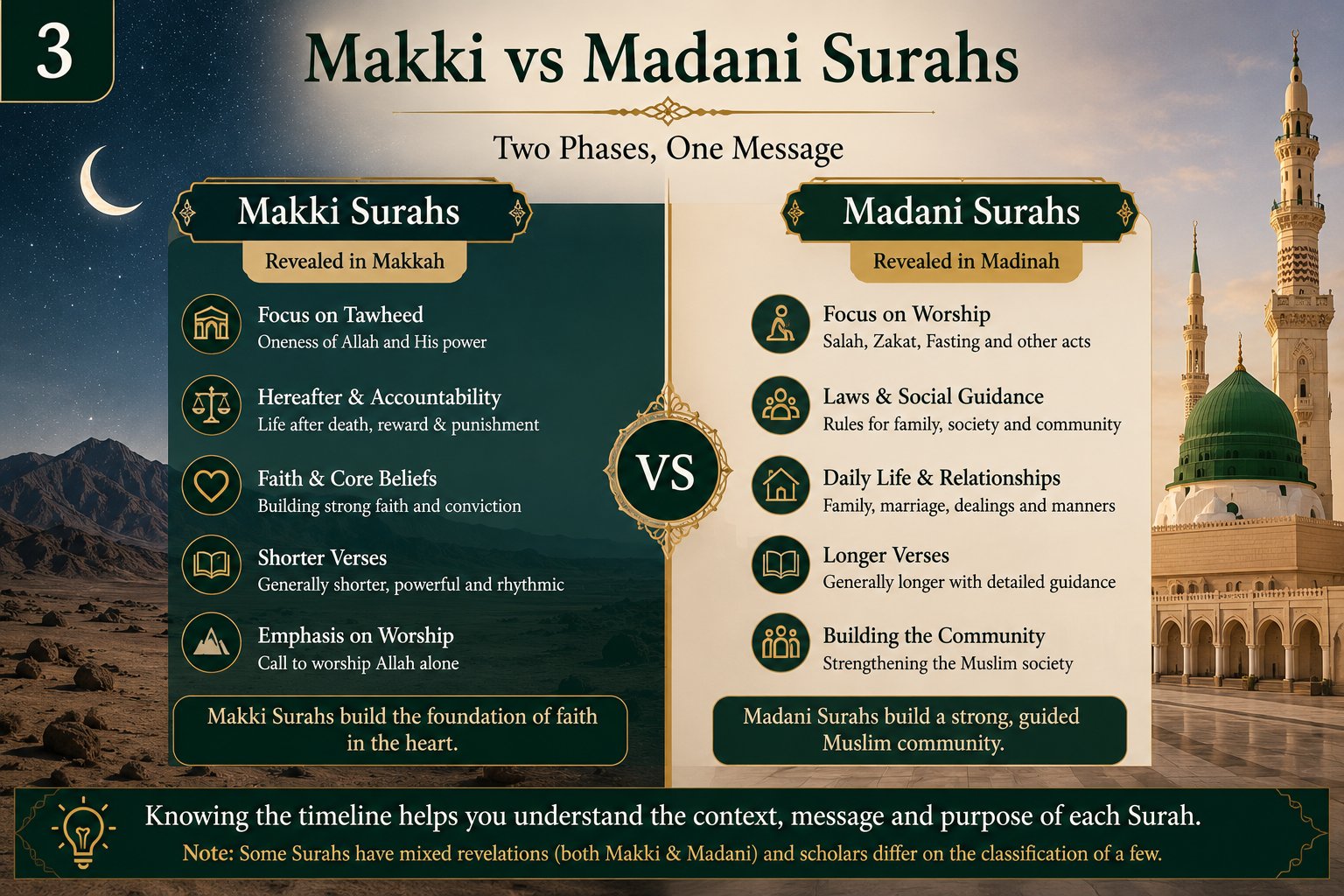
Chapters of the Quran are classified as either Makki (revealed before the Prophet’s ﷺ migration to Madinah) or Madani (revealed after). This isn’t just trivia — it changes what to expect from a chapter’s content and tone.
Makki Surahs
Often emphasize tawhid, the Hereafter, faith, and moral accountability, and the call to worship Allah, often with a powerful and rhythmic style. Commonly cited as around 86 of the Quran’s 114 chapters.
Madani Surahs
Often give more attention to worship, family and social life, law, community relations, and matters arising in the developing Muslim community in Madinah.
These are broad tendencies, not absolute rules, and scholars differ over the classification of some Surahs and verses. Knowing whether a chapter is generally Makki or Madani still helps explain why its tone and subject matter differ from another chapter — it’s context at the chapter level, before you even get to individual verses.
12. Understanding the Occasion and Context of Revelation
Beyond Makki/Madani classification, many individual verses have a documented “occasion of revelation” (asbab al-nuzul) — a specific event, question, or incident that prompted that verse. Classical scholars compiled entire books cataloguing these occasions. Knowing the occasion of revelation can clarify what a verse was addressing and help prevent a misleading reading. It doesn’t necessarily mean that a verse’s broader wording applies only to that original event — scholars of Tafsir have long distinguished between the specific incident that prompted a verse and the general principle its wording establishes.
A good Tafsir will note the occasion of revelation where one is documented — and will also tell you honestly when a verse has no specific occasion attached, since not every verse does. Don’t take a dramatic backstory for a verse at face value unless it’s actually cited to a real source.
13. How to Study One Surah Step by Step
Read it in Arabic (even slowly)
Keeps you connected to the text, even while leaning on translation for meaning.
Read a reliable translation
Get the surface meaning of the whole Surah in one pass.
Check Makki or Madani, and roughly when it was revealed
This sets the context before digging into individual verses.
Go through it in small sections with Tafsir
Five to ten verses at a time — echoing the reported practice of learning ten verses before moving on.
Identify the Surah’s central theme
Many Surahs have recurring themes that help a beginner see how their verses fit together.
Write down one thing to apply
Understanding that changes nothing practical tends to fade quickly.
14. A 15-Minute Daily Quran Study Routine
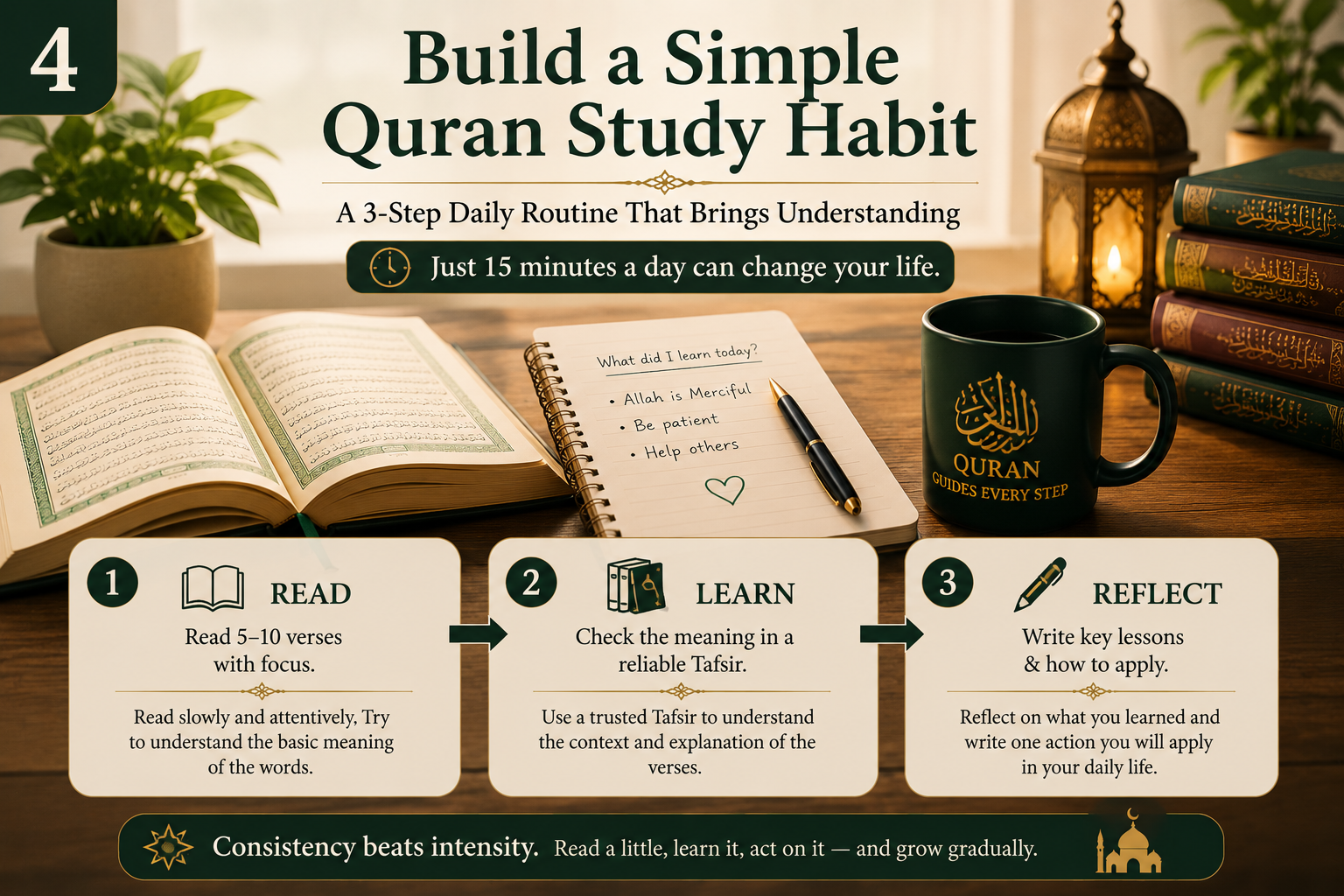
Consistency beats intensity. A short daily habit teaches you more over a year than an ambitious plan abandoned after a week. Here’s a simple 15-minute structure:
Minutes 1–5
Read 3–5 verses in Arabic, then read the translation slowly.
Minutes 5–12
Read the Tafsir for those same verses. Note the context and main point.
Minutes 12–15
Write one sentence: what this passage means, and one way it applies to your day.
If this is your first time studying the Seerah or Tafsir, don’t worry about covering a whole Surah quickly — a few verses done properly, most days of the week, adds up faster than it feels like it will.
15. How to Take Notes While Studying the Quran
Notes don’t need to be elaborate. A simple notebook or app with four fields works well: the verse reference, the surface meaning in your own words, the context (if documented), and one personal takeaway. Over months, this becomes a reference you’ll actually use — unlike highlighting a book you never reopen.
Some students also log recurring Quranic themes (patience, gratitude, justice, accountability) and which verses touch on each — useful later for studying a topic rather than a single Surah.
16. Common Mistakes Beginners Make
Maybe you’ve already watched two or three videos explaining the same verse and somehow ended up more confused. That’s usually a sign to slow down and return to a reliable Tafsir rather than keep adding more opinions.
Reading a verse in isolation
Skipping the surrounding verses and occasion of revelation, drawing a conclusion the fuller context wouldn’t support.
Relying on one unreviewed source
Taking a single online post or video’s interpretation as settled, without checking a recognized Tafsir.
Trying to cover too much, too fast
A full Juz a day with real understanding usually isn’t sustainable — it turns into skimming.
Treating translation as the final word
Forgetting translation is one layer, and nuance can be lost without a Tafsir to fill the gap.
Skipping application
Understanding a verse intellectually but never asking what it actually asks of you.
Avoiding difficult verses entirely
Skipping anything that raises a hard question, rather than seeing how scholars have addressed it.
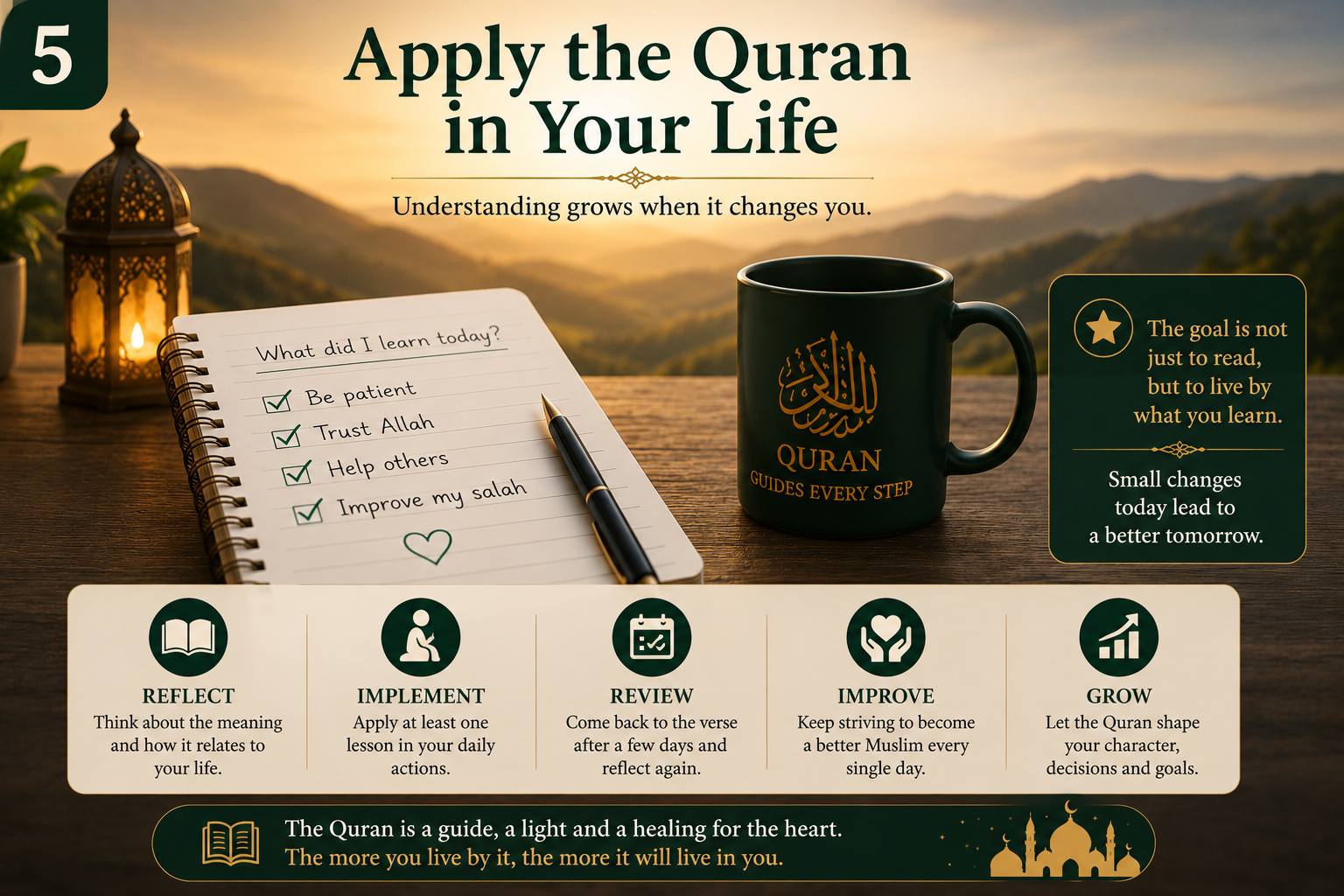
17. How to Apply Quranic Lessons to Daily Life
You read a verse, understand the translation, maybe even the Tafsir — and then a question comes to mind: does this actually apply to my situation today? That question is the whole point. The companions’ method — learning knowledge and action together — is the model here too.
After studying a passage, ask a concrete question: what does this actually change about how I speak, spend, treat people, or make decisions this week? A verse about patience isn’t fully understood until it’s tested against an actual frustrating moment; a verse about honesty isn’t fully understood until it’s tested against an actual temptation to shade the truth.
This is also where the daily notes from Section 15 pay off — reviewing them periodically turns scattered insights into a pattern you can actually notice in your own behavior over time.
18. How to Deal With Difficult Verses
Some verses raise real questions — about hardship, passages whose meaning has never been settled with certainty (mutashabihat), or wording that’s hard to parse without more context. That’s a normal part of studying scripture seriously, not a sign something’s wrong with you or the text.
Classical scholarship doesn’t approach a hard verse by guessing — it follows a sequence of evidence, and a beginner can follow the same sequence at a smaller scale:
Read the immediate context
The surrounding verses often change what a phrase is actually addressing.
Check related verses elsewhere
The Quran frequently clarifies itself — a general statement is often qualified elsewhere, the method Ibn Kathir leads with.
Check what authentic Sunnah says
The Prophet ﷺ personally clarified confusing verses for his companions — see the “wrongdoing” example in Section 5.
Check the linguistic and historical context
Arabic words carry meanings that don’t map cleanly onto translation — exactly what a good Tafsir supplies.
Check what established Tafsir concludes
A recognized work that shows its sourcing, not a blog post or video.
Note honestly if scholars have disagreed
Naming a real disagreement — and the reasoning behind each side — is more honest than presenting one view as the only one.
Don’t force a conclusion
If the meaning is still genuinely unclear, that’s fine — better an open question than a manufactured answer.
None of this is replaced by a personal impression offered as though it settled the matter. “I think this verse means…” is a fine starting point for reflection; it isn’t a stand-in for what sourced scholarship has actually shown a verse to establish. Where a passage is genuinely beyond what you can work through yourself, ask a knowledgeable teacher directly.
19. Recommended Beginner-Friendly Resources
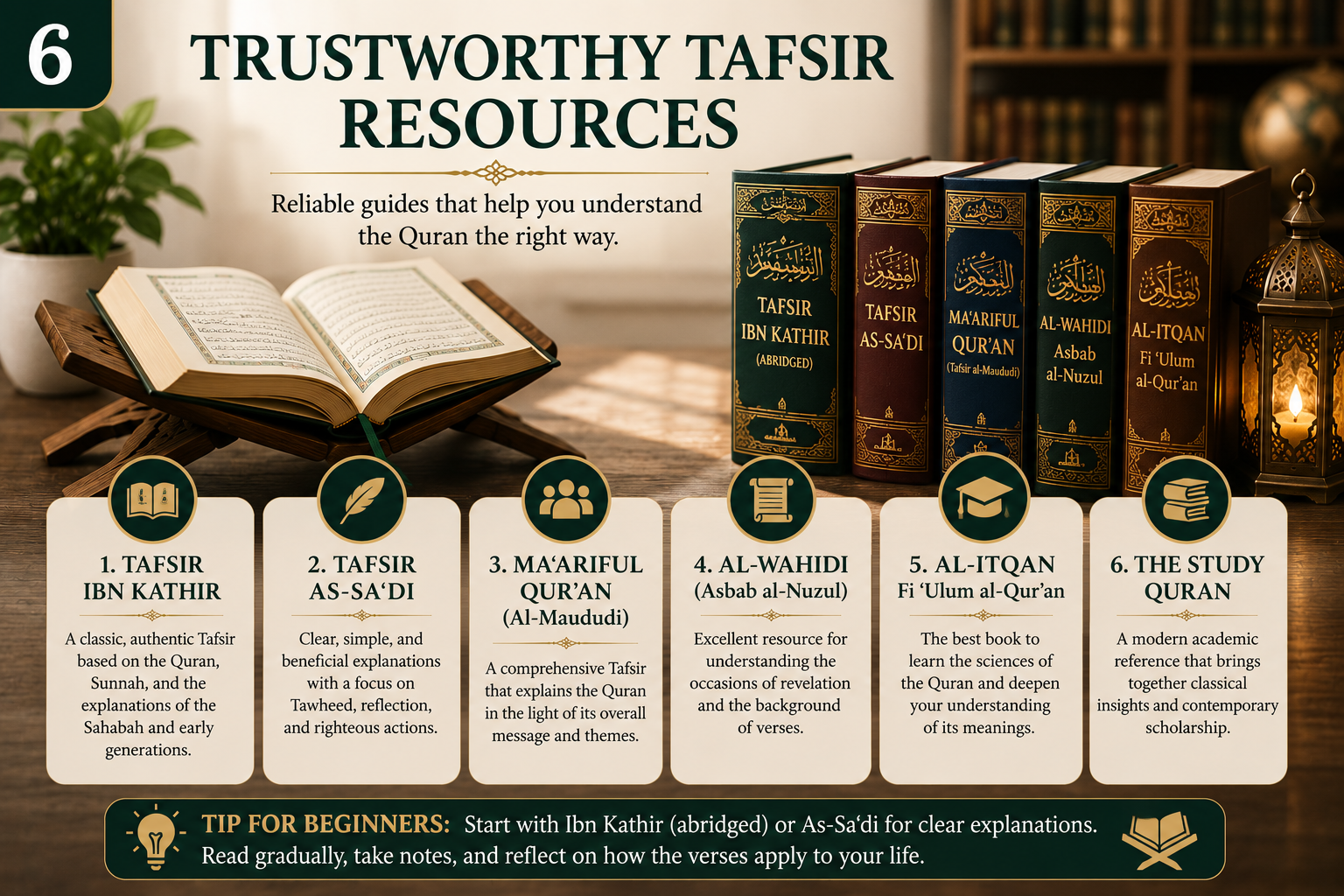
Tafsir Ibn Kathir (abridged)
One of the most widely used classical Tafsir works, available in an accessible abridged English translation.
Tafsir As-Sa’di
Known for clear, direct modern language — often recommended as a first Tafsir for beginners.
Ma’ariful Qur’an
A widely used Tafsir by Mufti Muhammad Shafi, especially popular among South Asian readers, with practical explanations.
The Study Quran (HarperOne)
A modern academic English translation and commentary drawing on classical Tafsir, useful as a single reference volume.
Whichever resource you start with, the same rule applies: check that it’s well-established and widely used by other students of the Quran, not just the first result a search engine happens to surface.
Frequently Asked Questions
Quick, direct answers to the questions beginners ask most often about understanding the Quran.
What’s the best way to start learning how to understand the Quran?
Pair a reliable translation with a trustworthy Tafsir, study a few verses at a time with their context, and build a short daily habit rather than trying to cover everything at once.
Do I need to know Arabic to understand the Quran?
No. You can begin through a reliable translation and trustworthy Tafsir, even without Arabic. Learning Arabic can deepen your engagement with the original text.
What’s the difference between translation and Tafsir?
Translation renders the Arabic into another language; Tafsir explains the meaning, context, and implications using the Quran, Hadith, and scholarly analysis.
Which Tafsir should a beginner start with?
An accessible, widely used one in plain language — Tafsir As-Sa’di or the abridged Tafsir Ibn Kathir are common starting points.
How much should I study per day as a beginner?
A short, consistent habit — around 15 minutes covering a few verses — beats occasional long sessions.
What are Makki and Madani verses?
Makki verses were revealed before the migration to Madinah and focus on core belief; Madani verses were revealed after and address community life.
Can I interpret Quranic verses on my own?
You can and should reflect on what a verse means for you — that’s encouraged. For the formal meaning it establishes, especially on rulings, lean on recognized Tafsir rather than a personal impression.
Why does context matter when reading the Quran?
Many verses respond to specific events; reading them without that context can lead to conclusions the fuller picture wouldn’t support.
What should I do about verses I find difficult to understand?
Check a reputable Tafsir, look at the context and occasion of revelation, and ask a knowledgeable teacher if the question remains unresolved.
May Allah make the Quran a source of guidance, understanding, and light for every reader who sincerely seeks it.
Editorial & Source Note
This guide draws on the Quran itself, authentic Hadith, and recognized classical and modern Tafsir works — full references below. It’s written for beginners and doesn’t substitute for study with a qualified teacher, especially for rulings or genuinely difficult passages.
- This is educational content, not a fatwa or substitute for scholarly guidance.
- Last reviewed: August 17, 2026.
References & Further Reading
Qur’an References
- Qur’an 47:24 — “do they not reflect upon the Qur’an?”
- Qur’an 38:29 — a Book revealed for reflection.
- Qur’an 3:7 — clear (muhkamat) vs ambiguous (mutashabihat) verses.
- Qur’an 16:43 — “ask the people of knowledge if you do not know.”
- Qur’an 17:106 — the Quran revealed gradually.
- Qur’an 6:82 and 31:13 — the “wrongdoing means shirk” example in Section 5.
Hadith References
- Musnad Ahmad 23482 (Hasan) — companions learning ten verses at a time.
- Sahih al-Bukhari 32 — the Prophet ﷺ clarifying “wrongdoing” means shirk; the Section 5 example.
Classical & Recommended Tafsir
- Ibn Kathir, Tafsir al-Qur’an al-‘Azim — abridged English edition; his method (Qur’an, Sunnah, early reports) is the basis for Section 10 — see this summary.
- Al-Tabari, Jami’ al-Bayan — fully translated here; weighs interpretations via linguistic analysis (tarjih) — see this comparison of both methods.
- Abd al-Rahman as-Sa’di, Taysir al-Karim al-Rahman — plain, direct language.
- Mufti Muhammad Shafi, Ma’ariful Qur’an — a widely used practical Tafsir.
- Seyyed Hossein Nasr (ed.), The Study Quran — academic translation and commentary.
- Al-Wahidi, Asbab al-Nuzul — the classical reference on occasions of revelation.
- As-Suyuti, Al-Itqan fi ‘Ulum al-Qur’an — classical reference, including Makki/Madani classification.
This guide describes general study methods and widely accepted classifications — not a substitute for a qualified teacher on rulings or disputed interpretation.
Related IslamicEduHub Guides
Unpublished guides above stay as plain text to avoid 404s — linked once live.
Pingback: - IslamicEduHub