
The Life of Prophet Muhammad ﷺ: A Beginner’s Seerah Guide
A clear, chronological introduction to the Seerah — from his early years in Makkah and the first revelation in the Cave of Hira, through the Hijrah, the Madinan period, his character, and his lasting legacy — with sources and honest notes on what is well-established versus disputed.
Home › Islamic History › The Life of Prophet Muhammad ﷺ
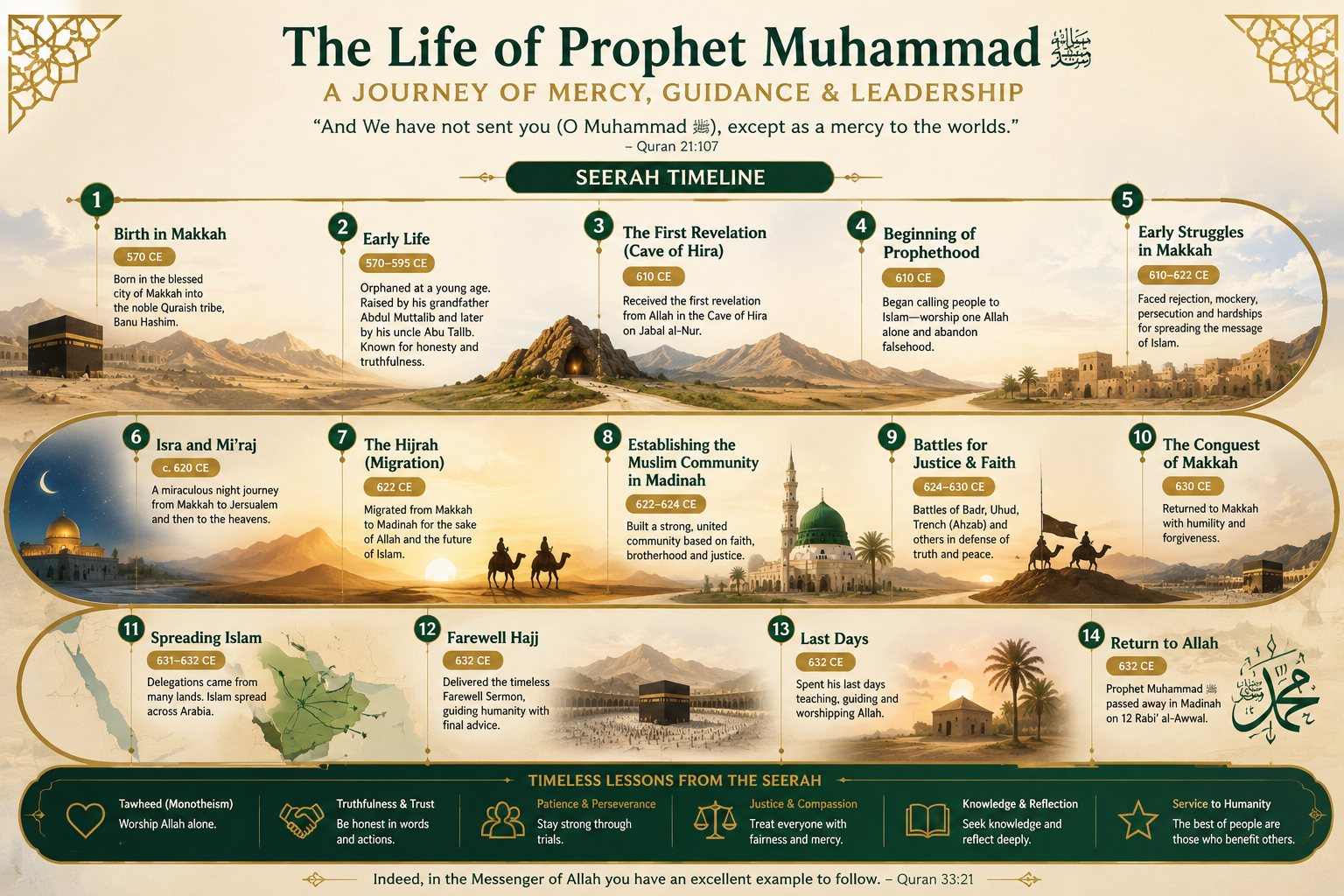
Prophet Muhammad ﷺ was born in Makkah around 570 CE, received the first revelation of the Qur’an at around age 40 in the Cave of Hira, and spent roughly 23 years conveying Islam — first to a small, persecuted community in Makkah, then, after the Hijrah to Madinah in 622 CE, building the first Muslim community there. He passed away in Madinah in 632 CE, leaving behind the Qur’an, his own example (the Sunnah), and a global faith community.
In This Guide
- 1. Who Was Prophet Muhammad ﷺ?
- 2. Prophet Muhammad’s Early Life
- 3. Prophet Muhammad ﷺ Before Prophethood
- 4. The First Revelation
- 5. The Early Years of Prophethood in Makkah
- 6. The Makkan Period
- 7. The Hijrah to Madinah
- 8. Prophet Muhammad ﷺ in Madinah
- 9. Major Events in the Madinan Period
- 10. The Character of Prophet Muhammad ﷺ
- 11. What Can Muslims Learn From His Life?
- 12. The Final Years of Prophet Muhammad ﷺ
- 13. Why Is the Seerah Important for Muslims?
- 14. How to Study the Seerah Responsibly
- 15. Frequently Asked Questions
- 16. Final Thoughts
- 17. References & Further Reading
Who was Prophet Muhammad ﷺ, and why does his life matter to Muslims today, fourteen centuries later? His biography — the Seerah — isn’t studied the way most people study history. Muslims read it to understand how to live: how to be patient when things fall apart, how to stay honest when it costs you something, how to lead without becoming arrogant, and how to worship without losing touch with ordinary life.
This guide walks through his life roughly in order — birth and early years in Makkah, the first revelation in the Cave of Hira, the difficult Makkan period, the Hijrah to Madinah, the major events of his later life, his character, and what Muslims take from it today. Where a detail is well-documented in the Qur’an or authentic Hadith, that’s noted; where something is less certain, that’s noted too.
1. Who Was Prophet Muhammad ﷺ?
Muhammad ibn Abdullah ﷺ was born in Makkah, in the Arabian Peninsula, into the Quraysh tribe — specifically the clan of Banu Hashim, a respected but not the wealthiest clan by the time of his birth. Makkah was a trading hub built around the Kaaba, a structure Muslims believe was originally built for the worship of one God, though by the sixth century it had become a center of idol worship.
Muslims believe Muhammad ﷺ is the final prophet in a line that includes Ibrahim (Abraham), Musa (Moses), and Isa (Jesus), peace be upon them all — sent to call people back to the worship of one God and deliver the Qur’an, which Muslims hold to be the literal, unaltered word of God.
Muslims study his Seerah for a reason that goes beyond curiosity about the past: the Qur’an itself instructs believers to look at his life as a model of conduct, not just a historical record.
“There has certainly been for you in the Messenger of Allah an excellent pattern for anyone whose hope is in Allah and the Last Day and who remembers Allah often.”
2. Prophet Muhammad’s Early Life
Birth and Family
Prophet Muhammad ﷺ was born in Makkah around 570 CE — a year Islamic tradition calls the “Year of the Elephant,” referencing an event described in Surah Al-Fil. His father, Abdullah, died before he was born, on a trading journey, so he entered the world already an orphan.
Childhood in Makkah
Following an Arabian custom of the time, infants from Makkah’s noble families were often sent to be nursed among Bedouin tribes in the desert, thought to build stronger health and better Arabic speech. He was nursed by Halimah al-Sa’diyyah of the Banu Sa’d tribe and spent his earliest years with her family before returning to his mother.
His Mother and Early Childhood
His mother, Aminah, raised him after his return, but she too passed away when he was only around six, during a journey back from visiting relatives in Madinah. By this point, he had lost both parents before reaching the age of seven.
His Grandfather and Uncle
After his mother’s death, his grandfather, Abd al-Muttalib — a respected Quraysh leader and custodian of the Kaaba — took him in. When his grandfather died roughly two years later, guardianship passed to his uncle, Abu Talib, who raised him as his own son and remained a protector throughout much of Muhammad’s ﷺ life, even after Abu Talib himself did not accept Islam.
His Reputation for Honesty
Long before revelation, Muhammad ﷺ was known across Makkah for his honesty — so much so that people called him Al-Amin, “the trustworthy one,” and entrusted him with valuables and business dealings. His reputation was so strong that even some opponents of his later message continued to trust him personally to hold their property safe.
3. Prophet Muhammad ﷺ Before Prophethood
His Work and Character
As a young man, he worked in trade, travelling with merchant caravans, including journeys to Syria. The same reputation for honesty that earned him the title Al-Amin is described in the Seerah as part of why people sought him out for business — in a city where reputation was currency in its own right.
Marriage to Khadijah رضي الله عنها
Khadijah bint Khuwaylid was a successful, respected businesswoman in Makkah. According to the classical Seerah accounts, she was impressed by his honesty and skill after he managed a trading venture for her, and it was she who proposed marriage. He was around 25 at the time, with Khadijah somewhat older — her age is often cited as around 40, though that figure comes from later sources and is best read as a repeated estimate rather than a settled fact.
Their marriage lasted around 25 years, until her death, and was a partnership marked by deep mutual respect. She was also the first person to accept his message once revelation began.
Life in Makkah Before Revelation
In the years before revelation, he lived a settled, respected life — married, a father, known for good character, largely uninvolved in the idol worship and social ills around him. He also spent increasing amounts of time in quiet reflection, withdrawing from the city’s noise.
His Time in the Cave of Hira
In the years leading up to revelation, he developed a habit of retreating to a small cave on Jabal al-Nur (“the Mountain of Light”), just outside Makkah, known as the Cave of Hira. There he would spend extended periods in solitude and reflection, away from Makkah’s idol worship and social conflicts. It was in this cave, during Ramadan, that the first revelation came to him.
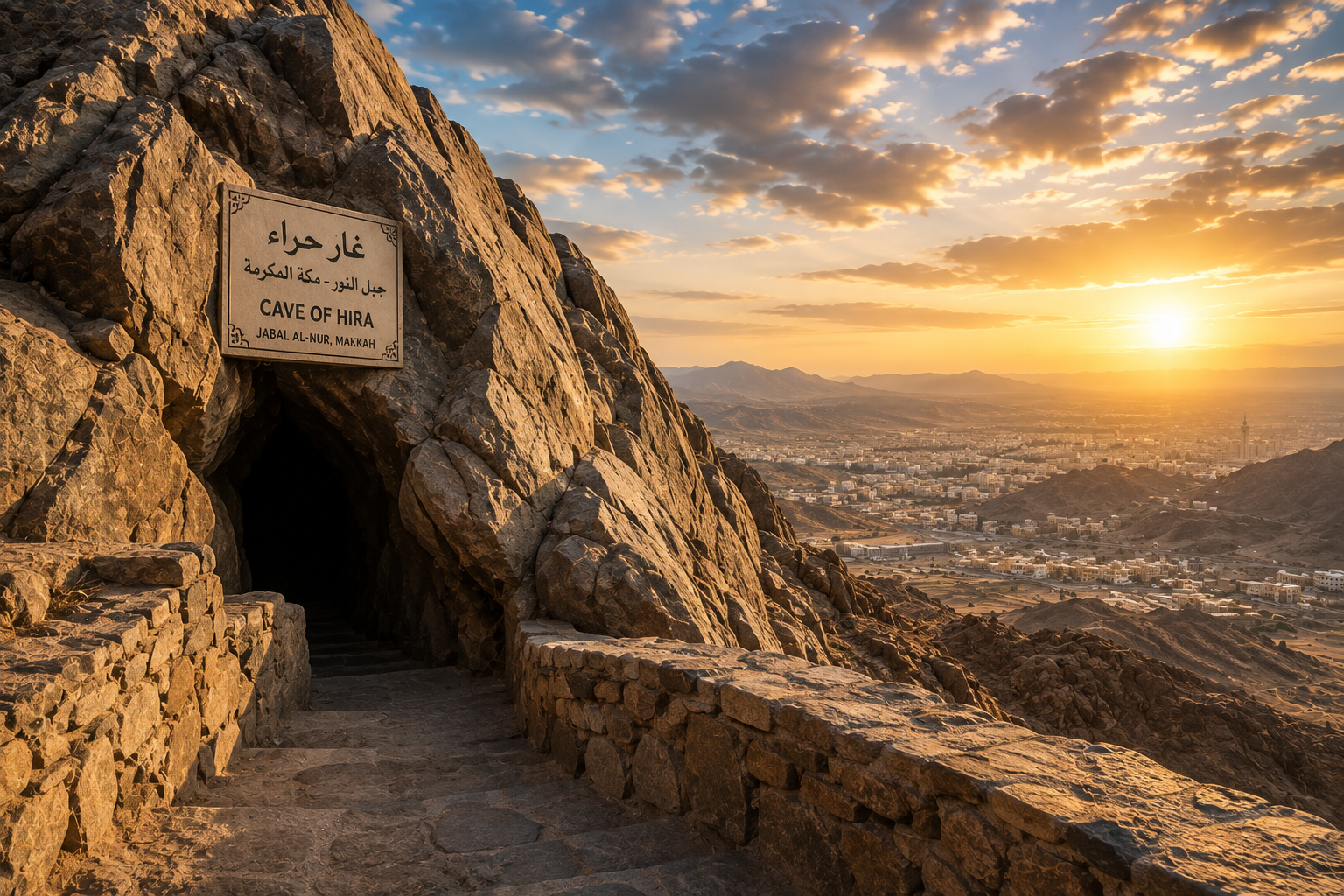
4. The First Revelation
What Happened in the Cave of Hira?
According to the account preserved in Sahih al-Bukhari, the angel Jibreel (Gabriel) came to Muhammad ﷺ in the Cave of Hira and commanded him, “Read” (Iqra). He was not a person known to read or write, and replied that he could not read. The angel embraced him tightly and repeated the command three times, before delivering the first verses of what would become the Qur’an.
The First Revelation
“Read in the name of your Lord who created — created man from a clinging substance. Read, and your Lord is the most Generous — who taught by the pen — taught man that which he knew not.”
These verses, from what is now Surah Al-Alaq, are the earliest revealed part of the Qur’an.
The Beginning of Prophethood
He returned home shaken and afraid, uncertain what had just happened to him. The detailed narration in Sahih al-Bukhari describes him trembling and asking to be wrapped in a blanket, saying he feared for himself.
The Pause, and the Second Revelation
Traditional accounts describe a pause in revelation after this first experience — a period referred to as fatrat al-wahy. According to a separate narration in Sahih al-Bukhari, revelation resumed when he again saw the angel he had seen at Hira, which prompted the revelation of the opening verses of Surah Al-Muddaththir (“O you who is covered”). This second revelation marks the point his mission shifted from private experience to a public commission to warn and call people to Islam, after which revelation continued more regularly.
Khadijah’s Support
Khadijah رضي الله عنها comforted him and, in the account preserved in Bukhari, reassured him: Allah would not disgrace him, because he maintained family ties, spoke truthfully, helped the poor and needy, and supported the causes of righteousness.
She then took him to her cousin Waraqah ibn Nawfal, an elderly man familiar with earlier scriptures. Waraqah recognized the experience as the same kind of revelation received by earlier prophets, and told him his people would oppose and expel him because of it.
5. The Early Years of Prophethood in Makkah
The Call to Islam
After a pause, revelation resumed and Muhammad ﷺ began inviting people to Islam quietly at first, largely among family and close friends, before eventually calling more openly and publicly.
Early Muslims
Khadijah رضي الله عنها was the first to accept his message, followed by his close friend Abu Bakr, his young cousin Ali, and his freed servant Zayd ibn Harithah. From there, the community grew slowly, drawing people from across Makkah’s social classes — including many who were poor or enslaved and took real personal risk in accepting the message.
First Opposition
As the message became public and challenged the idol worship central to Makkah’s religious and economic life, Quraysh’s leadership began to push back — mockery and social pressure at first, since Muhammad’s ﷺ own reputation made him hard to dismiss outright.
Persecution of Muslims
Early Muslims, particularly those without powerful clan protection, faced real physical persecution — beatings, torture, and economic boycott. Some of the earliest and most painful accounts describe enslaved converts being tortured for their faith, tests of endurance still remembered and taught today.
Patience and Perseverance
Throughout this period, Muhammad ﷺ counseled patience rather than retaliation, continuing to preach despite the hardship — one of the most frequently cited lessons drawn from the early Seerah.
6. The Makkan Period
As the Muslim community grew, so did Quraysh’s opposition — including pressure on Abu Talib to withdraw his protection of his nephew, which he resisted for years. The events below trace how that pressure escalated.
Migration to Abyssinia
To protect vulnerable early Muslims from worsening persecution, Muhammad ﷺ advised them to migrate to Abyssinia (modern-day Ethiopia), ruled by a Christian king, the Negus, known for his justice. This migration — sometimes called the “first Hijrah” — offered them safety under his protection.
The Boycott
At one point, Quraysh imposed a broad social and economic boycott on Muhammad’s ﷺ clan, Banu Hashim, cutting off trade and marriage ties to force them to abandon their protection of him. It lasted several difficult years before eventually collapsing.
The Year of Sorrow
Around 619 CE, within a short span of time, Muhammad ﷺ lost both his wife Khadijah — his closest companion for 25 years — and his uncle and protector Abu Talib. Islamic tradition remembers this period as Aam al-Huzn, the Year of Sorrow, and it’s easy to see why: he lost his emotional anchor and his political shield within months of each other, at a time when opposition was already severe.
Ta’if
Seeking support elsewhere, Muhammad ﷺ travelled to the nearby city of Ta’if, where he was rejected and, as the sources describe, physically attacked by a hostile crowd. The journey to Ta’if was one of the most painful episodes of his life.
Yet his response is one of the most moving parts of the Seerah: according to the narration recorded in both Sahih al-Bukhari and Sahih Muslim, when offered the chance to have the city destroyed, he prayed for its people’s future guidance instead.
Isra and Mi’raj
Islamic tradition holds that, during this difficult period, Muhammad ﷺ experienced the Isra and Mi’raj — a night journey from Makkah to Jerusalem, followed by an ascension through the heavens, referenced in the Qur’an’s opening verse of Surah Al-Isra and understood by Muslims as a profound, faith-strengthening experience during an otherwise bleak period.
7. The Hijrah to Madinah
Why Did the Muslims Leave Makkah?
With persecution intensifying, a turning point came when a group from Yathrib (soon renamed Madinah) invited Muhammad ﷺ to their city, both to mediate between its feuding tribes and to be accepted as a prophet and leader. This invitation, formalized through the Pledges of Aqabah, opened the door to migration.
The Journey to Madinah
In 622 CE, Muslims began migrating from Makkah to Madinah in small groups to avoid attention. Muhammad ﷺ left later, accompanied by Abu Bakr, reportedly hiding for a time in the Cave of Thawr while Quraysh searched for them. This migration — the Hijrah — later marks the starting point of the Islamic (Hijri) calendar.
The Beginning of the Madinan Community
Arriving in Madinah marked a major shift: for the first time, Muslims had a place to live openly and organize as a community, rather than surviving under persecution. The Hijrah is widely treated as the dividing line between the Makkan period — faith, patience, endurance — and the Madinan period, focused on building a functioning community.
8. Prophet Muhammad ﷺ in Madinah
Building the Muslim Community
In Madinah, Muhammad ﷺ took on a role beyond preaching: civic and spiritual leader of a growing, diverse community, responsible for its organization, defense, and internal disputes.
The Mosque
One of his first acts was establishing a mosque — a simple structure that served as a place of worship, a community center, a place for teaching, and effectively a seat of governance.
Brotherhood
Muhammad ﷺ formally paired Makkan migrants (the Muhajirun) with Madinan hosts (the Ansar) in bonds of brotherhood. Many migrants had arrived with nothing more than what they could carry — this system meant they didn’t have to rebuild alone.
Relations With Other Communities
Madinah was religiously mixed, home to several Jewish tribes alongside the Muslim newcomers and existing Arab tribes. Muhammad ﷺ established what is often called the Constitution of Madinah, an agreement setting out mutual rights and responsibilities between these groups, intended to make Madinah a shared, cooperatively defended city.
Leadership and Justice
As Madinah’s leader, Muhammad ﷺ was known to be personally accessible — settling disputes directly, treating people according to the same standards regardless of status, and famously stating that even if his own daughter were to steal, he would apply justice equally.
9. Major Events in the Madinan Period
It’s tempting to skim this period as a list of battles. But each of these events had its own specific cause and outcome within an ongoing conflict with Makkah — not a standalone spectacle — and the Muslims’ conduct within each one is often what Muslims remember most, more than who won or lost. If this is your first time studying the Seerah, don’t worry about memorizing every date — start with what changed at each turning point.
-
Battle of Badr (624 CE)
A heavily outnumbered Muslim force defeated a larger Quraysh army — a pivotal early victory that gave the young Madinan community credibility and confidence.
-
Battle of Uhud (625 CE)
A costly battle in which early gains were reversed after a group of archers left their position, leading to significant Muslim casualties — often taught as a lesson in discipline.
-
Battle of the Trench (627 CE)
Facing a large coalition army, the Muslims dug a defensive trench around exposed parts of Madinah — reportedly suggested by the Companion Salman al-Farisi — successfully preventing the siege.
-
Treaty of Hudaybiyyah (628 CE)
A ten-year peace treaty with Quraysh that, despite seeming unfavorable on paper, is widely regarded as a major strategic success — it created stability that let Islam spread more widely.
-
The Conquest of Makkah (630 CE)
After Quraysh violated the Hudaybiyyah treaty, Muhammad ﷺ marched on Makkah with a large following. The city fell with minimal bloodshed, and he issued a general amnesty to those who had persecuted the Muslims for years — a defining example of his mercy.
-
The Farewell Pilgrimage (632 CE)
Muhammad’s ﷺ only complete Hajj after the Hijrah, and the occasion of his Farewell Sermon.
10. The Character of Prophet Muhammad ﷺ
Much of what Muslims draw from his life comes not from major historical events but from his everyday character, documented extensively in the Qur’an and authentic Hadith.
Mercy
Repeatedly shown toward enemies, the poor, children, and even animals — the amnesty at the conquest of Makkah is one of the clearest examples.
Honesty
The trait he was known for since childhood, maintained consistently even in the accounts of religious opponents.
Patience
Demonstrated through years of persecution in Makkah, personal loss, and the setbacks of the Madinan period.
Forgiveness
Extended to people who had directly wronged him, most visibly after the conquest of Makkah.
Justice
Applied evenly regardless of a person’s status, wealth, or relationship to him personally.
Humility
He mended his own clothes, did household chores, and discouraged excessive reverence toward himself.
Treatment of Family and Companions
Companions consistently described him as warm, approachable, and attentive in personal relationships — playful with children, affectionate with his family, and quick to check on the wellbeing of people around him, including those with far lower social status than his own.
11. What Can Muslims Learn From His Life?
Patience During Hardship
The Makkan period shows that enduring difficulty without abandoning one’s principles is itself a form of strength.
Trust in Allah
Repeatedly modeled during moments of real uncertainty, from the Cave of Thawr during the Hijrah to the Battle of the Trench.
Mercy Toward Others
Especially toward people who have wronged you — the conquest of Makkah remains the clearest single example.
Keeping Promises
Reflected in his adherence to agreements like the Constitution of Madinah and the Treaty of Hudaybiyyah, even when the terms were difficult.
Leadership With Responsibility
He treated leadership as accountability to his community, not privilege over it.
Balancing Worship and Daily Life
He worked, traded, married, raised a family, and led a state — worship was woven through ordinary life, not separate from it.
12. The Final Years of Prophet Muhammad ﷺ
By 630 CE, Makkah — the city that had once forced him into exile — had come under Muslim control, as covered in the timeline above. The years that followed brought his final pilgrimage, his passing, and the legacy he left behind.
The Farewell Pilgrimage and Sermon
In 632 CE, he performed his only Hajj after the Hijrah, attended by a very large number of Muslims — what’s now known as the Farewell Pilgrimage. During it, he delivered his Farewell Sermon, addressing the sanctity of life and property, the equal worth of people regardless of ethnicity, the rights of women, the prohibition of usury, and the importance of holding firmly to the Qur’an — a speech often summarized as his core message.
His Passing
He fell ill shortly after returning to Madinah from that pilgrimage and passed away there in 632 CE, in the room of his wife Aisha رضي الله عنها, adjoining the mosque he had built with his own hands years earlier.
His Legacy
He left behind the Qur’an, preserved as revealed; his own example, the Sunnah, preserved through the Companions who transmitted what they had seen and heard; and a community that, within a remarkably short time, had spread across and beyond the Arabian Peninsula.
13. Why Is the Seerah Important for Muslims?
Beyond personal lessons, the Seerah plays a structural role in Islamic learning — it’s the thread that ties several other fields together:
- Context for the Sunnah: it supplies the setting behind many individual Hadith, explaining who said what, when, and why.
- Context for the Qur’an: a significant share of the Qur’an’s verses were revealed in response to specific events in his life — without the Seerah, those verses can read as abstract.
- Context for Islamic law: Seerah chronology can help scholars understand when certain rulings, practices, and events occurred.
- A check on later claims: knowing the documented timeline makes it easier to recognize when a popular story doesn’t line up with the historical record.
14. How to Study the Seerah Responsibly
If you’re new to the Seerah, one of the most useful habits you can build is asking a simple question whenever a story sounds a little too neat: where did this come from? A few habits make that easier.
Start With Authentic Sources
Begin with the Qur’an itself and authentically graded Hadith collections like Sahih al-Bukhari and Sahih Muslim, rather than secondhand retellings of unclear origin. Our guide on what Hadith is and how it’s authenticated covers that groundwork.
Distinguish Qur’an From Hadith and Later Reports
Not every detail commonly repeated about the Seerah carries the same level of certainty. The Qur’an’s wording is preserved exactly; authentic Hadith are individually graded; and later biographical compilations sometimes include material with weaker or unclear chains of transmission.
Check Historical Claims
Specific numbers, exact dates, detailed dialogue, and dramatic embellishments are worth double-checking against a reliable source before repeating them as settled fact — especially for battles, miracles, or childhood stories that sometimes get exaggerated in popular retellings.
Don’t Share Viral Stories Without Verification
The same caution that applies to viral “the Prophet ﷺ said” quotations applies here too: an inspiring-sounding Seerah story circulating online isn’t automatically accurate just because it’s widely shared. Check it against a reliable source, the same way you’d verify a Hadith before repeating it as Sunnah.
15. Frequently Asked Questions
Quick, direct answers to the questions people ask most often about the life of Prophet Muhammad ﷺ.
Who was Prophet Muhammad ﷺ?
He was the final prophet in Islam, born in Makkah around 570 CE, who received the Qur’an as revelation and conveyed it to humanity over roughly 23 years.
Where was Prophet Muhammad ﷺ born?
He was born in Makkah, in the Arabian Peninsula, into the Banu Hashim clan of the Quraysh tribe.
When did Prophet Muhammad ﷺ receive the first revelation?
In the Cave of Hira, during the month of Ramadan, when he was around 40 years old.
What happened during the Hijrah?
In 622 CE, Muhammad ﷺ and his followers migrated from Makkah to Madinah to escape persecution and build a Muslim community, after being invited by residents of Madinah. This migration marks the start of the Islamic calendar.
How long did Prophet Muhammad ﷺ live in Madinah?
Around 10 years, from the Hijrah in 622 CE until his passing in 632 CE.
What was Prophet Muhammad ﷺ known for?
Among many things, he was known for honesty even before Prophethood, mercy toward enemies, patience through hardship, and justice applied equally to everyone.
Why is the Seerah important?
It provides the lived context for the Qur’an and Sunnah, and offers Muslims a practical example of character, patience, leadership, and worship rather than an abstract set of ideals.
What are the best sources for studying the Seerah?
The Qur’an and authentically graded Hadith collections like Sahih al-Bukhari and Sahih Muslim are the most reliable starting points, alongside reputable classical Seerah scholarship for additional context.
What can Muslims learn from the life of Prophet Muhammad ﷺ?
Patience during hardship, trust in Allah, mercy toward others, keeping promises, responsible leadership, and balancing worship with everyday life are among the most commonly drawn lessons.
16. Final Thoughts
The Seerah isn’t something Muslims simply read about — it’s something they learn from. The life of Prophet Muhammad ﷺ moves from an orphaned childhood in Makkah, through years of persecution met with patience, to leadership in Madinah built on justice and mercy, and finally to a legacy that reshaped how a large part of the world understands faith, character, and community.
Studying it seriously means resisting the urge to flatten it into either a simple hero story or a dry list of dates — and instead sitting with what it actually shows: that character, patience, mercy, and responsibility to others are not separate from worship. They are what worship looks like, lived out.
May Allah send peace and blessings upon Prophet Muhammad ﷺ, and grant us the ability to learn from his example with sincerity and understanding.
Editorial & Source Note
This guide draws primarily on the Qur’an and authentically graded Hadith, cross-checked against classical Seerah biographies for narrative events — full references in Section 17. Embellished details from popular retellings that aren’t in these primary sources are left out.
- No image on this page depicts the face or figure of Prophet Muhammad ﷺ, in keeping with mainstream Islamic practice.
- This is educational content, not a substitute for in-depth study with a qualified teacher.
- Last reviewed: August 2026.
17. References & Further Reading
Qur’an References
- Qur’an 33:21 — the Prophet ﷺ as an excellent example.
- Qur’an 96:1–5 — the first revealed verses (Surah Al-Alaq).
- Qur’an 17:1 — the opening verse referencing the night journey (Isra).
Hadith References
- Sahih al-Bukhari 3 — first revelation, Cave of Hira.
- Sahih al-Bukhari 4 — the pause (fatrat al-wahy) and Surah Al-Muddaththir.
- Sahih al-Bukhari 4770 — the Safa hill narration on his honesty.
- Sahih al-Bukhari 3231, Muslim 1795 — the Ta’if incident.
- Sahih al-Bukhari 3475, 6788 — justice regardless of status.
- Sahih al-Bukhari 3900, Muslim 1780 — amnesty at the Conquest of Makkah.
- Sahih Muslim 1218 — the Farewell Sermon.
Qur’an Cross-References for the Madinan Period
- Surah Al-Ahzab (33), verses 9–27 — Battle of the Trench.
- Surah Al-Fath (48) — Treaty of Hudaybiyyah.
Classical Seerah References
- Ibn Hisham, As-Seerah an-Nabawiyyah — the standard classical biography behind most narrative details in this guide.
- Ibn Kathir, As-Seerah an-Nabawiyyah — cross-references Ibn Hisham with Hadith.
- At-Tabari, Tarikh al-Rusul wa’l-Muluk — used as a cross-check.
- Safi-ur-Rahman al-Mubarakpuri, Ar-Raheeq Al-Makhtum (“The Sealed Nectar”) — accessible modern synthesis.
- Muhammad Hamidullah, The Constitution of Madina.
Note: narrative events (birth, childhood, migrations, battles, treaties) come primarily from classical Seerah biographies rather than individually graded Hadith — normal for Seerah writing. Exact dates and ages are commonly cited estimates, not points of unanimous agreement.
Related IslamicEduHub Guides
These cluster guides aren’t published yet, so the entries above are intentionally left as plain text rather than clickable links, to avoid sending readers to a 404 page.