
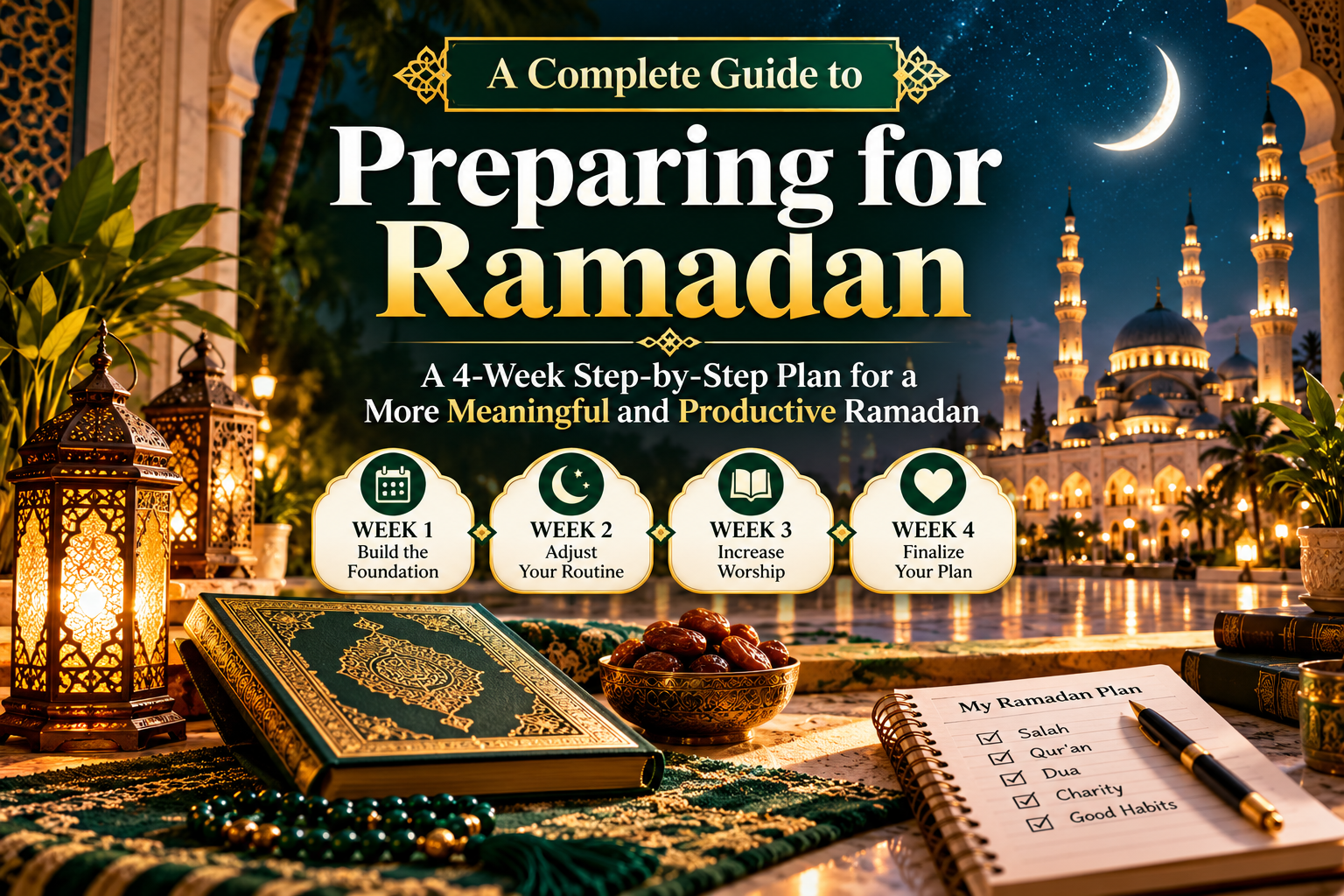
Ramadan Preparation Guide: A Practical 4-Week Plan
Ramadan catches many well-meaning people off guard: lost sleep, a missed Quran target and a routine that was never ready for the hours. This guide spreads the preparation over the four weeks before Ramadan, one focus per week.
- 4-week plan
- Fiqh notes + practical guidance
- Sleep, health & Zakat
If your Ramadan tends to lose momentum after the first week, this Ramadan preparation guide is for you. You already know the usual advice to read more Quran and set goals. The question here is different: what can you do in the four weeks before Ramadan so that the second week does not hit so hard?
Many of us treat Ramadan like a switch. One day it is lunch, tea and sleeping through Fajr; the next it is fasting, Taraweeh and a Quran target, with no ramp-up. By Day 7 or 8 the excitement wears off and you are left with sleep loss and physical fatigue. That is not necessarily a faith problem. Sometimes your sleep, schedule, workload or daily routine simply were not ready for the change. Preparation is not about maximizing a checklist; it is about entering Ramadan with your obligations, intention, health and daily routine in a sustainable place.
The short version: start four weeks before Ramadan and add one layer a week.
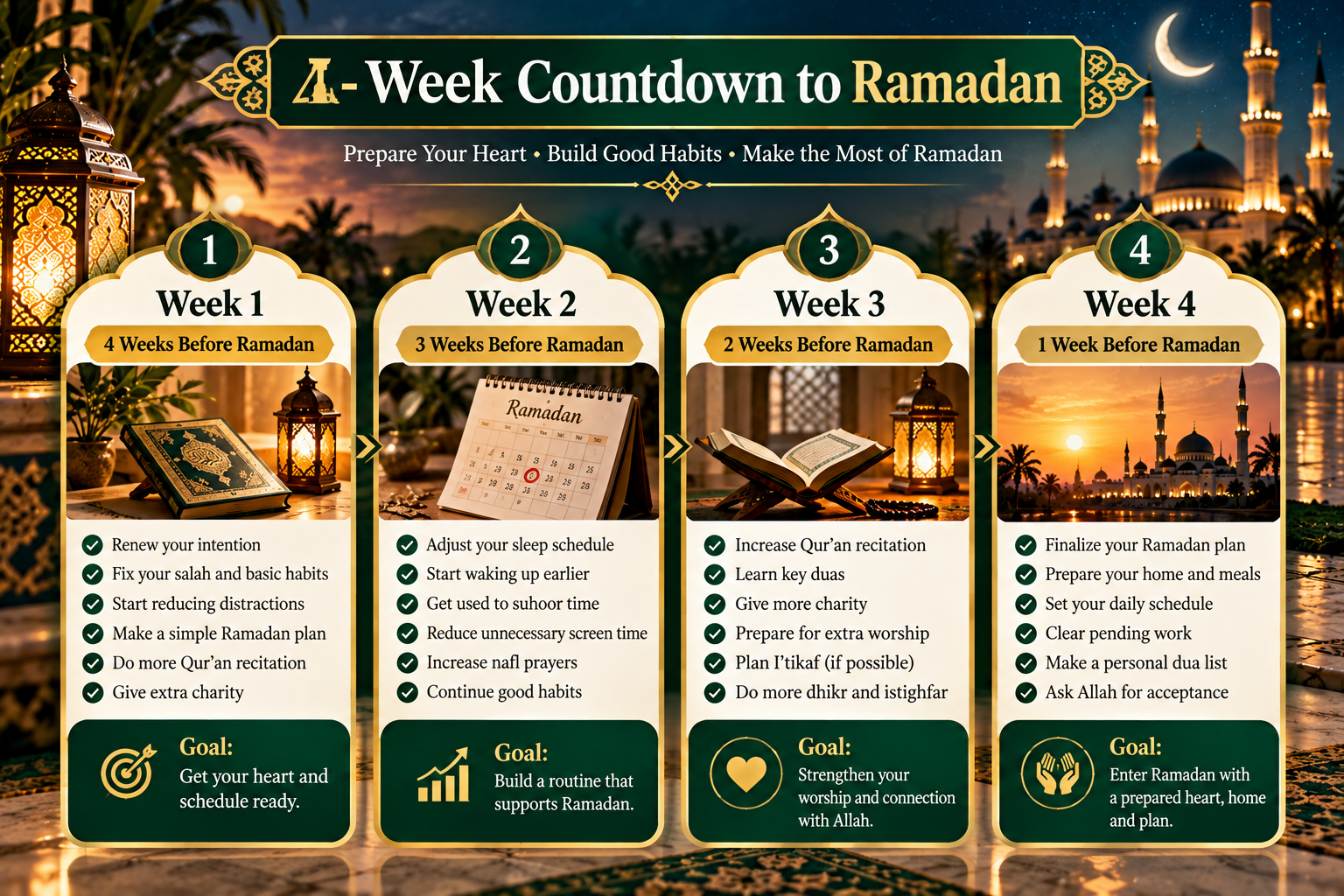
- 4 weeks out: protect the five prayers; if appropriate for you, practise voluntary Monday and Thursday fasting.
- 3 weeks out: a page of Quran a day, renew your intention, address strained relationships where it is safe to do so, adjust children’s routines.
- 2 weeks out: get used to longer night prayer, shift your sleep, check whether Zakat is due, and if you have a health condition, discuss fasting with your healthcare professional before Ramadan.
- Final week: make up missed fasts (or ask a scholar), clear your phone, plan the last ten nights, and choose two or three habits for after Eid.
If you only have one or two weeks, start from the matching section rather than trying to catch up on everything. If you have less time, skip the extra layers and protect the essentials first.
This four-week schedule is an IslamicEduHub planning framework, not a prescribed Sunnah timetable. The Quran and hadith give the religious principles; the weekly plan is our practical way of applying them. Quran and hadith quotes carry a reference you can open. Fiqh points are flagged where scholars differ, and health points are general information, not medical advice.
- 4 weeks: begin at Week 4.
- 3 weeks: begin at Week 3.
- 2 weeks: begin at Week 2.
- 1 week: go to the Final Week.
- Ramadan starts tomorrow: go to If Ramadan Starts Tomorrow.
What the Prophet صلى الله عليه وسلم Did in Sha’ban
Aisha reported: “Allah’s Messenger صلى الله عليه وسلم used to fast till one would say that he would never stop fasting, and he would abandon fasting till one would say that he would never fast. I never saw Allah’s Messenger صلى الله عليه وسلم fasting for a whole month except the month of Ramadan, and did not see him fasting in any month more than in the month of Sha’ban.”
Aisha does not say he fasted every day of Sha’ban; in the same hadith she says he never fasted a whole month apart from Ramadan. She describes more fasting in Sha’ban than in any other month. The hadith reports what he did. It does not give a reason, but another narration does:
Usamah bin Zaid said: “I said: ‘O Messenger of Allah, I do not see you fasting any month as much as Shaban.’ He said: ‘That is a month to which people do not pay much attention, between Rajab and Ramadan. It is a month in which the deeds are taken up to the Lord of the worlds, and I like that my deeds be taken up when I am fasting.'”
Sunan an-Nasa’i 2357 (graded Hasan on Sunnah.com)
So the reason he gave is that deeds are taken up in that month and he liked to be fasting when his were. Some people read Sha’ban fasting as a kind of preparation for Ramadan, but neither hadith says so. This guide borrows the idea of building up gradually. That is our practical suggestion, not a rule of the Sunnah.
Ramadan Basics: What Is Obligatory and What Is Voluntary
The plan below mixes obligations and voluntary practices, and it helps to keep them apart.
Obligatory (fard). Fasting Ramadan is obligatory for Muslims who are legally accountable and able to fast, subject to the exemptions and concessions in Islamic law (Quran 2:183-185): “So whoever sights [the new moon of] the month, let him fast it; and whoever is ill or on a journey – then an equal number of other days” (2:185). Separately, the five daily prayers are obligatory.
Voluntary worship (including recommended Sunnah/nafl practices). Taraweeh, Tahajjud, Monday and Thursday fasting, extra prayer after Isha and a daily Quran target are examples of voluntary practices. Build them, but do not let a missed voluntary habit make you neglect the obligatory ones.
Taraweeh and Tahajjud. Taraweeh commonly refers to the voluntary night prayer of Ramadan, often prayed in congregation after Isha. Tahajjud commonly refers to voluntary night prayer performed after sleeping. Scholars discuss how the two terms relate and how many rak’ahs to pray, so follow a trusted scholar or your masjid’s established practice. See our guide to praying Tahajjud.
New to fasting? Learn the basic rules of intention, what invalidates a fast, and the main concessions for illness, travel and menstruation before Ramadan. Those details are outside this preparation guide. If anything specific to your situation is unclear, ask a qualified scholar or your masjid.
4 Weeks Before: Prayers and Fasting
Get the basics working first
Fix your five daily prayers before anything else. They are the obligatory base. If Fajr is the one you miss, solve that now: a second alarm, phone across the room, a friend who calls you. If Isha keeps getting pushed to right before sleep, set a fixed time for it.
Practise voluntary Monday and Thursday fasting this week, if appropriate for you. The Prophet صلى الله عليه وسلم said that deeds are presented on Mondays and Thursdays, and that he loved his deeds to be presented while he was fasting (Tirmidhi 747). From a practical point of view, some people find that practising fasting beforehand makes the change in meal timing easier. That is our observation, not something the hadith states.
If you still owe Ramadan fasts, ask a qualified scholar how to balance make-up fasting with voluntary fasting in your situation. If you have a medical condition, read the health note in the 2-weeks section first.
If your prayers are already solid, add a short voluntary prayer after Isha. Keep it short and manageable.
3 Weeks Before: Quran, Intention, Relationships and Family
Build the habits you will need, fix what is broken
Restart your Quran habit first. Ramadan is the month in which the Quran was revealed:
شَهْرُ رَمَضَانَ ٱلَّذِىٓ أُنزِلَ فِيهِ ٱلْقُرْءَانُ هُدًى لِّلنَّاسِ وَبَيِّنَـٰتٍ مِّنَ ٱلْهُدَىٰ وَٱلْفُرْقَانِ
“The month of Ramadhan [is that] in which was revealed the Qur’an, a guidance for the people and clear proofs of guidance and criterion.”
Surah Al-Baqarah 2:185 (Quran.com, Sahih International translation)
So the Quran is the first habit to restart. As a simple starting target, try one page a day. Pick up the mushaf after Fajr or Maghrib, read a page and close it, with a translation if you can. The goal is to be continuing a habit on Day 1 rather than starting one.
Prepare your intention. Preparation is not only logistics. Renew your intention to spend the month for Allah’s sake, name one recurring weakness and make sincere tawbah for it, write three duas, and choose one act of worship you will protect even on your busiest days. Then give thanks for being able to welcome another Ramadan.
Settle any disputes you are carrying. Here is the hadith behind this:
Abu Huraira reported Allah’s Messenger صلى الله عليه وسلم as saying: “The gates of Paradise are not opened but on two days, Monday and Thursday, and then every servant (of Allah) is granted pardon who does not associate anything with Allah except the person in whose (heart) there is rancour against his brother. And it would be said: Look towards both of them until there is reconciliation…” (the last line is repeated three times in the narration).
The hadith warns that unresolved rancour can hold back this special pardon until the two people reconcile. If you are carrying a grudge against another Muslim, it is worth repairing before the month begins. Make a sincere, safe effort toward reconciliation. You do not have to agree with them. If contact is unsafe or has been harmful to you, talk it through with a trusted scholar or counsellor instead of forcing a meeting.
If you have children, start adjusting their routine now. Once a Muslim reaches puberty, they become legally accountable for religious obligations, including Ramadan fasting, subject to the normal rulings and exemptions. Abu Dawud 4403 is a hadith about legal accountability before puberty; it is not a detailed ruling on children’s fasting. Younger children may practise gradually if they are able and willing, but should never be harmed or pressured. Ask a scholar if you are unsure about your child. Bedtimes may need to shift for Taraweeh nights, but younger children’s sleep and wellbeing should remain a priority.
2 Weeks Before: Body, Sleep, Money and Health
Get the practical things out of the way
Get used to longer night prayer. If longer night prayers are physically demanding for you, standing a little longer each night after Isha may make the transition easier. Read whatever Quran you have memorised.
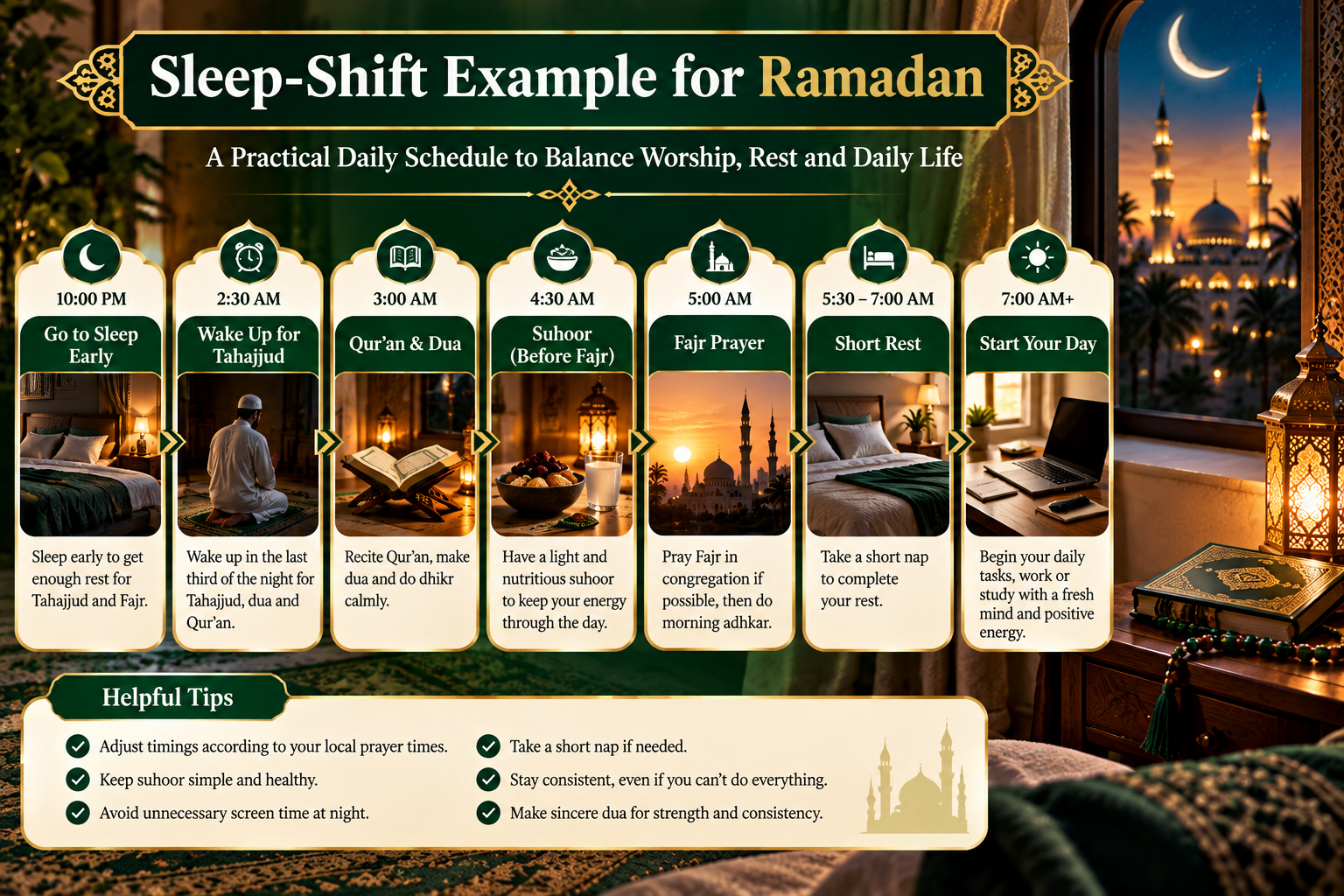
Shift your sleep a little at a time. Work backwards from your own Fajr time, and use your local Ramadan timetable rather than the example here. If your local Fajr is around 4:45 and you want to finish suhoor by about 4:15, you may need to be up around 4:00. If you normally wake at 7, move your wake-up time 30 minutes earlier this week and another 30 minutes next week, and bring your bedtime forward with it.
Ease off caffeine before Day 1. If you regularly consume caffeine, suddenly cutting it can cause withdrawal symptoms, including headaches, for some people. Starting to reduce caffeine during these two weeks may make the transition easier. See MedlinePlus: Caffeine in the diet.
Check whether Zakat is due. For many forms of monetary wealth such as cash, savings and gold, Zakat becomes due when the relevant conditions are met, including reaching the relevant nisab and, where applicable, completing the relevant hawl period (lunar year). The details differ by asset type and scholarly opinion, so check your Zakat date and method with a qualified scholar if your situation is complicated.
If your date falls in Ramadan, gather your bank statements, relevant asset values and information about debts or liabilities that may affect your calculation, then use the Zakat Calculator, so the last ten nights are not spent with a spreadsheet. Whether Zakat may be paid before its due date is a matter on which scholars discuss differing details, so ask a qualified scholar. To understand the nisab, see how to calculate the nisab.
If you have a health condition, talk to your doctor or healthcare professional this week. Diabetes, high blood pressure, long-term medication use, pregnancy, breastfeeding and chronic illness can all affect whether or how you fast. Discuss it before Ramadan, not on Day 3 when something goes wrong. Do not stop, skip or change medication on your own; ask whether the timing can be adjusted, and ask a pharmacist too if your question is about medication timing.
Then ask a qualified scholar how the rulings apply to you, because exemptions depend on the case. If you feel seriously unwell during a fast, seek medical help. This guide is not medical advice.
Fitting Ramadan Around Work, School and Family
A plan only works if it fits your actual week. Talk to your manager or teacher before the month starts about hours, breaks and prayer times: some workplaces and schools can adjust and some cannot, and it is easier to ask early. At home, decide before Day 1 who cooks, who wakes the children for suhoor, and when each adult can rest. On busy days, keep to a realistic baseline: the obligatory prayers, a little Quran and dua, and rest.
Before Ramadan:
- Confirm work or school prayer and break arrangements.
- Assign household and suhoor responsibilities.
- Identify one realistic rest window.
During Ramadan:
- Protect the obligatory prayers.
- Reduce unnecessary commitments.
- Keep a minimum worship baseline.
Final Week: Clear the Decks
Remove what will get in the way
Make up missed Ramadan fasts if you still owe them. The Quran allows days missed through illness or travel to be made up later (2:184-185). Aisha reported that she sometimes missed days of Ramadan and could only make them up in Sha’ban (Bukhari 1950); the narrator adds that she was busy with the Prophet’s صلى الله عليه وسلم affairs.
If you still owe days, make a plan to complete them as soon as you reasonably can. If you have delayed making them up, especially with another Ramadan approaching, ask a qualified scholar what applies to you. Scholars discuss differently the effect of delay, what counts as an excuse, and whether anything extra is owed.
Get your phone out of the way. Move social media apps off your home screen, set time limits and silence notifications that are not family or work. Your evenings are what you want free for Taraweeh and Quran.
Write a dua list. Specific things, not just “Ya Allah bless me”: “help me get through this exam,” “heal the thing between me and my brother,” “make this debt easier,” “help me stop doing X.” Keep it on paper or in your phone for the nights when your mind goes blank in sujood. The guide to making dua covers the principles.
Prepare food in advance. If one person in your household does most of the cooking, share the load where you can. Freeze whatever your family usually eats, and plan simple suhoor options such as eggs, oats, dates or fruit. Less time in the kitchen can leave more time and energy for worship and family.
Plan your last ten nights now. Decide whether you hope to observe I’tikaf, and check its requirements with your masjid or a qualified scholar in advance. Also decide which nights get extra effort and how you will protect your energy (leave, naps, shared childcare). The night-by-night plan is in our guide to the last 10 days of Ramadan.
Skip new voluntary fasts in the last day or two before Ramadan. The Prophet صلى الله عليه وسلم said: “None of you should fast a day or two before the month of Ramadan unless he has the habit of fasting (Nawafil) (and if his fasting coincides with that day) then he can fast that day” (Bukhari 1914). So if you already fast Mondays and Thursdays and one of them falls just before Ramadan, that is fine. Anything extra, added only as preparation, can wait. This is about voluntary fasting; questions about make-up fasts should go to a qualified scholar.
Minimum Viable Ramadan
- Protect the five daily prayers.
- Fast Ramadan if you are able and obligated.
- Keep a small Quran connection and make dua.
- Sleep enough to function safely.
- Do not sacrifice your health or obligatory responsibilities for an unrealistic checklist.
Optional goals can be reduced. The point is consistency, not perfection.
If Ramadan Starts Tomorrow
Do not try to complete the whole four-week plan. Prioritise the obligatory prayers, learn the basic fasting rules that apply to you, settle urgent work and family arrangements, prepare your suhoor and sleep as far as you can, and avoid turning preparation into a last-minute checklist marathon. Then start the month with the Minimum Viable Ramadan above and build from there.
Plan for After Ramadan
Ramadan gives you structure for thirty days. Without a plan, it can be easy to lose that structure once Eid comes. Before the month begins, pick two or three small habits to keep after Eid. Possible habits include:
- Continue voluntary Monday and Thursday fasting, if appropriate for you.
- Continue reading one page of Quran after Fajr.
- Continue a short voluntary prayer after Isha.
The infographic groups these into three areas: salah, Quran and dhikr, and good deeds.

Write your choices down and put them somewhere you will see them after Eid. By the end of Ramadan, you may be emotionally full and physically tired, which is not the best time to make long-term decisions.
The Prophet صلى الله عليه وسلم said: “Do good deeds properly, sincerely and moderately and know that your deeds will not make you enter Paradise, and that the most beloved deed to Allah is the most regular and constant even if it were little” (Sahih al-Bukhari 6464). The hadith supports regular, moderate worship. Our application is practical: choose habits you can sustain after Ramadan rather than a big one you drop after a week.
Your 4-Week Checklist
Practical suggestions, not religious requirements.
4 weeks out
- Five daily prayers on time
- Voluntary Monday and Thursday fasts, if appropriate for you
3 weeks out
- One page of Quran a day, as a starting target
- Renew your intention, make tawbah, write three duas
- Where safe, reach out to anyone you have fallen out with
- Start adjusting your children’s bedtime
2 weeks out
- A little voluntary prayer after Isha
- Move sleep earlier and ease off caffeine
- Check whether Zakat is due
- Get medical advice if you have a health condition
- Talk to your manager or teacher, and plan the household week
Final week
- Make up missed fasts, or ask a scholar about them
- Set phone limits and write your dua list
- Prepare some meals in advance
- Last ten nights planned, I’tikaf requirements checked
- Two or three habits chosen for after Eid
Frequently Asked Questions
What should I do four weeks before Ramadan?
Protect your five daily prayers first, then add one layer a week: a small Quran habit and renewed intention, longer night prayer and a gradual sleep shift, and in the final week a clear phone, a plan for the last ten nights and a few habits for after Eid. This order is our planning framework, not a Sunnah timetable.
How did the Prophet صلى الله عليه وسلم fast in Sha’ban?
He fasted more in Sha’ban than in any other month, though never a whole month apart from Ramadan (Bukhari 1969). When Usamah asked about it, he said it is a month people pay little attention to and that deeds are taken up in it, and he liked to be fasting when his were (Nasai 2357). Neither hadith presents it as preparation for Ramadan.
Are Monday and Thursday fasts, and Taraweeh, obligatory?
No. They are voluntary practices. Fasting in Ramadan and the five daily prayers are the obligations. Build the voluntary habits, but keep the obligatory ones first.
What if I am ill, travelling, pregnant or breastfeeding and cannot fast?
The Quran allows those who are ill or travelling to make up the days later (2:184-185). The rules for pregnancy and breastfeeding can involve different scholarly details depending on the circumstances and the concern for the mother or child. Ask a qualified scholar what applies to you, and speak with your doctor or healthcare professional about the medical side. Never stop or change medication on your own.
How do I stop caffeine headaches during Ramadan?
Some regular caffeine users get withdrawal symptoms such as headaches when they stop suddenly, so reducing caffeine gradually in the weeks before Ramadan may be easier. For example, you could reduce the amount step by step or switch to a lower-caffeine drink. Speak to your doctor if the headaches are severe or you take medication.
Should I calculate Zakat before Ramadan?
Check whether your Zakat date falls before or during Ramadan. If Zakat is due, preparing the calculation in advance can make Ramadan easier. The exact calculation depends on your assets and applicable fiqh rules, so use a reliable calculator or ask a qualified scholar if your situation is complex. Whether Zakat may be paid before its due date is a matter on which scholars discuss differing details.
What should I do if Ramadan starts tomorrow?
Do not attempt the whole plan. Protect the five prayers, learn the fasting rules that apply to you, settle urgent arrangements, plan suhoor and sleep, and keep a small Quran and dua habit. If you were thinking of starting a new voluntary fast on the final day or two, see the Bukhari 1914 note in the Final Week section.
How should I prepare for Ramadan spiritually?
Renew your intention, make tawbah, repair strained relationships where it is safe to do so, write specific duas, and choose one act of worship to protect. Reduce the distractions that crowd out worship, such as phone time, and aim for quality over a long list of goals.
What should a beginner learn before their first Ramadan fast?
Learn the intention, what invalidates a fast, the concessions for illness, travel and menstruation, and how to plan suhoor and iftar. Ask a trusted scholar or your masjid about anything specific to you. This guide covers preparation only, not the full rules of fasting.
Related Guides
Sources and Methodology
- Primary sources. Quran and hadith citations identify the textual sources. Quran quotes use the Sahih International translation on Quran.com; hadith quotes follow the English on Sunnah.com, and each reference links to its source.
- Fiqh. Fiqh statements are presented cautiously and flagged where scholars differ. They are scholarly interpretation, not something the quoted text states on its own.
- Practical planning. The weekly schedule, sleep, caffeine, phone, meal and scheduling tips are editorial guidance, not religious rulings.
- Health. Health points are general educational information, not diagnosis or individual medical advice.
- Personal circumstances. Where a ruling depends on your situation, we direct you to a qualified scholar or healthcare professional.
- Review status. Written and edited by the IslamicEduHub editorial team. This guide has not been reviewed by a named scholar or medical professional. Last reviewed: October 4, 2026
| Source | Used for | Type |
|---|---|---|
| Quran 2:183-185 | Ramadan fasting, making up missed days | Quran |
| Bukhari 1969 | Fasting in Sha’ban | Hadith |
| Nasa’i 2357 (Hasan on Sunnah.com) | Sha’ban and deeds being taken up | Hadith |
| Tirmidhi 747 (Hasan on Sunnah.com) | Monday and Thursday fasting | Hadith |
| Muslim 2565 | Reconciliation | Hadith |
| Bukhari 1950 | Making up missed fasts | Hadith |
| Bukhari 1914 | Fasting just before Ramadan | Hadith |
| Bukhari 6464 | Regular, moderate deeds | Hadith |
| Abu Dawud 4403 (listed as authentic on Hadeethenc.com) | Legal accountability before puberty | Hadith |
| MedlinePlus: Caffeine in the diet | Caffeine withdrawal symptoms and gradual reduction | Medical reference |
English wording follows the translations shown on Sunnah.com and Quran.com; translations can differ slightly between sources. The sources cited here clearly establish the obligation of Ramadan fasting for those it applies to, and the provision for making up missed days in the cases addressed by Quran 2:184-185. Other details in this guide involve fiqh interpretation, and some have scholarly disagreement: the effect of delaying make-up fasts, the details for pregnancy and breastfeeding, the rak’ahs of Taraweeh, and paying Zakat before its date. This guide is educational and is not a fatwa or medical advice.
IslamicEduHub Editorial Team writes practical guides on worship, Ramadan and Islamic basics. This article has not been reviewed by a named scholar or medical professional; it is general guidance, not a fatwa or medical advice. For questions specific to your circumstances, consult a qualified local scholar. If you find a mistake, contact us and we will correct it.
Last reviewed: October 4, 2026.
Found an error? Contact IslamicEduHub. Follow us on Facebook.