
Hadith Collection Finder — Match Yourself to the Right CollectionHadith Collection Finder
Find the right hadith collection for what you’re actually studying
Answer three quick questions about your interest, your authentication standard, and your study level — the hadith collection finder matches you to the classical collections built for that job, with real compiler details and match reasoning.
No account, no data sent anywhere — the hadith collection finder runs entirely in your browser.

The Tool
Run the Hadith Collection Finder
Your matched hadith collections
Background
What Is a Hadith Collection?
A hadith collection is a compiled book of narrations recording the sayings, actions, and approvals of the Prophet Muhammad ﷺ, each one traced back through a chain of narrators known as an isnad. Classical scholars spent lifetimes gathering, cross-checking, and grading these reports, which is why collections differ so much in size, organizing method, and authentication standard. That’s exactly the gap the hadith collection finder is built to close: instead of guessing which book to open, you get a shortlist matched to what you’re actually trying to learn.
Some collections, like Sahih al-Bukhari and Sahih Muslim, include only the most rigorously authenticated narrations. Others, like Sunan Abu Dawood or Jami at-Tirmidhi, deliberately include weaker narrations alongside strong ones because they were compiled as legal reference works, with the compiler noting each grade. A hadith collection finder that understands these differences saves a student from picking a book that doesn’t match their actual goal.
Mechanics
How This Hadith Collection Finder Works
- Set your interest. Choose the subject area you’re actually studying — worship, manners, fiqh, seerah, academic isnad work, or general study.
- Set your authentication standard. Decide whether you want Sahih-only narrations, a Sahih-and-Hasan mix, or the full comprehensive picture used in research.
- Set your study level. Beginner, intermediate, and advanced study each favor different collections and organizing styles.
- Read your matched folios. The hadith collection finder scores all ten collections against your three answers and returns the closest matches with a match-seal percentage and the reasoning behind it.
Criteria
What Should a Hadith Collection Include?
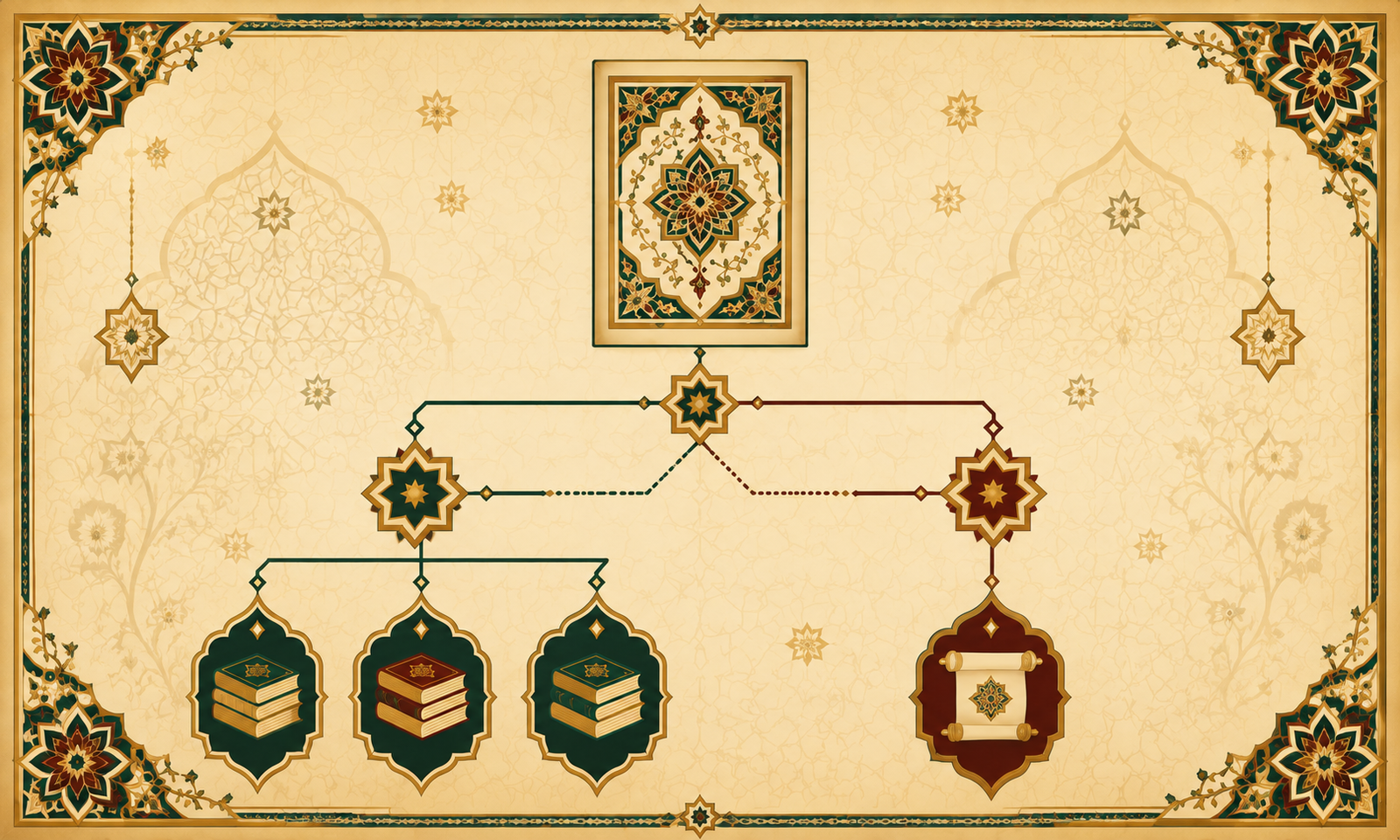
- A stated authentication standard — Sahih only, mixed with explicit grading, or comprehensive for research.
- A named compiler and century of compilation, so you can place the work historically.
- A clear organizing method — by fiqh chapter, by narrator (musnad), or thematic selection.
- Full isnad chains preserved, not just the matn (text), for anyone doing narrator-level research.
- A stated scope — legal rulings, daily conduct, seerah, or a broad general reference.
- Cross-referencing to companion collections, useful for comparative study.
Worked Example
A Worked Example
A student studying daily manners & ethics at a beginner level, who wants Sahih and Hasan narrations, gets this shortlist from the hadith collection finder:
| Rank | Collection | Match | Why it matched |
|---|---|---|---|
| 1 | Riyad as-Salihin | 100% | Thematic manners selection, beginner-friendly, Sahih/Hasan graded. |
| 2 | Muwatta Imam Malik | 65% | Beginner-accessible, blends narration with early practice. |
| 3 | Sahih al-Bukhari | 65% | Sahih standard, beginner-usable through selected chapters. |
Who It’s For
Hadith Collection Finder by Study Level
New to hadith studies
Start with Riyad as-Salihin or the Muwatta — shorter, thematically organized, and easier to sit with cover to cover.
Building a fiqh foundation
Sahih Muslim, Jami at-Tirmidhi, and Mishkat al-Masabih pair strong authentication with legal-chapter organization.
Isnad & narrator research
Sunan an-Nasa’i and Musnad Ahmad reward readers doing chain-of-narration or comparative narrator work.
Best Practices
Getting the Most Out of a Hadith Collection Finder
- Match the collection to the question, not the other way around — a fiqh question deserves a legally organized collection.
- Note the grading a compiler gives each narration; “included in the book” is not the same as “authenticated Sahih.”
- Cross-check a narration across two collections when it matters for a ruling or a shared lesson.
- Keep a primary reference source open alongside any hadith collection finder result for the full Arabic text and chain.
For primary-text lookup and narrator-level detail, Sunnah.com is a widely used reference for the collections covered here.
Pitfalls
Common Mistakes When Choosing a Hadith Collection
FAQ
Hadith Collection Finder — Frequently Asked Questions
Is the hadith collection finder an AI tool?
No. The hadith collection finder runs a local, rule-based matching engine built from a fixed dataset of ten classical collections — nothing is generated by an AI model, and nothing you enter is sent to a server. A future version could connect to a secure backend, but today’s matching logic is fully deterministic.
Which hadith collections does this tool cover?
The hadith collection finder currently scores against the Kutub al-Sittah (Bukhari, Muslim, Abu Dawood, Tirmidhi, an-Nasa’i, Ibn Majah), plus the Muwatta of Imam Malik, Musnad Ahmad, Riyad as-Salihin, and Mishkat al-Masabih.
What does the match percentage mean?
Each collection is scored against your interest, authentication preference, and study level. A higher percentage means a closer fit on all three factors, not a ranking of religious authority.
Can I use the hadith collection finder for academic research?
Yes — select “comprehensive” authentication and “advanced” study level to surface collections like Musnad Ahmad and Sunan an-Nasa’i that suit narrator-level research, then verify specific narrations against a primary source.
Does the hadith collection finder replace a scholar or teacher?
No. It’s a starting-point reference for choosing which book to open next. Rulings, grading disputes, and interpretation should still go through a qualified teacher.
Is there a cost to use the hadith collection finder?
The hadith collection finder is free, requires no signup, and runs entirely in your browser.
Keep Exploring
Related Reading
Note: swap the first link for your actual hadith-by-topic-finder or hadith-source-checker article URLs once published — I couldn’t confirm those page URLs are live yet, so I didn’t want to guess and hand Rank Math a broken internal link.
Ready to find your hadith collection?
Answer three questions above and the hadith collection finder will match you to the classical collections built for your study.
Use the Hadith Collection Finder