
Quran Juz Finder
Enter any Surah and Ayah — instantly find which of the 30 Juz (Para) it falls in, its Hizb quarter, and the full Ayah range that Juz covers.
Nothing you type ever leaves this page — the lookup runs on a local dataset, no external calls.
Find My Juz ↓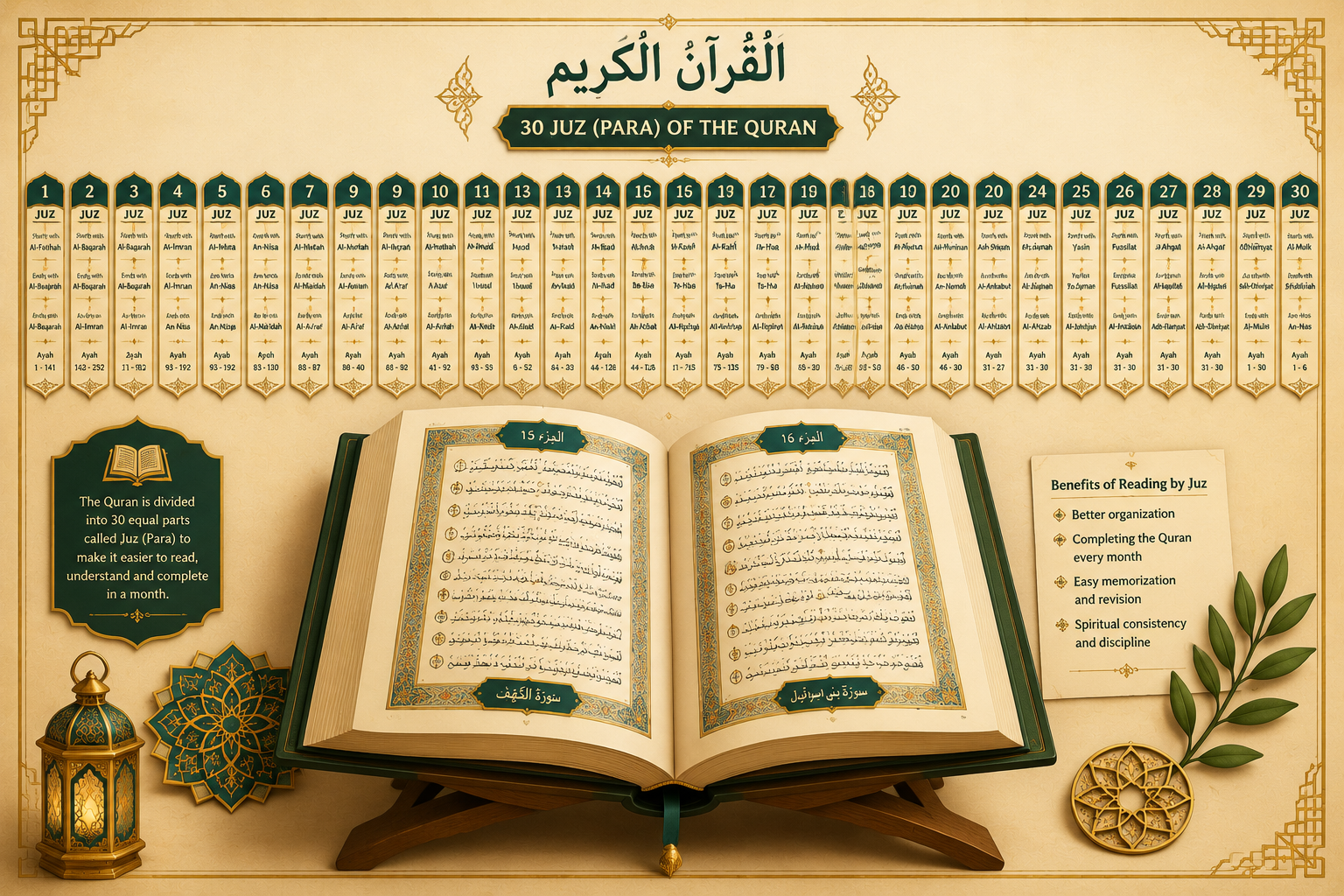
Table of Contents
Find a Juz in Two Fields
Each bar is one Juz (Para) of the 30 that make up the Quran — the highlighted bar is your result.
Choose a Surah and Ayah above, then select “Find Juz” to see your result here.
Juz 1 — Alif-Lam-Meem
What Is a Juz (Para)?
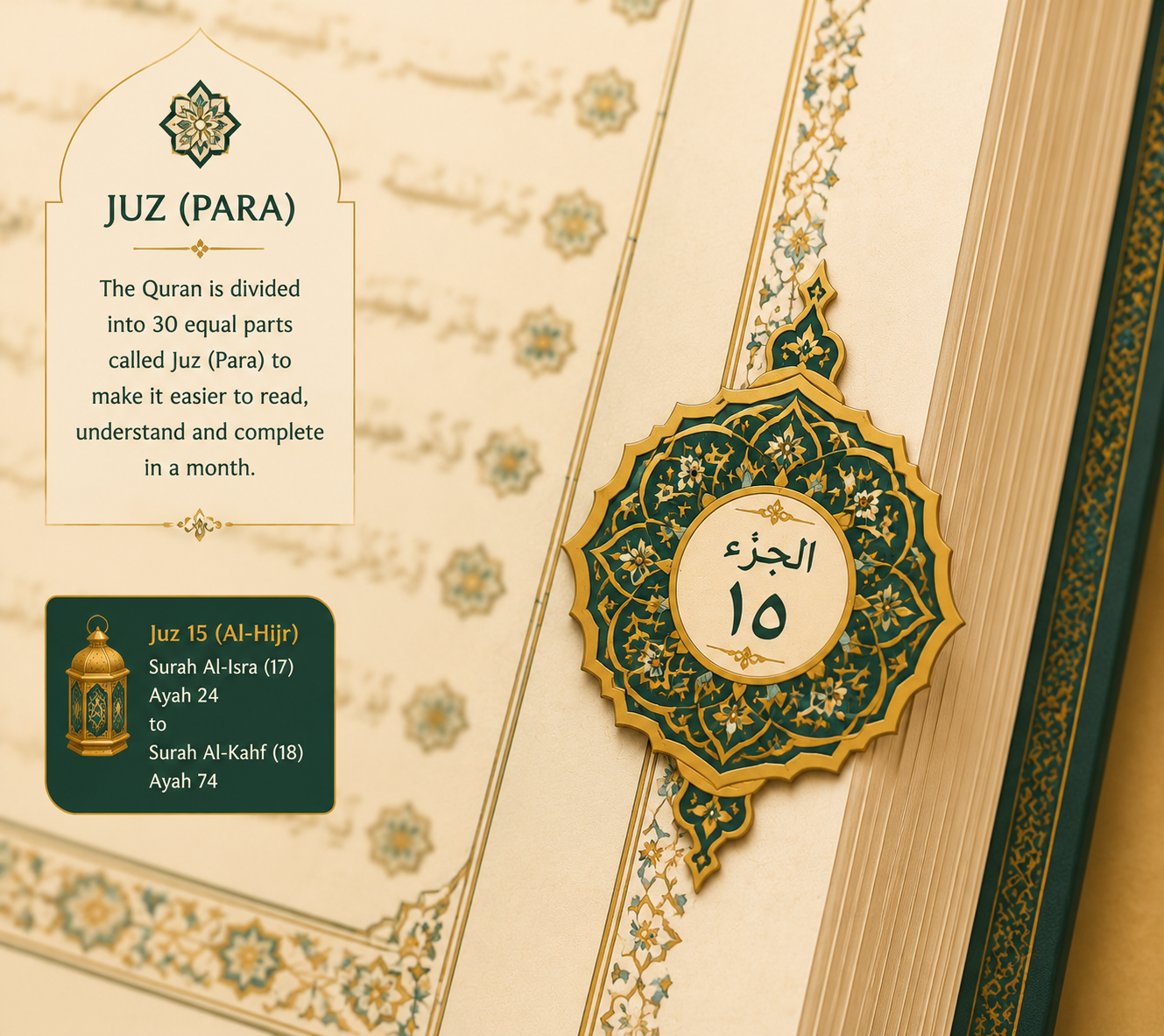
A Juz — called Para in Urdu and South Asian usage — is one of 30 roughly equal parts the Quran’s 6,236 verses are divided into. The division isn’t based on subject matter or chapter breaks; it’s a reading-length split created so a reader can complete the entire Quran in a month, one Juz per day, or in a week using the seven-part Manzil system.
Each Juz is further split into four Hizb quarters (Rub’), giving 120 quarter-markers across the whole Mushaf. These markers appear in the margins of most printed copies and are what the Quran Juz Finder above uses to place any Ayah precisely.
How This Quran Juz Finder Works
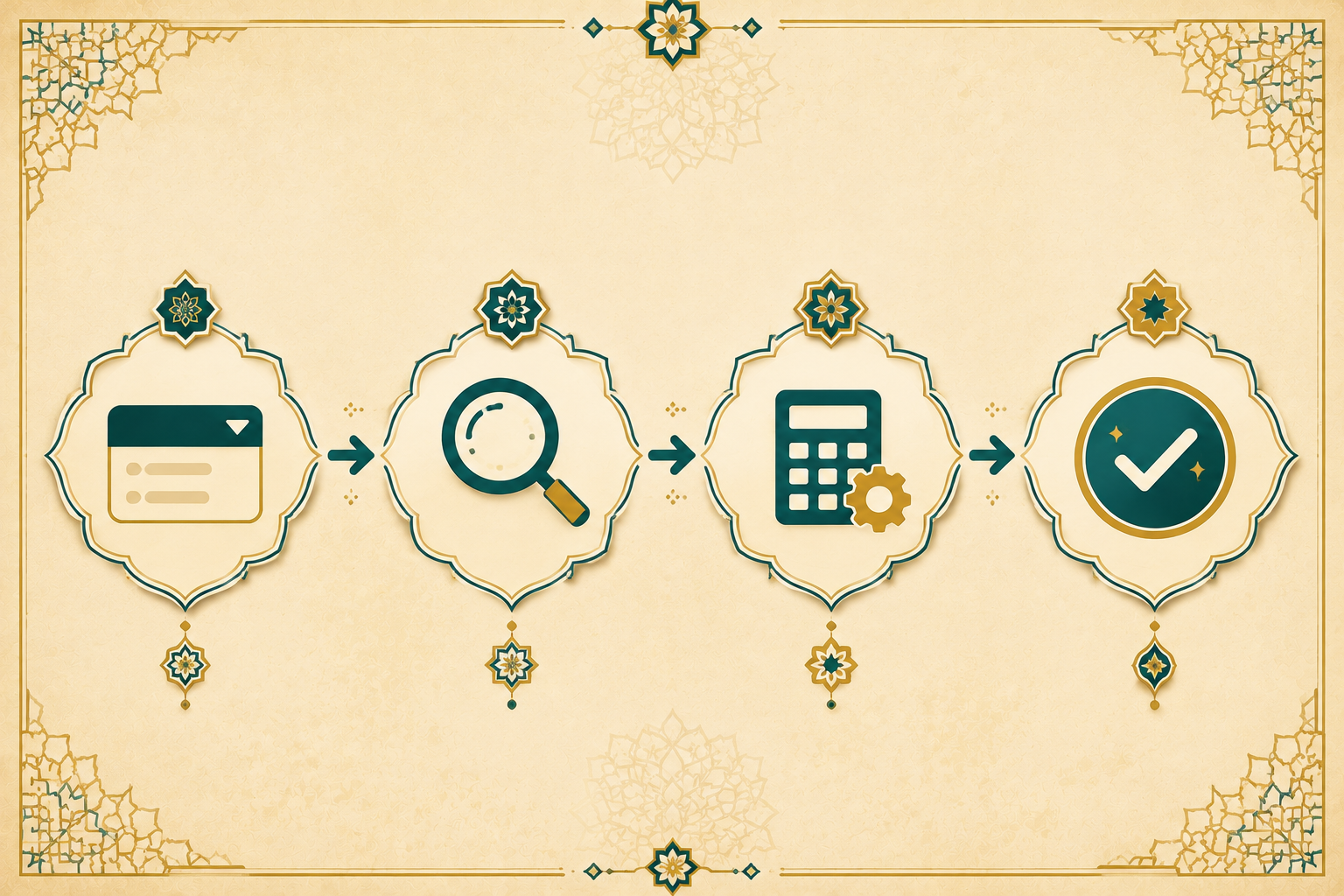
- Pick a Surah and Ayah. The tool holds a local table of all 114 Surahs and their verified Ayah counts.
- The engine walks the 30 Juz boundary table. Every Juz has a fixed starting Surah:Ayah — the tool finds which range your Ayah falls inside.
- It estimates the Hizb quarter. Your position inside that Juz is measured as a quarter-fraction to flag roughly which Rub’ you’re in.
- Results render instantly. No page reload, no server call — the calculation runs in your browser in milliseconds.
What Should a Juz Reference Include?
- The exact starting Surah name and Ayah number for the Juz
- The Juz’s common Arabic name where one exists (several Juz are named after their opening words, e.g. Juz 1 “Alif-Lam-Meem”)
- Which Hizb quarter a given Ayah sits in, for Tarawih and daily-portion planning
- A quick way to move between “how many pages have I read” and “which Juz am I in”
- No login wall — a Juz lookup is a 5-second task and should stay that way
Sample Lookups
A few real results from the tool above, so you can sanity-check your own search:
| Input | Result | Juz Starts At | Juz Ends At |
|---|---|---|---|
| Al-Baqarah, Ayah 25 | Juz 1 | Al-Fatihah 1:1 | Al-Baqarah 2:141 |
| Al-Baqarah, Ayah 255 (Ayat al-Kursi) | Juz 3 | Al-Baqarah 2:253 | Aal-E-Imran 3:92 |
| Al-Kahf, Ayah 10 (Ashab al-Kahf) | Juz 15 | Al-Isra 17:1 | Al-Kahf 18:74 |
| Ya-Sin, Ayah 1 | Juz 22 | Al-Ahzab 33:31 | Ya-Sin 36:27 |
| An-Nas, Ayah 1 | Juz 30 | An-Naba 78:1 | An-Nas 114:6 |
Built for Every Kind of Reader
Daily Khatm Readers
Planning to finish the Quran in 30 days — confirm exactly where today’s portion starts and ends.
Tarawih Attendees
Follow along in Ramadan by knowing which Juz the Imam is reciting relative to your own Mushaf.
Madrasah Students
Cross-check homework references that cite a Juz or Hizb number against a specific Surah and Ayah.
New Reciters
Understand the 30-part structure of the Mushaf before memorizing or studying Tafsir by Juz.
Getting the Most Out of Juz-Based Reading
Juz divisions are a memorization and scheduling aid, not a textual or thematic boundary — a Juz can start or end mid-sentence, mid-Surah, or mid-story. When studying meaning rather than pace, read by complete Surah or by thematic passage instead, and treat the Juz marker purely as a bookmark.
For the authoritative verse numbering and Mushaf layout this tool’s dataset follows, the King Fahd Complex for the Printing of the Holy Quran is the standard reference used by most modern print and digital Mushaf editions.
Common Juz-Counting Mistakes
Quran Juz Finder — Frequently Asked Questions
How accurate is this Quran Juz Finder?
The Quran Juz Finder uses the standard 30-Juz boundary table matched to the widely used Madani Mushaf verse numbering, so Surah-and-Ayah lookups align with the print edition most readers use.
Does the Quran Juz Finder work without an internet connection after loading?
Yes. Once the page has loaded, the Quran Juz Finder performs every calculation locally in your browser with no server or API call, so results appear instantly even on a slow connection.
What’s the difference between a Juz and a Hizb?
A Juz is 1 of 30 equal parts of the Quran; a Hizb quarter is 1 of 4 smaller divisions inside each Juz, giving 120 quarter-markers in total across the Mushaf.
Can I look up a Juz number to see which Surahs it covers?
Yes — switch the Quran Juz Finder to “Juz Number → Range” mode, enter any number from 1 to 30, and it returns the exact Surah and Ayah where that Juz starts and ends.
Is the Hizb quarter shown by this tool exact?
The Hizb quarter is an estimate based on verse position within the Juz rather than the traditional printed quarter-markers, so treat it as a close guide and confirm against your own Mushaf’s margin marks for precise study or recitation planning.
Do I need to create an account to use the Quran Juz Finder?
No signup is required — the Quran Juz Finder is free to use directly on this page with no account, download, or installation.
Continue Your Study
Update these two links to the actual matching articles live on this site before publishing — see the WordPress checklist below.