
Isha Time Finder
Enter your location and date to instantly calculate tonight’s Isha prayer time — using the same twilight-angle methods (MWL, ISNA, Karachi, Egypt, Umm al-Qura) used by prayer timetables worldwide.

Calculate Tonight’s Isha Time
Pick a city or enter coordinates, choose a calculation method, and generate your result.
Not sure which to use? See “What Should an Isha Time Finder Include?” below — most regions default to MWL or ISNA.
Isha prayer time for —
–:–
What Is an Isha Time Finder?
An Isha time finder is a calculator that works out when Isha — the fifth and final obligatory daily prayer — begins for a specific location and date. Because Isha starts once true night falls (the point when even the last reddish-white glow of twilight has faded from the horizon), its time can’t be read off a clock the way Dhuhr or Asr roughly can. It has to be derived from the sun’s position below the horizon.
This Isha time finder uses solar geometry — latitude, longitude, and the date — to work out how far the sun has to dip below the horizon before twilight ends, then converts that into a clock time using whichever calculation method (MWL, ISNA, Karachi, Egypt, or Umm al-Qura) you select. The result updates instantly, entirely in your browser.

How This Isha Time Finder Works
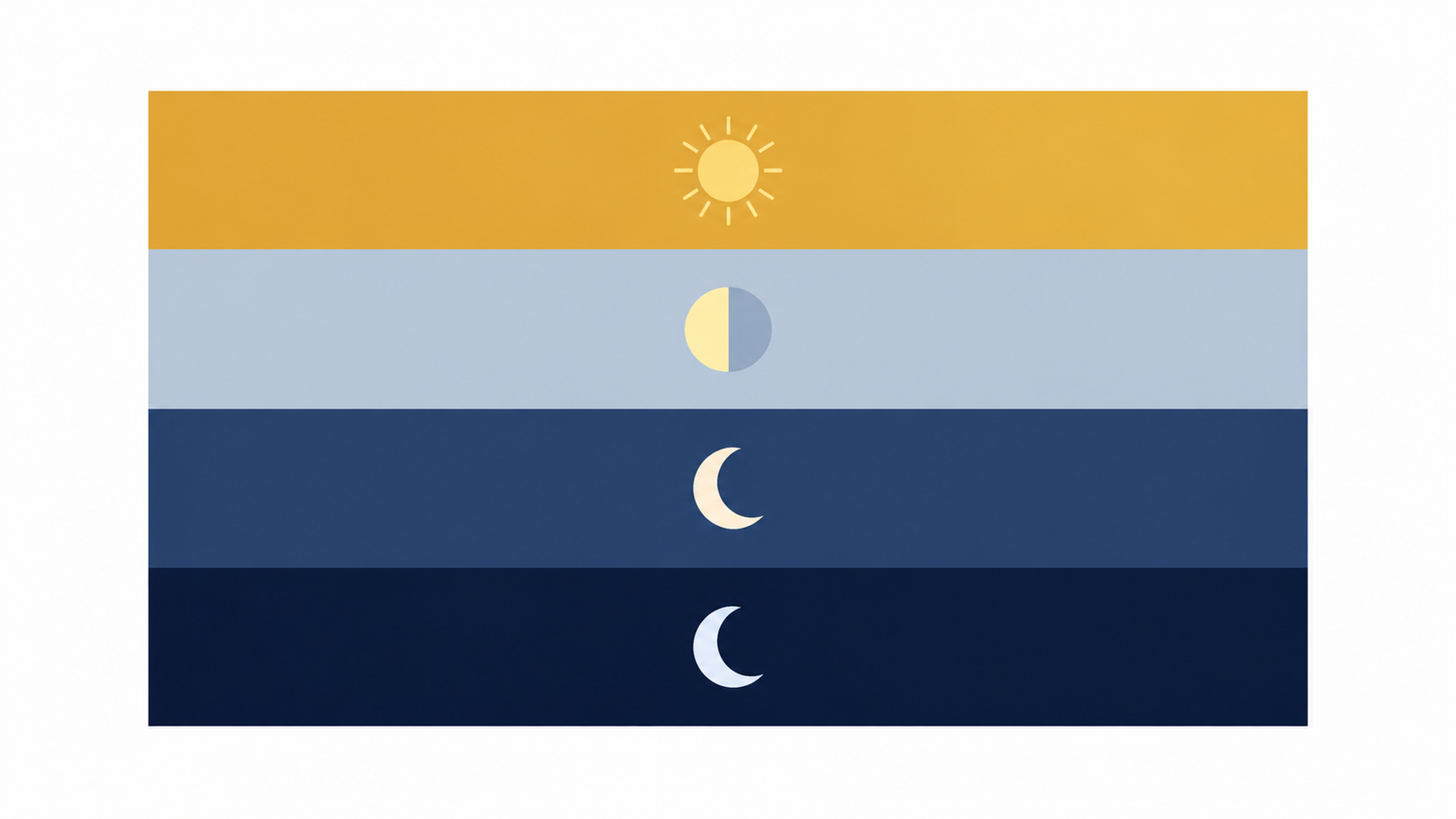
- Set your location. Choose a preset city or enter latitude and longitude directly — this fixes how far you are from the equator and from the reference meridian.
- Pick the date. The sun’s declination changes daily, which shifts sunset and twilight length throughout the year — so the same city can have an Isha time that moves by over an hour between summer and winter.
- Choose a calculation method. Each Islamic authority (MWL, ISNA, Karachi, Egypt, Umm al-Qura) defines “night” using a slightly different twilight angle, typically 15–18° below the horizon.
- The engine computes solar noon and sunset for your date and location using the sun’s declination and the equation of time, then finds the exact clock time at which the sun reaches your chosen angle below the horizon.
- Your result appears instantly — the Isha time finder displays the calculated Isha time alongside sunset, civil twilight, and nautical twilight for context, plus the option to copy, print, or download it.
What Should an Isha Time Finder Include?
- Support for more than one calculation method — no single angle convention is correct everywhere.
- A visible reference to sunset and intermediate twilight stages, not just a single output time.
- Date sensitivity — a good Isha time finder recalculates for the selected date, not just “today.”
- Clear handling for high-latitude locations, where twilight can last for hours in summer.
- A plain-language note on which method matches which region, so users aren’t left guessing.
- No dependency on sending your location to a third-party server.
Worked Example: Isha Time in Lahore, Pakistan
Using the Isha time finder for Lahore (31.5497°N, 74.3436°E, UTC+5) on a mid-winter date with the Muslim World League (17°) method:
| Stage | Approx. Time | What It Marks |
|---|---|---|
| Sunset (Maghrib) | ~5:12 PM | Sun’s disk fully below the horizon |
| Civil twilight ends | ~5:38 PM | Sun 6° below horizon; outdoor light fades fast |
| Nautical twilight ends | ~6:06 PM | Sun 12° below horizon; horizon line disappears |
| Isha begins (MWL 17°) | ~6:32 PM | Sun 17° below horizon; sky considered fully dark |
Exact minutes shift daily — always check the live result above for today’s date, not this illustrative example.
Who Uses an Isha Time Finder — and How
New Muslims
Learning the five daily prayers for the first time and wanting to understand why Isha’s clock time changes daily, unlike Dhuhr or Asr.
Travelers & Expats
Landing in a new city or time zone and needing an accurate local Isha time without waiting for their usual app to update.
Students & Educators
Studying Islamic astronomy or teaching how twilight angles translate into real prayer schedules across latitudes.
Best Practices for Using an Isha Time Finder
- Match the calculation method to the one your local mosque or national authority follows, rather than defaulting blindly to MWL.
- At latitudes above roughly 48–50°, treat computed Isha times cautiously in summer — twilight may never fully end, and most authorities recommend a fixed-percentage or nearest-latitude rule instead.
- Re-check your Isha time finder result close to the date you need it — angles and daylight length shift daily, especially near the solstices.
- Cross-reference with a trusted regional prayer timetable when precision matters (e.g., for a mosque schedule), rather than relying on a single calculator alone.
For a deeper technical reference on how these twilight-angle conventions were established and how they differ across authorities, see PrayTimes.org’s calculation methods documentation.
Common Mistakes When Finding Isha Time
Isha Time Finder — Frequently Asked Questions
How does an Isha time finder calculate the exact time?
An Isha time finder calculates the exact time by determining the sun’s declination and the equation of time for your chosen date, then finding the clock time at which the sun reaches a set number of degrees below the horizon (typically 15–18°, depending on the method) at your latitude and longitude.
Which calculation method should I use in this Isha time finder?
Most users should match the method their local mosque or national Islamic authority follows. The Muslim World League (17°) is a common global default, ISNA (15°) is standard in North America, and Umm al-Qura is used in Saudi Arabia.
Is this Isha time finder connected to a live AI or external prayer-time API?
No — this Isha time finder is a local, rule-based calculation engine that runs entirely in your browser using standard solar-position formulas. It is not powered by a live AI model, and no location data is sent to any server. A secure backend could be connected in the future if real-time data becomes necessary.
Why does the Isha time finder show a different result than my prayer app?
Differences usually come from the calculation method selected, rounding conventions, or a slightly different UTC offset. Two tools using different twilight angles can legitimately show Isha times 10–20 minutes apart for the same city and date.
Does this Isha time finder work at high latitudes?
It works using standard twilight-angle formulas, which become unreliable above roughly 48–50° latitude during summer months, when true astronomical night may not occur. In those cases, consult a local Islamic authority’s high-latitude adjustment rule.
Can I use this Isha time finder for Ramadan or Suhoor/Iftar planning?
This Isha time finder calculates Isha specifically. Iftar aligns with the sunset/Maghrib time shown as a reference chip in the results, but Suhoor timing depends on Fajr, which this tool does not calculate.
Related Reading
Never Miss Isha Again
Bookmark this Isha time finder and check it each evening — your calculation method and location stay ready for next time.