
Hijri Date Converter
Convert any Gregorian date to the Hijri (Islamic) calendar — or a Hijri date back to Gregorian — instantly, with the lunar month shown on a simple visual wheel.

Use the Hijri Date Converter
Choose a direction, enter a date, and this Hijri Date Converter will calculate the matching date on the other calendar using a fixed tabular Islamic calendar — the same civil method used by most digital Hijri calendars.
Note: this Hijri Date Converter uses the standard tabular calculation, not local moon sighting — results can differ from a mosque’s announced date by ±1 day. See “Common Mistakes” below.
What Is a Hijri Date Converter?
A Hijri Date Converter is a calculation tool that translates a date between the Gregorian (solar) calendar used internationally and the Hijri (lunar) calendar used for Islamic worship and religious observances. Because the Hijri year runs roughly 10–11 days shorter than the Gregorian year, the same Gregorian date corresponds to a different Hijri date every year — which is exactly the gap this Hijri Date Converter closes.
Rather than relying on a live API or a third-party lookup, this converter runs a fixed mathematical rule (the tabular Islamic calendar) directly in your browser, so it works instantly and offline, and never sends your input anywhere.

How This Hijri Date Converter Works
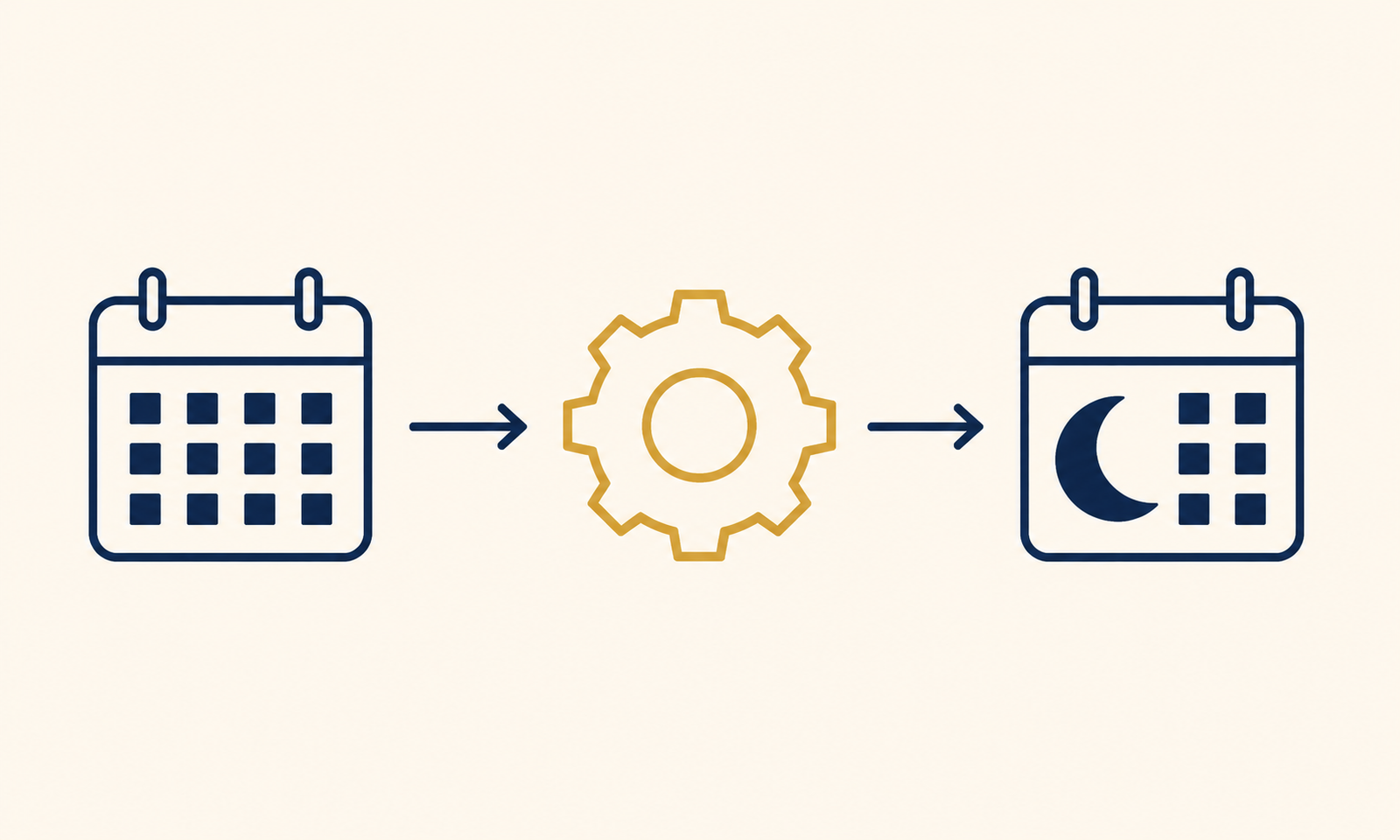
- Pick a direction — Gregorian → Hijri, or Hijri → Gregorian.
- Enter the date — day, month, and year in whichever calendar you’re starting from.
- The engine converts to a Julian Day Number — a single continuous day-count both calendars can be measured against.
- That day number is re-expressed in the target calendar’s month/day/year using the standard 30-year Hijri leap-year cycle.
- Your result appears instantly, with the matching lunar month highlighted on the wheel.
What Should a Hijri Date Converter Result Include?
- The full converted date — day, month name, and year, not just numbers
- The Hijri month name written out (e.g. “Ramadan,” “Dhul-Hijjah”), not just a month number
- A clear label of which calendar the result is in (AH vs. CE/AD)
- An accuracy note explaining that tabular results can be ±1 day from local moon-sighting announcements
- An easy way to copy, print, or save the result for records, invitations, or planning documents
Worked Example
Here’s what the Hijri Date Converter produces for a sample Gregorian input:
| Field | Value |
|---|---|
| Input (Gregorian) | 18 August 2026 |
| Converted (Hijri) | 4 Rabi’ al-Thani 1448 AH |
| Hijri month meaning | 4th month of the Islamic lunar year |
| Accuracy note | ±1 day depending on regional moon-sighting confirmation |
Who Uses a Hijri Date Converter?
🕌 For Worship Planning
Checking roughly when Ramadan, Eid al-Fitr, or Eid al-Adha will fall relative to the Gregorian calendar.
🎓 Students & Researchers
Converting historical Hijri dates from Islamic texts into Gregorian years for study or citation.
✉️ Event & Document Use
Adding the correct Hijri date to invitations, certificates, or family records.
✈️ Travel & Business
Anticipating dates in countries where the Hijri calendar affects public holidays or business hours.
Best Practices When Using a Hijri Date Converter
- Treat the result as a reliable estimate, not a religious ruling — for fasting or Eid, always confirm with your local moon-sighting authority
- Double-check the year field — Hijri years (AH) and Gregorian years (CE) are not offset by a fixed number, since the gap grows over time
- For historical dates, remember some regions used slightly different calendar reforms — cross-check important dates against a second source
- Save or print important conversions rather than re-deriving them from memory later
Further reading on how the Hijri calendar itself is structured: Islamic calendar — Wikipedia.
Common Mistakes People Make With Hijri Dates
Frequently Asked Questions
How accurate is this Hijri Date Converter?
It uses the standard tabular Islamic calendar, the same civil calculation method used by most digital Hijri calendars. It can be off by one day compared to a date confirmed by local moon sighting, since actual lunar observation varies by region.
Does this Hijri Date Converter require an internet connection?
No. Once the page loads, all conversion happens locally in your browser using JavaScript — no data is sent to a server, and no API key is used.
Can I convert both Gregorian to Hijri and Hijri to Gregorian?
Yes. Use the two tabs above the form to switch direction — the Hijri Date Converter handles both conversions with the same underlying calculation.
Why do Hijri dates sometimes differ by a day between countries?
Because the Islamic month traditionally begins with the sighting of the new crescent moon, and moon visibility can differ by region and by the sighting method each country’s religious authority follows.
Is this Hijri Date Converter free to use?
Yes, the Hijri Date Converter on IslamicEduHub is completely free, with no sign-up and no limit on how many dates you convert.
Can I use this tool for historical Hijri dates?
Yes, though for dates from several centuries ago, cross-check against a second source — some regions historically used calendar reforms that create small variances from the modern tabular system.
Related Reading
Convert Your Next Hijri Date in Seconds
No sign-up, no app to install — just accurate, instant Gregorian–Hijri conversion whenever you need it.
Use the Hijri Date Converter ↑